NEET Exam  >  NEET Test  >  Chemistry Class 11  >  Test: Stoichiometry & Stoichiometric Calculations (NCERT) - NEET MCQ

Stoichiometry & Stoichiometric Calculations (NCERT) - NEET Chemistry


MCQ Practice Test & Solutions: Test: Stoichiometry & Stoichiometric Calculations (NCERT) (25 Questions)

You can prepare effectively for NEET Chemistry Class 11 with this dedicated MCQ Practice Test (available with solutions) on the important topic of "Test: Stoichiometry & Stoichiometric Calculations (NCERT)". These 25 questions have been designed by the experts with the latest curriculum of NEET 2026, to help you master the concept.

Test Highlights:

  • - Format: Multiple Choice Questions (MCQ)
  • - Duration: 25 minutes
  • - Number of Questions: 25

Sign up on EduRev for free to attempt this test and track your preparation progress.

Test: Stoichiometry & Stoichiometric Calculations (NCERT) - Question 1

What is the correct statement related to Avogadro?       

Detailed Solution: Question 1

This is a fundamental constant in chemistry that represents the number of atoms or molecules in one mole of a substance.
Its value is approximately 6.022 x 10²³
Avogadro's number is a key concept in stoichiometry. 

Test: Stoichiometry & Stoichiometric Calculations (NCERT) - Question 2

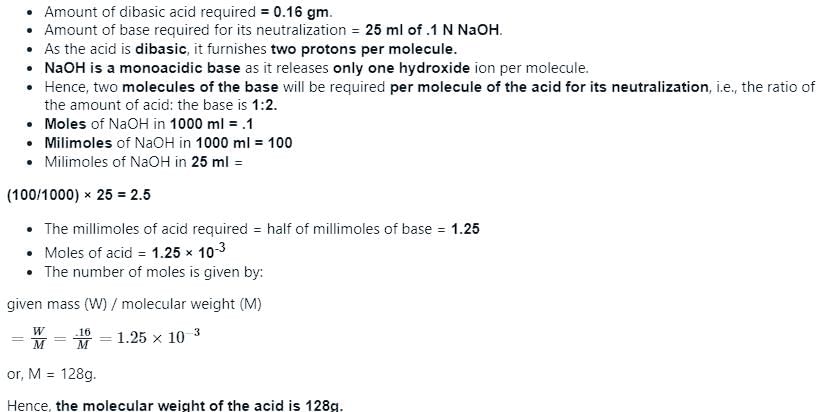
0.16 gm of a dibasic acid required 25 ml of .1N NaOH solution for completed neutralisation. The molecular weight of the acid is
Detailed Solution: Question 2

Test: Stoichiometry & Stoichiometric Calculations (NCERT) - Question 3

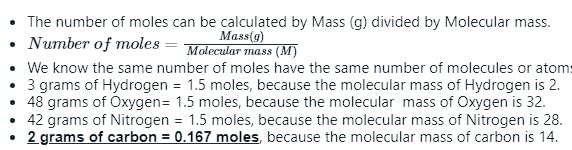
Which one of the following has different number of molecules? (All kept at normal temperature and pressure).     
Detailed Solution: Question 3

Test: Stoichiometry & Stoichiometric Calculations (NCERT) - Question 4

Find the amount of carbon dioxide produced by the combustion of 20g of methane.

Detailed Solution: Question 4

The chemical balanced equation for combustion of methane is CH4(g) + 2O2(g) →CO2(g) + 2H2O(g). From the above equation, 1 mole of methane gives 1 mole of carbon dioxide. But 20g of methane = 1.25 moles, therefore it gives 1.25 moles of carbon dioxide = 44(1.25) = 55g.

Test: Stoichiometry & Stoichiometric Calculations (NCERT) - Question 5

What is the amount (in moles) of water produced when 8 g of hydrogen is reacted with 32 g of oxygen?

Detailed Solution: Question 5

Correct answer: B - 2 moles.

Moles of H2 = 8 g ÷ 2 g·mol-1 = 4 mol.

Moles of O2 = 32 g ÷ 32 g·mol-1 = 1 mol.

The balanced equation is 2H2 + O2 → 2H2O, which shows 1 mol of O2 produces 2 mol of H2O.

Available H2 (4 mol) is more than needed for 1 mol O2 (requires 2 mol H2), so O2 is the limiting reagent.

Therefore the amount of water formed = 2 moles. Option B is correct.

Test: Stoichiometry & Stoichiometric Calculations (NCERT) - Question 6

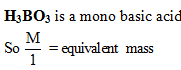
The equivalent mass of H3BO3 (M = Molar mass of H3BO3) in its reaction with NaOH to from Na2B4O7 is equal to –                       
Detailed Solution: Question 6

Test: Stoichiometry & Stoichiometric Calculations (NCERT) - Question 7

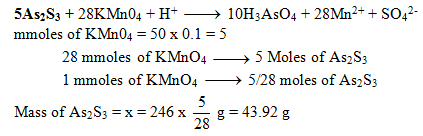
X gram of pure As2S3 is completely oxidised to respective highest oxidation states by 50 ml of 0.1 M hot acidified KMnO4 then x mass of As2S3 taken is : (Molar mass of As2S3 = 246)
Detailed Solution: Question 7

Test: Stoichiometry & Stoichiometric Calculations (NCERT) - Question 8

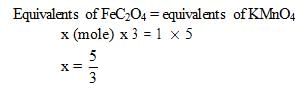
The number of moles of ferrous oxalate oxidised by one mole of KMnO4 is
Detailed Solution: Question 8

Test: Stoichiometry & Stoichiometric Calculations (NCERT) - Question 9

How many moles of KMnO4 are needed a mixture of 1 mole of each FeSO4 & FeC2O4 in acidic medium

Detailed Solution: Question 9

Test: Stoichiometry & Stoichiometric Calculations (NCERT) - Question 10

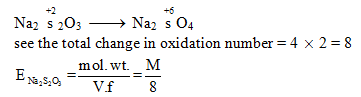
In the reaction  

Na2S2O3 + 4C12 + 5H2O → Na2SO4 + H2S04 + 8HCI

the equivalent weight of Na2 S2 O3 will be

(M= molecular weight of Na2S2O3)
Detailed Solution: Question 10

Test: Stoichiometry & Stoichiometric Calculations (NCERT) - Question 11

C2H4 + xO2 -> 2CO2 + yH2O, what is the value of x + y?

Detailed Solution: Question 11

The balance combustion equation is C2H4 + 3O2 -> 2CO2 + 2H2O, => x = 3, y = 2, => x + y = 5.

Test: Stoichiometry & Stoichiometric Calculations (NCERT) - Question 12

The following equations are balanced atomwise and chargewise.

(i) Cr2O72- + 8H+ + 2H2O2 → 2Cr3+ + 7H2O + 2O2

(ii) Cr2O72- + 8H+ + 5H2O2→ 2Cr3+ + 9H2O + 4O2

(iii) Cr2O72- + 8H+ + 7H2O2→ 2Cr+ + 11H2O + 5O2

The precise equationl equations representing the oxidation of H2O2 is/are

Detailed Solution: Question 12

The correct answer is option A
Cr2O72- converts into Cr3+ in acidic medium I.e. in H+ medium.
First balance the Cr atom on both sides and then Oxygen atom. H+ is in excess due to acidic medium.
Add H+ as +ve charge to balance the charge on both sides.

Test: Stoichiometry & Stoichiometric Calculations (NCERT) - Question 13

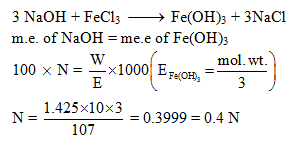
An excess of NaOH was added to 100 mL of a ferric chloride solution. This caused the precipitation of 1,425 g of Fe(OH)3. Calculate the normality of the ferric chloride solution
Detailed Solution: Question 13

Test: Stoichiometry & Stoichiometric Calculations (NCERT) - Question 14

In the reaction CrO5 + H2SO4 →Cr2(SO4)3 + H2O + O2 one mole of CrO5 will liberate how many moles of O2

Detailed Solution: Question 14

The balanced chemical reaction is,

From the balanced chemical reaction, we conclude that

As, 4 moles of CrO5 react to give 7 moles of O2 

So, 1 mole of CrO5 react to give 7/4 moles of O2

Test: Stoichiometry & Stoichiometric Calculations (NCERT) - Question 15

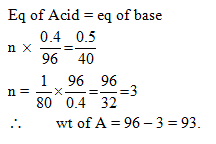
0.4g of a polybasic acid HnA (all the hydrogens are acidic) requires 0.5g of NaOH for complete neutralization. The number of replaceable hydrogen atoms in the acid and the molecular weight of 'A' would be : (Molecular weight of the acid is 96 gms.)
Detailed Solution: Question 15

Test: Stoichiometry & Stoichiometric Calculations (NCERT) - Question 16

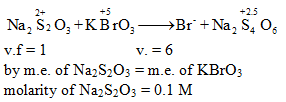
A solution of Na2S2O3 is standardized iodimetrically against 0.1262 g of Mr% This process requires 45 mL of the Na2 S203 solution. What is the strength of the Na2S2O3?
Detailed Solution: Question 16

Test: Stoichiometry & Stoichiometric Calculations (NCERT) - Question 17

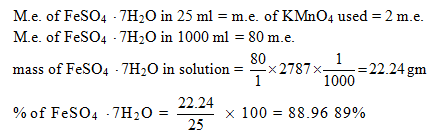
25.0 g of FeSO4.7H2O was dissolved in water containing dilute H2SO4, and the volume was made up to 1.0 L. 25.0 mL of this solution required 20 mL of an N/10 KMnO4 solution for complete oxidation. The percentage of FeSO4. 7H2O in the acid solution is
Detailed Solution: Question 17

Test: Stoichiometry & Stoichiometric Calculations (NCERT) - Question 18

1.0 mol of Fe reacts completely with 0.65 mol of O2 to give a mixture of only Fe0 and Fe2O3. The mole ratio of ferrous oxide to ferric oxide is

Detailed Solution: Question 18

2Fe + O2 →→ 2FeO
​4Fe + 3O2 →→2Fe2O3
Let x moles  of Fe reacts to produce FeO
Thus amount of Fe reacted to produce Fe2O3 = 1-x  Moles
Now
2 Moles of Fe reacts to produce FeO with = 1 moles of O2
1 moles of Fe reacts ​ to produce FeO with = 1/2 moles of O2
x moles of Fe ​ to produce FeO with = 0.5x moles of O2
4 moles of Fe reacts to produce Fe2O3 with =  3 moles of O2
1-x moles of Fe reacts to produce Fe2O3 = (3/4) x (1-x) Moles of O2
EQUATION :
1)  0.5x + 3/4(1−x) =0.65 moles of O2
Thus 
x = 0.4 moles
2 Moles of Fe produces = 2 mole of FeO
0.4 moles of Fe produces = 0.4 moles of FeO
4 moles of Fe produces = 2 moles of  Fe2O3
(1-0.4 )moles of Fe produces = (1/2) x 0.6 Moles = 0.3 moles of Fe2O3
Thus
FeO/Fe2O3 = 0.4/0.3 = 4/3

Test: Stoichiometry & Stoichiometric Calculations (NCERT) - Question 19

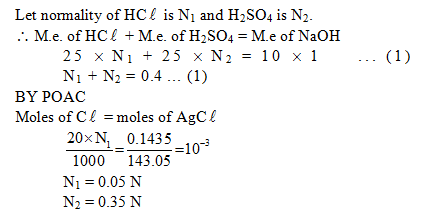
25 mL of a solution containing HCf and H2S04 required 10 mL of a 1 N NaOH solution for neutralization. 20 mL of the same acid mixture on being treated with an excess of AgNO3 gives 0.1425 g of AgCf. The normality of the HC and the normality of the H2S04 are respectively
Detailed Solution: Question 19

Test: Stoichiometry & Stoichiometric Calculations (NCERT) - Question 20

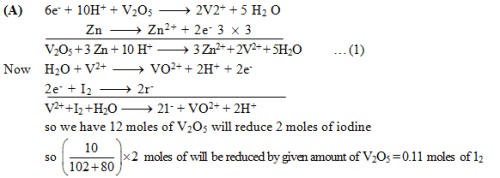
If 10 gm of V2O5 is dissolved in acid and is reduced to V2+ by zinc metal, how many mole of I2 could be reduced by the resulting solution if it is further oxidised to VO2+ ions ?

[Assume no change in state of Zn2+ions] (V = 51, 0 = 16, I = 127) :
Detailed Solution: Question 20

Test: Stoichiometry & Stoichiometric Calculations (NCERT) - Question 21

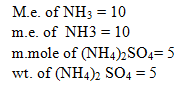
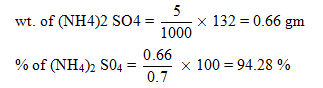
0.70 g of mixture (NH4)2 SO4 was boiled with 100 mL of 0.2 N NaOH solution till all the NH3(g) evolved and get dissolved in solution itself. The remaining solution was diluted to 250 mL. 25 mL of this solution was neutralized using 10 mL of a 0.1 N H2SO4 solution. The percentage purity of the (NH4)2 SO sample is
Detailed Solution: Question 21

Test: Stoichiometry & Stoichiometric Calculations (NCERT) - Question 22

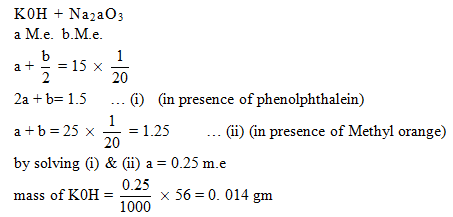
A mixed solution of potassium hydroxide and sodium carbonate required 15 mL. of an N/20 HCI solution when titrated with phenolphthalein as an indicator. But the same amount of the solution when titrated with methyl orange as an indicator required 25 mL of the same acid. The amount of KOH present in the solution is
Detailed Solution: Question 22

Test: Stoichiometry & Stoichiometric Calculations (NCERT) - Question 23

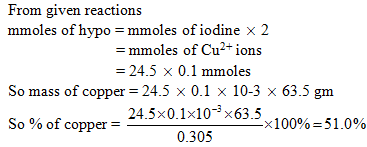
The percentage of copper in a copper(II) salt can be determined by using a thiosulphate titration. 0.305 gm of a copper(II) salt was dissolved in water and added to, an excess of potassium iodide solution liberating iodine according to the following equation

 2Cu2 (aq) + 4I (aq)   2CuI(s) + I2(aq)

The iodine liberated required 24.5cm3 of a 0.100 mole dm-3 solution of sodium thiosulphate

2S2032- (aq) + I2(aq) → 2I (aq) + S4062- (aq)

the percentage of copper, by mass in the copper (ll) salt is. [Atomic mass of copper = 63.5]
Detailed Solution: Question 23

Test: Stoichiometry & Stoichiometric Calculations (NCERT) - Question 24

KIO3 reacts with KI to liberate iodine and liberated Iodine is titrated with standard hypo solution, The reactions are

1. IO3 + I →I2                (valency factor = 5/3)

2. I2 + S2O32– → S4O62– + I–        (valency factor = 2)

meq of hypo = meq of I2 = meq of IO3 + meq of I

IO3 react with I ⇒ meq of IO3 = meq of I

Statement-1 : meq of hypo = 2 x meq of IO3

Statement-2 : valency factor of I2 in both the equation are different therefore we cannot equate milliequivalents in sequence

Detailed Solution: Question 24

The correct answer is option A
Milliequivalent of IO3​ is equal to milliequivalent of I.
Milliequivalent of hypo is equal to milliequivalent of IO3​ plus milliequivalent of I.
The milliequivalent of hypo is twice the milliequivalent of IO3​. It is also twice the milliequivalent of I.

Test: Stoichiometry & Stoichiometric Calculations (NCERT) - Question 25

In the reaction:
2 C2H6 + 7 O2 → 4 CO2 + 6 H2O
how many moles of CO2 are formed when 1 mole of O2 is consumed?

Detailed Solution: Question 25

1 mole O2 x (4 mole CO2 / 7 mole O2 ) = 4/7 mole CO2

101 videos|250 docs|76 tests
Information about Test: Stoichiometry & Stoichiometric Calculations (NCERT) Page
In this test you can find the Exam questions for Test: Stoichiometry & Stoichiometric Calculations (NCERT) solved & explained in the simplest way possible. Besides giving Questions and answers for Test: Stoichiometry & Stoichiometric Calculations (NCERT), EduRev gives you an ample number of Online tests for practice
101 videos|250 docs|76 tests
Download as PDF



