
AP EAMCET Mock Test - 4 Free Online Test 2026
Full Mock Test & Solutions: AP EAMCET Mock Test - 4 (160 Questions)
You can boost your JEE 2026 exam preparation with this AP EAMCET Mock Test - 4 (available with detailed solutions).. This mock test has been designed with the analysis of important topics, recent trends of the exam, and previous year questions of the last 3-years. All the questions have been designed to mirror the official pattern of JEE 2026 exam, helping you build speed, accuracy as per the actual exam.
Mock Test Highlights:
- - Format: Multiple Choice Questions (MCQ)
- - Duration: 180 minutes
- - Total Questions: 160
- - Analysis: Detailed Solutions & Performance Insights
- - Sections covered: Physics, Chemistry, Mathematics
Sign up on EduRev for free and get access to these mock tests, get your All India Rank, and identify your weak areas to improve your marks & rank in the actual exam.

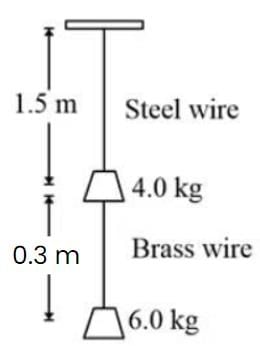
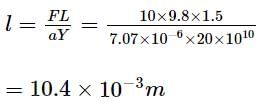
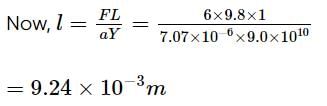
Find the elongation of the steel and brass wire in the fig. unloaded length of steel wire = 1.5 m, unloaded length of brass wire 0.3 cm, diameter of each wire = 0.3 cm. Young's modulus for steel = 20 × 1010 Pa and that for brass = 9.0 × 10¹⁰ Pa.
Detailed Solution: Question 1


When sounded together, a column of air and a tuning fork produce 4 beats per second. The tuning fork gives the lower note. The temperature of air is 15°C. When the temperature falls to 10°C, the two produce 3 beats per second. Find the frequency of the fork.
Detailed Solution: Question 2

 u15 = (v + 4)


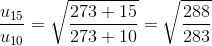 …(2)
…(2)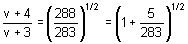
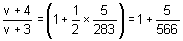
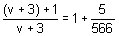
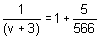
 v = 110.2 Hz
  110 Hz
A particle moves in xy plane according to the law x = a sin ωt and y = a(1 - cos ωt), where a and w are constant. The particle traces
Detailed Solution: Question 3
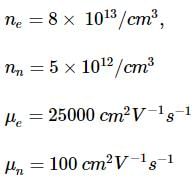
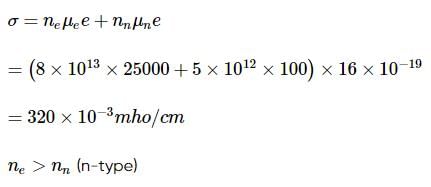
A semiconductor has an electron concentration of 8×10¹³ per cm3 and a hole concentration of 5 x 10¹² per cm3. The electron mobility is 25000 cm2 V−1 s−1
and the hole mobility is 100 cm2 V. s−1 . Then,
and the hole mobility is 100 cm2 V. s−1 . Then,
Detailed Solution: Question 4
A 2 μF, capacitor C1 is charged to a voltage 100 V and a 4 μF capacitor C2 is charged to a voltage 50 V. The capacitors are then connected in parallel. What is the loss of energy due to parallel connection?
Detailed Solution: Question 5



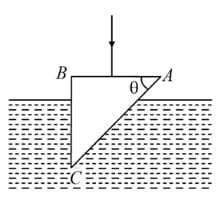
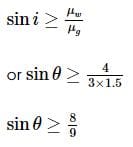
Figure shows, a glass prism ABC (refractive index 1.5), immersed in water (refractive index 43). A ray of light incident normally on face AB. If it is totally reflected at face AC then
Detailed Solution: Question 6
A hollow sphere of mass M and radius R is initially at rest on a horizontal rough surface. It moves under the action of a constant horizontal force F as shown in the figure.
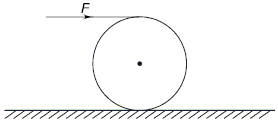
The frictional force between the sphere and the surface is
The frictional force between the sphere and the surface is
Detailed Solution: Question 7
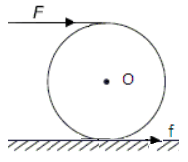
 MRa
MRa .
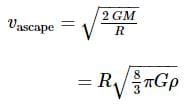
.The escape velocity from the earth is 11 km s−1. The escape velocity from a planet having twice the radius and same mean density as that of the earth is
Detailed Solution: Question 8
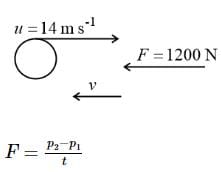
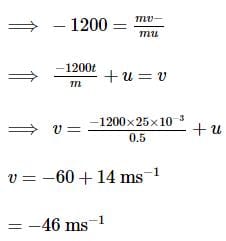
A force of 1200 N acts on a 0.5 kg steel ball as result of collision lasting 25 ms. If the force is in a direction opposite to the initial velocity of 14 m s−1 then the final speed of the steel ball would be
Detailed Solution: Question 9
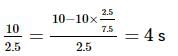
Three identical balls, ball I, ball II and ball III are placed on a smooth floor on a straight line at a separation of 10 m
between them as shown in the figure. Initially, the balls are stationary. Ball I is given a velocity of 10 m s−1 towards ball II. The collision between ball I and II is inelastic with coefficient of restitution 0.5 but collision between ball II
and III is perfectly elastic. What is the time interval between two consecutive collisions between ball I and II ?
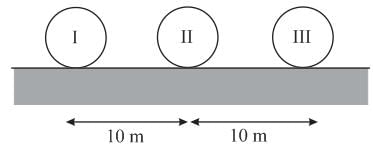
between them as shown in the figure. Initially, the balls are stationary. Ball I is given a velocity of 10 m s−1 towards ball II. The collision between ball I and II is inelastic with coefficient of restitution 0.5 but collision between ball II
and III is perfectly elastic. What is the time interval between two consecutive collisions between ball I and II ?
Detailed Solution: Question 10
A particle of mass 5 kg moving in the x−y plane has its potential energy given by U = (−7x+24y) Joule, x and y
being in meter. Initially at t =0 ,the particle is located at the origin (0, 0) and moving with a velocity of 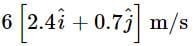 . Find the magnitude of force acting on the particle.
being in meter. Initially at t =0 ,the particle is located at the origin (0, 0) and moving with a velocity of
. Find the magnitude of force acting on the particle.Detailed Solution: Question 11
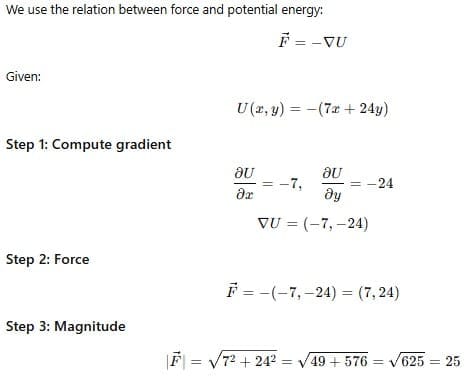
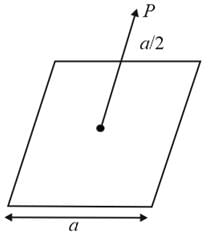
A charge Q is placed at a distance a/2 above the centre of a square surface of side length a. The electric flux through the square surface due to the charge would be?
Detailed Solution: Question 12
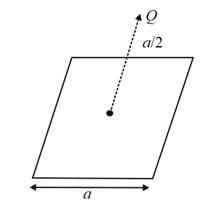

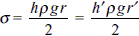
A capillary tube of radius r is immersed in water and water rises in it to a height h. The mass of water in the capillary tube is 5 g. Another capillary tube of radius 2r is immersed in water. The mass of water, that will rise in this tube, is
Detailed Solution: Question 13

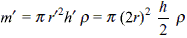

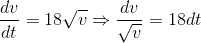
If a = 18√v (where 'a' and 'v' are acceleration and velocity at any instant, respectively), then the acceleration when the time t = 1 second is
Detailed Solution: Question 14




The following figure shows a spherical Gaussian surface and a charge distribution (magnitude of all the given point charges is different). When calculating the flux of electric field through the Gaussian surface, the electric field will be due to

Detailed Solution: Question 15
 . Here, the electric field E is due to charge inside the Gaussian surface only. Hence, the correct option is (d).
If an unchanged capacitor is charged by connecting it to a battery, then the amount of energy lost as heat is
Two wires of same metal have the same length but their cross-sections are in the ratio 3:1. They are joined in series. The resistance of the thicker wire is 10 Ω. The total resistance of the combination will be
The number of molecules of ATP produced in the lipid metabolism of a molecule of palmitic acid is
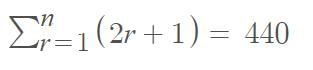
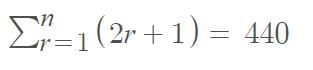 , then n = ........
Detailed Solution: Question 21
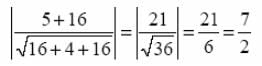
The distance between 4x + 2y + 4z- 16 = 0 and 4x + 2y + 4z + 5 = 0 is
Detailed Solution: Question 22
Which of the following diagrams correctly represents intersection of sets A and B?
Detailed Solution: Question 23
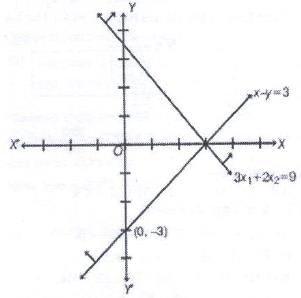
For LP.P, maximize z = 4x, + 2x2 subject to 3x1 + 2x2 ≥ 9, x1 - x2 ≤ 3, x1 ≥ 0, x2 ≥ 0 has...
Detailed Solution: Question 24
Detailed Solution: Question 25
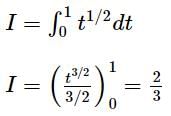
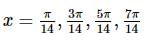
The number of distinct real roots of the equation tan2 2x + 2tan2x tan3x − 1 = 0, in the interval  is:
is:
is:Detailed Solution: Question 26
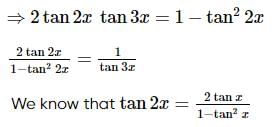
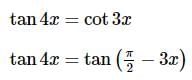


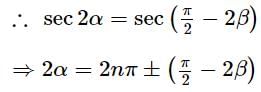
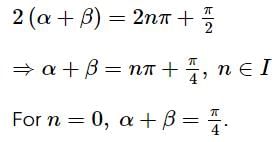
If 2sec2α = tanβ + cotβ, then one of the values of (α + β) {where, (α + β) is not an odd multiple of π/2} is
Detailed Solution: Question 27

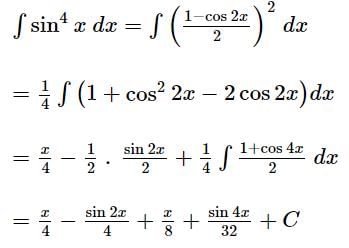
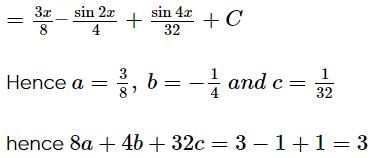
 is equal to
Detailed Solution: Question 28
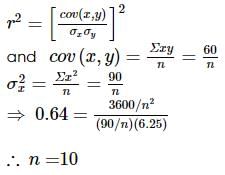
If x and y are deviations from arithmetic mean, r=0.8, Σxy=60 , σy=2.5 and Σx2=90, then number of items in the series is,
Detailed Solution: Question 29
For any non zero vector, a,b,c
a.[(b + c) x (a + b + c)] = ...
Detailed Solution: Question 30
