UPSC Exam  >  UPSC Test  >  CSAT Preparation  >  Test: Geometry- 2 - UPSC MCQ

Geometry- 2 - UPSC Free MCQ Test with solutions


MCQ Practice Test & Solutions: Test: Geometry- 2 (15 Questions)

You can prepare effectively for UPSC CSAT Preparation with this dedicated MCQ Practice Test (available with solutions) on the important topic of "Test: Geometry- 2". These 15 questions have been designed by the experts with the latest curriculum of UPSC 2026, to help you master the concept.

Test Highlights:

  • - Format: Multiple Choice Questions (MCQ)
  • - Duration: 15 minutes
  • - Number of Questions: 15

Sign up on EduRev for free to attempt this test and track your preparation progress.

Test: Geometry- 2 - Question 1

A cyclic quadrilateral is such that two of its adjacent angles are divisible by 6 and 10 respectively. One of the remaining angles will necessarily be divisible by:

Detailed Solution: Question 1

We know that the sum of the opposite angles of a cyclic quadrilateral is 180 degrees. Let the four angles be A, B, C, and D, with A and B being the angles divisible by 6 and 10, respectively.

Since A is divisible by 6 and B is divisible by 10, we know that A = 6m and B = 10n for some integers m and n.

Now, consider the opposite angles. Since the sum of opposite angles is 180 degrees, we have:

C = 180 - B = 180 - 10n
D = 180 - A = 180 - 6m

We want to find which of the given options the angles C or D are necessarily divisible by. Let's examine each option:

1. 3: Since B is divisible by 10, it is possible that B is divisible by 5 but not 3 (e.g. B = 10). In this case, C = 180 - B would not be divisible by 3. Also, A is divisible by 6, so A is always divisible by 3, which means D = 180 - A would never be divisible by 3. So, this option is incorrect.

2. 4: Since A is divisible by 6, it is possible that A is divisible by 2 but not 4 (e.g. A = 6). In this case, D = 180 - A would not be divisible by 4. Also, B is divisible by 10, so B is always divisible by 2, which means C = 180 - B would never be divisible by 4. So, this option is also incorrect.

3. 8: If A is divisible by 6, then it can be even or odd multiples of 6 (e.g. A = 6, 12, 18, ...). D will be 180 - A, which means D can be both even and odd (e.g. D = 180 - 6 = 174, D = 180 - 12 = 168, D = 180 - 18 = 162, ...). Since D can be both even and odd, it is not necessarily divisible by 8. Similarly, C can also be both even and odd, so it is not necessarily divisible by 8. Thus, this option is also incorrect.

4. None of these: Since none of the previous options work, the correct answer is None of these.

So, the correct answer is option 4: None of these.

Test: Geometry- 2 - Question 2

The volume of two spheres are in the ratio 27 : 125. The ratio of their surface area is?

Detailed Solution: Question 2

 Option 4 : 9 : 25

Given

Ratio of volume of two spheres = 27 : 125

Formula used

surface area of sphere =4πr2

Volume of sphere = (4/3)πr3

Where r is radius respectively

Calculation

[(4/3)πR3/(4/3)πr3] = 27/125

Where R and r are radius of two sphere

⇒ R3/r3= 27/125

⇒ R = 3r/5

Surface area of 1st sphere/Surface area of 2nd sphere =[4π(3r/5)2]/4πr2

⇒ 9 : 25

∴ Ratio of surface area of two spheres is 9 : 25.

Test: Geometry- 2 - Question 3

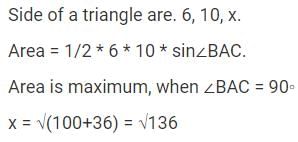
Sides of a triangle are 6, 10 and x for what value of x is the area of the △ the maximum?
Detailed Solution: Question 3

Test: Geometry- 2 - Question 4

Detailed Solution: Question 4


Test: Geometry- 2 - Question 5

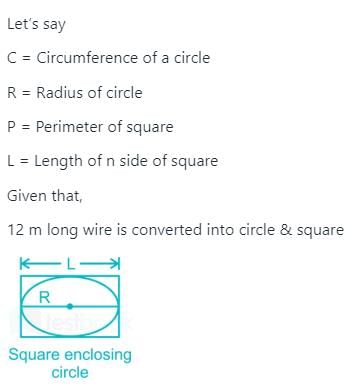
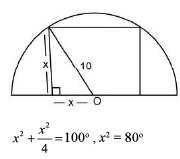
A square is inscribed in a semi circle of radius 10 cm. What is the area of the inscribed square? (Given that the side of the square is along the diameter of the semicircle.)
Detailed Solution: Question 5

Test: Geometry- 2 - Question 6

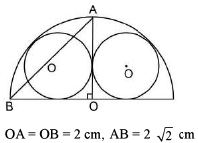
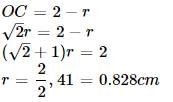
Two circles of an equal radii are drawn, without any overlap, in a semicircle of radius 2 cm. If these are the largest possible circles that the semicircle can accommodate, what is the radius (in cm) of each of the circles?
Detailed Solution: Question 6

Test: Geometry- 2 - Question 7

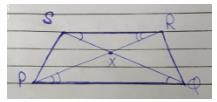
PQRS is a Trapezzium, in which PQ is Parralel to RS, and PQ = 3 (RS) . The diagnol of the Trapezzium intersect each other at X, then the ratio of,  ar ( ∆ PXQ)  : ar ( ∆ RXS)  is?
Detailed Solution: Question 7

In ∆ PXQ and ∆ RXS

=> angle P = angle R

    angle Q  =  angle S 

:- ∆ PXQ  ~ ∆ RXS  ( AA similarity rule)  

ar ( ∆ PXQ) /  ar ( ∆ RXS) = ( PQ / RS) ^ 2 

 =  ( 3 / 1 ) ^ 2

=     9 / 1 

Therefore,  ar ( ∆ PXQ) :  ar          ( ∆ RXS) 

=   9:1

Test: Geometry- 2 - Question 8

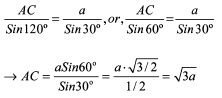
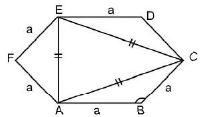
Let ABCDEF be a regular hexagon. What is the ratio of the area of the triangle ACE to that of the hexagon ABCDEF?

Detailed Solution: Question 8

Test: Geometry- 2 - Question 9

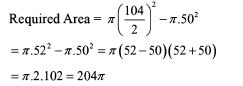
A pond 100 m in diameter is surrounded by a circular grass walk-way 2 m wide. How many square metres of grass is the on the walk-way?
Detailed Solution: Question 9

Test: Geometry- 2 - Question 10

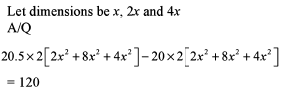
The dimensions of a rectangular box are in the ratio of 1:2:4 and the difference between the costs of covering it with the cloth and a sheet at the rate of Rs 20 and Rs 20.5 per sq m respectively is Rs 126. Find the dimensions of the box.
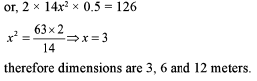
Detailed Solution: Question 10

Test: Geometry- 2 - Question 11

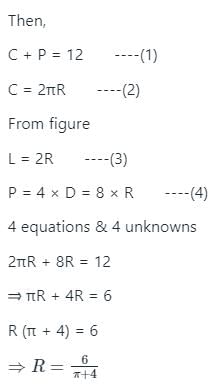
The ratio of the area of a square inscribed in a semicircle to that of the area of a square inscribed in the circle of the same radius is
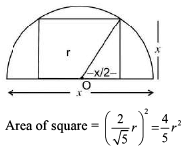
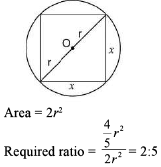
Detailed Solution: Question 11

Test: Geometry- 2 - Question 12

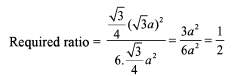
The ratio of the area of a square to that of the square drawn on the its the diagonal is
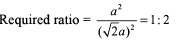
Detailed Solution: Question 12

Test: Geometry- 2 - Question 13

What is the area of the triangle in which two of its medians 9 cm and 12 cm long intersect at the right angles?
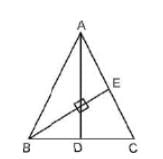
Detailed Solution: Question 13

Step 1: Understand the Problem
In a triangle ABC, medians are line segments from a vertex to the midpoint of the opposite side. Here, two medians (say from vertices A and B) are 9 cm and 12 cm long and intersect at the centroid G at 90°. The centroid divides each median in a 2:1 ratio (vertex to centroid is twice the length from centroid to midpoint).

Step 2: Assign the Medians and Use the Centroid Property
Assume:

  • Median AD (from A to midpoint D of BC) = 9 cm.

  • Median BE (from B to midpoint E of CA) = 12 cm.

At the centroid G:

  • AG : GD = 2 : 1, so AG = (2/3) × 9 = 6 cm, GD = 3 cm.

  • BG : GE = 2 : 1, so BG = (2/3) × 12 = 8 cm, GE = 4 cm.

Since the medians intersect at G at 90°, triangle AGB has a right angle at G.

Step 3: Use the Perpendicular Medians Property
A key geometric result states that if two medians of a triangle intersect at right angles at the centroid, the area of the triangle can be found using the formula:
Area of triangle ABC = (2/3) × m1 × m2,
where m1 and m2 are the lengths of the perpendicular medians.

Substitute the given lengths:
Area = (2/3) × 9 × 12 = (2/3) × 108 = 72 cm².

Test: Geometry- 2 - Question 14

Four horses are tethered at four comers of a square plot of side 14 m so that the adjacent horses can just reach one another. There is a small circular pond of area 20 m2 at the centre. Find the ungrazed area.

Detailed Solution: Question 14

Total area of plot = 14 * 14 = 196m2
Horses can graze in quarter circle of radius = 7m
Grazed area = 4 * (pie r2)/4 = 154 m2
Area of plot when horses cannot reach = (196 - 154) = 42m2
Ungrazed area = 42 - 20 = 22m2

Test: Geometry- 2 - Question 15

Two sides of a triangle are 4 and 5. Then, for the area of the triangle, which one of the following bounds is the sharpest?

Detailed Solution: Question 15

Let AB = 4 and BC = 5 and AB is perpendicular to BC

then Area = 1/2 AB . AC = 1/2 . 4.5 = 10 

148 videos|300 docs|126 tests
Information about Test: Geometry- 2 Page
In this test you can find the Exam questions for Test: Geometry- 2 solved & explained in the simplest way possible. Besides giving Questions and answers for Test: Geometry- 2, EduRev gives you an ample number of Online tests for practice
148 videos|300 docs|126 tests
Download as PDF