JEE Exam  >  JEE Test  >  Mathematics (Maths) Main & Advanced  >  Test: Permutations Non Distinct Objects - JEE MCQ

Permutations Non Distinct Objects - Free MCQ Practice Test with solutions,


MCQ Practice Test & Solutions: Test: Permutations Non Distinct Objects (20 Questions)

You can prepare effectively for JEE Mathematics (Maths) for JEE Main & Advanced with this dedicated MCQ Practice Test (available with solutions) on the important topic of "Test: Permutations Non Distinct Objects". These 20 questions have been designed by the experts with the latest curriculum of JEE 2026, to help you master the concept.

Test Highlights:

  • - Format: Multiple Choice Questions (MCQ)
  • - Duration: 20 minutes
  • - Number of Questions: 20

Sign up on EduRev for free to attempt this test and track your preparation progress.

Test: Permutations Non Distinct Objects - Question 1

Sonia has 10 balloons out of which 5 are red, 2 white, 2 blue and 1pink, which she wants to use for the decoration. Her favourite pink colour balloon should be filled with toffees and should be put at the centre of the room above the cake table and remaining 9 at the wall behind the cake table. How many ways she can arrange the balloons?

Detailed Solution: Question 1

1 balloon is fixed that is to be placed above the cake
Now she have to arrange 9 balloons = 9!/(5!*2!*2!)
(9*8*7*6*5!)/((5!*2*2)
= (9*8*7*6)/(2*2)
= 756

Test: Permutations Non Distinct Objects - Question 2

In how many ways can 3 letters be posted in 4 letter boxes?

Detailed Solution: Question 2

The first letter can be posted in 4 ways. So, total outcomes about the first letter = 4.
For every outcome about the first letter, the second letter can be posted in 4 ways. So, total outcomes about the first and the second letters= (4*4) = 16.
Therefore, following the same route, we can say, total possible outcomes about the first and the second letters= (4*4*4) = 64.

Test: Permutations Non Distinct Objects - Question 3

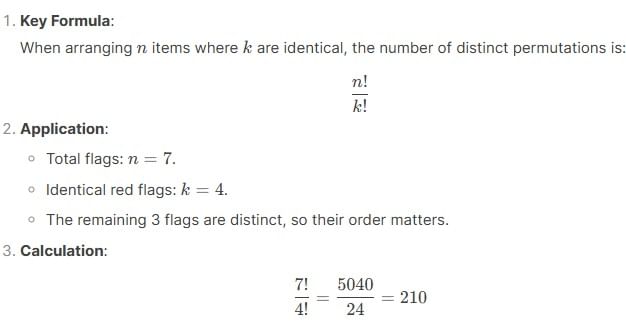
Among 7 flags 4 are of red colour and the rest are all different colours. How mant different signals can be generated using these flags?

Detailed Solution: Question 3
Test: Permutations Non Distinct Objects - Question 4

 If (n + 1)! = 20(n – 1)!, then n is equal to

Detailed Solution: Question 4

(n + 1)! = 20 (n – 1)!
n (n + 1) = 20
(n – 4) (n + 5) = 0          
Since, (n – 1)! exists, n ≥ 1
So, n = 4 

Test: Permutations Non Distinct Objects - Question 5

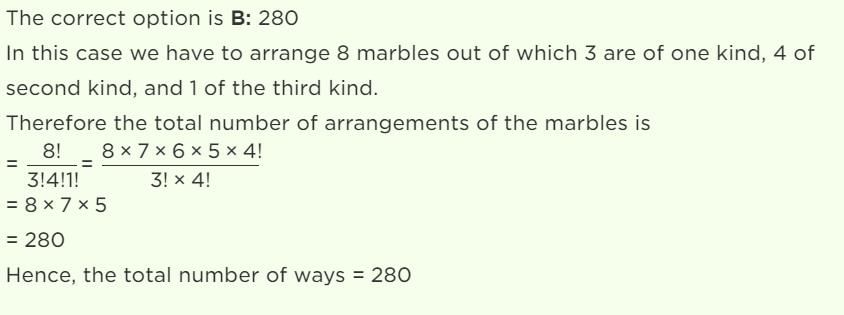
There are 3 white, 4 red and 1 blue marbles in a bag. They are drawn one by one and arranged in a row. Assuming that all 8 marbles are drawn, determine the number of different arrangements if marbles of same colour are indistinguishable.

Detailed Solution: Question 5
Test: Permutations Non Distinct Objects - Question 6

The number of permutations of n different objects taken r at a time, where repetition is allowed

Detailed Solution: Question 6

Number of permutations of n different things taken r at a time when repetition is allowed = nr

Test: Permutations Non Distinct Objects - Question 7

In a class 6 students have to be arranged for a photograph. If the prefect and the vice must occupy the positions at either ends, how many ways the students can be arranged?

Detailed Solution: Question 7

In a class of 6 students. Two students at both ends. Remaining four students have to be arranged 
= 2 * 4! 
= 2 * 24
= 48

Test: Permutations Non Distinct Objects - Question 8

How many different words can be formed using the letters of the word BHARAT, which begin with B and end with T?

Detailed Solution: Question 8

If the first & last letter is fixed, then we find out, the number of permutations of the remaining letters, i.e. 4
= 4!/2!
= 4*3*2!/2!
= 12

Test: Permutations Non Distinct Objects - Question 9

Find the number of words with or without meaning which can be made using all the letters of the word SWEET.

Detailed Solution: Question 9

Sweet has 5 letters, so it gives 5! but there are two letters which are same
Number of words will be = (5! ÷ 2!) = 60

Test: Permutations Non Distinct Objects - Question 10

If n = 4 and r = 2, the value of 

Detailed Solution: Question 10

n!/(n-r)!
4!/(4-2)!  = 4*3*2!/2!
= 12

Test: Permutations Non Distinct Objects - Question 11

How many ways can three white and three red balloons be arranged in a row?

Detailed Solution: Question 11

3 white balls, 3 red balls
Total balls = 6
Total no. of ways = (6!)/(3!)(3!)
= (6*5*4*3!)/(3!*3*2)
= (5*4) = 20

Test: Permutations Non Distinct Objects - Question 12

Out of 7 consonants and 4 vowels, how many words of 3 consonants and 2 vowels can be formed?

Detailed Solution: Question 12

1/4! + 1/5!
= 1/4![1 + 1/5]
1/4![6/5]
=> 6/5!

Test: Permutations Non Distinct Objects - Question 13

In a room there are 2 green chairs, 3 yellow chairs and 4 blue chairs. In how many ways can Raj choose 3 chairs so that at least one yellow chair is included? 

Detailed Solution: Question 13

At least one yellow chair means “total way no yellow chair
Total ways to select 3 chairs form the total (2+3+4) chairs 9C3
9C3 = 9!/3!*6! = 84ways
Now, we dont want even one yellow chair
So, we should select 3 chairs from 6 chairs (2green & 4blue) = 6C3
6C3 = 6!/3!3! = 20 ways
hence , ways to select at least one yellow chair = 84-20 = 64 ways.

Test: Permutations Non Distinct Objects - Question 14

In how many ways can 10 people line up at a ticket window of a cinema hall?

Detailed Solution: Question 14

 If you imagine there are 10 spots on the floor in a line where people can stand, then the first person has 10 choices of where to stand.
The second person has 9 choices since the first person is already on one of the spots.
The third person has 8 choices. And so on until the last person has no choice.
We can now mulitply the numbers together. 10x9x8x7x6x5x4x3x2x1. This is called a factorial (where you multiply all of the consecutive numbers together from 1) and it is written as 10!.
This means there are 3,628,800 ways of arranging the 10 people

Test: Permutations Non Distinct Objects - Question 15

The number of permutation of n objects, where p1 objects are of one kind, pobjects are of second kind, and so on till pk objects are of kth kind and rest, if any, are of different kinds is

Detailed Solution: Question 15

By theorem, The number of permutations of n objects, where p1 objects are of one kind, p2 are of second kind, ..., pk are of kth kind and the rest, if any, are of different kind is n!/(p1! * p2! *......* pk!)

Test: Permutations Non Distinct Objects - Question 16

In a group of 6 boys and 4 girls, four children are to be selected. In how many different ways can they be selected such that at least one boy should be there?

Detailed Solution: Question 16

Test: Permutations Non Distinct Objects - Question 17

Number of signals that can be made using given 4 flags of which 3 are blue and 1 is red?

Detailed Solution: Question 17

Total flags = 4
Blue = 3
red = 1
Total no. of signals = (4!*3!)/3!
= 4

Test: Permutations Non Distinct Objects - Question 18

A coin is tossed 6 times, in how many throws can 4 heads and 2 tails be obtained?

Detailed Solution: Question 18

To begin with, we calculate the total number of possibilities that arise from tossing a coin 6 times . On each toss , we have 2 possibilities - a head or a tail. This gives us
2*2*2*2*2*2 = 64 possibilities
Now let's list out the desirable outcomes.
   Having 4 heads
H H H H T T - This is one example of the above outcome. Something like
H H H T H T would also be equally likely and would be a desirable outcome. Thus to calculate all such permutations
= (6!/4!) ∗ 2!
= 15ways

Test: Permutations Non Distinct Objects - Question 19

Which one of the following options is true?

Detailed Solution: Question 19

Option D is correct.

3! = 6 and 2! = 2.

So 3!/2! = 6 ÷ 2 = 3, which matches the right-hand side.

For completeness, 3! + 2! = 6 + 2 = 8, which is not equal to 5! = 120, and 3! × 2! = 6 × 2 = 12, which is not equal to 6! = 720. Also 1! = 1, so 3! + 2! ≠ 1!.

Test: Permutations Non Distinct Objects - Question 20

How many three letter codes can be formed by only vowels of English alphabets, given that repetition of letters is allowed?

Detailed Solution: Question 20

We have 5 choices (a, e, i, o, u)
3 letter codes = 5 * 5 * 5
= 125

173 videos|510 docs|154 tests
Information about Test: Permutations Non Distinct Objects Page
In this test you can find the Exam questions for Test: Permutations Non Distinct Objects solved & explained in the simplest way possible. Besides giving Questions and answers for Test: Permutations Non Distinct Objects, EduRev gives you an ample number of Online tests for practice
Download as PDF