NEET Exam  >  NEET Test  >  Physics Class 12  >  Test: Coulomb's Law & Its Applications - NEET MCQ

Coulomb's Law & Its Applications - NEET Physics Class 12 Free MCQ Test


MCQ Practice Test & Solutions: Test: Coulomb's Law & Its Applications (10 Questions)

You can prepare effectively for NEET Physics Class 12 with this dedicated MCQ Practice Test (available with solutions) on the important topic of "Test: Coulomb's Law & Its Applications". These 10 questions have been designed by the experts with the latest curriculum of NEET 2026, to help you master the concept.

Test Highlights:

  • - Format: Multiple Choice Questions (MCQ)
  • - Duration: 10 minutes
  • - Number of Questions: 10

Sign up on EduRev for free to attempt this test and track your preparation progress.

Test: Coulomb's Law & Its Applications - Question 1

Two insulated charged copper spheres A and B have their centers separated by a distance of 50 cm. What is the mutual force of electrostatic repulsion if the charge on each is 6.5×10⁻⁷ C? The radii of A and B are negligible compared to the distance of separation.
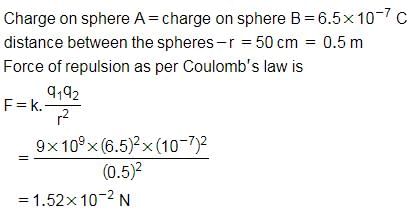
Detailed Solution: Question 1

Test: Coulomb's Law & Its Applications - Question 2

Two charges 1C and -4C exists in air. What is the direction of force?

Detailed Solution: Question 2

Since the charges are unlike, the force will be attractive. Thus the force directs from 1C to -4C.

Test: Coulomb's Law & Its Applications - Question 3

Ratio of the permittivity of medium to the permittivity of free space is known as

Detailed Solution: Question 3

The ratio of a medium's permittivity to the permittivity of free space is known as the dielectric constant or relative permittivity. The equation for relative permittivity is κ = ϵ/ϵ0, where ϵ is the permittivity of the medium and ϵ0 is the permittivity of free space. Both permittivity and the permittivity of free space have the same unit, farads per meter (F/m), so the dielectric constant is dimensionless. 

Test: Coulomb's Law & Its Applications - Question 4

An infinite number of charges, each equal to 4C, are placed along the x-axis at x = 1 m, x = 2 m, x = 4 m, x = 8 m and so on. The total force on a charge of 1C placed at the origin is
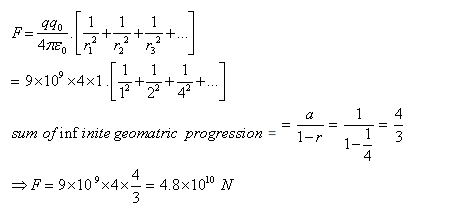
Detailed Solution: Question 4

Test: Coulomb's Law & Its Applications - Question 5

Two point charges 3μC and + 7μC repel each other with a force of 12 N. If each is given an additional charge -5 μC, what will be the new force between them?
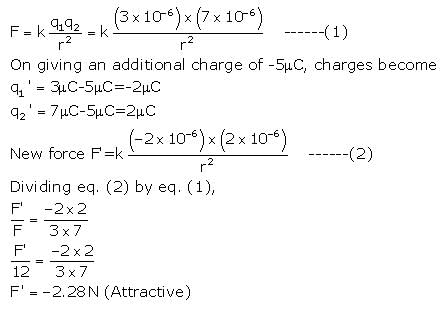
Detailed Solution: Question 5

Test: Coulomb's Law & Its Applications - Question 6

Electrostatic force is 

Detailed Solution: Question 6

Electrostatics means charges at rest, or relatively at rest so this force can be applicable only when charge produce electric field which is constant which is possible only when charges at rest or relatively at rest.

Test: Coulomb's Law & Its Applications - Question 7

Two positive charges 

Detailed Solution: Question 7

According to coulomb's law unlike charges always attract each other while like charges always repel each other so between two positive charges repulsion is working.

Test: Coulomb's Law & Its Applications - Question 8

Under the influence of the coulomb field of charge +Q, a charge −q is moving around it in an elliptical orbit. Find out the correct statement(s). 

Detailed Solution: Question 8

Since the charge –q is moving in elliptical orbit so to make its motion stable the total angular momentum of the charge is constant since it experience a centripetal force from the charge +Q so it follow the motion as the motion of earth around sun.

Test: Coulomb's Law & Its Applications - Question 9

The force between two charges is 120 N. If the distance between the charges is doubled, the force will be

Detailed Solution: Question 9

Coulombs law states the force between two charged particles is directly proportional to the product of charges and inversely proportional to the square of distance between them.
So if the distance is doubled then the force would decrease 4 times.
So the new force would be 120/4=30 Newton.

Test: Coulomb's Law & Its Applications - Question 10

When the distance between two charged particle is halved, the force between them becomes
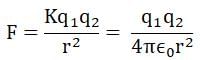
Detailed Solution: Question 10

74 videos|346 docs|92 tests
Information about Test: Coulomb's Law & Its Applications Page
In this test you can find the Exam questions for Test: Coulomb's Law & Its Applications solved & explained in the simplest way possible. Besides giving Questions and answers for Test: Coulomb's Law & Its Applications, EduRev gives you an ample number of Online tests for practice
74 videos|346 docs|92 tests
Download as PDF