Civil Engineering (CE) Exam  >  Civil Engineering (CE) Test  >  APSC AE CE Mock Test Series 2026  >  APSC AE CE Paper 1 Mock Test - 10 - Civil Engineering (CE) MCQ

APSC AE CE Paper 1 Mock Test - 10 Free Online Test 2026


Full Mock Test & Solutions: APSC AE CE Paper 1 Mock Test - 10 (100 Questions)

You can boost your Civil Engineering (CE) 2026 exam preparation with this APSC AE CE Paper 1 Mock Test - 10 (available with detailed solutions).. This mock test has been designed with the analysis of important topics, recent trends of the exam, and previous year questions of the last 3-years. All the questions have been designed to mirror the official pattern of Civil Engineering (CE) 2026 exam, helping you build speed, accuracy as per the actual exam.

Mock Test Highlights:

  • - Format: Multiple Choice Questions (MCQ)
  • - Duration: 120 minutes
  • - Total Questions: 100
  • - Analysis: Detailed Solutions & Performance Insights

Sign up on EduRev for free and get access to these mock tests, get your All India Rank, and identify your weak areas to improve your marks & rank in the actual exam.

APSC AE CE Paper 1 Mock Test - 10 - Question 1

The yield of a well depends upon

Detailed Solution: Question 1

Concept:

The yield of a well means the discharge from the well excavated through the given aquifer

Q = nva A = KiA

where,

n = porosity

va = the actual flow velocity of groundwater

A = the area of the aquifer opening onto the wells

K = the permeability of the soil

From the above relation, we can say that yield of a well (Q) is directly proportional to flow velocity, area of aquifer and permeability of soil.

APSC AE CE Paper 1 Mock Test - 10 - Question 2

The part of the wall on which the arch rests, is called

Detailed Solution: Question 2

The part of the wall on which the arch rests, is called an abutment.

The clear horizontal distance between two supports of an arch is called a span.

The exterior curved surface of the arch is called the extrados.

APSC AE CE Paper 1 Mock Test - 10 - Question 3

Torsion resisting capacity of a given RC section

Detailed Solution: Question 3

As the area of longitudinal and transverse reinforcement increases and hence the torsion resistance capacity of the section increases. To resist torsion section reinforcement must consist of closely spaced stirrups and longitudinal bars.

APSC AE CE Paper 1 Mock Test - 10 - Question 4

Pascal’s law states that pressure at any point in a fluid at rest has -

Detailed Solution: Question 4

The pressure at any point in a fluid at rest has the same magnitude in all directions.

Hence the correct answer is option B.

APSC AE CE Paper 1 Mock Test - 10 - Question 5

Bitumen emulsion is -

APSC AE CE Paper 1 Mock Test - 10 - Question 6

Generally, wooden mould are made from -

Detailed Solution: Question 6

Generally, wooden moulds are made from Sheesham wood.

Hence the correct answer is option B.

APSC AE CE Paper 1 Mock Test - 10 - Question 7

The limit to Poisson's ratio is :

Detailed Solution: Question 7

The Poisson's ratio of a stable, isotropic, linear elastic material cannot be less than - 1.0 nor greater than 0.5 due to the requirement that Young's modulus, the shear modulus, and bulk modulus have positive values.

APSC AE CE Paper 1 Mock Test - 10 - Question 8

When one is overhead expenditure of the following items

Detailed Solution: Question 8

Overhead expenses are all costs on the income statement except for direct labour, direct materials, and directexpenses. Overhead expenses include accounting fees, advertising, insurance, interest, legal fees, labor burden, rent, repairs, supplies, taxes, telephone bills, travel expenditures, and utilities.

APSC AE CE Paper 1 Mock Test - 10 - Question 9

The minimum grade of reinforced concrete in seawater as per IS 456: 2000 is :

Detailed Solution: Question 9

Concrete in sea-water or exposed directly along the sea-coast shall be at least M 20 Grade in plain concrete and M 30 in case of reinforced concrete.

APSC AE CE Paper 1 Mock Test - 10 - Question 10

The strength based the classification of a brick is made on the basis of following

Detailed Solution: Question 10

IS : 3101 — Aluminium collapsible tubes.
IS : 3102 — Classification of burnt clay brick.
IS : 3495 — Method of test of burnt clay brick.
IS : 3496 — Specification for dobby lags and pegs.

APSC AE CE Paper 1 Mock Test - 10 - Question 11

The solidification of molten magma when it reaches the surface of earth results in the formation of

Detailed Solution: Question 11

Granite, basalt and traps are the igneous rock Granite cools above earth surface Basalt and traps cools below earth surface.

APSC AE CE Paper 1 Mock Test - 10 - Question 12

The % of elongation of the piece under tension indicates its:

Detailed Solution: Question 12

Ductility is a solid material’s ability to deform under tensile stress; this is often characterized by the material’s ability to be stretched into a wire.

Hence the option D is correct.

APSC AE CE Paper 1 Mock Test - 10 - Question 13

Moment of inertia is a concept application in the case of :

Detailed Solution: Question 13

The moment of inertia is a physical property that combines the mass and distribution of the particles around the rotation axis.

Hence the option A is correct.

APSC AE CE Paper 1 Mock Test - 10 - Question 14

Disinfection of drinking water is done to remove-

Detailed Solution: Question 14

Distribution of drinking water is done to remove bacteria.

Hence the option D is correct.

APSC AE CE Paper 1 Mock Test - 10 - Question 15

ISI has specified the full strength the full strength of concrete after-

Detailed Solution: Question 15

ISI has specified per 50 kg cement.

It has a gain of strength beyond 28 days.

The quantum of increase depends on the grade and type of cement curing and environmental conditions. The design should be based on 28 days characteristic strength of concrete unless there is evidence to justify a higher strength for is a piece of evidence to justify a higher strength for a particular due to age.

Hence the option D is correct.

APSC AE CE Paper 1 Mock Test - 10 - Question 16

Bolts are most suitable to carry-

Detailed Solution: Question 16

bolts are most suitable to carry axial tension.

Hence the option C is correct.

APSC AE CE Paper 1 Mock Test - 10 - Question 17

The minimum headroom over a stair must be-

Detailed Solution: Question 17

Headroom

A problem is rarely solved without one section of stair passing beneath another or under a landing. In those cases, one must be certain that stairs will not bump his or her head. The minimum headroom of all parts of a stairway must not be less than 80 inches (203.2 cm). It is measured vertically from a tread nosing, floor surface, or landing.

Hence the option B is correct.

APSC AE CE Paper 1 Mock Test - 10 - Question 18

The total water consumption, including domestic, commercial, and industrial demands for average Indian people, is:

Detailed Solution: Question 18

Hence the option D is correct.

APSC AE CE Paper 1 Mock Test - 10 - Question 19

In the manometer, the fluid whose pressure is being measured should have a density :

Detailed Solution: Question 19

The fluid whose pressure is being measured should have a mass density less than that of the manometric fluid, and the two fluids should not be able to mix readily – that is, they must be immiscible.

Hence the correct answer is option A.

APSC AE CE Paper 1 Mock Test - 10 - Question 20

As per IS: 800-1984, the lacings of compression member shall be proportioned to resist a total transverse shear 'S' equal to at least

Detailed Solution: Question 20

Lacing can be designed to resist a total transverse shear at any point in the member equal to 2.5% of axial force in the member. This shear shall be divided among lacing systems in parallel planes.

Hence the correct answer is option C.

APSC AE CE Paper 1 Mock Test - 10 - Question 21

The crops require maximum watering during-

Detailed Solution: Question 21

The first watering given to a crop, when the crop is a few centimeters high, is called korwaterning. It is usually the maximum watering.

APSC AE CE Paper 1 Mock Test - 10 - Question 22

Effective length of a column held in position in both ends and restrained against rotation at one end-

Detailed Solution: Question 22

According to IS: 800 – 1984, table for an effective length of a compression member for different degrees of end restraint of compression member.

APSC AE CE Paper 1 Mock Test - 10 - Question 23

The radius of a simple curve is 300 m, and the length of the specified chord is 30 m; the degree of the curve is-

Detailed Solution: Question 23

For 30m chord,

APSC AE CE Paper 1 Mock Test - 10 - Question 24

In concrete Cylinder strength-

Detailed Solution: Question 24

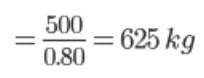
Cylinder strength = 0.8 Cube strength

APSC AE CE Paper 1 Mock Test - 10 - Question 25

Horizontal stiffener in a plate girder is provided to safeguard against web buckling due to-

Detailed Solution: Question 25

When a plate girder bends, its curvature creates vertical compression in the web is due to the downward vertical component of compression flange and the upward vertical component of tension flange bending stress. The web must have sufficient vertical buckling strength to withstand this squeezing effect.

APSC AE CE Paper 1 Mock Test - 10 - Question 26

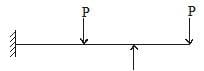
The rigid frame shown in the figure is-

Detailed Solution: Question 26

(Ds = 3mre – 3J)

(=3×23 – 3 × 3 = 0)

Hence it is determinate and stable.

In general: If The structure is number of unknowns < number="" of="" equations="" unstable="" number="" of="" unknowns="number" of="">

Stable & Determinate number of unknowns > number of equations Indeterminate The procedure outlined above does not always work with regard to stability. An alternate method (the displaced shape method) of determining whether a structure is stable or unstable, and determinate or indeterminate is the following

  • If the displaced shape of the structure can be drawn so that no members deform, the structure is unstable.

  • If the displaced shape cannot be drawn without causing a member to deform, the structure is stable.

If removal of one constraint (a support force or a member force) causes the structure to be unstable (i.e. the structure can be displaced without deforming a member), then the original structure is stable and determinate. o If two or more constraints need to be removed to cause the structure to be unstable, the original structure is stable and indeterminate.

Hence, the correct option is (A)

APSC AE CE Paper 1 Mock Test - 10 - Question 27

The ratio of the water stored in the root zone during irrigation, to the water needed in the root zone prior to irrigation is called:

Detailed Solution: Question 27

Efficiency of water-storage (ηs): It is the ratio of the water stored in the root zone during irrigation to the water needed in the root zone prior to irrigation (i.e the amount of water to be stored in the field such that moisture content is raised to field capacity).

Hence, the correct option is (B)

APSC AE CE Paper 1 Mock Test - 10 - Question 28

What is the specific energy (m-kg/kg) for 1 m depth of flow having velocity of 3 m/s?

Detailed Solution: Question 28

Specific Energy,

Where y = depth of the flow

v = velocity of the flow

g = acceleration due to gravity

APSC AE CE Paper 1 Mock Test - 10 - Question 29

Which one of the following methods would be best suited for the disposal of plastic and rubber waste?

Detailed Solution: Question 29

Pyrolysis is a process of chemically decomposing organic materials such as plastic and rubber at elevated temperatures in the absence of oxygen.

In general, pyrolysis does not involve reactions with oxygen, water, or any other reagents.

Composting: Composting of refuse is a biological method of decomposing solid waste. If the organic materials excluding plastics, leather, and rubber are separated from the solid wastes and are subjected to decomposition either aerobically or anaerobically, the remaining end product is called compost or humus. The entire process involving both the separation and bacterial conversion of the organic solid wastes is known as Composting.

Incineration is one of the most effective methods of reducing the volume and weight of solid waste by burning it in a well-designed furnace.

APSC AE CE Paper 1 Mock Test - 10 - Question 30

The lower water-cement ratio in concrete produces:

Detailed Solution: Question 30

The water-cement ratio is the ratio of the weight of water to the weight of cement used in a concrete mix.

A lower ratio leads to higher strength and durability but may make the mix difficult to work with and form.

The water-cement ratio is inversely proportional to the strength of concrete, lower water-cement ratio leads to an increase in bonds between the aggregates, cement, and sand.

As w/c increases quantity of cement in concrete reduces hence the availability of paste in concrete reduces. Poorer the paste higher the creep. therefore we can say that strength of concrete is inversely proportional to the creep.

View more questions
20 tests
Information about APSC AE CE Paper 1 Mock Test - 10 Page
In this test you can find the Exam questions for APSC AE CE Paper 1 Mock Test - 10 solved & explained in the simplest way possible. Besides giving Questions and answers for APSC AE CE Paper 1 Mock Test - 10, EduRev gives you an ample number of Online tests for practice
Download as PDF