Mechanical Engineering Exam  >  Mechanical Engineering Tests  >  HPCL Mechanical Engineer Mock Test - 9 - Mechanical Engineering MCQ

HPCL Mechanical Engineer Mock Test - 9 - Mechanical Engineering MCQ


Test Description

30 Questions MCQ Test - HPCL Mechanical Engineer Mock Test - 9

HPCL Mechanical Engineer Mock Test - 9 for Mechanical Engineering 2026 is part of Mechanical Engineering preparation. The HPCL Mechanical Engineer Mock Test - 9 questions and answers have been prepared according to the Mechanical Engineering exam syllabus.The HPCL Mechanical Engineer Mock Test - 9 MCQs are made for Mechanical Engineering 2026 Exam. Find important definitions, questions, notes, meanings, examples, exercises, MCQs and online tests for HPCL Mechanical Engineer Mock Test - 9 below.
Solutions of HPCL Mechanical Engineer Mock Test - 9 questions in English are available as part of our course for Mechanical Engineering & HPCL Mechanical Engineer Mock Test - 9 solutions in Hindi for Mechanical Engineering course. Download more important topics, notes, lectures and mock test series for Mechanical Engineering Exam by signing up for free. Attempt HPCL Mechanical Engineer Mock Test - 9 | 170 questions in 150 minutes | Mock test for Mechanical Engineering preparation | Free important questions MCQ to study for Mechanical Engineering Exam | Download free PDF with solutions
HPCL Mechanical Engineer Mock Test - 9 - Question 1

The area of rhombus using its diagonals d1  and  d2 is

Detailed Solution for HPCL Mechanical Engineer Mock Test - 9 - Question 1
  • The area of a rhombus is calculated using the two diagonals.
  • Dividing the rhombus along its diagonals creates four right triangles.
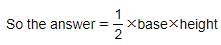
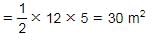
  • Thus, the formula becomes 1/2 multiplied by the product of d1 and d2.
  • Answer d, which represents 1/2 (d1 x d2), is correct.
HPCL Mechanical Engineer Mock Test - 9 - Question 2

Pipe A can fill a tank of 1000 liters in 150 minutes. In how many minutes can it fill a tub of 60 liters while working with 5% of its efficiency?

Detailed Solution for HPCL Mechanical Engineer Mock Test - 9 - Question 2

First, find the normal rate of Pipe A:

  • Pipe A fills 1000 liters in 150 minutes.
  • Hence, its normal rate = 1000 / 150 = 6.6667 liters per minute.

Next, if it works at only 5% efficiency, its rate becomes:

  • 5% of 6.6667 = 0.05 × 6.6667 = 0.3333 liters per minute (approximately).

Finally, to fill 60 liters at this reduced rate:

  • Time required = 60 / 0.3333 ≈ 180 minutes.

Answer: 180 minutes (Option c).

Hence, Option C is correct.

HPCL Mechanical Engineer Mock Test - 9 - Question 3

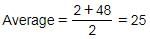
What is the average of all even numbers between 1 and 50?
Detailed Solution for HPCL Mechanical Engineer Mock Test - 9 - Question 3

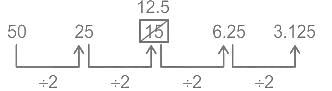
All even numbers between 1 and 50 = 2 to 48

Hence, Option D is correct.

HPCL Mechanical Engineer Mock Test - 9 - Question 4

The average of 100 numbers is 210. The average of these 100 numbers and 20 other new numbers is 200. What is the average of 20 new numbers?

Detailed Solution for HPCL Mechanical Engineer Mock Test - 9 - Question 4


Sum of 100 numbers =100×210=21000
Sum of 120 numbers =120×200=24000
Sum of 20 numbers =24000−21000=3000
∴ Average of 20 new numbers =3000/20=150


Hence, Option D is correct.

HPCL Mechanical Engineer Mock Test - 9 - Question 5

In the following figure, ∠B : ∠C = 2 : 3, find ∠B + ∠C.

Detailed Solution for HPCL Mechanical Engineer Mock Test - 9 - Question 5

∠DAC = ∠B + ∠C
(Exterior angle prop. of a Δ ABC)
According to question,
130° = 2A + 3A
5A = 130°
A = 26°
∴ ∠B = 52°; ∠C = 78°

HPCL Mechanical Engineer Mock Test - 9 - Question 6

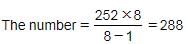
The difference between a number and 12.50% of the same number is 252. What is 44.44% of the number?

Detailed Solution for HPCL Mechanical Engineer Mock Test - 9 - Question 6


Hence, Option A is correct.

HPCL Mechanical Engineer Mock Test - 9 - Question 7

How many rotations of a wheel with a 21 m radius are required to cover a distance of 6.60 km?

Detailed Solution for HPCL Mechanical Engineer Mock Test - 9 - Question 7

Perimeter of the wheel

Hence, Option B is correct.

HPCL Mechanical Engineer Mock Test - 9 - Question 8

A pipe can empty a tank in 80 minutes. In how many minutes can the pipe empty 45% of the tank?

Detailed Solution for HPCL Mechanical Engineer Mock Test - 9 - Question 8


Hence, Option B is correct.

HPCL Mechanical Engineer Mock Test - 9 - Question 9

A candidate in an examination was asked to find  of a certain number. By mistake he found  of it. Thus, his answer was 25 more than the correct answer. The number was :

Detailed Solution for HPCL Mechanical Engineer Mock Test - 9 - Question 9

Let the required number be x.
As given,

HPCL Mechanical Engineer Mock Test - 9 - Question 10

  is equal to :-

Detailed Solution for HPCL Mechanical Engineer Mock Test - 9 - Question 10

2n(24-2) + 2-3
2nx2x23
14 + 2-3
24
7/8+1/8
1

HPCL Mechanical Engineer Mock Test - 9 - Question 11

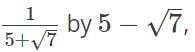
By rationalising the denominator ofwe get __________

Detailed Solution for HPCL Mechanical Engineer Mock Test - 9 - Question 11

When the denominator of an expression contains a term with a square root, the process of converting it to an equivalent expression whose denominator is a rational number is called rationalising the denominator.
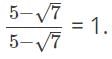
By multiplying we will get same expression since 
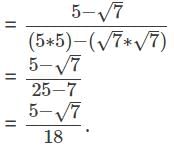
Therefore, 

HPCL Mechanical Engineer Mock Test - 9 - Question 12

Directions to Solve

In each of the following questions find out the alternative which will replace the question mark.

Question -

BLOCKED : YOLXPVW :: ? : OZFMXS

Detailed Solution for HPCL Mechanical Engineer Mock Test - 9 - Question 12

HPCL Mechanical Engineer Mock Test - 9 - Question 13

A word with letters jumbled has been given. Choose the correct order of letters which are required to form the correct word.

Jumbled word: PTIOISCL

Detailed Solution for HPCL Mechanical Engineer Mock Test - 9 - Question 13

1) 8, 4, 3, 7, 1, 5, 2, 6

2) 5, 2, 7, 3, 4, 1, 8, 6

3) 3, 1, 6, 8, 4, 5, 2, 7

4) 1, 4, 8, 3, 2, 5, 7, 6

'POLITICS' is a meaningful English word.

Hence, '1, 4, 8, 3, 2, 5, 7, 6' is the correct answer.

HPCL Mechanical Engineer Mock Test - 9 - Question 14

Directions: Each of the following consists of a question and two statements numbered I and II given below it. You have to decide whether the data provided in the statements are sufficient to answer the question:

Six persons – I, J, K, L, M, and N have visited different countries – U, V, W, X, Y, and Z and are sitting around a triangular table facing the center, one person on each corner and one person on each side. Who sits 3rd to the left of the one who visited W?
Statement I:
K, who visited Y sits 2nd to the right of J. Two persons sits between I and the one who visited U. L visited Z and sits on the corner, just to the right of the one who visited X. M sits immediate left of K. The one who visited W sits at a corner.
Statement II: The one who visited Z, sits just right of I at a corner. Two persons sit between J and N, who visited W. M visited U and sits just left of K who visited Y.

Detailed Solution for HPCL Mechanical Engineer Mock Test - 9 - Question 14

From Statement I: From this statement, we get the following diagram


Clearly, Statement I alone is not sufficient to answer the question.

From Statement II: From this statement, we get following diagram


Clearly, Statement II alone is not sufficient to answer the question.

Checking both Statement, I and II together:

Here, on merging both the statements we get the following diagram,


So, by combining both the statements, we can say J sits 3rd to the left of N, who visited W..

Clearly, Statement I and Statement II together are necessary to answer the question.

Hence, option E is the correct answer.
 

HPCL Mechanical Engineer Mock Test - 9 - Question 15

Directions to Solve

In each of the following questions find out the alternative which will replace the question mark.

Question -

KeaC : CaeK :: XgmF : ?

Detailed Solution for HPCL Mechanical Engineer Mock Test - 9 - Question 15

First and fouth letters are interchanged while second and third letters are interchanged.

HPCL Mechanical Engineer Mock Test - 9 - Question 16

Directions to Solve

In each of the following questions find out the alternative which will replace the question mark.

Question -

Flow : River :: Stagnant : ?

Detailed Solution for HPCL Mechanical Engineer Mock Test - 9 - Question 16

As Water of a River flows similarly water of Pool is Stagnant.

HPCL Mechanical Engineer Mock Test - 9 - Question 17

Select the number which can be placed at the sign of the question mark (?) from the given alternatives.

Detailed Solution for HPCL Mechanical Engineer Mock Test - 9 - Question 17

The logic follows here is:

In fig 1:

12 = 6 ÷ 2 × 4

12 = 3 × 4 

12 = 12

In fig 2:

80 = 20 ÷ 2 × 8

80 = 10 × 8

80 = 80

Similarly,

63 = ? ÷ 2 × 21

63 / 21 = ? ÷ 2

3 = ? ÷ 2

? = 3 × 2

? = 6

Hence, the correct answer is "6".

HPCL Mechanical Engineer Mock Test - 9 - Question 18

Direction: Study the following information carefully and answer the given questions besides.

Six people P, Q, R, S, T and U are sitting at different corners of a hexagonal table, all facing the centre of the table. Only one person is sitting between P and U. S is sitting second to the right of R. T is not sitting beside S. Exactly two persons are sitting between P and Q.
Q. Which of the following person sits immediate right of Q?

Detailed Solution for HPCL Mechanical Engineer Mock Test - 9 - Question 18

From the common explanation, we get T sits immediate right of Q.
Hence, Option B is correct.
Final Arrangement:

Common Explanation:
References:

Exactly two persons are sitting between P and Q.
Only one person is sitting between P and U.
Inferences:
From the above references, we get two different cases:

References:
S is sitting second to the right of R.
Inferences:
From the above reference, we get the following arrangements:

References:
T is not sitting beside S.
Inferences:
So, from this case 2 will be eliminated as T is not sitting beside S.
Hence, we get our final arrangement:

HPCL Mechanical Engineer Mock Test - 9 - Question 19

In each of the following questions find out the alternative which will replace the question mark.
Cassock : Priest :: ? : Graduate

Detailed Solution for HPCL Mechanical Engineer Mock Test - 9 - Question 19

A Priest wears cassock (a full-length garment worn by certain Christian clergy, members of church choirs, and others having an office or role in a church.) while Graduate wears gown.

HPCL Mechanical Engineer Mock Test - 9 - Question 20
If x + 1/x = 25, find the value of x – 1/x.
Detailed Solution for HPCL Mechanical Engineer Mock Test - 9 - Question 20

Given:

x + 1/x = 25

Concept Used:

If x + 1/x = p then, x – 1/x = √(p2 – 4)

Calculation:

It is given that x + 1/x = 25

We know that if x + 1/x = p then, x – 1/x = √(p2 – 4)

⇒ x – 1/x = √(252 – 4)

⇒ x – 1/x = √(625 – 4)

⇒ x – 1/x = √621

∴ value of x – 1/x is √621.
HPCL Mechanical Engineer Mock Test - 9 - Question 21

If in a certain code language, 'four' is called 'five', 'five' is called 'six', 'six' is called 'seven', 'seven' is called 'eight', 'eight' is called 'nine' and 'nine' is called 'ten'. Then what is cube of the number 2?

Detailed Solution for HPCL Mechanical Engineer Mock Test - 9 - Question 21

According to the given information:


So, the cube of the number 2 is 8.

But in the statement, 'eight' is called 'nine'.

Hence, the correct answer is "Nine".

HPCL Mechanical Engineer Mock Test - 9 - Question 22

P, Q, R, S and T are sitting in a straight line facing the North. P sits next to S but not to T. Q is sitting next to R, who sits on the extreme left corner. Who sits to the immediate left of S if T does not sit next to Q?

Detailed Solution for HPCL Mechanical Engineer Mock Test - 9 - Question 22


P sits to the immediate left of S.

Hence, option A is correct.

HPCL Mechanical Engineer Mock Test - 9 - Question 23

Direction: Study the following question carefully and choose the right answer.

If PLANT is coded as TNBLP, then LOGIC will be coded as

Detailed Solution for HPCL Mechanical Engineer Mock Test - 9 - Question 23


Hence, option A is correct.

HPCL Mechanical Engineer Mock Test - 9 - Question 24

Diesel engines are generally

Detailed Solution for HPCL Mechanical Engineer Mock Test - 9 - Question 24
In the case of IC engines, two types of governing are involved.

Quality-Based Governing: In this type of engines, we can control the air-fuel ratio or quality of the air-fuel mixture. This is done in the case of diesel engines, where the fuel is introduced inside the cylinder by fuel injection.

Quantity Based Governing: In this type of engine, we can not control the air-fuel ratio by any means. We can control the volume of the mixture supplied to the engine. This is employed in SI engines.

HPCL Mechanical Engineer Mock Test - 9 - Question 25

A poppet value is produced by

Detailed Solution for HPCL Mechanical Engineer Mock Test - 9 - Question 25

A poppet valve (also called a mushroom valve) is a valve typically used to control the timing and quantity of gas or vapor flow into an engine. It consists of a hole, usually round or oval, and a tapered plug, usually a disk shape on the end of a shaft also called a valve stem.

HPCL Mechanical Engineer Mock Test - 9 - Question 26

What is the safe working pressure for a spherical pressure vessel 1.5 m internal diameter and 1.5 cm wall thickness if the maximum allowable tensile stress is 45 MPa?

Detailed Solution for HPCL Mechanical Engineer Mock Test - 9 - Question 26
For thin spherical vessel:

For a thin spherical pressure vessel, both longitudinal and hoop stress is the same and given as

HPCL Mechanical Engineer Mock Test - 9 - Question 27

The coldest part of the domestic refrigerator is

Detailed Solution for HPCL Mechanical Engineer Mock Test - 9 - Question 27
Working of different parts of the refrigerator are

Compressor: The compressor is located at the back of the refrigerator and in the bottom area. The compressor sucks the refrigerant from the evaporator and discharges it at high pressure and temperature. The compressor is driven by the electric motor, and it is the major power-consuming device of the refrigerator.

Condenser: The condenser is the thin coil of copper tubing located at the back of the refrigerator. The refrigerant from the compressor enters the condenser,stress-strain where it is cooled by the atmospheric air, thus losing heat absorbed by it in the evaporator and the compressor.

Expansive valve or the capillary: The refrigerant leaving the condenser enters the expansion device, which is the capillary tube in domestic refrigerators. The capillary is the thin copper tubing made up of a number of turns of the copper coil. When the refrigerant is passed through the capillary, its pressure and temperature drop down suddenly.

Evaporator or chiller or freezer: The refrigerant at very low pressure and temperature enters the evaporator or the freezer. It is the coldest part of the refrigerator. The refrigerant absorbs the heat from the substance to be cooled in the evaporator, gets evaporated, and is then sucked by the compressor. This cycle keeps on repeating.

Receiver: The primary function of the receiver is to catch and hold any liquid refrigerant that didn’t boil off in the evaporator. Liquid refrigerant getting to the compressor can damage the pistons.

HPCL Mechanical Engineer Mock Test - 9 - Question 28

Size of the shaper is specified by

Detailed Solution for HPCL Mechanical Engineer Mock Test - 9 - Question 28
Shaping, planning, and slotting operations are similar machining processes that provide a cutting action due to straight-line reciprocating motion between the tool and the work. In all the processes, single-point cutting tools are used.

In shaping and planning operations, straight and flat surfaces are created. In shaping operation, the speed motion is accomplished by moving the cutting tool, while in planning, the motion is accomplished by the workpiece. Shaping is performed in a machine tool called a shaper, whereas the machine tool for planning is called a planer. The slotting process is identical to shaping except that the motion of the ram is vertical instead of horizontal.

The size of the shaper is specified by the maximum length of stroke or cut it makes. The maximum stroke length of the shaper is 900 mm.

HPCL Mechanical Engineer Mock Test - 9 - Question 29

An ocean linear 250 m long has a maximum speed of 15m/sec. The speed of a model 10m long, to simulate the wave resistance should be

Detailed Solution for HPCL Mechanical Engineer Mock Test - 9 - Question 29

Guidance: The wave resistance is a function of Froude's number. In order to determine the model speed, the Froude model law is used.

HPCL Mechanical Engineer Mock Test - 9 - Question 30

Which one of the following is a boiler mounting?

Detailed Solution for HPCL Mechanical Engineer Mock Test - 9 - Question 30
The boiler mountings are part of the boiler and are required for proper functioning. It is essential fitting for the safe working of a boiler.

Some of the important mountings are Water level Indicator, Pressure Gauge, Safety Valve, Fusible Plug, Feed Check Valve, and Steam Stop Valve.

The accessories are mounted on the boiler to increase its efficiency. These units are optional on an efficient boiler.

The following accessories are normally used on a modern boiler: Economizer, Superheater, Air preheater, Feedwater pump, Steam injector, Chimney.

View more questions
Information about HPCL Mechanical Engineer Mock Test - 9 Page
In this test you can find the Exam questions for HPCL Mechanical Engineer Mock Test - 9 solved & explained in the simplest way possible. Besides giving Questions and answers for HPCL Mechanical Engineer Mock Test - 9, EduRev gives you an ample number of Online tests for practice
Download as PDF