NEET Exam  >  NEET Test  >  NCERT Based Tests  >  Test: Planck’s Quantum Theory - NEET MCQ

Planck’s Quantum Theory - NEET NCERT Based Tests Free MCQ Test with solutions


MCQ Practice Test & Solutions: Test: Planck’s Quantum Theory (15 Questions)

You can prepare effectively for NEET NCERT Based Tests for NEET with this dedicated MCQ Practice Test (available with solutions) on the important topic of "Test: Planck’s Quantum Theory". These 15 questions have been designed by the experts with the latest curriculum of NEET 2026, to help you master the concept.

Test Highlights:

  • - Format: Multiple Choice Questions (MCQ)
  • - Duration: 15 minutes
  • - Number of Questions: 15

Sign up on EduRev for free to attempt this test and track your preparation progress.

Test: Planck’s Quantum Theory - Question 1

The energy of a photon in Joules that has a wavelength of 9.0 m is:
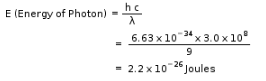
Detailed Solution: Question 1

Test: Planck’s Quantum Theory - Question 2

The ratio of the energy of a photon of 2000 Ǻ wavelength radiation to that of 4000 Ǻ radiation is:

Detailed Solution: Question 2

We have E = hc/λ
E1/E2 = 4000Å/2000Å = 2

Test: Planck’s Quantum Theory - Question 3

A radio operator broadcast on the 6-meter band. The frequency of this electromagnetic radiation is __________ MHz.

Detailed Solution: Question 3

Test: Planck’s Quantum Theory - Question 4

Electromagnetic radiation travels through vacuum at a speed of __________ m/s.

Detailed Solution: Question 4

The speed of light (electromagnetic radiation) through vacuum has a constant value of 3.00 x 10⁸m/s and is independent of the wavelength in vacuum.

Test: Planck’s Quantum Theory - Question 5

 What is the frequency of light in s-1 that has a wavelength of 3.12 x 10⁻³ cm?

Detailed Solution: Question 5

The wavelength (λ) and frequency (ν) of electromagnetic wave is related by the equation c = λ.ν,

Where c is the speed of light = 3.00 x 10⁸ m/s, λ is the wavelength in m and ν is the frequency is s-1or Hz.

Substituting the values in the formula, we get,

c = λ.ν

ν = c/λ

ν = 3.0 x 10⁸ / 3.12 x 10-5

= 0.96 x 10¹³ m =  9.62 X 10¹²

Test: Planck’s Quantum Theory - Question 6

The ejected electrons from the surface of metal in photoelectric effect are called:

Detailed Solution: Question 6

If light beyond a specific threshold frequency hits a metal surface, electrons are ejected from the surface of the metal. The minimum energy required to eject an electron from the surface is called the work function of the metal. These ejected electrons are called photoelectrons. The kinetic energy of the most energetic electron among these photoelectrons is called the maximum kinetic energy.

Test: Planck’s Quantum Theory - Question 7

 If the value of azimuthal quantum number is 3, the possible values of magnetic quantum numbers would be:

Detailed Solution: Question 7

The total possible values of m for l range from – through 0 to +. 

Test: Planck’s Quantum Theory - Question 8

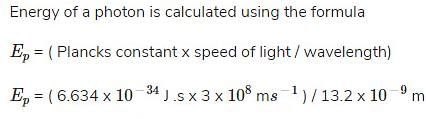
What is the energy of a photon that has a wavelength of 13.2 nm?
Detailed Solution: Question 8


 = 1.51 × 10⁻¹⁷ J.

Test: Planck’s Quantum Theory - Question 9

What is correct about wave number?

Detailed Solution: Question 9

Wavenumber is defined as the number of complete wave cycles per unit length of a linear space. It can also be referred to as the spatial frequency of the waves represented in radians per unit distance, or cycles per unit distance. It is usually measured in units of reciprocal centimeters (cm-1) and reciprocal meters (m-1).

Test: Planck’s Quantum Theory - Question 10

The wavelength of light that has a frequency of 1.20 × 10¹³s-1 is __________ m.

Detailed Solution: Question 10

The speed of all form of electromagnetic wave is related by the equation c = λ.v, whereby, λ = 3.0 x 10⁸ / 1.2 x 1013 = 2.5 x 10 -5 m.

Test: Planck’s Quantum Theory - Question 11

 Which of the following radiation has the shortest wavelength.

Detailed Solution: Question 11

Radio waves, infrared rays, visible light, ultraviolet rays, X-rays, and gamma raysare all types of electromagnetic radiation. Radio waves have the longest wavelength, and gamma rays have the shortest wavelength.

Test: Planck’s Quantum Theory - Question 12

 Who discovered and first used the constant h = 6.6 x 10⁻³⁴ J.s?

Detailed Solution: Question 12

Max Planck gave the Planck’s quantum theory and was the first to determine the value of h which is the Planck’s constant.

Test: Planck’s Quantum Theory - Question 13

The energy of a photon of light has what kind of proportionality to its frequency and its wavelength.

Detailed Solution: Question 13

As E=h(frequency) E is directly proportional to frequency and as frequency = speed of light / wavelength frequency is inversely proportional to wavelength.

Test: Planck’s Quantum Theory - Question 14

What is the wavelength of light (nm) that has a frequency 4.62 ×10¹⁴s-1?

Detailed Solution: Question 14

The wavelength (λ) and frequency (ν) of electromagnetic wave is related by the equation c = λ.ν, whereby, λ = 3.0 x10⁸ / 4.62 ×1014 =  0.649 x 10⁻⁶ m = 649nm

Test: Planck’s Quantum Theory - Question 15

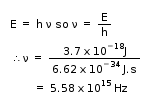
What is the frequency of a photon that has an energy of 3.7 x 10-18J?
Detailed Solution: Question 15

677 tests
Information about Test: Planck’s Quantum Theory Page
In this test you can find the Exam questions for Test: Planck’s Quantum Theory solved & explained in the simplest way possible. Besides giving Questions and answers for Test: Planck’s Quantum Theory, EduRev gives you an ample number of Online tests for practice
Download as PDF



