NEET Exam  >  NEET Test  >  Chemistry Class 11  >  Test: Structure of Atom - 1 - NEET MCQ

Structure of Atom - 1 - NEET Chemistry Class 11 Free MCQ Test with solutions


MCQ Practice Test & Solutions: Test: Structure of Atom - 1 (12 Questions)

You can prepare effectively for NEET Chemistry Class 11 with this dedicated MCQ Practice Test (available with solutions) on the important topic of "Test: Structure of Atom - 1". These 12 questions have been designed by the experts with the latest curriculum of NEET 2026, to help you master the concept.

Test Highlights:

  • - Format: Multiple Choice Questions (MCQ)
  • - Duration: 12 minutes
  • - Number of Questions: 12

Sign up on EduRev for free to attempt this test and track your preparation progress.

Test: Structure of Atom - 1 - Question 1

If the kinetic energy of an electron is increased four times, the wavelength of the de-Broglie wave associated with it would become

Detailed Solution: Question 1

The wavelength λ is inversely proportional to the square root of kinetic energy. So if KE is increased 4 times, the wavelength becomes half.

λ∝1/√KE

Hence Option A is the answer.

Test: Structure of Atom - 1 - Question 2

Calculate the wavelength (in nanometer) associated with a proton moving at 1.0×10³ms-1 (Mass of proton = 1.67×10⁻²⁷kg and h = 6.63×10⁻³⁴Js)

Detailed Solution: Question 2

Given mp = 1.67×10⁻²⁷kg
h = 6.63×10⁻³⁴Js
v = 1.0×10³ms-1

We know wavelength λ = h/mv
∴λ = 6.63×10⁻³⁴/(1.67×10-27 × 1.0×103)
= 0.40×10⁻¹⁰
≈ 0.40nm

Hence, Option (B) is the Correct Answer.

Test: Structure of Atom - 1 - Question 3

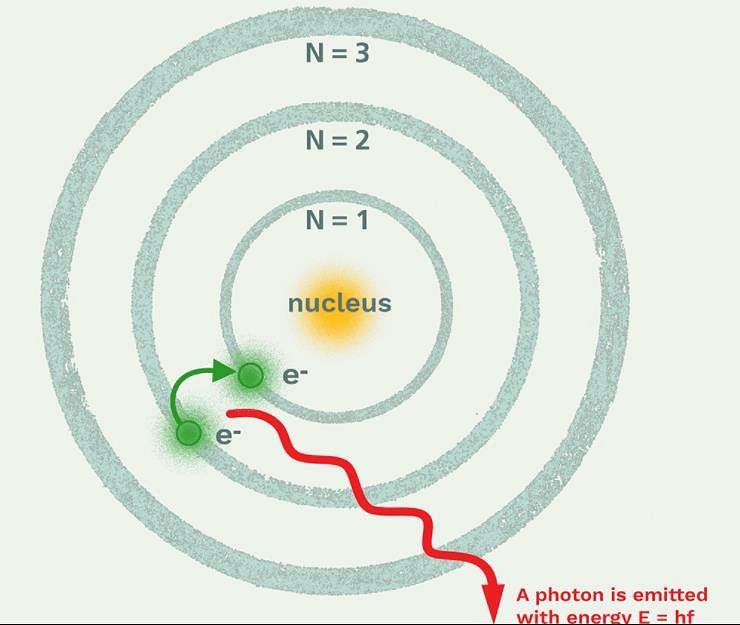
The frequency of light emitted for the transition n = 4 to n = 2 of He+ is equal to the transition in H atom corresponding to which of the following
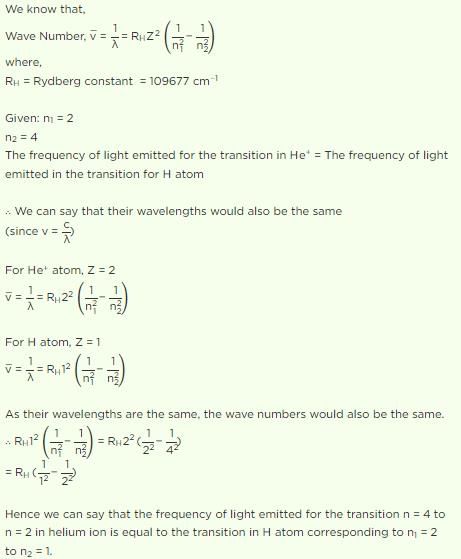
Detailed Solution: Question 3

Correct Answer is A.

Test: Structure of Atom - 1 - Question 4

The radius of the second Bohr orbit for the hydrogen atom is :
(Planck’s constant, h = 6.262×10⁻³⁴Js: Mass of electron = 9.1091×10⁻³¹kg; Charge of electron e = 1.60210×10⁻¹⁹C; permittivity of vacuum ε0 = 8.854185×10⁻¹²kg-1m-3A2)
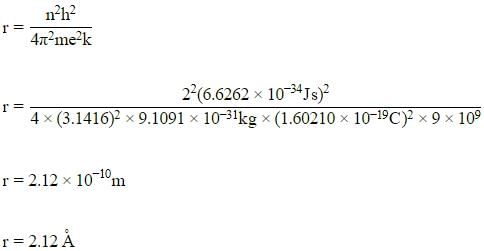
Detailed Solution: Question 4

Test: Structure of Atom - 1 - Question 5

The number of radial nodes for 3p orbital is:

Detailed Solution: Question 5

  • Number of radial nodes = n - l – 1

where n = principal quantum number, l = azimuthal quantum number

  • For 3p orbital, n = 3 – 1 – 1 = 1
  • Number of radial nodes = 3 – 1 – 1 = 1. 

Test: Structure of Atom - 1 - Question 6

A sub-shell with n = 6 , l = 2 can accommodate a maximum of
Detailed Solution: Question 6

n = 6, l = 2 means 6d → will have 5 orbitals. 

∴ max 10 electrons can be accommodate as each orbital can have maximum of 2 electrons. 

Test: Structure of Atom - 1 - Question 7

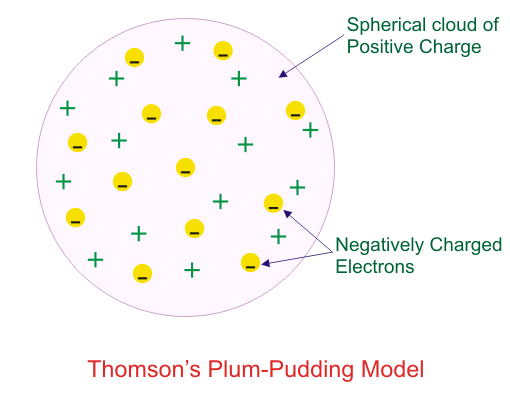
Thomson’s plum pudding model explained:

Detailed Solution: Question 7

  • An atom consists of a positively charged sphere with electrons filled into it. The negative and positive charges present inside an atom are equal and as a whole, an atom is electrically neutral.
  • Thomson’s model of the atom as compared to plum pudding and watermelon.
  • He compared the red edible part of the watermelon to a positively charged sphere whereas the seeds of watermelon to negatively charged particles.

electrical world

Test: Structure of Atom - 1 - Question 8

Which of the following conclusions could not be derived from Rutherford’s α -particle scattering experiment?

Detailed Solution: Question 8

  • Concept of electrons moving in a circular path of fixed energy called orbits was put forward by Bohr and not derived from Rutherford's scattering experiment.
  • Out of a large number of circular orbits theoretically possible around the nucleus.
  • The electron revolves only in those orbits which have a tired value of energy Hence, these orbits are called energy level or stationary states.

Test: Structure of Atom - 1 - Question 9

The nature of positive rays depends on?

Detailed Solution: Question 9

  • The nature of positive rays produced in a vacuum discharge tube depends upon the nature of the gas-filled.
  • The positive rays consist of positive ions obtained by removing one or more electrons from gas molecules.

Test: Structure of Atom - 1 - Question 10

The nucleus of a tritium atom, 3H, contains

Detailed Solution: Question 10

  • Tritium (3H) is the only radioactive isotope of hydrogen.
  • The nucleus of a tritium atom consists of a proton and two neutrons.

Test: Structure of Atom - 1 - Question 11

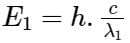
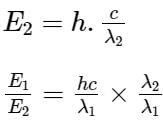
The wavelengths of two photons are 2000 Å and 4000 Å respectively. What is the ratio of their energies?
Detailed Solution: Question 11


= 4000/2000
= 2

Test: Structure of Atom - 1 - Question 12

The ion that is isoelectronic with CO is-

Detailed Solution: Question 12

Isoelectronic species are the having same number of electrons.
Number of electrons in CO = 6 + 8 = 14
O2- = 16 + 1 = 17
N2+ = 14 - 1 = 13
O2+ = 1 6 - 1 = 15
CN- = 6 + 7 + 1 = 14
Hence, CO isoelectronic with CN ion.

98 videos|243 docs|71 tests
Information about Test: Structure of Atom - 1 Page
In this test you can find the Exam questions for Test: Structure of Atom - 1 solved & explained in the simplest way possible. Besides giving Questions and answers for Test: Structure of Atom - 1, EduRev gives you an ample number of Online tests for practice
98 videos|243 docs|71 tests
Download as PDF