NEET Exam  >  NEET Test  >  Chemistry Class 11  >  Test: Alkenes - NEET MCQ

Alkenes - NEET Free MCQ Test with solutions


Test Description

15 Questions MCQ Test Chemistry Class 11 - Test: Alkenes

Test: Alkenes for NEET 2026 is part of Chemistry Class 11 preparation. The Test: Alkenes questions and answers have been prepared according to the NEET exam syllabus.The Test: Alkenes MCQs are made for NEET 2026 Exam. Find important definitions, questions, notes, meanings, examples, exercises, MCQs and online tests for Test: Alkenes below.
Solutions of Test: Alkenes questions in English are available as part of our Chemistry Class 11 for NEET & Test: Alkenes solutions in Hindi for Chemistry Class 11 course. Download more important topics, notes, lectures and mock test series for NEET Exam by signing up for free. Attempt Test: Alkenes | 15 questions in 15 minutes | Mock test for NEET preparation | Free important questions MCQ to study Chemistry Class 11 for NEET Exam | Download free PDF with solutions
Test: Alkenes - Question 1

Which of the following compounds will lose optical activity after the reaction ?
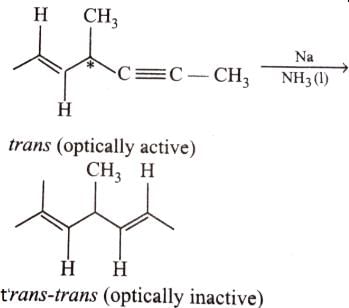
Detailed Solution for Test: Alkenes - Question 1

The correct answer is option B

Test: Alkenes - Question 2

Which of the following reactions produces an alkene?

Detailed Solution for Test: Alkenes - Question 2

Option a) Diazene(N2H2) is a hydrogenating agent. So, there will be no reaction.
Option b) Al2O3+CrO3 acts as a dehydrogenation catalyst and so an alkene is formed. (Here 1-propene is formed)
Option c) This reaction is Wolff Kishner reaction. Here, acetone would be converted to alkane.
Option d) Zn/CH3COOH substitutes Cl with H and an alkane is formed.

Test: Alkenes - Question 3

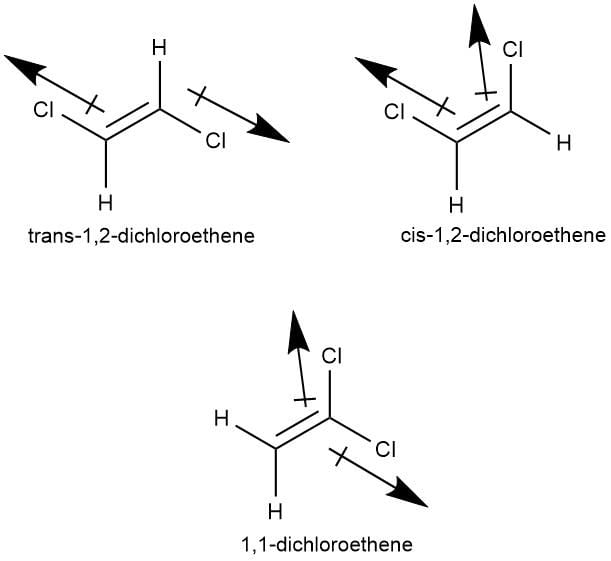
Which of the following alkenes will exhibit geometrical isomerism?

Detailed Solution for Test: Alkenes - Question 3

The correct answer is Option A - CH₃-CH=CH-CH₃

For geometrical (cis-trans) isomerism in alkenes, each carbon of the C=C bond must be bonded to two different groups.

Option A: each double-bond carbon is bonded to H and CH₃, so both carbons have two different substituents; hence cis-trans isomerism is possible.

Option B: one double-bond carbon has two H atoms (identical substituents), so geometrical isomerism is not possible.

Option C: one double-bond carbon has two H atoms, so geometrical isomerism is not possible.

Option D: one double-bond carbon is bonded to two identical methyl groups, so the required difference of substituents is absent and geometrical isomerism is not possible.

Therefore, only Option A exhibits geometrical (cis-trans) isomerism.

Test: Alkenes - Question 4
In the electrophilic addition of HBr to propene in the presence of peroxide, the major product formed is:
Detailed Solution for Test: Alkenes - Question 4

The correct answer is Option B - 1-Bromopropane

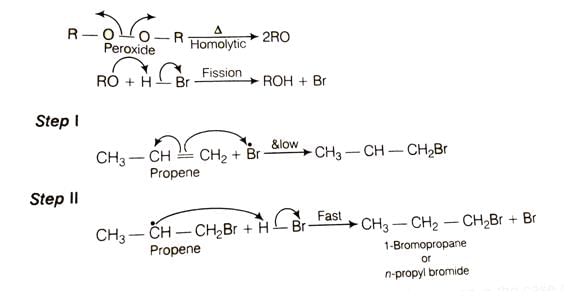
In the presence of peroxide, addition of HBr proceeds by a free-radical chain mechanism (the peroxide effect), which gives anti-Markovnikov regiochemistry.

Initiation:RO-OR → 2 RO· (by heat or light)

Initiation (continued):RO· + HBrROH + Br·

Propagation 1:Br· adds to propene at the terminal carbon to give the more stable secondary radical: Br· + CH3-CH=CH2 → CH3-CH·-CH2-Br

Propagation 2: The resulting alkyl radical abstracts H from HBr, forming the product and regenerating Br·: CH3-CH·-CH2-Br + HBr → CH3-CH2-CH2-Br + Br·

Because the bromine radical first adds to the less substituted carbon, the chain gives the anti-Markovnikov product, namely 1-bromopropane, as the major product.

Test: Alkenes - Question 5
Match List-I with List-II:
List-I (Reaction)List-II (Product/Reagent)
(A) Alkene + H₂O/H⁺(I) Vicinal dihalide
(B) Alkene + Br₂(II) Alcohol
(C) Alkene + HBr (peroxide)(III) Anti-Markownikoff product
(D) Alkene + O₃ then Zn/H₂O(IV) Carbonyl compounds
Detailed Solution for Test: Alkenes - Question 5

The correct answer is Option A - A: (A)-(II), (B)-(I), (C)-(III), (D)-(IV)

For (A): acid-catalysed addition of water (H2O/+) to an alkene proceeds by formation of a carbocation intermediate and follows the Markovnikov orientation, so the net product is an alcohol.

For (B): addition of Br2 across a carbon-carbon double bond gives a 1,2-dibromo structure, i.e. a vicinal dihalide, by electrophilic addition (bromonium-ion formation followed by attack by bromide).

For (C): addition of HBr in the presence of peroxides proceeds by a radical chain mechanism that reverses the usual regioselectivity; this anti-Markovnikov outcome places bromine on the less substituted carbon, giving the anti-Markovnikov product.

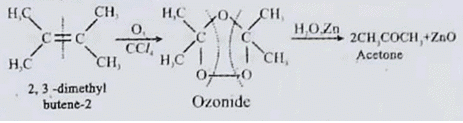
For (D): ozonolysis with O3 followed by reductive workup (e.g., Zn/H2O) cleaves the double bond to give carbonyl compounds (aldehydes or ketones) corresponding to the original alkene substituents.

Test: Alkenes - Question 6
Consider the following statements regarding the electrophilic addition mechanism in alkenes:
A. The first step involves the formation of a carbocation intermediate.
B. The carbocation formed is planar in geometry.
C. The more stable carbocation leads to the major product.
D. The π-electrons of the double bond attack the electrophile.
E. The mechanism follows Markownikoff's rule in the absence of peroxide.

Which of the following combinations are correct?
Detailed Solution for Test: Alkenes - Question 6

The correct answer is Option C - B, C, D and E only

Statement A is not universally correct; although protonation of an alkene (as in hydrohalogenation or hydration) commonly gives a free carbocation intermediate, some electrophilic additions (for example, addition of X₂) proceed via a bridged halonium ion rather than a free carbocation, so the first step does not always produce a free carbocation.

Statement B is correct because a free carbocation is sp²-hybridised and therefore has a planar geometry with an empty p-orbital perpendicular to the plane.

Statement C is correct: formation of the more stable carbocation intermediate is favoured, and this preference controls the regiochemistry so that the pathway leading to the more stable carbocation gives the major product.

Statement D is correct since the π-electrons of the double bond act as a nucleophile and attack the electrophile in the initial bond-forming step of electrophilic addition.

Statement E is correct in the context of hydrohalogenation: in the absence of peroxides addition of H-X follows Markovnikov's rule; the presence of peroxides can induce a radical pathway (notably for HBr) that gives the anti-Markovnikov product.

Thus, B, C, D and E are correct while A is not universally true; the correct option is stated above.

Test: Alkenes - Question 7
When but-1-ene undergoes ozonolysis followed by reductive workup with Zn/H₂O, the products formed are:
Detailed Solution for Test: Alkenes - Question 7

The correct answer is Option A - Propanal and methanal

Ozonolysis cleaves a carbon-carbon double bond into two carbonyl fragments; a reductive workup (for example Zn/H2O or Me2S) converts the ozonide to the corresponding aldehydes or ketones without further oxidation.

When one double-bond carbon is a methylene (-CH2=) and the other is -CH-R, the methylene carbon is converted to methanal (HCHO), while the other carbon gives an aldehyde corresponding to its attached alkyl group.

Following this, the two carbon fragments give methanal (HCHO) and propanal (CH3CH2CHO).

Hence the products are propanal and methanal, so Option A is correct.

Test: Alkenes - Question 8
In the addition of HCl to 2-methylpropene, the major product is 2-chloro-2-methylpropane. This is explained by:
Detailed Solution for Test: Alkenes - Question 8

The correct answer is Option A - Formation of more stable tertiary carbocation

The reaction proceeds by electrophilic addition, where the π bond is protonated to give a carbocation intermediate; the pathway that forms the more stable carbocation is preferred.

A tertiary carbocation is more stable than secondary or primary carbocations because of greater hyperconjugation and the electron-releasing +I effect of alkyl groups, so formation of the tertiary cation is the favored step.

Once the tertiary carbocation is formed, the chloride ion performs a nucleophilic attack on that carbocation to give the corresponding tertiary alkyl chloride as the major product.

The peroxide effect (Kharasch effect) causes anti-Markovnikov addition only in the case of HBr via a radical mechanism; it does not lead to the same outcome with HCl under normal conditions.

Formation of a primary carbocation is less stable and therefore not the preferred pathway, so option C is incorrect.

Similarly, anti-Markovnikov addition (option D) does not apply here for HCl in the absence of a radical-promoting system; the reaction follows the Markovnikov-type route through the more stable carbocation.

Test: Alkenes - Question 9
Which of the following statements about geometrical isomerism in alkenes is NOT correct?
Detailed Solution for Test: Alkenes - Question 9

The correct answer is Option D - Geometrical isomers are also called conformational isomers

Geometrical isomerism (also called cis-trans isomerism) is a type of stereoisomerism that arises from restricted rotation about a C=C double bond, giving distinct spatial arrangements of substituents.

Statement A is correct: such isomers often show different physical properties (for example, differences in boiling point, melting point or dipole moment between the cis and trans forms).

Statement B is correct: free rotation around a C=C bond is not possible under normal conditions because the π (pi) bond must be broken to rotate the bonded atoms fully.

Statement C is correct: for an alkene to exhibit geometrical isomerism, each of the two carbon atoms of the double bond must be bonded to two different groups; if one carbon has two identical substituents, cis-trans isomerism is not possible.

Statement D is incorrect: conformational isomers (or rotamers) are stereoisomers that interconvert by rotation about single bonds and do not require breaking a bond; this is fundamentally different from geometrical isomerism, which involves a double bond and cannot be converted without breaking the π bond.

Therefore, Option D is not correct.

Test: Alkenes - Question 10
The peroxide effect in the addition of HBr to alkenes involves:
Detailed Solution for Test: Alkenes - Question 10

The correct answer is Option B - Free radical mechanism

The presence of peroxides causes the reaction to proceed by a free radical chain mechanism, which gives anti-Markovnikov addition of HBr to alkenes.

The chain is initiated by homolysis of the peroxide: RO-OR → 2 RO· (by heat or light).

RO· + HBr → ROH + Br·

The first propagation step is addition of the Br· to the double bond to give the more stable carbon radical, so bromine attaches to the less substituted carbon:

Br· + RCH=CH2 → RCH(Br)-CH2·

The carbon radical then abstracts hydrogen from HBr, giving the alkyl bromide and regenerating Br· to continue the chain:

RCH(Br)-CH2· + HBr → RCH(Br)-CH3 + Br·

Termination occurs by radical combination (for example, Br· + Br· → Br2), which stops the chain.

The peroxide effect is observed specifically with HBr because the formation and reactions of Br· radicals make the propagation steps energetically favorable; the corresponding radical chain propagation is not favourable for HCl or HI, so those hydrogen halides do not show the peroxide-induced anti-Markovnikov addition under the same conditions.

Test: Alkenes - Question 11

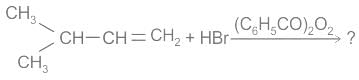
The major product of the following chemical reaction is:

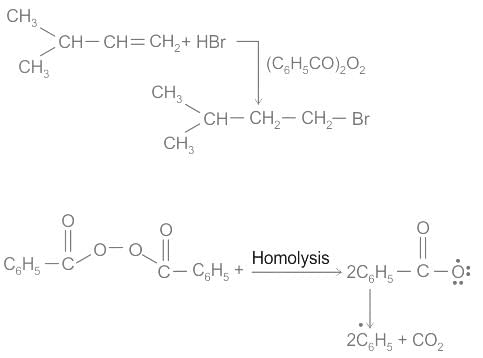
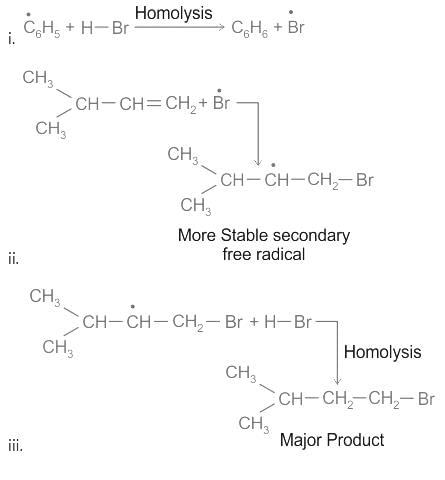
Detailed Solution for Test: Alkenes - Question 11

ANTI MARKOVNIKOV RULE: 

Addition of halo acid or protic acid to an alkene in presence of peroxide in such a way that proton makes a bond with most substituted carbon atom of alkene or in simple words proton will form a bond with carbon which has less no. of hydrogens and nucleophile will form a bond with carbon which has more no. of hydrogens.

Mechanism: Peroxide effect proceeds via the free radical chain mechanism

Test: Alkenes - Question 12
Consider the following reagents/conditions for reactions with alkenes:
A. H₂/Pt catalyst
B. Br₂ in CCl₄
C. HBr in presence of peroxide
D. O₃ followed by Zn/H₂O
E. H₂O/H₂SO₄

Which of these follow Markownikoff's rule?
Detailed Solution for Test: Alkenes - Question 12

The correct answer is Option B - E only

H₂/Pt undergoes catalytic hydrogenation (syn addition of H₂ across the double bond); this reaction does not involve formation of a carbocation and therefore has no regiochemical preference of the type described by Markovnikov's rule.

Br₂ in CCl₄ adds by an electrophilic pathway through a bromonium ion and gives anti addition to form a vicinal dibromide; this process does not follow Markovnikov's rule.

HBr in presence of peroxide proceeds by a radical chain (the peroxide effect) and gives anti-Markovnikov regiochemistry, so it does not follow Markovnikov's rule.

O₃ followed by Zn/H₂O is ozonolysis, which cleaves the C=C to give carbonyl compounds; this is not an electrophilic addition and Markovnikov's rule is not applicable.

H₂O/H₂SO₄ gives acid-catalysed hydration via a carbocation intermediate, so the nucleophile (water) attaches to the more substituted carbocation centre and the reaction follows Markovnikov's rule.

Only the reaction with H₂O/H₂SO₄ follows Markovnikov's rule; hence the correct choice is Option B - E only.

Test: Alkenes - Question 13
Polymerization of ethene under high pressure and temperature in the presence of traces of oxygen produces:
Detailed Solution for Test: Alkenes - Question 13

The correct answer is Option A - Low density polythene

Under high pressure and high temperature with traces of oxygen, ethene polymerises by a free radical polymerisation mechanism; the small amount of oxygen helps generate radical initiators that start chain growth.

The radical mechanism produces branched chains in the polymer structure; these branches prevent close chain packing and result in a material of lower density.

The product formed under these conditions is therefore low density polythene (commonly abbreviated LDPE), characterised by its branched structure and relatively low density.

By contrast, high density polythene (HDPE) is obtained by coordination polymerisation using a Ziegler-Natta catalyst (or similar catalysts) under milder pressure/temperature and gives mostly linear chains that pack closely and have higher density.

Polyvinyl chloride is the polymer of vinyl chloride monomer, and Teflon (polytetrafluoroethylene) is the polymer of tetrafluoroethylene; these are formed from different monomers and different polymerisation conditions, so they are not formed in the described high-pressure ethene polymerisation.

Therefore, the correct option is Low density polythene.

Test: Alkenes - Question 14

Detailed Solution for Test: Alkenes - Question 14

The correct answer is Option b -

Assumption: the chosen option shows an alkene whose double-bonded carbons are substituted by a greater number of alkyl groups than the other structures.

Key rule: the stability of alkenes increases with the degree of alkyl substitution on the double bond; in order of stability: tetrasubstituted > trisubstituted > disubstituted > monosubstituted.

Reason: alkyl substituents stabilise the C=C bond by hyperconjugation and the electron-donating inductive effect, which lower the energy of the alkene and increase its thermodynamic stability.

Application: since Option b is the most substituted alkene among the choices (having the largest number of alkyl groups attached to the double-bonded carbons), it is the most stable; therefore Option b is the correct choice.

*Multiple options can be correct
Test: Alkenes - Question 15

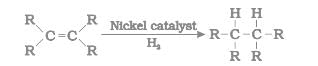
Which of the following reaction produce propane as a major product?
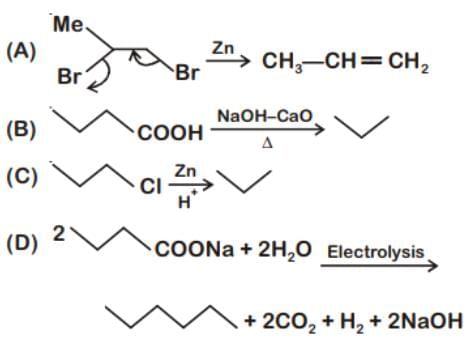
Detailed Solution for Test: Alkenes - Question 15

101 videos|250 docs|76 tests
Information about Test: Alkenes Page
In this test you can find the Exam questions for Test: Alkenes solved & explained in the simplest way possible. Besides giving Questions and answers for Test: Alkenes, EduRev gives you an ample number of Online tests for practice
101 videos|250 docs|76 tests
Download as PDF