CBSE Class 6  >  Class 6 Test  >  Mathematics  >  Test: Patterns in Mathematics - 2 - Class 6 MCQ

Patterns in Mathematics - 2 - Class 6 Free MCQ Test with solutions


MCQ Practice Test & Solutions: Test: Patterns in Mathematics - 2 (10 Questions)

You can prepare effectively for Class 6 Mathematics for Class 6 with this dedicated MCQ Practice Test (available with solutions) on the important topic of "Test: Patterns in Mathematics - 2". These 10 questions have been designed by the experts with the latest curriculum of Class 6 2026, to help you master the concept.

Test Highlights:

  • - Format: Multiple Choice Questions (MCQ)
  • - Duration: 15 minutes
  • - Number of Questions: 10

Sign up on EduRev for free to attempt this test and track your preparation progress.

Test: Patterns in Mathematics - 2 - Question 1

Which of the following is a square number?

Detailed Solution: Question 1

A square number is a number that can be expressed as the square of an integer (e.g., 1² = 1, 2² = 4, 3² = 9, etc.).

Among the options:

  • 20 is not a square number.
  • 24 is not a square number.
  • 25 is a square number because 5² = 25.
  • 30 is not a square number.

So, the correct answer is C: 25.

Test: Patterns in Mathematics - 2 - Question 2

What pattern do the numbers 3, 6, 9, 12 follow?

Detailed Solution: Question 2

The numbers 3, 6, 9, 12 are increasing by 3 each time.

  • 3 + 3 = 6
  • 6 + 3 = 9
  • 9 + 3 = 12

This shows that the numbers are multiples of 3.

So, the correct answer is C: Multiple of 3.

Test: Patterns in Mathematics - 2 - Question 3

How many dots are in the third triangular number?

Detailed Solution: Question 3
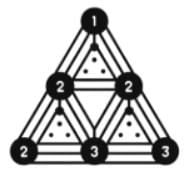
The triangular numbers are formed by arranging dots in an equilateral triangle. The sequence of triangular numbers is:

1st triangular number: 1 dot
2nd triangular number: 1 + 2 = 3 dots
3rd triangular number: 1 + 2 + 3 = 6 dots
4th triangular number: 1 + 2 + 3 + 4 = 10 dots

So, the third triangular number has 6 dots.

The correct answer is B: 6.

Test: Patterns in Mathematics - 2 - Question 4

If you start with the number 2 and keep adding 2, what sequence are you creating?

Detailed Solution: Question 4

Adding 2 repeatedly to the number 2 creates a sequence of even numbers (2, 4, 6, 8, and so on). This is because even numbers are separated by a difference of 2.

Test: Patterns in Mathematics - 2 - Question 5

What is the sum of the first three odd numbers?

Detailed Solution: Question 5

The first three odd numbers are:

1, 3, and 5.

To find their sum:

1 + 3 + 5 = 9

So, the correct answer is C: 9.

Test: Patterns in Mathematics - 2 - Question 6

Which of the following shapes is a three-dimensional object?

Detailed Solution: Question 6
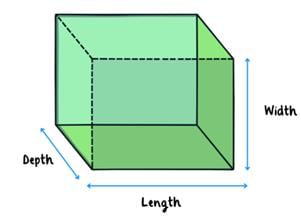
A three-dimensional object has depth in addition to length and width. Among the options:

  • A square is a 2D shape, having only length and width.
  • A triangle is also a 2D shape, having length and width.
  • A circle is a 2D shape, having only radius and no depth.
  • A cube is a 3D shape, having length, width, and depth.

So, the correct answer is D: Cube.

Test: Patterns in Mathematics - 2 - Question 7

Which sequence of numbers represents the number of sides in regular polygons?

Detailed Solution: Question 7

The sequence of numbers representing the number of sides in regular polygons starts with a triangle (3 sides), followed by a square (4 sides), pentagon (5 sides), hexagon (6 sides), and so on.

So, the correct sequence is C: 3, 4, 5, 6..., which represents the number of sides in regular polygons.

Test: Patterns in Mathematics - 2 - Question 8

Which of the following number sequences is related to triangular numbers?

Detailed Solution: Question 8

The sequence related to triangular numbers is formed by the sum of consecutive integers:

  • 1st triangular number: 1
  • 2nd triangular number: 1 + 2 = 3
  • 3rd triangular number: 1 + 2 + 3 = 6
  • 4th triangular number: 1 + 2 + 3 + 4 = 10
  • 5th triangular number: 1 + 2 + 3 + 4 + 5 = 15

Thus, the sequence 1, 3, 6, 10, 15... is related to triangular numbers.

The correct answer is A: 1, 3, 6, 10, 15....

Test: Patterns in Mathematics - 2 - Question 9

Which number is both a square and a triangular number?

Detailed Solution: Question 9

A number that is both a square number and a triangular number is a special number that can be expressed as both the square of an integer and the sum of consecutive natural numbers (triangular number).

Let's check the options:

  • 16 is a square number (4² = 16), and it's also a triangular number because 1 + 2 + 3 + 4 = 10 (not 16).
  • 25 is a square number (5² = 25), but it's not a triangular number.
  • 36 is a square number (6² = 36), and it is also a triangular number (1 + 2 + 3 + 4 + 5 + 6 = 21, but still not the correct triangular number for 36).
  • 49 is a square number (7² = 49) but not a triangular number.

Hence, 36 is both a square and a triangular number.

The correct answer is C: 36.

Test: Patterns in Mathematics - 2 - Question 10

What do regular polygons and number sequences have in common?

Detailed Solution: Question 10

Regular polygons and number sequences both follow specific patterns. Regular polygons have a consistent number of sides and angles, while number sequences follow particular rules, such as adding or multiplying by the same value to form the next number. Both concepts are predictable and structured, which is why they can be described by patterns.

32 videos|423 docs|23 tests
Information about Test: Patterns in Mathematics - 2 Page
In this test you can find the Exam questions for Test: Patterns in Mathematics - 2 solved & explained in the simplest way possible. Besides giving Questions and answers for Test: Patterns in Mathematics - 2, EduRev gives you an ample number of Online tests for practice
32 videos|423 docs|23 tests
Download as PDF