CBSE Class 6  >  Class 6 Test  >  Mathematics  >  Test: Lines and Angles - 2 - Class 6 MCQ

Lines and Angles - 2 - Class 6 Mathematics Free MCQ Test with solutions


MCQ Practice Test & Solutions: Test: Lines and Angles - 2 (10 Questions)

You can prepare effectively for Class 6 Mathematics for Class 6 with this dedicated MCQ Practice Test (available with solutions) on the important topic of "Test: Lines and Angles - 2". These 10 questions have been designed by the experts with the latest curriculum of Class 6 2026, to help you master the concept.

Test Highlights:

  • - Format: Multiple Choice Questions (MCQ)
  • - Duration: 15 minutes
  • - Number of Questions: 10

Sign up on EduRev for free to attempt this test and track your preparation progress.

Test: Lines and Angles - 2 - Question 1

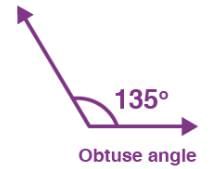
Which of the following angles is classified as obtuse?

Detailed Solution: Question 1

An obtuse angle is one that is greater than 90° but less than 180°. Since 135° falls within this range, it is classified as an obtuse angle.

Test: Lines and Angles - 2 - Question 2

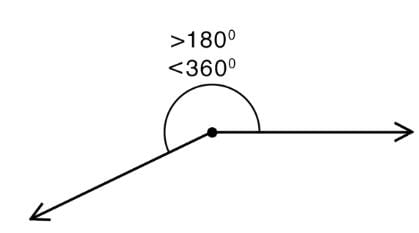
What is a reflex angle?

Detailed Solution: Question 2

A reflex angle is one that measures more than 180° but less than 360°. It represents the larger angle that is formed by extending a straight angle beyond 180°.

Test: Lines and Angles - 2 - Question 3

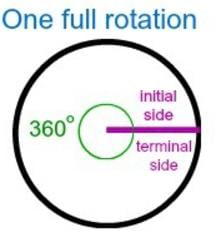
How many degrees are there in a full turn?

Detailed Solution: Question 3

A full turn is a complete rotation around a point, which measures 360°. This is why a circle is divided into 360 equal degrees.

Test: Lines and Angles - 2 - Question 4

What happens to the angle size if you open a book wider?

Detailed Solution: Question 4

As you open a book wider, the angle between the cover and the pages increases. The more you open the book, the larger the angle becomes.

Test: Lines and Angles - 2 - Question 5

Which of the following is not a type of angle based on its measure?

Detailed Solution: Question 5
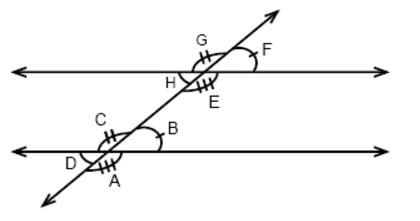
The correct answer is C: Parallel angle.

Parallel angle is not a type of angle based on its measure. The other options are types of angles:

  • Acute angle: Less than 90°.
  • Obtuse angle: Greater than 90° but less than 180°.
  • Reflex angle: Greater than 180° but less than 360°.

Parallel refers to lines that never meet, not an angle.

Test: Lines and Angles - 2 - Question 6

What is the name of the line that divides an angle into two equal parts?

Detailed Solution: Question 6
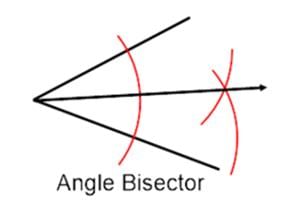
An angle bisector is a line or ray that divides an angle into two equal parts, creating two angles of the same measure.

Test: Lines and Angles - 2 - Question 7

The number of acute angles in the given figure is

Detailed Solution: Question 7

Let's examine the angles in the figure:

  • 45° is an acute angle.
  • 40° is an acute angle.
  • 30° is an acute angle.
  • 65° is an acute angle.

All angles that are less than a right angle or in other words, less than 90 degree. Such angles are called acute angles

(c) 4 acute angles.

Test: Lines and Angles - 2 - Question 8

The number of line segments in the given figure is

Detailed Solution: Question 8

Let's break it down in a simple way:

In the given figure, we have 5 points labelled A, B, C, D, and E.

To find how many line segments can be formed, we need to connect any two points with a straight line. A line segment is a straight line connecting two points.

With 5 points, we can connect each point to every other point. For example:

  • A can connect to B, C, D, and E.
  • B can connect to C, D, and E (but we already counted AB).
  • C can connect to D and E (we've already counted AB, AC, and AD).
  • D can connect to E.

If we count all the connections, we find a total of 10 line segments.

Thus, the answer is 10 line segments.

Test: Lines and Angles - 2 - Question 9

Number of lines which can be drawn passing through two given points

Detailed Solution: Question 9

  • If you are given two distinct points, only one straight line can pass through both of them. This is a basic rule in geometry.
  • There can be no more than one line passing through two points because a straight line is uniquely determined by any two points on it.

So, the answer is 1 line.

Test: Lines and Angles - 2 - Question 10

Measures of the shorter angle between hour and minute hands of a clock at 9 0 ’clock is

Detailed Solution: Question 10

  • The minute hand is at 12

  • The hour hand is at 9

How do we find the angle between them?

  • A clock is a circle. A circle has 360 degrees.

  • There are 12 numbers on a clock.

  • So, the space between each number is:
    360 ÷ 12 = 30 degrees

Now count how many numbers are between 9 and 12:

  • From 9 to 12, there are 3 numbers (9 to 10, 10 to 11, 11 to 12)

So, the angle is:

  • 3 × 30 = 90 degrees

32 videos|423 docs|23 tests
Information about Test: Lines and Angles - 2 Page
In this test you can find the Exam questions for Test: Lines and Angles - 2 solved & explained in the simplest way possible. Besides giving Questions and answers for Test: Lines and Angles - 2, EduRev gives you an ample number of Online tests for practice
32 videos|423 docs|23 tests
Download as PDF