CAT Exam  >  CAT Test  >  Level-wise Tests  >  Test Level 1: Number System - 1 - CAT MCQ

Test Level 1: Number System - 1 Solved MCQs CAT


MCQ Practice Test & Solutions: Test Level 1: Number System - 1 (10 Questions)

You can prepare effectively for CAT Level-wise Tests for CAT with this dedicated MCQ Practice Test (available with solutions) on the important topic of "Test Level 1: Number System - 1". These 10 questions have been designed by the experts with the latest curriculum of CAT 2026, to help you master the concept.

Test Highlights:

  • - Format: Multiple Choice Questions (MCQ)
  • - Duration: 20 minutes
  • - Number of Questions: 10

Sign up on EduRev for free to attempt this test and track your preparation progress.

Test Level 1: Number System - 1 - Question 1

The last digit of the number obtained by multiplying the numbers 81 × 82 × 83 × 84 × 85 × 86 × 87 × 88 × 89 will be

Detailed Solution: Question 1

The units digit in this case would obviously be ‘0’ because the given expression has a pair of 2 and 5 in it’s prime factors.

Test Level 1: Number System - 1 - Question 2

When we multiply a certain two-digit number by the sum of its digits, 405 is achieved. If you multiply the number written in reverse order of the same digits by the sum of the digits, we get 486. Find the number.

Detailed Solution: Question 2

The two numbers should be factors of 405. A factor search will yield the factors. (look only for 2 digit factors of 405 with sum of digits between 1 to 19).
Also 405 = 5 × 34. Hence: 15 × 27
45 × 9 are the only two options. 
From these factors pairs only the second pair gives us the desired result. 
i.e. Number × sum of digits = 405.
Hence, the answer is 45.

Test Level 1: Number System - 1 - Question 3

Let D be a recurring decimal of the form D = 0. a1 a2 a1 a2 a1 a2 . . . . , where digits a1 and a2 lie between 0 and 9 . Further at most one of them is zero. Which of the following numbers necessarily produces an integer when multiplied by D?

Detailed Solution: Question 3

  • it's a very simple question,
  • Let D=0.abababab        (say - 1)
  • Multiply both sides by 100 i.e
  • 100D = ab.abababab     (say - 2)
  • now subtract 1 from 2. That gives
  • 99D = ab
  • D = ab/99.
  • hence out of all the options if we multiply 198 by ab/99 we get
  • = (ab / 99)x 198 = 2ab
  • hence we got an integer.
  • So option B is the right answer.

Test Level 1: Number System - 1 - Question 4

If 381A is divisible by 9, find the value of smallest natural number A.

Detailed Solution: Question 4

For 381A to be divisible by 9, the sum of the digits 3 + 8 + 1 + A should be divisible by 9.
For that to happen A should be 6.
Option (d) is correct.

Test Level 1: Number System - 1 - Question 5

Find the ratio between the LCM and HCF of 5, 15 and 20.

Detailed Solution: Question 5

LCM of 5, 15 and 20 = 60.
HCF of 5, 15 and 20 = 5.
The required ratio is 60:5 = 12:1

Test Level 1: Number System - 1 - Question 6

If the number A is even, which of the following will be true?

Detailed Solution: Question 6

Only the first option can be verified to be true in this case.
If A is even, 3A would always be divisible by 6 as it would be divisible by both 2 and 3.
Options b and c can be seen to be incorrect by assuming the value of A as 4.

Test Level 1: Number System - 1 - Question 7

A number 15B is divisible by 6. Which of these will be true about the positive integer B?

Detailed Solution: Question 7

For a number to be divisible by 6, it must be divisible by both 2 and 3.
Therefore, For the number 15B to be divisible by 6. it must satisfy two conditions:

  1. Divisibility by 2: The number must be even.
  2. Divisibility by 3: The sum of its digits must be divisible by 3.

Since 15B represents a number with digits 1, 5, and B, let’s analyze each option for B:

  • For divisibility by 2, B must be even (i.e., 0, 2, 4, 6, or 8) because an even B makes 15B an even number.
  • For divisibility by 3, the sum 1+5+B=6+B must be divisible by 3.

Since 6 is already divisible by 3, any even B (0, 2, 4, 6, or 8) will keep the sum divisible by 3.

The correct answer is: (d) Both (a) and (c)

Also, the value of B is divisible by 6. Therefore, both options are correct, B will be even and B will be divisible by 6.

Test Level 1: Number System - 1 - Question 8

Find the units digit of the expression 256251 + 36528 + 7354.

Detailed Solution: Question 8

Let’s re‐evaluate each term’s units digit carefully:

  1. 25⁶²⁵¹
    Any power of a number ending in 5 ends in 5 (once past the first power).
    ⇒ units digit = 5.

  2. 36⁵²⁸
    Any power of a number ending in 6 ends in 6.
    ⇒ units digit = 6.

  3. 73⁵⁴
    We only care about the base’s units digit, 3. The cycle for 3ⁿ mod 10 is length 4:

    • 3¹ ≡ 3

    • 3² ≡ 9

    • 3³ ≡ 7

    • 3⁴ ≡ 1
      Then it repeats every 4.
      Compute 54 mod 4 = 2.
      So 3⁵⁴ has the same units digit as 3², namely 9.

Now add the three units digits: 5 + 6 + 9 = 20 ⇒ units digit = 0.
Hence the correct answer is 0.

Test Level 1: Number System - 1 - Question 9

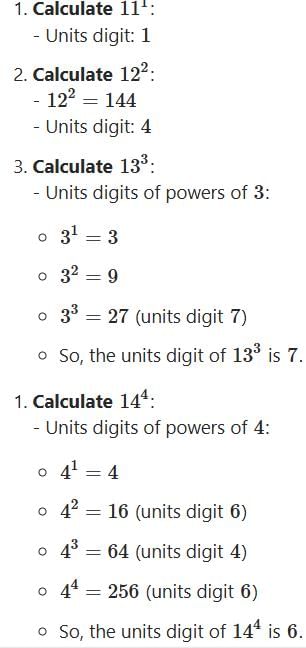
Find the units digit of the expression 111 + 122 + 133 + 144 + 155 + 166.
Detailed Solution: Question 9

\

Test Level 1: Number System - 1 - Question 10

Find the number of zeroes at the end of 1090!

Detailed Solution: Question 10

The number of zeroes would be given by adding the quotients when we successively divide 1090 by 5 : 1090/5 + 218/5 + 43/5 + 8/5 = 218 + 43 + 8 + 1 = 270. Option (a) is correct.

5 docs|246 tests
Information about Test Level 1: Number System - 1 Page
In this test you can find the Exam questions for Test Level 1: Number System - 1 solved & explained in the simplest way possible. Besides giving Questions and answers for Test Level 1: Number System - 1, EduRev gives you an ample number of Online tests for practice
Download as PDF