CAT Exam  >  CAT Test  >  Quantitative Aptitude (Quant)  >  CAT Practice: Permutation & Combination - 2 - CAT MCQ

CAT Practice: Permutation & Combination - 2 - Free MCQ Test with solutions


MCQ Practice Test & Solutions: CAT Practice: Permutation & Combination - 2 (10 Questions)

You can prepare effectively for CAT Quantitative Aptitude (Quant) with this dedicated MCQ Practice Test (available with solutions) on the important topic of "CAT Practice: Permutation & Combination - 2". These 10 questions have been designed by the experts with the latest curriculum of CAT 2026, to help you master the concept.

Test Highlights:

  • - Format: Multiple Choice Questions (MCQ)
  • - Duration: 18 minutes
  • - Number of Questions: 10

Sign up on EduRev for free to attempt this test and track your preparation progress.

*Answer can only contain numeric values
CAT Practice: Permutation & Combination - 2 - Question 1

P, Q, R and S are four towns. One can travel between P and Q along 3 direct paths, between Q and S along 4 direct paths, and between P and R along 4 direct paths. There is no direct path between P and S, while there are few direct paths between Q and R, and between R and S. One can travel from P to S either via Q, or via R, or via Q followed by R, respectively, in exactly 62 possible ways. One can also travel from Q to R either directly, or via P, or via S, in exactly 27 possible ways. Then, the number of direct paths between Q and R is


Detailed Solution: Question 1
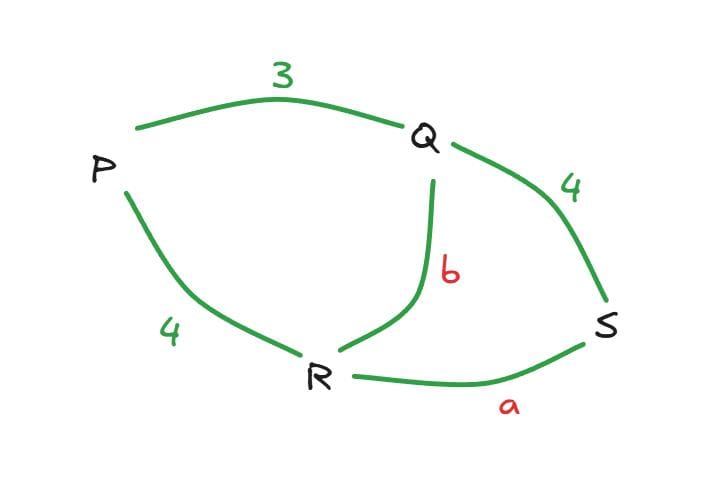
Let's take the number of paths between Q and R to be b and the number of paths between R and S to be a

We are given the paths from P to S through R (which would be 4a), the paths from P to S through Q (which would be 12) and the paths from P to Q to R to S, which would be 3ab) is equal to 62
Giving the relation 4a+12+3ab = 62
Or 4a+3ab = 50

The paths from Q to R directly (which would be b), through P( which would be 12) and through S (which would be 4a) are 27
Giving the relation b+12+4a = 27
Or 4a+b = 15

Subtracting this equation from the first one we got, we get 3ab-b=35, or b(3a-1)=35
b can be 1, 3, 5 or 7
Substituting these values in the second equation, we see that it can not be 1 or 5, leaving only 3 or 7 as the possible values. 

Substituting b as 3 in the first equation would give 13a=50, which is not true. 
Substituting bas 7 in the first equation would give 25a= 50, which would give a=2

We are asked the number of paths from Q to R, which is b=7

Therefore, 7 is the correct answer. 

*Answer can only contain numeric values
CAT Practice: Permutation & Combination - 2 - Question 2

How many 4 digit numbers, having all distinct digits exist, such that the digits are all in ascending order?


Detailed Solution: Question 2

Basically, any 4 digits chosen from 1-9, can be arranged in exactly 1 way, such that all four digits are in ascending order. Hence total number of such numbers possible is 9C4 = 126.
For instance if the digits chosen are 7, 3, 4 and 8, we can arrange them in ascending order in exactly one way, as 3478.
Thus 126 such numbers are obtainable.

CAT Practice: Permutation & Combination - 2 - Question 3

There are 10 train stops between Hyderabad and Vizag. How many types of tickets should be printed to service all kinds of passengers travelling either way on the train?


Detailed Solution: Question 3

The two train stops can be selected in 12C2

ways and the direction can be selected in 2 ways. So, total number of ways is 12 x 11 = 132

CAT Practice: Permutation & Combination - 2 - Question 4

How many 4-digit numbers, each greater than 1000 and each having all four digits distinct, are there with 7 coming before 3?


Detailed Solution: Question 4

Here there are two cases possible

Case 1: When 7 is at the left extreme In that case 3 can occupy any of the three remaining places and the remaining two places can be taken by (0, 1, 2, 4, 5, 6, 8, 9)

So total ways 3(8)(7)= 168

Case 2: When 7 is not at the extremes Here there are 3 cases possible. And the remaining two places can be filled in 7(7) ways.(Remember 0 can't come on the extreme left)

Hence in total 3(7)(7) = 147 ways

Total ways 168 + 147 = 315 ways

CAT Practice: Permutation & Combination - 2 - Question 5

Rohan is standing at the bottom of a staircase. He starts tossing a coin, and every time it shows Heads, he climbs up two steps, while every time it shows Tails he climbs up one step. After a while, he finds that he has climbed up a total of 8 steps. How many possible sequences of Heads and Tails could he have thrown?


Detailed Solution: Question 5

The man could have climbed 8 steps in the following possible sequences of Heads/Tails:-

I. 8 consecutive Tails → 1 way

II. 6 Tails, 1 Head → 7C1 = 7 ways

III. 4 Tails, 2 Head → 6C2 = 15 ways

IV. 2 Tails, 3Head → 5C3 = 10 ways

V. 4 consecutive Heads → 1 way

Thus total possible number of ways = (1 + 7 + 15 + 10 + 1) = 34 ways.

*Answer can only contain numeric values
CAT Practice: Permutation & Combination - 2 - Question 6

The number of ways of distributing 15 identical balloons, 6 identical pencils and 3 identical erasers among 3 children, such that each child gets at least four balloons and one pencil, is


Detailed Solution: Question 6

This question is an application of the product rule in probability and combinatorics.
In the product rule, if two events A and B can occur in x and y ways, and for an event E, both events A and B need to take place, the number of ways that E can occur is xy. This can be expanded to 3 or more events as well.
Event 1: Distribution of balloons Since each child gets at least 4 balloons, we will initially allocate these 4 balloons to each of them.
So we are left with 15 - 4 x 3 = 15 - 12 = 3 balloons and 3 children.
Now we need to distribute 3 identical balloons to 3 children.

Event 2: Distribution of pencils
Since each child gets at least one pencil, we will allocate 1 pencil to each child. We are now left with 6 - 3 = 3 pencils.
We now need to distribute 3 identical pencils to 3 children.

Event 3: Distribution of erasers
We need to distribute 3 identical erasers to 3 children.

Applying the product rule, we get the total number of ways = 10 x 10 x 10 = 1000.

CAT Practice: Permutation & Combination - 2 - Question 7

How many 4-digit numbers have at least one 8 or at least one 9 in them, but not both?

Detailed Solution: Question 7

Let us first calculate the number of 4-digit numbers with at least one 8 and no 9.

We calculate all 4-digit numbers having no 9 and subtract from it the number of 4-digit numbers with no 8 and no 9 to get the required count.

Number of all 4-digit numbers having no 9 = 8 x 9 x 9 x 9

Number of 4-digit numbers with no 8 and no 9 = 7 x 8 x 8 x 8

Hence, the required count = 8 x 9 x 9 x 9 - 7 x 8 x 8 x 8 = 2248

To calculate the number of 4-digit numbers with at least one 9 and no 8, we will do the same and get 2248.

Hence, total = 4496.

CAT Practice: Permutation & Combination - 2 - Question 8

The sum of all the possible numbers of 4 digits formed by digits 3, 5, 5, and 6 using each digit once is

Detailed Solution: Question 8

Total number of different numbers of 4 digits formed by using these digits only once = 4!/2! = 12.

The numbers formed whose unit digit is 3 = 3

The number formed whose unit digit is 5 = 6

The number formed whose unit digit is 6 = 3

(Same rule is applicable for 10th, 100th and 1000th units)

Sum of the total number of unit digits = 3×3+5×6 +6×3 = 57

Sum of the 10th digit number = 57×10

Sum of the 100th digit number = 57×100

Sum of the 1000th digit number = 57×1000

Sum of all the numbers formed = 57(1+10+100 + 1000) = 63327.

CAT Practice: Permutation & Combination - 2 - Question 9

India and Australia player one-day international cricket series until anyone team win 4 matches. No match ended in a  draw. In how many ways can the series be won?

Detailed Solution: Question 9
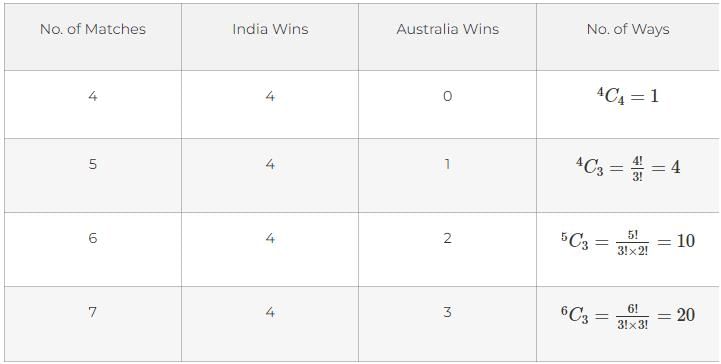
So, India can win the series in 1+4+10+20 = 35 ways.
Similarly, Australia can win the series in 35 ways.
Hence, the total number of ways in which the series can be won is 35+35=70 ways.

CAT Practice: Permutation & Combination - 2 - Question 10

What is the number of whole numbers formed on the screen of a calculator which can be recognised as numbers with (unique) correct digits when they are read inverted? The greatest number that can be formed on the screen of the calculator is 999999.

Detailed Solution: Question 10
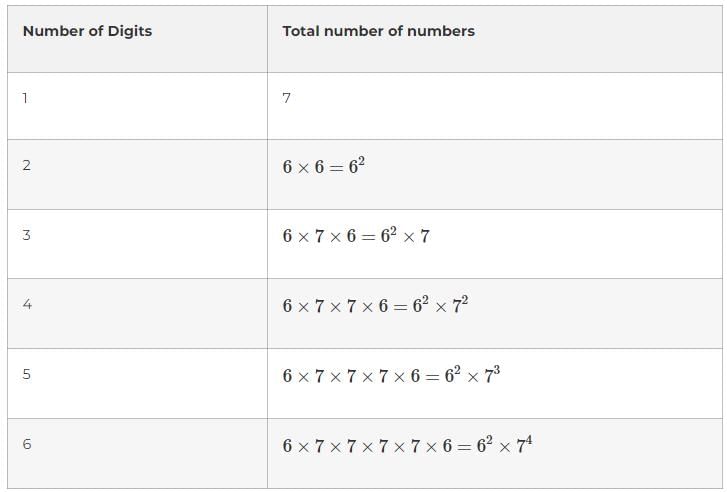
The digits which can be recognised as unique digits when they are Inverted in a calculator are 0, 1, 2, 5, 6, and 9 Since the number cannot begin with zero all the numbers having 0 at units place should be discarded for otherwise when reed upside down the number yen begin with 3 we now :1St the different posibililities

Thus, the number of required numbers = 7 + 62 + 62 x 7 + .. + 62 x 7

136 videos|255 docs|86 tests
Information about CAT Practice: Permutation & Combination - 2 Page
In this test you can find the Exam questions for CAT Practice: Permutation & Combination - 2 solved & explained in the simplest way possible. Besides giving Questions and answers for CAT Practice: Permutation & Combination - 2, EduRev gives you an ample number of Online tests for practice
136 videos|255 docs|86 tests
Download as PDF


