You can prepare effectively for NEET Biology Class 12 with this dedicated MCQ Practice Test (available with solutions) on the important topic of "Test: Common Diseases in Humans & Immunity". These 15 questions have been designed by the experts with the latest curriculum of NEET 2026, to help you master the concept.
Test Highlights:
Sign up on EduRev for free to attempt this test and track your preparation progress.
Formation of antibodies within our body is called:
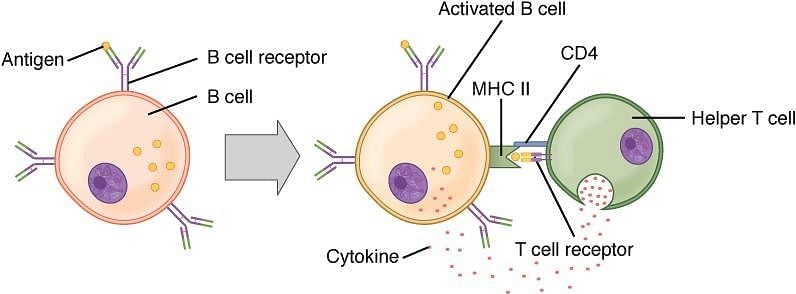
Detailed Solution: Question 1
Topic in NCERT: Active and Passive ImmunityLine in NCERT: "When a host is exposed to antigens, which may be in the form of living or dead microbes or other proteins, antibodies are produced in the host body. This type of immunity is called active immunity."
Detailed Solution: Question 2
Topic in NCERT: Acquired ImmunityLine in NCERT: "The B-lymphocytes produce an army of proteins in response to pathogens into our blood to fight with them. These proteins are called antibodies."
Which lymphoid organ reduces in size as an individual ages and becomes quite small by the time of puberty?
Detailed Solution: Question 3
Topic in NCERT: Lymphoid organsLine in NCERT: "The thymus is quite large at the time of birth but keeps reducing in size with age and by the time puberty is attained it reduces to a very small size."
The disease chikungunya is transmitted by:
Detailed Solution: Question 4
Topic in NCERT: Preventing Vector-Borne DiseasesLine in NCERT: "Such precautions have become more important especially in the light of recent widespread incidences of the vector-borne (Aedes mosquitoes) diseases like dengue and chikungunya in many parts of India."
Anti venom against snake poison contains:
Detailed Solution: Question 5
Topic in NCERT: Passive ImmunisationLine in NCERT: "Even in cases of snakebites, the injection which is given to the patients, contain preformed antibodies against the snake venom."
The sporozoites that cause infection, when a female Anopheles mosquito bites a person, are stored in_________.
Detailed Solution: Question 6
Topic in NCERT: Life Cycle of PlasmodiumLine in NCERT: "The parasites multiply within them to form sporozoites that are stored in their salivary glands."
How are Infectious Diseases transmitted?
Detailed Solution: Question 7
Topic in NCERT: COMMON DISEASES IN HUMANSLine in NCERT: "A healthy person acquires the infection by inhaling the droplets/aerosols released by an infected person or even by sharing glasses and utensils with an infected person."
Assertion (A): Malaria is caused by a virus.
Reason (R): Malaria is transmitted to humans by the bite of infected Anopheles mosquitoes.
Detailed Solution: Question 8
Topic in NCERT: MALARIA AND ITS CAUSATIVE AGENTLine in NCERT: "Plasmodium, a tiny protozoan is responsible for this disease."
Which of the following is the unit of immune system?
Detailed Solution: Question 9
Topic in NCERT: Immune System in the BodyLine in NCERT: "The human immune system consists of lymphoid organs, tissues, cells and soluble molecules like antibodies."
Immuno-deficiency syndrome could develop due to:
Detailed Solution: Question 10
Fill in the blanks in the different columns of the table given below
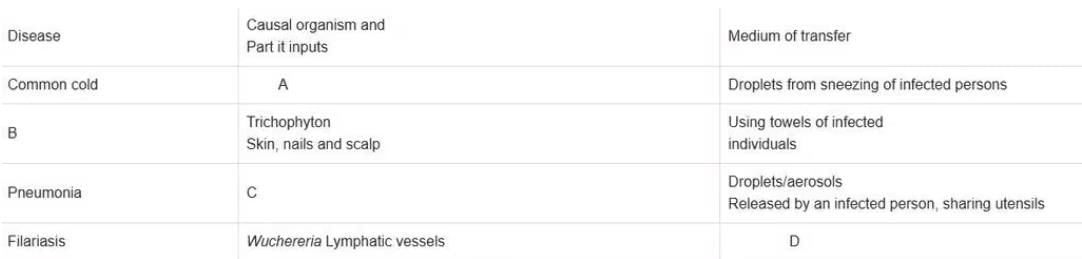
Detailed Solution: Question 11
Detailed Solution: Question 12
Topic in NCERT: AllergiesLine in NCERT: "The antibodies produced to these are of IgE type."
The chemical test that is used for diagnosis of typhoid is:
Detailed Solution: Question 13
Detailed Solution: Question 14
Select the correct sequence about the life cycle of Plasmodium:
Detailed Solution: Question 15
69 videos|305 docs|161 tests |



