Electrical Engineering (EE) Exam  >  Electrical Engineering (EE) Test  >  GATE Mock Test Series 2027  >  Test: Transfer Function - 1 - Electrical Engineering (EE) MCQ

GATE Electrical Engineering (EE) Test: Transfer Function - 1 Free Online


MCQ Practice Test & Solutions: Test: Transfer Function - 1 (20 Questions)

You can prepare effectively for Electrical Engineering (EE) GATE Electrical Engineering (EE) Mock Test Series 2027 with this dedicated MCQ Practice Test (available with solutions) on the important topic of "Test: Transfer Function - 1". These 20 questions have been designed by the experts with the latest curriculum of Electrical Engineering (EE) 2026, to help you master the concept.

Test Highlights:

  • - Format: Multiple Choice Questions (MCQ)
  • - Duration: 60 minutes
  • - Number of Questions: 20

Sign up on EduRev for free to attempt this test and track your preparation progress.

Test: Transfer Function - 1 - Question 1

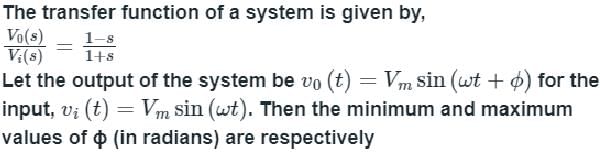
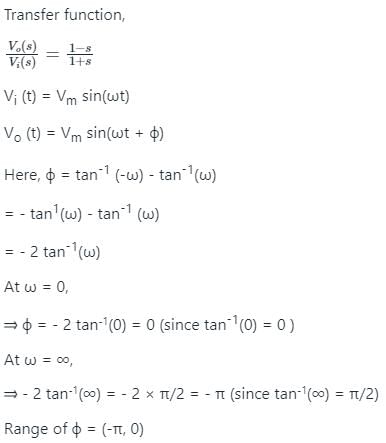
Detailed Solution: Question 1

Test: Transfer Function - 1 - Question 2

The output of the feedback control system must be a function of:

Detailed Solution: Question 2

Explanation: In a feedback control system, the output is determined by a combination of the input signal and the feedback signal. The input signal is the desired output or reference, while the feedback signal is a portion of the actual output that is fed back into the system to compare with the input. This comparison helps the system to adjust its output to minimize the error between the input and the actual output. By considering both the input and feedback signals, the system can continuously adapt and achieve the desired output.

Test: Transfer Function - 1 - Question 3

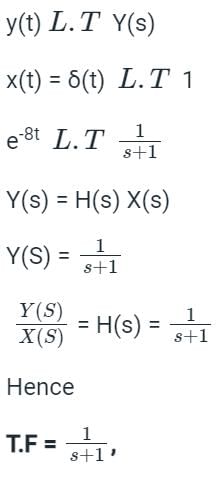
The unit impulse response of a certain system is found to be e-8t. Its transfer function is _______.
Detailed Solution: Question 3

The impulse response is defined as the output of an LTI system due to a unit impulse signal input being applied at time t = 0.

y(t) = h(t) x(t) = h(t) δ(t)

where δ(t) is the unit impulse function and h(t) is the unit impulse response of a continuous-time LTI system.

Calculations:-

Given-

y(t)  = e-8t 

x(t) = δ(t)

For calculating the transfer function convert the time domain response into Laplace or S domain.

*Answer can only contain numeric values
Test: Transfer Function - 1 - Question 4

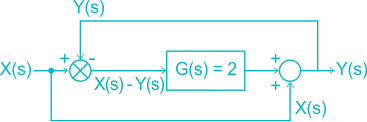
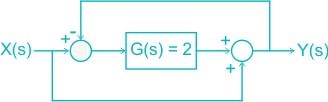
For the system shown in the figure, Y(s)/X(s) = _________. (Answer in integer )

Detailed Solution: Question 4

The circuit is redrawn as shown:

[X(s) – Y(s)] G(s) + X(s) = Y(s)

Given G(s) = 2

(X(s) – Y(s)) 2 + X(s) = Y(s)

= 2 X(s) + X(s) = Y(s) + 2Y(s)

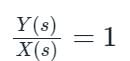
= 3 X(s) = 3 Y(s)

Test: Transfer Function - 1 - Question 5

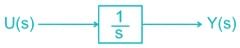
Assuming zero initial condition, the response y(t) of the system given below to a unit step input u(t) is
Detailed Solution: Question 5

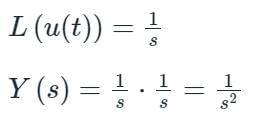
Laplace transform of u(t) is given by 

Taking Inverse Laplace transform

y(t) = t.u(t)

Test: Transfer Function - 1 - Question 6

The sum of the gains of the feedback paths in the signal flow graph shown in fig.  is

Detailed Solution: Question 6

Option A is correct.

A feedback loop (loop) is a closed path that starts and ends at the same node without visiting any node more than once.

The simple (non-repeating) loops present are the three local feedbacks with gains a·f, b·e and c·d.

Any longer product such as a·b·e·f or a·b·c·d·e·f would require revisiting an intermediate node and so do not qualify as simple loops for the sum-of-loop-gains.

Therefore the sum of the gains of the feedback paths is a·f + b·e + c·d, i.e. af + be + cd. Hence option A.

Test: Transfer Function - 1 - Question 7

A linear system with H(s) = 1/s is excited by a unit step function input. The output for t > 0 is given by

Detailed Solution: Question 7

TF = H(s) = 1/s,

Input is unit step, R(s) = 1/s

Now output for t > 0 can be calculated as

C(s) = H(s) x R(s)

C(s) = (1/s) x (1/s)

C(s) = 1 / s2

L-1[C(s)] = t

C(t) = t = ramp function

Test: Transfer Function - 1 - Question 8

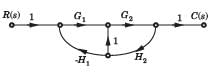
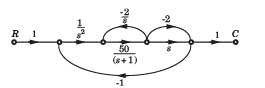
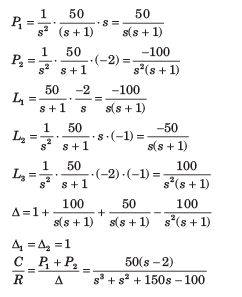
The overall transfer function C/R of the system shown in fig. will be:
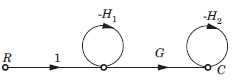
Detailed Solution: Question 8


Test: Transfer Function - 1 - Question 9

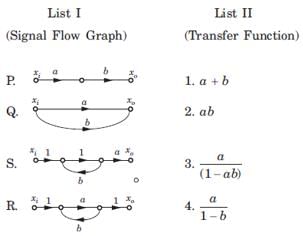
Consider the List I and List II

The correct match is

Detailed Solution: Question 9

  • P. P1 = ab, Δ = 1, L = 0 ,T = ab
  • Q. P1 = a, P2 = 6 , Δ = 1, L = Δk = 0,T  = a+b
  • R. P1 = a, L1 = b, Δ = 1 - b, Δ1 =1,
  • S. P1 = a, L1 = ab, Δ = 1 - ab, Δ1 = 1, 

Test: Transfer Function - 1 - Question 10

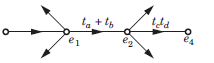
For the signal flow graph shown in fig. an equivalent graph is
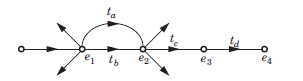
Detailed Solution: Question 10

While writing the transfer function of this signal flow graph,

e2= tae1 + tbe= (ta+ tb) e1 

Then, signal flow graph will lokk like this:

Test: Transfer Function - 1 - Question 11

The block diagram of a system is shown in fig. The closed loop transfer function of this system is
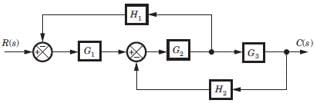
Detailed Solution: Question 11

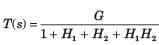
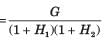
Consider the block diagram as SFG. There are two feedback loop -G1G2H1 and -G2G3H2 and one forward path G1G2 G3 . So (D) is correct option.

Test: Transfer Function - 1 - Question 12

For the system shown in fig. transfer function C(s) R(s) is
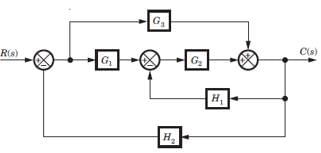
Detailed Solution: Question 12

Consider the block diagram as a SFG. Two forward path G1G2 and G3 and three loops -G1G2 H2, -G2H1, -G3 H2
There are no nontouching loop. So (B) is correct.

Test: Transfer Function - 1 - Question 13

In the signal flow graph shown in fig. the transfer function is
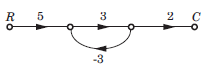
Detailed Solution: Question 13

P1 = 5 x 3 x 2 = 30, Δ = 1 - (3x - 3) = 10
Δ1 = 1, 

Test: Transfer Function - 1 - Question 14

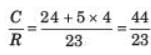
In the signal flow graph shown in fig. the gain C/R is
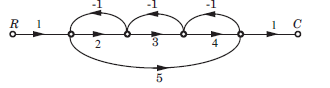
Detailed Solution: Question 14

Note: the provided diagram is too small/low-resolution to unambiguously read the direction and connectivity of every branch. I cannot reliably recompute the transfer function without a clearer diagram. Please upload a higher-resolution image or give the directed-graph gains in text (node-to-node gains and node numbering). Once the exact directed edges and their polarities are confirmed, I will recompute the transfer function using Mason's gain formula step by step.

Assumption checklist for re-evaluation (please confirm):

  • Which node is the first node after R (its label/number).
  • Exact directed edges and their gains (for example: R → 2 : 1, 2 → 3 : -1, etc.).
  • Direction and gain of the long feedback arc (for example: C → 2 : 5).

After you provide a clear image or the above adjacency/gain list I will:

  • identify all forward paths and their gains,
  • list all individual loops and their gains,
  • compute Δ and each Δ_k (Mason's formula),
  • give the final transfer function C/R and select the correct option.

Test: Transfer Function - 1 - Question 15

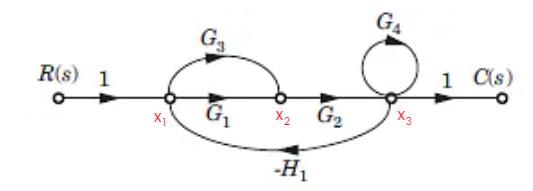
The gain C(s)/R(s) of the signal flow graph shown in fig.

Detailed Solution: Question 15

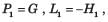
X1 = 1 - H1

X2 = (G1 + G3) X1 - X3H1

X= X2G2 + G4

Test: Transfer Function - 1 - Question 16

The negative feedback closed-loop system was subjected to 15V. The system has a forward gain of 2 and a feedback gain of 0.5. Determine the output voltage and the error voltage.

Detailed Solution: Question 16

The negative feedback closed-loop system, subjected to 15V, has a forward gain of 2 and a feedback gain of 0.5.

  • The output voltage is calculated as the product of the forward gain and the effective input voltage.
  • The effective input voltage is the difference between the input voltage and the feedback voltage.

To find the output voltage:

  • Calculate the feedback voltage: Output Voltage multiplied by Feedback Gain.
  • Effective input = Input voltage - Feedback voltage.
  • Output voltage = Forward gain x Effective input voltage.

After solving, the output voltage is 15V and the error voltage is 7.5V.

Test: Transfer Function - 1 - Question 17

For the block diagram shown in fig. transfer function C(s)/R(s) is
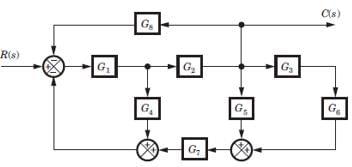
Detailed Solution: Question 17

Four loops -G1G4, -G1G2G5, -G1,G2G5G7 and -G1G2G3G3G7.

There is no nontouching loop. So (B) is correct.

Test: Transfer Function - 1 - Question 18

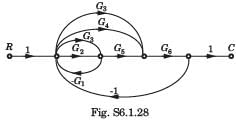
For the block diagram shown in fig. the numerator of transfer function is
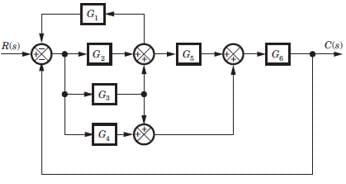
Detailed Solution: Question 18

SFG

P1 = G2G5G6 , P2 = G3G5G6, P3 = G3G6 , P4 = G4G6
If any path is deleted, there would not be any loop.
Hence Δ1 = Δ2 = Δ3 = Δ4 = 1 

Test: Transfer Function - 1 - Question 19

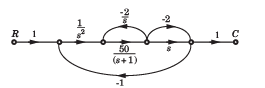
For the block diagram shown in fig.  the transfer function C(s)/R(s) is
Detailed Solution: Question 19

Test: Transfer Function - 1 - Question 20

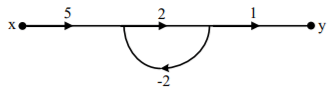
In the signal flow graph of figure y/x equals

Detailed Solution: Question 20

Transfer function

PK = 5 x 2 x 1 = 10
ΔK = 1
Δ = 1 - (-4) = 5

= 2

26 docs|247 tests
Information about Test: Transfer Function - 1 Page
In this test you can find the Exam questions for Test: Transfer Function - 1 solved & explained in the simplest way possible. Besides giving Questions and answers for Test: Transfer Function - 1, EduRev gives you an ample number of Online tests for practice
Download as PDF