


All Exams >
Class 6 >
6 Months Preparation for Class 6 (CBSE) >
All Questions
All questions of The Other Side of Zero for Class 6 Exam
What is the result of subtracting 8 from 6?- a)-2
- b)+2
- c)+10
- d)-10
Correct answer is option 'A'. Can you explain this answer?
What is the result of subtracting 8 from 6?
a)
-2
b)
+2
c)
+10
d)
-10

|
Shiksha Academy answered |
To subtract +8 from +6, we perform the operation:
6 − 8 = - 2
So, the result is - 2.
The correct answer is A: - 2.

Which of the following is the correct subtraction of +4 from -3?- a)+7
- b)-7
- c)+1
- d)-1
Correct answer is option 'B'. Can you explain this answer?
a)
+7
b)
-7
c)
+1
d)
-1

|
Vp Classes answered |
Subtracting +4 from -3 is -3 - 4 = -7.
On a vertical number line, where are the positive numbers placed?- a)To the right of 0.
- b)To the left of 0.
- c)Above 0.
- d)Below zero.
Correct answer is option 'C'. Can you explain this answer?
On a vertical number line, where are the positive numbers placed?
a)
To the right of 0.
b)
To the left of 0.
c)
Above 0.
d)
Below zero.

|
Kunal Mehta answered |
On a vertical number line, positive numbers are located above zero. As we look upward on a vertical number line, the values of the numbers increase. On a vertical number line, negative numbers are located above zero.
The predecessor of −16 is- a)−15
- b)−17
- c)15
- d)17
Correct answer is option 'B'. Can you explain this answer?
The predecessor of −16 is
a)
−15
b)
−17
c)
15
d)
17

|
Dr Manju Sen answered |
To find the predecessor of a number we move from right to the left on the number line
And , −17 lies on left side of −16
Hence, −17 is the predecessor of −16
Option (B) is the correct answer
If you are at Floor -2 in Bela's Building and press the '+' button 3 times, where will you be?- a)Floor +1
- b)Floor 0
- c)Floor -1
- d)Floor -5
Correct answer is option 'A'. Can you explain this answer?
a)
Floor +1
b)
Floor 0
c)
Floor -1
d)
Floor -5
|
|
Shiksha Academy answered |
Starting at Floor -2 and moving up 3 floors brings you to Floor +1.
Bela's Building of Fun has floors numbered from +3 to -3. If you start at the Welcome Hall (Floor 0) and press the '+' button twice, which floor will you reach?- a)Floor +1
- b)Floor -1
- c)Floor +2
- d)Floor 0
Correct answer is option 'C'. Can you explain this answer?
a)
Floor +1
b)
Floor -1
c)
Floor +2
d)
Floor 0

|
Subset Academy answered |
Starting at Floor 0, pressing the '+' button twice will take you up two floors, which brings you to Floor +2.
On the number line, what is the result of moving from +4 to -1?- a)+5
- b)-5
- c)+3
- d)-3
Correct answer is option 'B'. Can you explain this answer?
a)
+5
b)
-5
c)
+3
d)
-3
|
|
Shiksha Academy answered |
Moving from +4 to -1 involves moving 5 steps to the left, so the result is -5.
Which of the following statements is CORRECT?
Statement 1: When a positive integer and a negative integer are added, we always get a negative integer.
Statement 2: When two negative integers are added, we get a positive integer.- a)Only Statement 1
- b)Only Statement 2
- c)Both Statement 1 and Statement 2
- d)Neither Statement 1 nor Statement 2
Correct answer is option 'D'. Can you explain this answer?
Which of the following statements is CORRECT?
Statement 1: When a positive integer and a negative integer are added, we always get a negative integer.
Statement 2: When two negative integers are added, we get a positive integer.
Statement 1: When a positive integer and a negative integer are added, we always get a negative integer.
Statement 2: When two negative integers are added, we get a positive integer.
a)
Only Statement 1
b)
Only Statement 2
c)
Both Statement 1 and Statement 2
d)
Neither Statement 1 nor Statement 2

|
Devika Basak answered |
Understanding the Statements
To determine the correctness of the given statements, let's analyze them one by one.
Statement 1: Positive and Negative Integer Addition
- When a positive integer (e.g., +5) and a negative integer (e.g., -3) are added, the result depends on their absolute values.
- If the positive integer is larger than the negative integer, the result will be positive (e.g., +5 + -3 = +2).
- If the negative integer is larger, the result will be negative (e.g., +3 + -5 = -2).
- Thus, Statement 1 is incorrect because we do not always get a negative integer.
Statement 2: Adding Two Negative Integers
- When two negative integers (e.g., -2 and -3) are added, the result is always negative.
- For example, -2 + -3 = -5.
- This means that the sum of two negative integers will never yield a positive integer.
- Therefore, Statement 2 is also incorrect.
Conclusion
- Both statements are incorrect based on the definitions of adding positive and negative integers.
- Thus, the correct answer is option 'D': Neither Statement 1 nor Statement 2 is correct.
Understanding these principles is essential for mastering integer operations in mathematics.
To determine the correctness of the given statements, let's analyze them one by one.
Statement 1: Positive and Negative Integer Addition
- When a positive integer (e.g., +5) and a negative integer (e.g., -3) are added, the result depends on their absolute values.
- If the positive integer is larger than the negative integer, the result will be positive (e.g., +5 + -3 = +2).
- If the negative integer is larger, the result will be negative (e.g., +3 + -5 = -2).
- Thus, Statement 1 is incorrect because we do not always get a negative integer.
Statement 2: Adding Two Negative Integers
- When two negative integers (e.g., -2 and -3) are added, the result is always negative.
- For example, -2 + -3 = -5.
- This means that the sum of two negative integers will never yield a positive integer.
- Therefore, Statement 2 is also incorrect.
Conclusion
- Both statements are incorrect based on the definitions of adding positive and negative integers.
- Thus, the correct answer is option 'D': Neither Statement 1 nor Statement 2 is correct.
Understanding these principles is essential for mastering integer operations in mathematics.
The additive inverse of a negative integer- a)is always negative
- b)is always positive
- c)is the same integer
- d)zero
Correct answer is option 'B'. Can you explain this answer?
The additive inverse of a negative integer
a)
is always negative
b)
is always positive
c)
is the same integer
d)
zero

|
Aniket Mukherjee answered |
Understanding Additive Inverse
The additive inverse of a number is what you add to that number to get zero. For any integer 'x', the additive inverse is '-x'.
Negative Integer Example
Consider a negative integer, for example, -5. The additive inverse of -5 is calculated as follows:
- Additive Inverse = -(-5) = 5
Thus, the additive inverse of a negative integer is always a positive integer.
Explanation of Options
Let's analyze the given options:
- a) Is always negative
- This is incorrect because the additive inverse of a negative integer is positive.
- b) Is always positive
- This is the correct answer. The additive inverse of any negative integer results in a positive integer.
- c) Is the same integer
- This option is incorrect. The additive inverse changes the sign, so it cannot be the same integer.
- d) Zero
- This is also incorrect. The additive inverse of a negative integer is not zero but a positive integer.
Conclusion
In conclusion, the additive inverse of a negative integer is always positive. This means that if you have a negative number and you take its additive inverse, you will always end up with a positive number, ensuring the sum equals zero when added together.
The additive inverse of a number is what you add to that number to get zero. For any integer 'x', the additive inverse is '-x'.
Negative Integer Example
Consider a negative integer, for example, -5. The additive inverse of -5 is calculated as follows:
- Additive Inverse = -(-5) = 5
Thus, the additive inverse of a negative integer is always a positive integer.
Explanation of Options
Let's analyze the given options:
- a) Is always negative
- This is incorrect because the additive inverse of a negative integer is positive.
- b) Is always positive
- This is the correct answer. The additive inverse of any negative integer results in a positive integer.
- c) Is the same integer
- This option is incorrect. The additive inverse changes the sign, so it cannot be the same integer.
- d) Zero
- This is also incorrect. The additive inverse of a negative integer is not zero but a positive integer.
Conclusion
In conclusion, the additive inverse of a negative integer is always positive. This means that if you have a negative number and you take its additive inverse, you will always end up with a positive number, ensuring the sum equals zero when added together.
If you start at Floor -1 and press the '-' button twice, where will you be?- a)Floor -3
- b)Floor -2
- c)Floor -4
- d)Floor 0
Correct answer is option 'A'. Can you explain this answer?
a)
Floor -3
b)
Floor -2
c)
Floor -4
d)
Floor 0

|
Partho Nair answered |
Understanding the Elevator System
When using an elevator, the buttons typically represent the floors in a building. Floors can be numbered positively (above ground) or negatively (below ground). In this scenario, you start at Floor -1.
Starting Point
- You begin at Floor -1.
- This indicates you are one level below the ground floor.
Pressing the - Button
- Pressing the - button means you want to go down to the next lower floor.
- Each press of the - button takes you down one floor.
Calculating the Movement
1. First Press:
- Starting at Floor -1, pressing the - button once takes you down to Floor -2.
2. Second Press:
- From Floor -2, pressing the - button again takes you down to Floor -3.
Final Result
- After pressing the - button twice:
- First press: Floor -1 → Floor -2
- Second press: Floor -2 → Floor -3
Therefore, you end up at Floor -3 after pressing the - button twice.
Conclusion
The correct answer to the question is option 'A', which is Floor -3. This understanding of the elevator system and the floor numbering is crucial for interpreting how movements between floors work.
When using an elevator, the buttons typically represent the floors in a building. Floors can be numbered positively (above ground) or negatively (below ground). In this scenario, you start at Floor -1.
Starting Point
- You begin at Floor -1.
- This indicates you are one level below the ground floor.
Pressing the - Button
- Pressing the - button means you want to go down to the next lower floor.
- Each press of the - button takes you down one floor.
Calculating the Movement
1. First Press:
- Starting at Floor -1, pressing the - button once takes you down to Floor -2.
2. Second Press:
- From Floor -2, pressing the - button again takes you down to Floor -3.
Final Result
- After pressing the - button twice:
- First press: Floor -1 → Floor -2
- Second press: Floor -2 → Floor -3
Therefore, you end up at Floor -3 after pressing the - button twice.
Conclusion
The correct answer to the question is option 'A', which is Floor -3. This understanding of the elevator system and the floor numbering is crucial for interpreting how movements between floors work.
If you subtract -10 from -5, what is the result?- a)+5
- b)-15
- c)-5
- d)+15
Correct answer is option 'A'. Can you explain this answer?
a)
+5
b)
-15
c)
-5
d)
+15
|
|
Dr Manju Sen answered |
Subtracting a negative is like adding the positive, so -5 - (-10) = -5 + 10 = +5.
In a game, if you move 3 steps forward and then 2 steps backward, where are you now?- a)1 step forward
- b)1 step backward
- c)5 steps forward
- d)0 steps forward
Correct answer is option 'A'. Can you explain this answer?
a)
1 step forward
b)
1 step backward
c)
5 steps forward
d)
0 steps forward

|
EduRev Class 6 answered |
Moving 3 steps forward and then 2 steps backward leaves you 1 step forward.
Number of even numbers between 58 and 80 is - a)10
- b)11
- c)12
- d)13
Correct answer is option 'A'. Can you explain this answer?
Number of even numbers between 58 and 80 is
a)
10
b)
11
c)
12
d)
13

|
Indu Gupta answered |
Option A is right
If a number side to be an even number is must be divisible by 22. Therefore the even number between 5858 and 8080 are
60, 62, 64, 66, 68, 70, 72, 74, 76, 78.
So, there are 1010 even numbers between 58 and 80
On the number line, what is the distance between -7 and +3?- a)10 units
- b)4 units
- c)7 units
- d)9 units
Correct answer is option 'A'. Can you explain this answer?
a)
10 units
b)
4 units
c)
7 units
d)
9 units

|
Arjun Yadav answered |
Understanding Distance on the Number Line
To find the distance between two points on a number line, follow these steps:
1. Identify the Points
We have two points: -7 and +3.
2. Use the Distance Formula
The distance between two points \( a \) and \( b \) on a number line is calculated using the formula:
Distance = |a - b|
3. Calculate the Distance
Here, we'll calculate the distance between -7 and +3:
Distance = |-7 - 3|
Distance = |-10|
Distance = 10 units
Visualizing the Calculation
- Starting from -7, if you move towards the right to reach 0, that is 7 units.
- Then, moving from 0 to +3 is an additional 3 units.
Thus, the total distance from -7 to +3 is:
7 units (to reach 0) + 3 units (to reach +3) = 10 units.
Conclusion
The correct answer is indeed option 'A', which states that the distance between -7 and +3 is 10 units. This method can be applied to find the distance between any two points on the number line.
To find the distance between two points on a number line, follow these steps:
1. Identify the Points
We have two points: -7 and +3.
2. Use the Distance Formula
The distance between two points \( a \) and \( b \) on a number line is calculated using the formula:
Distance = |a - b|
3. Calculate the Distance
Here, we'll calculate the distance between -7 and +3:
Distance = |-7 - 3|
Distance = |-10|
Distance = 10 units
Visualizing the Calculation
- Starting from -7, if you move towards the right to reach 0, that is 7 units.
- Then, moving from 0 to +3 is an additional 3 units.
Thus, the total distance from -7 to +3 is:
7 units (to reach 0) + 3 units (to reach +3) = 10 units.
Conclusion
The correct answer is indeed option 'A', which states that the distance between -7 and +3 is 10 units. This method can be applied to find the distance between any two points on the number line.
Calculate: 9 − (−6)- a)3
- b)−3
- c)15
- d)−15
Correct answer is option 'C'. Can you explain this answer?
Calculate:
9 − (−6)
a)
3
b)
−3
c)
15
d)
−15
|
|
Shivam Chakraborty answered |
Understanding the Expression
To solve the expression 9 - (-6), we need to carefully evaluate the subtraction of a negative number.
Step-by-Step Calculation
- Identify the Operation: The expression involves subtracting a negative number.
- Rule of Subtracting Negatives: When you subtract a negative number, it is equivalent to adding the positive version of that number.
- Rewrite the Expression: Thus, we can rewrite the expression 9 - (-6) as 9 + 6.
Performing the Addition
- Calculate the Sum:
- 9 + 6 = 15
Conclusion
- The final result of the expression 9 - (-6) is 15.
- Therefore, the correct answer is option 'C', which is 15.
This logical breakdown helps us understand why the answer is 15, making it clear that subtracting a negative number effectively increases the total.
To solve the expression 9 - (-6), we need to carefully evaluate the subtraction of a negative number.
Step-by-Step Calculation
- Identify the Operation: The expression involves subtracting a negative number.
- Rule of Subtracting Negatives: When you subtract a negative number, it is equivalent to adding the positive version of that number.
- Rewrite the Expression: Thus, we can rewrite the expression 9 - (-6) as 9 + 6.
Performing the Addition
- Calculate the Sum:
- 9 + 6 = 15
Conclusion
- The final result of the expression 9 - (-6) is 15.
- Therefore, the correct answer is option 'C', which is 15.
This logical breakdown helps us understand why the answer is 15, making it clear that subtracting a negative number effectively increases the total.
What is the sum of -3 and +5?- a)+8
- b)+2
- c)-2
- d)0
Correct answer is option 'B'. Can you explain this answer?
a)
+8
b)
+2
c)
-2
d)
0

|
Rohini Seth answered |
Adding -3 and +5, we subtract 3 from 5, resulting in +2.
If you start at Floor +2 and move 4 floors down, where will you end up?- a)Floor -2
- b)Floor 0
- c)Floor +4
- d)Floor -4
Correct answer is option 'A'. Can you explain this answer?
a)
Floor -2
b)
Floor 0
c)
Floor +4
d)
Floor -4
|
|
Subset Academy answered |
Moving 4 floors down from +2 takes you to Floor -2.
If your bank balance is ₹100 and you spend ₹120, what will your balance be?- a)₹220
- b)₹0
- c)₹-20
- d)₹20
Correct answer is option 'C'. Can you explain this answer?
a)
₹220
b)
₹0
c)
₹-20
d)
₹20

|
Rahul Kumar answered |
Spending ₹120 from ₹100 leaves you with a balance of ₹-20.
Which of the following represents a negative integer?- a)-2
- b)3
- c)0
- d)+5
Correct answer is option 'A'. Can you explain this answer?
a)
-2
b)
3
c)
0
d)
+5

|
Gunjan Lakhani answered |
A negative integer has a minus sign in front, like -2.
You are at Floor +3 and move 5 floors down. Which floor will you reach?- a)Floor -2
- b)Floor -3
- c)Floor -1
- d)Floor 0
Correct answer is option 'A'. Can you explain this answer?
a)
Floor -2
b)
Floor -3
c)
Floor -1
d)
Floor 0
|
|
Dr Manju Sen answered |
Moving 5 floors down from +3 will take you to Floor -2.
You deposit ₹50 into your bank account, then withdraw ₹70. What is your new balance if you started with ₹0?- a)₹-20
- b)₹70
- c)₹50
- d)₹-50
Correct answer is option 'A'. Can you explain this answer?
a)
₹-20
b)
₹70
c)
₹50
d)
₹-50

|
Rutuja Bose answered |
Understanding the Bank Transaction
To find your new balance after making a deposit and a withdrawal, we can break down the transactions step by step.
Initial Balance
- You start with ₹0 in your bank account.
Deposit Amount
- You deposit ₹50 into your account.
- New balance after the deposit:
- ₹0 + ₹50 = ₹50
Withdrawal Amount
- You then withdraw ₹70 from your account.
- New balance after the withdrawal:
- ₹50 - ₹70 = ₹-20
Final Balance
- After completing both transactions:
- Your balance is now ₹-20.
This means you are in a negative balance of ₹20, indicating that you owe the bank ₹20. Hence, the correct answer is option 'A', which states your balance is ₹-20.
Understanding how to manage deposits and withdrawals is essential for keeping track of your finances!
To find your new balance after making a deposit and a withdrawal, we can break down the transactions step by step.
Initial Balance
- You start with ₹0 in your bank account.
Deposit Amount
- You deposit ₹50 into your account.
- New balance after the deposit:
- ₹0 + ₹50 = ₹50
Withdrawal Amount
- You then withdraw ₹70 from your account.
- New balance after the withdrawal:
- ₹50 - ₹70 = ₹-20
Final Balance
- After completing both transactions:
- Your balance is now ₹-20.
This means you are in a negative balance of ₹20, indicating that you owe the bank ₹20. Hence, the correct answer is option 'A', which states your balance is ₹-20.
Understanding how to manage deposits and withdrawals is essential for keeping track of your finances!
If the temperature drops from 5°C to -3°C, what is the change in temperature?- a)-2°C
- b)-8°C
- c)+8°C
- d)+2°C
Correct answer is option 'B'. Can you explain this answer?
a)
-2°C
b)
-8°C
c)
+8°C
d)
+2°C
|
|
Gunjan Lakhani answered |
The temperature drops by 8°C, moving from +5°C to -3°C.
Addition of one negative and one positive integer is- a)always positive
- b)always negative
- c)same as the sign of larger number
- d)same as the sign of smaller number
Correct answer is option 'C'. Can you explain this answer?
Addition of one negative and one positive integer is
a)
always positive
b)
always negative
c)
same as the sign of larger number
d)
same as the sign of smaller number
|
|
Vp Classes answered |
If the magnitude of positive number is greater than the negative number then there will be some positive remainder after adding the negative number.Hence,it will be the sign of a large number.
Which of the following option is not true with respect to given number line?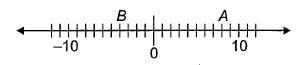
- a)B is greater than −10
- b)A is greater than 0
- c)A is greater than B
- d)B is greater than 0
Correct answer is option 'D'. Can you explain this answer?
Which of the following option is not true with respect to given number line?
a)
B is greater than −10
b)
A is greater than 0
c)
A is greater than B
d)
B is greater than 0
|
|
Shiksha Academy answered |
We have,
A = 8 and B = −4
The numbers on the number line increase on moving from left to right on the number line. The point B is left to the number 0, so B is less than 0.
A. − 4 > −10 ⇒ B > −10 True
B is right to −10. So, B is greater.
B. 8 > 0 ⇒ A > 0 True
A is right to 0. So, A is greater.
C. A > −4 ⇒ A > B True
A is right to B. So, A is greater.
D. As − 4 < 0 ⇒ B < 0. So, B > 0 is false.
0 is right to B. So, 0 is greater.
The numbers on the left of 0 are ______ numbers, and the numbers on the right of 0 are ________ numbers.- a)negative, positive
- b)positive, negative
- c)positive, positive
- d)negative, negative
Correct answer is option 'A'. Can you explain this answer?
The numbers on the left of 0 are ______ numbers, and the numbers on the right of 0 are ________ numbers.
a)
negative, positive
b)
positive, negative
c)
positive, positive
d)
negative, negative

|
Coachify answered |
This is a sample number line.
We can observe that: The numbers on the left of 0 are negative numbers and the numbers on the right of 0 are positive numbers.

Evaluate:(+5) + (−6) = ?- a)−1
- b)1
- c)2
- d)−2
Correct answer is option 'A'. Can you explain this answer?
Evaluate:
(+5) + (−6) = ?
a)
−1
b)
1
c)
2
d)
−2
|
|
Shiksha Academy answered |
Write given integers in addition expression and we get:
(+5) + (−6)
Subtract smaller integer 5 from bigger integer 6 as follows:
6 − 5 = 1
Since, the bigger integer −6 is a negative integer, so the result should also be negative that is −1
Hence, +5 − 6 = −1
Which of the following is true about 0 on the number line?- a)0 is greater than all negative numbers
- b)0 is less than all negative numbers
- c)0 is a positive number
- d)0 is a negative number
Correct answer is option 'A'. Can you explain this answer?
a)
0 is greater than all negative numbers
b)
0 is less than all negative numbers
c)
0 is a positive number
d)
0 is a negative number
|
|
EduRev Class 6 answered |
0 is greater than all negative numbers and is neither positive nor negative.
The coordinate of 3rd alphabet on left of C is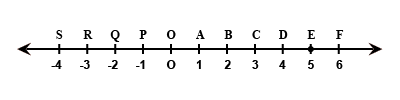
- a)−3
- b)3
- c)0
- d)1
Correct answer is option 'C'. Can you explain this answer?
The coordinate of 3rd alphabet on left of C is
a)
−3
b)
3
c)
0
d)
1
|
|
Gunjan Lakhani answered |
3rd alphabet to the left of C is O.
O lies on 0 on number line. Hence, its coordinate is 0.
On the number line, the integer 5 is located _______.- a)to the left of 0
- b)to the right of 0
- c)to the left of 1
- d)to the left of −2
Correct answer is option 'B'. Can you explain this answer?
On the number line, the integer 5 is located _______.
a)
to the left of 0
b)
to the right of 0
c)
to the left of 1
d)
to the left of −2
|
|
Coachify answered |
The number line represents all the real numbers. The positive numbers are on the right of 0 and the negative numbers are on the left of 0, as shown in the above figure.
Since 5 is a positive number, it lies to the right of 0.
Hence, on the number line, the integer 5 is located to the right of 0.

Compare: 1,00,002 ___ 10,00,002- a)>
- b)<
- c)=
- d)None of these
Correct answer is option 'B'. Can you explain this answer?
Compare: 1,00,002 ___ 10,00,002
a)
>
b)
<
c)
=
d)
None of these
|
|
Vp Classes answered |
If we write the given numbers in words well be easily able to solve this.
One lakh two and the second number is ten lakh two.
Obviously the second number is greater then the first.
So option B is the correct answer.
Which number is the additive inverse of +7?- a)+7
- b)-7
- c)0
- d)+14
Correct answer is option 'B'. Can you explain this answer?
a)
+7
b)
-7
c)
0
d)
+14
|
|
Gunjan Lakhani answered |
The additive inverse of +7 is -7 because their sum is zero.
By observing the above number line, state which of the following statements is true.
- a)B is 2
- b)A is 4
- c)B is –13
- d)B is −4
Correct answer is option 'D'. Can you explain this answer?
By observing the above number line, state which of the following statements is true.
a)
B is 2
b)
A is 4
c)
B is –13
d)
B is −4

|
Praveen Kumar answered |
From above number line we cans see that A is 7 marks right of 0 and B is 4 marks to the left of 0
So, A = 7 and B = −4
Hence, Option (D) is correct
On the following number line value ‘zero’ is shown by the point
- a)X
- b)Y
- c)Z
- d)W
Correct answer is option 'C'. Can you explain this answer?
On the following number line value ‘zero’ is shown by the point
a)
X
b)
Y
c)
Z
d)
W
|
|
Praveen Kumar answered |
Option (c) is correct; in the figure given below, each unit has a value of 5.

Answer the following using number line.The integer which is 7 more than −4 is - a)−7
- b)−3
- c)3
- d)7
Correct answer is option 'C'. Can you explain this answer?
Answer the following using number line.
The integer which is 7 more than −4 is
a)
−7
b)
−3
c)
3
d)
7
|
|
Coachify answered |
Starting from −4, move 7 unit right. So, from the above figure, we can conclude that integer 3 is 7 more than −4.

What should be added to 18 to get −34?- a)52
- b)−52
- c)−16
- d)16
Correct answer is option 'B'. Can you explain this answer?
What should be added to 18 to get −34?
a)
52
b)
−52
c)
−16
d)
16
|
|
Coachify answered |
Let the number be x.
Then according to the problem we get,
x + 18 = −34
or x = −34 − 18
or x = −52.
Which of the following statements is true?- a)-5 > -3
- b)0 < -1
- c)+3 > -2
- d)-6 > 0
Correct answer is option 'C'. Can you explain this answer?
a)
-5 > -3
b)
0 < -1
c)
+3 > -2
d)
-6 > 0

|
Eduskill Classes answered |
+3 is greater than -2 because positive numbers are always greater than negative numbers.
Which integer is the additive inverse of itself?- a)−1
- b)1
- c)0
- d)2
Correct answer is option 'C'. Can you explain this answer?
Which integer is the additive inverse of itself?
a)
−1
b)
1
c)
0
d)
2
|
|
Coachify answered |
Additive inverse of number is that when added to a number it results in 0
Additive inverse of itself = a + 0 = 0
Therefore a = 0
Hence the correct answer is option C.
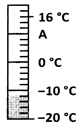

The integer 5 units to the right of 0 on the number line is:- a)+5
- b)−5
- c)+4
- d)−4
Correct answer is option 'A'. Can you explain this answer?
The integer 5 units to the right of 0 on the number line is:
a)
+5
b)
−5
c)
+4
d)
−4
|
|
Shiksha Academy answered |
Option A is right.
The integer 5 units to the right of 0 on the number line' is 0 + 5 = +5.
The integer 5 units to the right of 0 on the number line' is 0 + 5 = +5.
The smallest positive integer is- a)0
- b)10
- c)1
- d)9
Correct answer is option 'C'. Can you explain this answer?
The smallest positive integer is
a)
0
b)
10
c)
1
d)
9
|
|
Dr Manju Sen answered |
The smallest positive integer is 1. Positive integers are the numbers greater than 0, and the smallest of these is 1.
Thus, the smallest positive integer is 1Thus, the smallest positive integer is 1
When the integers 10, 0, 4, 5, 7 are arranged in descending or ascending order, them find out which of the following integers always remains in the middle of the arrangement.- a)5
- b)7
- c)4
- d)0
Correct answer is option 'A'. Can you explain this answer?
When the integers 10, 0, 4, 5, 7 are arranged in descending or ascending order, them find out which of the following integers always remains in the middle of the arrangement.
a)
5
b)
7
c)
4
d)
0

|
EduRev CAT answered |
We are given the integers 10, 0, 4, 5, 7. We need to arrange them in both ascending order (smallest to largest) and descending order (largest to smallest). Then we must check which integer always comes in the middle.
Step 1: Arrange in ascending order
Ascending means from the smallest to the greatest: 0, 4, 5, 7, 10.
Here, the middle number is the third one (since there are 5 numbers). So, the middle is 5.
Ascending means from the smallest to the greatest: 0, 4, 5, 7, 10.
Here, the middle number is the third one (since there are 5 numbers). So, the middle is 5.
Step 2: Arrange in descending order
Descending means from the greatest to the smallest: 10, 7, 5, 4, 0.
Here again, the middle number is the third one. So, the middle is still 5.
Descending means from the greatest to the smallest: 10, 7, 5, 4, 0.
Here again, the middle number is the third one. So, the middle is still 5.
Step 3: Compare both
Middle in ascending order = 5.
Middle in descending order = 5.
So, 5 always remains in the middle, no matter how we arrange.
Middle in ascending order = 5.
Middle in descending order = 5.
So, 5 always remains in the middle, no matter how we arrange.
Final Answer: The integer that always stays in the middle is a) 5
Chapter doubts & questions for The Other Side of Zero - 6 Months Preparation for Class 6 (CBSE) 2025 is part of Class 6 exam preparation. The chapters have been prepared according to the Class 6 exam syllabus. The Chapter doubts & questions, notes, tests & MCQs are made for Class 6 2025 Exam. Find important definitions, questions, notes, meanings, examples, exercises, MCQs and online tests here.
Chapter doubts & questions of The Other Side of Zero - 6 Months Preparation for Class 6 (CBSE) in English & Hindi are available as part of Class 6 exam.
Download more important topics, notes, lectures and mock test series for Class 6 Exam by signing up for free.
6 Months Preparation for Class 6 (CBSE)
303 videos|1455 docs|206 tests
|

|
© EduRev
|
Education Revolution
|


|







Signup on EduRev and stay on top of your study goals
10M+ students crushing their study goals daily