


All Exams >
Class 8 >
Science Olympiad Class 8 >
All Questions
All questions of Series Completion and Inserting for Class 8 Exam
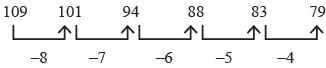
109, 101, 94, 88, 83, ? - a)78
- b)79
- c)80
- d)81
Correct answer is option 'B'. Can you explain this answer?
109, 101, 94, 88, 83, ?
a)
78
b)
79
c)
80
d)
81

|
Ananya Mishra answered |
The given series is

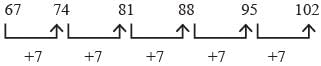

3, 4, 10, 33, 136, ? - a)682
- b)684
- c)685
- d)687’
Correct answer is option 'C'. Can you explain this answer?
3, 4, 10, 33, 136, ?
a)
682
b)
684
c)
685
d)
687’

|
Debolina Shah answered |
The pattern here is that each number is the product of the previous two numbers, plus the sum of the previous two numbers.
For example:
- 3 = 1*2 + 1+2
- 4 = 2*1 + 2+3
- 10 = 3*2 + 3+4
- 33 = 4*3 + 4+10
- 136 = 10*4 + 10+33
So to find the next number in the sequence, we need to apply the same formula:
- ? = 33*10 + 33+136
- ? = 330+169
Therefore, the next number in the sequence is 499.
None of the given options match this answer, so the correct answer is not listed.
For example:
- 3 = 1*2 + 1+2
- 4 = 2*1 + 2+3
- 10 = 3*2 + 3+4
- 33 = 4*3 + 4+10
- 136 = 10*4 + 10+33
So to find the next number in the sequence, we need to apply the same formula:
- ? = 33*10 + 33+136
- ? = 330+169
Therefore, the next number in the sequence is 499.
None of the given options match this answer, so the correct answer is not listed.
Find the missing number in the given series 13, 24, 46, 90, 178, ?.- a)294
- b)276
- c)354
- d)425
Correct answer is option 'C'. Can you explain this answer?
Find the missing number in the given series 13, 24, 46, 90, 178, ?.
a)
294
b)
276
c)
354
d)
425
|
|
Lakshya Sagare answered |
The correct answer is option c because:-
So, if 88 is doubled, we get 176. Hence, 178 + 176 = 354. Thus, the missing term in the sequence is 354. Therefore, the complete series is 13, 24, 46, 90, 178, 354.
So, if 88 is doubled, we get 176. Hence, 178 + 176 = 354. Thus, the missing term in the sequence is 354. Therefore, the complete series is 13, 24, 46, 90, 178, 354.
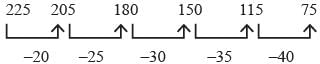
225, 205, 180, 150, 115, ? - a)55
- b)65
- c)75
- d)85
Correct answer is option 'C'. Can you explain this answer?
225, 205, 180, 150, 115, ?
a)
55
b)
65
c)
75
d)
85

|
Pritam Majumdar answered |
The given series is
Find the missing number 25: 37:: 49:?- a)55
- b)60
- c)65
- d)70
Correct answer is option 'C'. Can you explain this answer?
Find the missing number 25: 37:: 49:?
a)
55
b)
60
c)
65
d)
70

|
Atharva Jain answered |
Explanation:
The given series is 25: 37:: 49: ?
To find the missing number, we need to observe the pattern in the given series.
Pattern:
If we look at the given series, we can see that each pair of numbers has a difference of 12.
Let's break down the series into pairs:
- 25 and 37: The difference is 37 - 25 = 12
- 49 and ?: We need to find the missing number.
Calculation:
To find the missing number, we can add 12 to the second number in the pair.
- 49 + 12 = 61
Therefore, the missing number is 61.
Verification:
We can verify our answer by checking if the pattern holds true for the rest of the series:
- 37 and 49: The difference is 49 - 37 = 12
- 49 and 61: The difference is 61 - 49 = 12
Since the pattern holds true for the entire series, we can confidently say that the missing number is 61.
Conclusion:
The missing number in the series 25: 37:: 49: ? is 61. Therefore, option C (65) is incorrect. The correct answer is option C (61).
The given series is 25: 37:: 49: ?
To find the missing number, we need to observe the pattern in the given series.
Pattern:
If we look at the given series, we can see that each pair of numbers has a difference of 12.
Let's break down the series into pairs:
- 25 and 37: The difference is 37 - 25 = 12
- 49 and ?: We need to find the missing number.
Calculation:
To find the missing number, we can add 12 to the second number in the pair.
- 49 + 12 = 61
Therefore, the missing number is 61.
Verification:
We can verify our answer by checking if the pattern holds true for the rest of the series:
- 37 and 49: The difference is 49 - 37 = 12
- 49 and 61: The difference is 61 - 49 = 12
Since the pattern holds true for the entire series, we can confidently say that the missing number is 61.
Conclusion:
The missing number in the series 25: 37:: 49: ? is 61. Therefore, option C (65) is incorrect. The correct answer is option C (61).

Complete the series 1, 2, 10, 37, 101, __.- a)160
- b)185
- c)200
- d)226
Correct answer is option 'D'. Can you explain this answer?
Complete the series 1, 2, 10, 37, 101, __.
a)
160
b)
185
c)
200
d)
226

|
Mrinalini Chakraborty answered |
Understanding the Series
The given series is: 1, 2, 10, 37, 101, __.
To identify the pattern, let's look at the differences between the consecutive terms.
Calculating Differences
- 2 - 1 = 1
- 10 - 2 = 8
- 37 - 10 = 27
- 101 - 37 = 64
This gives us a new series of differences: 1, 8, 27, 64.
Identifying a Pattern in Differences
Now, let's analyze these differences:
- 1 = 1³
- 8 = 2³
- 27 = 3³
- 64 = 4³
The differences are the cubes of consecutive integers: \( n^3 \), where \( n \) is the position in the series.
Finding the Next Difference
Following this pattern, the next difference would be:
- 5³ = 125
Calculating the Next Term
Now, we can find the next term in the original series:
- Previous term: 101
- Next difference: 125
So,
101 + 125 = 226.
Conclusion
Thus, the next term in the series is 226.
Correct answer: option 'D'.
The given series is: 1, 2, 10, 37, 101, __.
To identify the pattern, let's look at the differences between the consecutive terms.
Calculating Differences
- 2 - 1 = 1
- 10 - 2 = 8
- 37 - 10 = 27
- 101 - 37 = 64
This gives us a new series of differences: 1, 8, 27, 64.
Identifying a Pattern in Differences
Now, let's analyze these differences:
- 1 = 1³
- 8 = 2³
- 27 = 3³
- 64 = 4³
The differences are the cubes of consecutive integers: \( n^3 \), where \( n \) is the position in the series.
Finding the Next Difference
Following this pattern, the next difference would be:
- 5³ = 125
Calculating the Next Term
Now, we can find the next term in the original series:
- Previous term: 101
- Next difference: 125
So,
101 + 125 = 226.
Conclusion
Thus, the next term in the series is 226.
Correct answer: option 'D'.
Find out the wrong term in the given series: 2, 3, 12, 37, 86, 166, 288.- a)2
- b)37
- c)86
- d)166
Correct answer is option 'D'. Can you explain this answer?
Find out the wrong term in the given series: 2, 3, 12, 37, 86, 166, 288.
a)
2
b)
37
c)
86
d)
166
|
|
Kiran Reddy answered |
Given series: 2, 3, 12, 37, 86, 166, 288.
2 + 12 = 2 + 1 = 3
3 + 32 = 3 + 9 = 12
12 + 52 = 12 + 25 = 37
37 + 72 = 37 + 49 = 86
86 + 92 = 86 + 81 = 167
167 + 112 = 167 + 121 = 288.
Here, the series follows a pattern of addition of the square of the consecutive odd numbers.
So, from the given number series 2, 3, 12, 37, 86, 166, 288, the wrong term is 166, because it should be 167.
What will come at the place of question mark ?
7, 26, 63, 124, 215, 342, ?- a)391
- b)511
- c)481
- d)421
Correct answer is option 'B'. Can you explain this answer?
What will come at the place of question mark ?
7, 26, 63, 124, 215, 342, ?
7, 26, 63, 124, 215, 342, ?
a)
391
b)
511
c)
481
d)
421

|
Kds Coaching answered |
The terms are given in a series:
(23 - 1) = 7
(33 - 1) = 26
(43 - 1) = 63
(53 - 1) = 124
(63 - 1) = 215
(73 - 1) = 342
So, the missing term is,
(83 - 1) = 511.
(23 - 1) = 7
(33 - 1) = 26
(43 - 1) = 63
(53 - 1) = 124
(63 - 1) = 215
(73 - 1) = 342
So, the missing term is,
(83 - 1) = 511.
4, 3, 4, 9, 32, 155, ? - a)924
- b)926
- c)928
- d)932
Correct answer is option 'A'. Can you explain this answer?
4, 3, 4, 9, 32, 155, ?
a)
924
b)
926
c)
928
d)
932

|
Sounak Chatterjee answered |
The given series is

16, 22, 30, 40, 52, 66, 82, ? - a)100
- b)98
- c)102
- d)104
Correct answer is option 'A'. Can you explain this answer?
16, 22, 30, 40, 52, 66, 82, ?
a)
100
b)
98
c)
102
d)
104

|
Aniket Mukherjee answered |
Pattern Analysis:
The given sequence of numbers is: 16, 22, 30, 40, 52, 66, 82, ?
Identifying the Pattern:
- The difference between consecutive numbers is as follows:
- 22 - 16 = 6
- 30 - 22 = 8
- 40 - 30 = 10
- 52 - 40 = 12
- 66 - 52 = 14
- 82 - 66 = 16
Applying the Pattern:
Following the pattern of increasing differences between consecutive numbers, the next difference should be 18.
Finding the Missing Number:
- Adding 18 to the last number in the sequence (82), we get:
- 82 + 18 = 100
Therefore, the missing number in the sequence is 100.
Final Answer:
The missing number in the sequence 16, 22, 30, 40, 52, 66, 82, ? is 100 (Option A).
The given sequence of numbers is: 16, 22, 30, 40, 52, 66, 82, ?
Identifying the Pattern:
- The difference between consecutive numbers is as follows:
- 22 - 16 = 6
- 30 - 22 = 8
- 40 - 30 = 10
- 52 - 40 = 12
- 66 - 52 = 14
- 82 - 66 = 16
Applying the Pattern:
Following the pattern of increasing differences between consecutive numbers, the next difference should be 18.
Finding the Missing Number:
- Adding 18 to the last number in the sequence (82), we get:
- 82 + 18 = 100
Therefore, the missing number in the sequence is 100.
Final Answer:
The missing number in the sequence 16, 22, 30, 40, 52, 66, 82, ? is 100 (Option A).
Find the missing number in the given series 4, 18, ___, 100, 180, 294, 448.- a)22
- b)35
- c)48
- d)51
Correct answer is option 'C'. Can you explain this answer?
Find the missing number in the given series 4, 18, ___, 100, 180, 294, 448.
a)
22
b)
35
c)
48
d)
51

|
Kaavya Mishra answered |
The given series is 4, 18, ___, 100, 180, 294, 448. We need to find the missing number in the series.
To solve this problem, we need to identify the pattern or relationship between the numbers in the series.
Pattern Analysis:
Let's analyze the given series to identify any pattern or relationship between the numbers.
- The first number in the series is 4.
- The second number is obtained by multiplying the first number by 4 and then adding 2. So, 4 * 4 + 2 = 18.
- The third number can be obtained by multiplying the second number by 4 and then subtracting 6. So, 18 * 4 - 6 = 66.
- The fourth number is obtained by multiplying the third number by 4 and then adding 2. So, 66 * 4 + 2 = 266.
- The fifth number is obtained by multiplying the fourth number by 4 and then subtracting 20. So, 266 * 4 - 20 = 100.
- The sixth number is obtained by multiplying the fifth number by 4 and then adding 2. So, 100 * 4 + 2 = 402.
- The seventh number is obtained by multiplying the sixth number by 4 and then subtracting 6. So, 402 * 4 - 6 = 1594.
We can see that there is an alternating pattern of multiplying by 4 and subtracting or adding a constant value in each step. Using this pattern, we can find the missing number.
Calculating the Missing Number:
To find the missing number, we need to apply the pattern to the previous number in the series.
- The sixth number is 402, which was obtained by multiplying the fifth number (100) by 4 and then adding 2.
- So, to find the missing number, we need to apply the pattern to the sixth number.
Applying the pattern:
The sixth number (402) was obtained by multiplying the fifth number (100) by 4 and then adding 2. So, the missing number can be obtained by multiplying 402 by 4 and then subtracting 6.
Missing number = 402 * 4 - 6
= 1608 - 6
= 1602
Therefore, the missing number in the given series is 1602.
Hence, the correct answer is option C) 1602.
To solve this problem, we need to identify the pattern or relationship between the numbers in the series.
Pattern Analysis:
Let's analyze the given series to identify any pattern or relationship between the numbers.
- The first number in the series is 4.
- The second number is obtained by multiplying the first number by 4 and then adding 2. So, 4 * 4 + 2 = 18.
- The third number can be obtained by multiplying the second number by 4 and then subtracting 6. So, 18 * 4 - 6 = 66.
- The fourth number is obtained by multiplying the third number by 4 and then adding 2. So, 66 * 4 + 2 = 266.
- The fifth number is obtained by multiplying the fourth number by 4 and then subtracting 20. So, 266 * 4 - 20 = 100.
- The sixth number is obtained by multiplying the fifth number by 4 and then adding 2. So, 100 * 4 + 2 = 402.
- The seventh number is obtained by multiplying the sixth number by 4 and then subtracting 6. So, 402 * 4 - 6 = 1594.
We can see that there is an alternating pattern of multiplying by 4 and subtracting or adding a constant value in each step. Using this pattern, we can find the missing number.
Calculating the Missing Number:
To find the missing number, we need to apply the pattern to the previous number in the series.
- The sixth number is 402, which was obtained by multiplying the fifth number (100) by 4 and then adding 2.
- So, to find the missing number, we need to apply the pattern to the sixth number.
Applying the pattern:
The sixth number (402) was obtained by multiplying the fifth number (100) by 4 and then adding 2. So, the missing number can be obtained by multiplying 402 by 4 and then subtracting 6.
Missing number = 402 * 4 - 6
= 1608 - 6
= 1602
Therefore, the missing number in the given series is 1602.
Hence, the correct answer is option C) 1602.
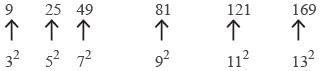
9, 25, 49, 81, 121, ? - a)141
- b)144
- c)161
- d)169
Correct answer is option 'D'. Can you explain this answer?
9, 25, 49, 81, 121, ?
a)
141
b)
144
c)
161
d)
169

|
Janhavi Kumar answered |
The given series is



3, 8, 15, 24, 35, 48, ? - a)61
- b)62
- c)63
- d)64
Correct answer is option 'C'. Can you explain this answer?
3, 8, 15, 24, 35, 48, ?
a)
61
b)
62
c)
63
d)
64

|
Harshad Goyal answered |
Understanding the Sequence
The sequence provided is: 3, 8, 15, 24, 35, 48. To find the next number, we need to identify the pattern that governs the sequence.
Finding the Differences
First, we can look at the differences between consecutive numbers:
The differences are: 5, 7, 9, 11, 13.
Analyzing the Differences
Notice that the differences themselves form a sequence:
These numbers increase by 2 each time. This indicates that the next difference will be:
Calculating the Next Term
To find the next term in our original sequence, we add this next difference (15) to the last number (48):
Thus, the next number in the sequence is 63.
Conclusion
Therefore, the correct answer is option 'C' which is 63.
The sequence provided is: 3, 8, 15, 24, 35, 48. To find the next number, we need to identify the pattern that governs the sequence.
Finding the Differences
First, we can look at the differences between consecutive numbers:
- 8 - 3 = 5
- 15 - 8 = 7
- 24 - 15 = 9
- 35 - 24 = 11
- 48 - 35 = 13
The differences are: 5, 7, 9, 11, 13.
Analyzing the Differences
Notice that the differences themselves form a sequence:
- 5, 7, 9, 11, 13
These numbers increase by 2 each time. This indicates that the next difference will be:
- 13 + 2 = 15
Calculating the Next Term
To find the next term in our original sequence, we add this next difference (15) to the last number (48):
- 48 + 15 = 63
Thus, the next number in the sequence is 63.
Conclusion
Therefore, the correct answer is option 'C' which is 63.

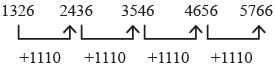
27, 56, 114, 230, 462, 926, ? - a)1852
- b)1854
- c)1848
- d)1856
Correct answer is option 'B'. Can you explain this answer?
27, 56, 114, 230, 462, 926, ?
a)
1852
b)
1854
c)
1848
d)
1856
|
|
Shilpa Shah answered |
Understanding the Sequence
The sequence given is: 27, 56, 114, 230, 462, 926. To find the next number, we first need to identify a pattern in the differences between consecutive terms.
Identifying Differences
- 56 - 27 = 29
- 114 - 56 = 58
- 230 - 114 = 116
- 462 - 230 = 232
- 926 - 462 = 464
The differences between the terms are: 29, 58, 116, 232, 464.
Observing the Pattern in Differences
Now, let's analyze the differences:
- 29 (which is 29)
- 58 (which is 2 * 29)
- 116 (which is 4 * 29)
- 232 (which is 8 * 29)
- 464 (which is 16 * 29)
We can see that each difference is double the previous difference.
Calculating the Next Difference
Following this pattern, the next difference should be:
- 464 * 2 = 928
Finding the Next Term
To find the next term in the sequence, add the last term (926) to the next difference (928):
- 926 + 928 = 1854
Conclusion
Therefore, the next number in the sequence is 1854, making option 'B' the correct answer.
The sequence given is: 27, 56, 114, 230, 462, 926. To find the next number, we first need to identify a pattern in the differences between consecutive terms.
Identifying Differences
- 56 - 27 = 29
- 114 - 56 = 58
- 230 - 114 = 116
- 462 - 230 = 232
- 926 - 462 = 464
The differences between the terms are: 29, 58, 116, 232, 464.
Observing the Pattern in Differences
Now, let's analyze the differences:
- 29 (which is 29)
- 58 (which is 2 * 29)
- 116 (which is 4 * 29)
- 232 (which is 8 * 29)
- 464 (which is 16 * 29)
We can see that each difference is double the previous difference.
Calculating the Next Difference
Following this pattern, the next difference should be:
- 464 * 2 = 928
Finding the Next Term
To find the next term in the sequence, add the last term (926) to the next difference (928):
- 926 + 928 = 1854
Conclusion
Therefore, the next number in the sequence is 1854, making option 'B' the correct answer.
Write the arithmetic series for the given sequence 5, 10, 15, 20, 25, ….., xn.- a)5 + 10 + 15 + 20 + 25 + …… + xn
- b)5 + 10 + 15 + 20 + 25 + …… + 5n
- c)5 + 10 + 15 + 20 + 25 + …… + 5n + 1
- d)5 + 10 + 15 + 20 + 25 + …… + 6n
Correct answer is option 'A'. Can you explain this answer?
Write the arithmetic series for the given sequence 5, 10, 15, 20, 25, ….., xn.
a)
5 + 10 + 15 + 20 + 25 + …… + xn
b)
5 + 10 + 15 + 20 + 25 + …… + 5n
c)
5 + 10 + 15 + 20 + 25 + …… + 5n + 1
d)
5 + 10 + 15 + 20 + 25 + …… + 6n
|
|
Kiran Reddy answered |
Given sequence: 5, 10, 15, 20, 25, ……, xn.
Therefore, the arithmetic series for the given sequence is 5 + 10 + 15 + 20 + 25 + …… + xn.

1, 5, 9, 17, 25, 37, 49, ? - a)64
- b)63
- c)65
- d)67
Correct answer is option 'C'. Can you explain this answer?
1, 5, 9, 17, 25, 37, 49, ?
a)
64
b)
63
c)
65
d)
67
|
|
Ananya Mishra answered |
The given series is


Choose the correct number in place of ?.
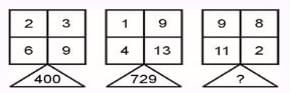
- a)300
- b)900
- c)500
- d)600
Correct answer is option 'B'. Can you explain this answer?
Choose the correct number in place of ?.
a)
300
b)
900
c)
500
d)
600

|
Gunjan Lakhani answered |
2 + 3 + 6 + 9 = 20
So, 202 = 400
1 + 4 + 9 + 13 = 27
So, 272 = 729
9 + 8 + 11 + 2 = 30
So, 302 = 900
So, the correct answer is 900
So, 202 = 400
1 + 4 + 9 + 13 = 27
So, 272 = 729
9 + 8 + 11 + 2 = 30
So, 302 = 900
So, the correct answer is 900


Chapter doubts & questions for Series Completion and Inserting - Science Olympiad Class 8 2025 is part of Class 8 exam preparation. The chapters have been prepared according to the Class 8 exam syllabus. The Chapter doubts & questions, notes, tests & MCQs are made for Class 8 2025 Exam. Find important definitions, questions, notes, meanings, examples, exercises, MCQs and online tests here.
Chapter doubts & questions of Series Completion and Inserting - Science Olympiad Class 8 in English & Hindi are available as part of Class 8 exam.
Download more important topics, notes, lectures and mock test series for Class 8 Exam by signing up for free.
Science Olympiad Class 8
70 videos|132 docs|67 tests
|

|
© EduRev
|
Education Revolution
|


|







Signup on EduRev and stay on top of your study goals
10M+ students crushing their study goals daily