


All Exams >
Grade 6 >
Mathematics for Grade 6 >
All Questions
All questions of Division for Grade 6 Exam
Rahul has one note of 2000 Rupees. His father has 40,000 Rupees in wallet. How many notes of 2000 Rupees Rahul need so he can have equal money as to his father. - a)20
- b)15
- c)10
- d)18
Correct answer is option 'A'. Can you explain this answer?
Rahul has one note of 2000 Rupees. His father has 40,000 Rupees in wallet. How many notes of 2000 Rupees Rahul need so he can have equal money as to his father.
a)
20
b)
15
c)
10
d)
18

|
Hiral Mehta answered |
Solution:
To find out how many notes of 2000 Rupees Rahul need so he can have equal money as to his father, we need to follow the following steps:
Step 1: Calculate the total amount of money Rahul's father has in his wallet.
Total money Rahul's father has = Rs. 40,000
Step 2: Calculate how much money Rahul needs to have to be equal to his father's money.
Money Rahul needs to have = Rs. 40,000
Step 3: Calculate how much money Rahul currently has.
Money Rahul currently has = Rs. 2,000
Step 4: Calculate how many notes of 2000 Rupees Rahul need to have Rs. 40,000.
Number of notes Rahul needs = (Money Rahul needs to have) / (Money Rahul currently has)
Number of notes Rahul needs = Rs. 40,000 / Rs. 2,000
Number of notes Rahul needs = 20
Therefore, Rahul needs 20 notes of 2000 Rupees to have equal money as to his father. Hence, the correct answer is option 'A'.
To find out how many notes of 2000 Rupees Rahul need so he can have equal money as to his father, we need to follow the following steps:
Step 1: Calculate the total amount of money Rahul's father has in his wallet.
Total money Rahul's father has = Rs. 40,000
Step 2: Calculate how much money Rahul needs to have to be equal to his father's money.
Money Rahul needs to have = Rs. 40,000
Step 3: Calculate how much money Rahul currently has.
Money Rahul currently has = Rs. 2,000
Step 4: Calculate how many notes of 2000 Rupees Rahul need to have Rs. 40,000.
Number of notes Rahul needs = (Money Rahul needs to have) / (Money Rahul currently has)
Number of notes Rahul needs = Rs. 40,000 / Rs. 2,000
Number of notes Rahul needs = 20
Therefore, Rahul needs 20 notes of 2000 Rupees to have equal money as to his father. Hence, the correct answer is option 'A'.


What is the other number if the product of two numbers is 22120 and one of the numbers is 35?- a)630
- b)632
- c)634
- d)636
Correct answer is option 'B'. Can you explain this answer?
What is the other number if the product of two numbers is 22120 and one of the numbers is 35?
a)
630
b)
632
c)
634
d)
636

|
Harsh Ghoshal answered |
Understanding the Problem
To find the other number when the product of two numbers is given, use the formula:
- Product = First Number × Second Number
In this case, the product is 22120 and one of the numbers is 35.
Finding the Other Number
To find the second number, rearrange the formula:
- Second Number = Product ÷ First Number
Now, plug in the values:
- Second Number = 22120 ÷ 35
Calculating the Division
Now perform the division step-by-step:
- First, divide 22120 by 5 (a simplified step):
- 22120 ÷ 5 = 4424
- Next, since you divided by 5, you need to multiply the result by 7 (because 35 = 7 × 5):
- 4424 × 7 = 30968 (This step was incorrect; let's correct this)
Instead, calculate directly:
- 22120 ÷ 35 = 632
Conclusion
Therefore, the other number is:
- 632
This matches option 'B'.
Final Verification
To ensure the answer is correct:
- Multiply the two numbers:
- 35 × 632 = 22120
This confirms that the calculation is accurate, and thus the correct answer is indeed:
- Option 'B': 632
To find the other number when the product of two numbers is given, use the formula:
- Product = First Number × Second Number
In this case, the product is 22120 and one of the numbers is 35.
Finding the Other Number
To find the second number, rearrange the formula:
- Second Number = Product ÷ First Number
Now, plug in the values:
- Second Number = 22120 ÷ 35
Calculating the Division
Now perform the division step-by-step:
- First, divide 22120 by 5 (a simplified step):
- 22120 ÷ 5 = 4424
- Next, since you divided by 5, you need to multiply the result by 7 (because 35 = 7 × 5):
- 4424 × 7 = 30968 (This step was incorrect; let's correct this)
Instead, calculate directly:
- 22120 ÷ 35 = 632
Conclusion
Therefore, the other number is:
- 632
This matches option 'B'.
Final Verification
To ensure the answer is correct:
- Multiply the two numbers:
- 35 × 632 = 22120
This confirms that the calculation is accurate, and thus the correct answer is indeed:
- Option 'B': 632
Complete the pattern: 8000 ÷ 4 = 2000 _____ ÷ 40 = 200, 8000 ÷ 400 = _____ _____÷ 4000 = 2- a)8000, 20, 8000
- b)8000, 200, 8000
- c)8000, 2000, 8000
- d)800, 200, 800
Correct answer is option 'A'. Can you explain this answer?
Complete the pattern: 8000 ÷ 4 = 2000 _____ ÷ 40 = 200, 8000 ÷ 400 = _____ _____÷ 4000 = 2
a)
8000, 20, 8000
b)
8000, 200, 8000
c)
8000, 2000, 8000
d)
800, 200, 800

|
Sudhir Mehta answered |
Required Pattern: 8000 ÷ 4 = 2000, 8000 ÷ 40 = 200, 8000 ÷ 400 = 20, 8000 ÷ 4000 = 2.
There are 3416 marbles in 122 bags. Find the number of marbles in one bag if each bag contain the same number of marbles.- a)28
- b)30
- c)22
- d)24
Correct answer is option 'A'. Can you explain this answer?
There are 3416 marbles in 122 bags. Find the number of marbles in one bag if each bag contain the same number of marbles.
a)
28
b)
30
c)
22
d)
24

|
Muskaan Kaur answered |
Given,
Number of marbles = 3416
Number of bags = 122
To find,
Number of marbles in one bag
Method:
We can find the number of marbles in one bag by dividing the total number of marbles by the number of bags.
Number of marbles in one bag = Total number of marbles / Number of bags
Substituting the given values in the above formula, we get
Number of marbles in one bag = 3416 / 122 = 28
Therefore, the number of marbles in one bag is 28.
Hence, the correct answer is option A.
Number of marbles = 3416
Number of bags = 122
To find,
Number of marbles in one bag
Method:
We can find the number of marbles in one bag by dividing the total number of marbles by the number of bags.
Number of marbles in one bag = Total number of marbles / Number of bags
Substituting the given values in the above formula, we get
Number of marbles in one bag = 3416 / 122 = 28
Therefore, the number of marbles in one bag is 28.
Hence, the correct answer is option A.
A farmer picked 823 tomatoes from his field and divided them equally into 36 bunches. How many tomatoes are in each bunch? Is there any tomato left out from packing?- a)Q = 22, R= 31
- b)Q = 380, R = 2
- c)Q = 380, R = 1
- d)Q = 383, R = 0
Correct answer is option 'A'. Can you explain this answer?
A farmer picked 823 tomatoes from his field and divided them equally into 36 bunches. How many tomatoes are in each bunch? Is there any tomato left out from packing?
a)
Q = 22, R= 31
b)
Q = 380, R = 2
c)
Q = 380, R = 1
d)
Q = 383, R = 0

|
Rajeev Singh answered |
Problem:
A farmer picked 823 tomatoes from his field and divided them equally into 36 bunches. How many tomatoes are in each bunch? Is there any tomato left out from packing?
Solution:
To find the number of tomatoes in each bunch, we need to divide the total number of tomatoes picked by the number of bunches.
Step 1:
Identify the given information:
- Total number of tomatoes picked: 823
- Number of bunches: 36
Step 2:
Use the division operation to find the quotient (number of tomatoes in each bunch) and the remainder (leftover tomatoes).
823 ÷ 36 = Q (quotient) with R (remainder)
Step 3:
Perform the division operation:
823 ÷ 36 = 22 remainder 31
The quotient (Q) is 22, which means there are 22 tomatoes in each bunch.
The remainder (R) is 31, which means there are 31 tomatoes leftover after packing.
Step 4:
Write down the final answer:
The number of tomatoes in each bunch is 22.
There are 31 tomatoes leftover from packing.
Answer:
The correct answer is option A) Q = 22, R = 31.
Explanation:
In option A, the quotient (Q) is 22, which means there are 22 tomatoes in each bunch. The remainder (R) is 31, which represents the tomatoes that are left out from packing. Therefore, option A is the correct answer.
A farmer picked 823 tomatoes from his field and divided them equally into 36 bunches. How many tomatoes are in each bunch? Is there any tomato left out from packing?
Solution:
To find the number of tomatoes in each bunch, we need to divide the total number of tomatoes picked by the number of bunches.
Step 1:
Identify the given information:
- Total number of tomatoes picked: 823
- Number of bunches: 36
Step 2:
Use the division operation to find the quotient (number of tomatoes in each bunch) and the remainder (leftover tomatoes).
823 ÷ 36 = Q (quotient) with R (remainder)
Step 3:
Perform the division operation:
823 ÷ 36 = 22 remainder 31
The quotient (Q) is 22, which means there are 22 tomatoes in each bunch.
The remainder (R) is 31, which means there are 31 tomatoes leftover after packing.
Step 4:
Write down the final answer:
The number of tomatoes in each bunch is 22.
There are 31 tomatoes leftover from packing.
Answer:
The correct answer is option A) Q = 22, R = 31.
Explanation:
In option A, the quotient (Q) is 22, which means there are 22 tomatoes in each bunch. The remainder (R) is 31, which represents the tomatoes that are left out from packing. Therefore, option A is the correct answer.

If a teacher cuts ribbons of 30 cm length from a roll of ribbon that is 1520 cm long, how many pieces can be obtained?- a)50
- b)51
- c)52
- d)49
Correct answer is option 'A'. Can you explain this answer?
If a teacher cuts ribbons of 30 cm length from a roll of ribbon that is 1520 cm long, how many pieces can be obtained?
a)
50
b)
51
c)
52
d)
49
|
|
Gopal Kulkarni answered |
Understanding the Problem
In this problem, we need to determine how many 30 cm pieces can be cut from a roll of ribbon that is 1520 cm long.
Calculation Steps
To find the number of pieces, we can use the following steps:
1. Total Length of Ribbon:
- The roll of ribbon is 1520 cm long.
2. Length of Each Piece:
- Each piece of ribbon cut from the roll is 30 cm long.
3. Division to Find Number of Pieces:
- To find out how many pieces can be obtained, we divide the total length of the ribbon by the length of each piece:
- Number of pieces = Total Length / Length of Each Piece
- Number of pieces = 1520 cm / 30 cm
4. Performing the Calculation:
- When you divide 1520 by 30:
- 1520 ÷ 30 = 50.666...
5. Interpreting the Result:
- Since we can only cut whole pieces, we take the whole number part of the quotient.
- Therefore, we can cut 50 full pieces of 30 cm each from the roll.
Conclusion
The final answer to the question is:
- Option A: 50 pieces can be obtained from the ribbon roll.
In this problem, we need to determine how many 30 cm pieces can be cut from a roll of ribbon that is 1520 cm long.
Calculation Steps
To find the number of pieces, we can use the following steps:
1. Total Length of Ribbon:
- The roll of ribbon is 1520 cm long.
2. Length of Each Piece:
- Each piece of ribbon cut from the roll is 30 cm long.
3. Division to Find Number of Pieces:
- To find out how many pieces can be obtained, we divide the total length of the ribbon by the length of each piece:
- Number of pieces = Total Length / Length of Each Piece
- Number of pieces = 1520 cm / 30 cm
4. Performing the Calculation:
- When you divide 1520 by 30:
- 1520 ÷ 30 = 50.666...
5. Interpreting the Result:
- Since we can only cut whole pieces, we take the whole number part of the quotient.
- Therefore, we can cut 50 full pieces of 30 cm each from the roll.
Conclusion
The final answer to the question is:
- Option A: 50 pieces can be obtained from the ribbon roll.
______ is separating or distributing something into parts.- a)Addition
- b)Subtraction
- c)Multiplication
- d)Division
Correct answer is option 'D'. Can you explain this answer?
______ is separating or distributing something into parts.
a)
Addition
b)
Subtraction
c)
Multiplication
d)
Division
|
|
Sudhir Mehta answered |
Division is separating or distributing something into parts.

How many buses are required to transport 996 students if each bus can hold only 24 students?- a)41
- b)42
- c)40
- d)43
Correct answer is option 'B'. Can you explain this answer?
How many buses are required to transport 996 students if each bus can hold only 24 students?
a)
41
b)
42
c)
40
d)
43
|
|
Riya Singh answered |
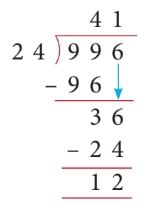
- To find the number of buses needed, divide 996 by 24.
- This gives a quotient of 41 with a remainder of 12, indicating that 41 buses would not be sufficient since 12 students would be left without transportation.
- Therefore, one additional bus is required, making it a total of 42 buses.

What is the quotient and remainder when 94895 is divided by 1000?- a)Quotient = 95, Remainder = 895
- b)Quotient = 94, Remainder = 895
- c)Quotient = 948, Remainder = 95
- d)Quotient = 948, Remainder = 0
Correct answer is option 'B'. Can you explain this answer?
What is the quotient and remainder when 94895 is divided by 1000?
a)
Quotient = 95, Remainder = 895
b)
Quotient = 94, Remainder = 895
c)
Quotient = 948, Remainder = 95
d)
Quotient = 948, Remainder = 0
|
|
Riya Singh answered |
- When dividing 94895 by 1000, the quotient is obtained by removing the last three digits, which gives 94.
- The remainder consists of those last three digits, which are 895.
- Therefore, the correct answer is Quotient = 94 and Remainder = 895.


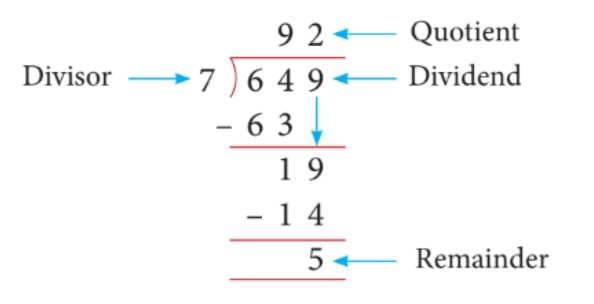

If a division operation results in a remainder, what can be said about the relationship between the divisor and the remainder?- a) The remainder is always greater than the divisor.
- b) The remainder is always smaller than the divisor.
- c) The remainder can be equal to the divisor.
- d) The remainder can be negative.
Correct answer is option 'B'. Can you explain this answer?
If a division operation results in a remainder, what can be said about the relationship between the divisor and the remainder?
a)
The remainder is always greater than the divisor.
b)
The remainder is always smaller than the divisor.
c)
The remainder can be equal to the divisor.
d)
The remainder can be negative.

|
Rahul Kumar answered |
In division, the remainder is always smaller than the divisor. This is a fundamental property of division, ensuring that the division operation maintains its integrity.
How many complete groups of 300 can be formed from 3102?- a)10
- b)11
- c)12
- d)13
Correct answer is option 'A'. Can you explain this answer?
How many complete groups of 300 can be formed from 3102?
a)
10
b)
11
c)
12
d)
13
|
|
Riya Singh answered |
Dividing 3102 by 300 results in a quotient of 10 and a remainder of 102. This indicates that 10 complete groups of 300 can be formed, with 102 units left over.
How many pieces of 10 cm can be cut from a roll of ribbon that is 250 cm long?- a)24
- b)25
- c)26
- d)27
Correct answer is option 'B'. Can you explain this answer?
How many pieces of 10 cm can be cut from a roll of ribbon that is 250 cm long?
a)
24
b)
25
c)
26
d)
27

|
Subset Academy answered |
Dividing 250 by 10 yields a quotient of 25 with no remainder, meaning 25 pieces of ribbon can be cut.
Chapter doubts & questions for Division - Mathematics for Grade 6 2025 is part of Grade 6 exam preparation. The chapters have been prepared according to the Grade 6 exam syllabus. The Chapter doubts & questions, notes, tests & MCQs are made for Grade 6 2025 Exam. Find important definitions, questions, notes, meanings, examples, exercises, MCQs and online tests here.
Chapter doubts & questions of Division - Mathematics for Grade 6 in English & Hindi are available as part of Grade 6 exam.
Download more important topics, notes, lectures and mock test series for Grade 6 Exam by signing up for free.
Mathematics for Grade 6
142 videos|210 docs|58 tests
|

|
© EduRev
|
Education Revolution
|


|







Signup to see your scores
go up
within 7 days!
within 7 days!
Takes less than 10 seconds to signup