


All Exams >
Grade 10 >
Geography for Grade 10 >
All Questions
All questions of Manufacturing Industries for Grade 10 Exam
Which is the only industry in India which is self-reliant?- a)Textile industry
- b)Iron and steel
- c)Electrical
- d)Sugar
Correct answer is option 'A'. Can you explain this answer?
Which is the only industry in India which is self-reliant?
a)
Textile industry
b)
Iron and steel
c)
Electrical
d)
Sugar
|
|
Neha Sharma answered |
Textile industry is considered to be self reliant because products produced at each stage are used as raw materials for next stage of production. Value chain refers to a number of activities that textile industry performs right from the production of raw materials to the delivery of finished products, and adds substantial value to that product at each stage of processing. ..
It contributes significantly to industrial production (about 14%) it creates employment generation this industry is the second largest after agriculture about 24.6% of foreign exchange earnings it contributes 4% to GDP...
Relevant information from ..The Hindu..
It contributes significantly to industrial production (about 14%) it creates employment generation this industry is the second largest after agriculture about 24.6% of foreign exchange earnings it contributes 4% to GDP...
Relevant information from ..The Hindu..

Rubber, Tea and coffee come under which type of Industry?
- a)Basic industry
- b)Heavy industry
- c)Agro based industry
- d)Mineral based industry
Correct answer is option 'C'. Can you explain this answer?
Rubber, Tea and coffee come under which type of Industry?
a)
Basic industry
b)
Heavy industry
c)
Agro based industry
d)
Mineral based industry

|
Partho Choudhury answered |
Agro-based industries are those industries which obtain raw-material from agriculture. Cotton textile, jute textile, sugar, vegetable oil etc are representative industries of an agro-based group of industry.
Oil India Limited (OIL) belongs to which of the following types of industries?- a)Joint sector
- b)Private sector
- c)Public sector
- d)Cooperative sector
Correct answer is option 'C'. Can you explain this answer?
Oil India Limited (OIL) belongs to which of the following types of industries?
a)
Joint sector
b)
Private sector
c)
Public sector
d)
Cooperative sector

|
Ojasvi Mehta answered |
Joint sector are owned jointly by the government and private individuals who have contributed to the capital. In joint sector, both public sector and private sector join hands to establish new enterprise.
Example - Oil India Limited, Gujarat Alkalies
The textile industry is an example of :- a)Agro-based industry
- b)Co-operative sector industry
- c)Mineral-based industry
- d)Marine based industry
Correct answer is option 'A'. Can you explain this answer?
The textile industry is an example of :
a)
Agro-based industry
b)
Co-operative sector industry
c)
Mineral-based industry
d)
Marine based industry

|
Tanishka Gupta answered |
Agro-based industries depend on raw materials produced by the agricultural sector. The products comprise mostly consumer goods. Agro-based industries are important from the point of view of contribution to industrial production and employment generation.
Which country has the largest installed capacity of spindles in the world?- a)Japan
- b)Phillippines
- c)china
- d)India
Correct answer is option 'C'. Can you explain this answer?
Which country has the largest installed capacity of spindles in the world?
a)
Japan
b)
Phillippines
c)
china
d)
India

|
Vivek Rana answered |
India has the second-largest installed capacity of spindles in the world, with 43.13 million spindles (30 March 2011) after China. China is the country has largest installed capacity of spindles in the world.
Which one of the following industries uses bauxite as a raw material?- a)Aluminium
- b)Cement
- c)Jute
- d)Steel
Correct answer is option 'A'. Can you explain this answer?
Which one of the following industries uses bauxite as a raw material?
a)
Aluminium
b)
Cement
c)
Jute
d)
Steel
|
|
Intelligent Nobita answered |
Yes. Aluminum is derived from bauxite rock.
From bauxite it is converted to alumina..
From alumina to aluminum....
Bauxite<><>
Hope this helps you.
From bauxite it is converted to alumina..
From alumina to aluminum....
Bauxite<><>
Hope this helps you.
Which one of the following factors plays the most important role in the location of an industry in a particular region?- a)Raw material
- b)Market
- c)Least production cost
- d)Transport
Correct answer is option 'C'. Can you explain this answer?
Which one of the following factors plays the most important role in the location of an industry in a particular region?
a)
Raw material
b)
Market
c)
Least production cost
d)
Transport

|
Kiran Mehta answered |
All the other factors only contribute to lowering the production costs. Raw material, if readily available, doesn't need to be transported and hence can lower the cost, and transport can either be inexpensive or expensive, and the presence of market also results in absence or presence of the need for transport.
Iron and steel are :
- a)Agro based industry
- b)Chemical industry
- c)Primary industry
- d)Tertiary industry
Correct answer is option 'C'. Can you explain this answer?
Iron and steel are :
a)
Agro based industry
b)
Chemical industry
c)
Primary industry
d)
Tertiary industry
|
|
Kirti Banerjee answered |
**Iron and steel are basic industries.**
**Explanation:**
**What are Basic Industries?**
Basic industries are those industries that provide the necessary raw materials for other industries and contribute to the overall growth and development of the economy.
**Iron and Steel - A Basic Industry:**
Iron and steel industry is considered a basic industry because it plays a crucial role in the development of various sectors of the economy. It is the foundation and backbone of industrialization and is involved in the production of essential goods required by other industries.
**Raw Material Production:**
1. Iron and steel industry is involved in the extraction of iron ore and coal, which are the primary raw materials required for the production of iron and steel.
2. Iron ore is mined from iron ore reserves and coal is obtained from coal mines.
3. These raw materials undergo various processes like mining, beneficiation, and transportation before they are used in the production of iron and steel.
**Iron and Steel Production:**
1. The iron and steel industry involves the conversion of iron ore into iron, and then further processing it to produce steel.
2. Iron ore is smelted in blast furnaces where it is heated with coke (produced from coal) and limestone to remove impurities and obtain pig iron.
3. The pig iron is then converted into steel through various processes like basic oxygen furnace or electric arc furnace.
**Contribution to Economy:**
1. The iron and steel industry provides the necessary raw materials for the manufacturing of various products like automobiles, machinery, construction materials, etc.
2. It contributes significantly to the GDP (Gross Domestic Product) and employment generation.
3. The industry also has a multiplier effect as it creates demand for other industries like mining, transportation, machinery, etc.
4. It promotes economic growth, export potential, and infrastructure development.
**Conclusion:**
Iron and steel industry is classified as a basic industry because it is involved in the production of essential raw materials required by other industries. It supports industrialization, contributes to the economy, and plays a vital role in the overall development of the country.
**Explanation:**
**What are Basic Industries?**
Basic industries are those industries that provide the necessary raw materials for other industries and contribute to the overall growth and development of the economy.
**Iron and Steel - A Basic Industry:**
Iron and steel industry is considered a basic industry because it plays a crucial role in the development of various sectors of the economy. It is the foundation and backbone of industrialization and is involved in the production of essential goods required by other industries.
**Raw Material Production:**
1. Iron and steel industry is involved in the extraction of iron ore and coal, which are the primary raw materials required for the production of iron and steel.
2. Iron ore is mined from iron ore reserves and coal is obtained from coal mines.
3. These raw materials undergo various processes like mining, beneficiation, and transportation before they are used in the production of iron and steel.
**Iron and Steel Production:**
1. The iron and steel industry involves the conversion of iron ore into iron, and then further processing it to produce steel.
2. Iron ore is smelted in blast furnaces where it is heated with coke (produced from coal) and limestone to remove impurities and obtain pig iron.
3. The pig iron is then converted into steel through various processes like basic oxygen furnace or electric arc furnace.
**Contribution to Economy:**
1. The iron and steel industry provides the necessary raw materials for the manufacturing of various products like automobiles, machinery, construction materials, etc.
2. It contributes significantly to the GDP (Gross Domestic Product) and employment generation.
3. The industry also has a multiplier effect as it creates demand for other industries like mining, transportation, machinery, etc.
4. It promotes economic growth, export potential, and infrastructure development.
**Conclusion:**
Iron and steel industry is classified as a basic industry because it is involved in the production of essential raw materials required by other industries. It supports industrialization, contributes to the economy, and plays a vital role in the overall development of the country.
In which of the following groups of cities were most of the manufacturing units located in the pre-independence
period?- a)Delhi, Kanpur, Moradabad
- b)Bangalore - Hyderabad
- c)Mumbai, Kolkata, Chennai
- d)Chandigarh, Ludhiana, Amritsar.
Correct answer is option 'C'. Can you explain this answer?
In which of the following groups of cities were most of the manufacturing units located in the pre-independence
period?
period?
a)
Delhi, Kanpur, Moradabad
b)
Bangalore - Hyderabad
c)
Mumbai, Kolkata, Chennai
d)
Chandigarh, Ludhiana, Amritsar.

|
Rajiv Gupta answered |
In the pre-independence period, most manufacturing units were located in places suitable for overseas trade like Mumbai, Kolkata, Chennai, etc. The reason was to reduce the cost of manufacturing (due to low transportation costs to bring-in raw materials) and transportation from manufacturing units to seaport.
NTPC is the Abbreviation of which company?
- a)National Textile Production Company
- b)National Technology Production Company
- c)National Thermal Power Corporation
- d)National Tuberculosis Prevention Corporation
Correct answer is option 'C'. Can you explain this answer?
NTPC is the Abbreviation of which company?
a)
National Textile Production Company
b)
National Technology Production Company
c)
National Thermal Power Corporation
d)
National Tuberculosis Prevention Corporation
|
|
Kabir Verma answered |
NTPC Limited, formerly known as National Thermal Power Corporation Limited, is an Indian Public Sector Undertaking, engaged in the business of generation of electricity and allied activities. It is a company incorporated under the Companies Act 1956 and is promoted by the Government of India.
The industries which have heavy types of raw material are called- a)light industries
- b)market
- c)both (a) and (b)
- d)none of these
Correct answer is option 'D'. Can you explain this answer?
The industries which have heavy types of raw material are called
a)
light industries
b)
market
c)
both (a) and (b)
d)
none of these

|
Rimjhim reddy answered |
D) none of these
Heavy industries are those that involve the production or processing of heavy types of raw materials. These industries are characterized by their large-scale operations, capital-intensive nature, and high levels of mechanization. Examples of heavy industries include steel production, cement manufacturing, and shipbuilding. Light industries, on the other hand, typically involve the production of smaller consumer goods and require less capital investment and raw materials. Examples of light industries include textile production, food processing, and electronics manufacturing.
Heavy industries are those that involve the production or processing of heavy types of raw materials. These industries are characterized by their large-scale operations, capital-intensive nature, and high levels of mechanization. Examples of heavy industries include steel production, cement manufacturing, and shipbuilding. Light industries, on the other hand, typically involve the production of smaller consumer goods and require less capital investment and raw materials. Examples of light industries include textile production, food processing, and electronics manufacturing.
Which of the following developments usually follows industrial activity?- a)Agriculture
- b)Urbanisation
- c)Electrification
- d)Mining
Correct answer is option 'B'. Can you explain this answer?
Which of the following developments usually follows industrial activity?
a)
Agriculture
b)
Urbanisation
c)
Electrification
d)
Mining
|
|
Kabir Verma answered |
Urbanization refers to the population shift from rural areas to urban areas, the gradual increase in the proportion of people living in urban areas, and the ways in which each society adapts to this change. This change can be due to the rapid industrialization for which the people may migrate.
Which one of the following industries uses limestone as a raw material?- a)Cement
- b)Aluminium
- c)Sugar
- d)Jute
Correct answer is option 'A'. Can you explain this answer?
Which one of the following industries uses limestone as a raw material?
a)
Cement
b)
Aluminium
c)
Sugar
d)
Jute
|
|
Rhea Reddy answered |
Limestone is used as a raw material in cement industry. It is the main ingredient for the production of cement. About 1.5 tonnes of limestone is used in the manufacture of 1 tonne of cement
Manufacturing industries includes ___________.
- a)Converting raw material into ready good
- b)Transporting raw material
- c)Producing raw material
- d)Procuring raw material
Correct answer is option 'A'. Can you explain this answer?
Manufacturing industries includes ___________.
a)
Converting raw material into ready good
b)
Transporting raw material
c)
Producing raw material
d)
Procuring raw material
|
|
Kiran Mehta answered |
The branch of manufacture and trade based on the fabrication, processing, or preparation of products from raw materials and commodities. This includes all foods, chemicals, textiles, machines, and equipment.
Which one of the following cities has emerged as the ‘electronic capital’ of India?- a)Delhi
- b)Kolkata
- c)Bengaluru
- d)Hyderabad
Correct answer is option 'C'. Can you explain this answer?
Which one of the following cities has emerged as the ‘electronic capital’ of India?
a)
Delhi
b)
Kolkata
c)
Bengaluru
d)
Hyderabad

|
Gowtham Vatti answered |
Bengaluru is called electronic capital of India because it plays a maximum role as the nation’s leading information technology (IT) exporter. t is one of India’s largest electronic/IT industrial parks, which stretches over 800 acres (3.2 km�). Indian technological organisations such as ISRO, Infosys, Wipro, Biocon and HAL are headquartered in this silicon valley city. It also has many software industries, aerospace, telecommunications and heavy industries. Many reputed educational institutions like Indian Institute of Science (IISc), Indian Institute of Management (Bangalore) (IIMB), International Institute of Information Technology, Bangalore (IIITB), National Institute of Fashion Technology, Bangalore, National Institute of Design, Bangalore (NID R&D Campus), National Law School of India University (NLSIU) and National Institute of Mental Health and Neurosciences (NIMHANS). Numerous state-owned aerospace and defence organisations, such as Bharat Electronics, Hindustan Aeronautics and National Aerospace Laboratories are located in the city.
this is for reference u can write your own by this
Which one of the following is not an effect of noise pollution?- a)Malaria
- b)Irritation
- c)Anger
- d)Increase in heart rate
Correct answer is option 'A'. Can you explain this answer?
Which one of the following is not an effect of noise pollution?
a)
Malaria
b)
Irritation
c)
Anger
d)
Increase in heart rate
|
|
Advait chandra answered |
Effects of Noise Pollution:
Irritation:
- Noise pollution can cause irritation and discomfort to individuals exposed to it.
- It can lead to headaches, fatigue, and stress.
Anger:
- Prolonged exposure to noise pollution can cause individuals to become agitated and angry.
- This can negatively affect their behavior and relationships with others.
Increase in Heart Rate:
- Exposure to high levels of noise pollution can cause an increase in heart rate and blood pressure.
- This can lead to cardiovascular problems and other health issues.
Not an Effect of Noise Pollution:
Malaria:
- Malaria is a disease caused by the transmission of parasites through mosquito bites.
- It is not directly related to noise pollution.
Irritation:
- Noise pollution can cause irritation and discomfort to individuals exposed to it.
- It can lead to headaches, fatigue, and stress.
Anger:
- Prolonged exposure to noise pollution can cause individuals to become agitated and angry.
- This can negatively affect their behavior and relationships with others.
Increase in Heart Rate:
- Exposure to high levels of noise pollution can cause an increase in heart rate and blood pressure.
- This can lead to cardiovascular problems and other health issues.
Not an Effect of Noise Pollution:
Malaria:
- Malaria is a disease caused by the transmission of parasites through mosquito bites.
- It is not directly related to noise pollution.
Read the text given below and answer the questions that follows:In ancient India, cotton textiles were produced with hand spinning and handloom weaving techniques. After the 18th century, power-looms came into use. Our traditional industries suffered a setback during the colonial period because they could not compete with the mill-made cloth from England. In the early years, the cotton textile industry was concentrated in the cotton growing belt of Maharashtra and Gujarat. Availability of raw cotton, market, transport including accessible port facilities, labour, moist climate, etc. contributed towards its localisation. This industry has close links with agriculture and provides a living to farmers, cotton boll pluckers and workers engaged in ginning, spinning, weaving, dyeing, designing, packaging, tailoring and sewing. The industry by creating demands supports many other industries, such as, chemicals and dyes, packaging materials and engineering works. While spinning continues to be centralised in Maharashtra, Gujarat and Tamil Nadu, weaving is highly decentralised to provide scope for incorporating traditional skills and designs of weaving in cotton, silk, zari, embroidery, etc. India has world class production in spinning, but weaving supplies low quality of fabric as it cannot use much of the high-quality yarn produced in the country. Weaving is done by handloom, power loom and in mills. The handspun khadi provides large scale employment to weavers in their homes as a cottage industry.Answer the following MCQs by choosing the most appropriate option.Q. Availability of raw cotton, market, transport including accessible port facilities, labour, moist climate, etc., contributed towards its localisation.- a)False
- b)True
- c)Somewhat true
- d)Not sure
Correct answer is option 'C'. Can you explain this answer?
Read the text given below and answer the questions that follows:
In ancient India, cotton textiles were produced with hand spinning and handloom weaving techniques. After the 18th century, power-looms came into use. Our traditional industries suffered a setback during the colonial period because they could not compete with the mill-made cloth from England. In the early years, the cotton textile industry was concentrated in the cotton growing belt of Maharashtra and Gujarat. Availability of raw cotton, market, transport including accessible port facilities, labour, moist climate, etc. contributed towards its localisation. This industry has close links with agriculture and provides a living to farmers, cotton boll pluckers and workers engaged in ginning, spinning, weaving, dyeing, designing, packaging, tailoring and sewing. The industry by creating demands supports many other industries, such as, chemicals and dyes, packaging materials and engineering works. While spinning continues to be centralised in Maharashtra, Gujarat and Tamil Nadu, weaving is highly decentralised to provide scope for incorporating traditional skills and designs of weaving in cotton, silk, zari, embroidery, etc. India has world class production in spinning, but weaving supplies low quality of fabric as it cannot use much of the high-quality yarn produced in the country. Weaving is done by handloom, power loom and in mills. The handspun khadi provides large scale employment to weavers in their homes as a cottage industry.
Answer the following MCQs by choosing the most appropriate option.
Q. Availability of raw cotton, market, transport including accessible port facilities, labour, moist climate, etc., contributed towards its localisation.
a)
False
b)
True
c)
Somewhat true
d)
Not sure
|
|
Sheena dasgupta answered |
Explanation of the Correct Answer
The statement in question asserts that various factors, including the availability of raw cotton, market, transport, accessible port facilities, labour, and moist climate, contributed to the localisation of the cotton textile industry in India. The correct answer is option 'C' (Somewhat true) because:
Factors Contributing to Localisation
- **Availability of Raw Cotton**: The regions of Maharashtra and Gujarat are known for their fertile lands conducive for cotton cultivation, which directly supports the textile industry.
- **Market Access**: Proximity to markets allows for easier distribution and sale of textile products, enhancing the industry's viability.
- **Transport Infrastructure**: Accessible port facilities enable the export of textiles, while good transport networks facilitate the movement of raw materials and finished goods.
- **Labour Force**: Availability of skilled and unskilled labour is crucial for both handloom and power-loom operations.
- **Moist Climate**: A humid climate is essential for cotton processing, influencing the quality and durability of textiles produced.
Partial Influence of Other Factors
- While these factors do contribute significantly to localisation, it is essential to note that external influences such as technological advancements (introduction of power-looms) and historical events (colonial impacts) also play a vital role in shaping the industry.
- Additionally, the decentralisation of weaving allows for traditional skills to thrive, influencing the overall production quality and variety.
Conclusion
Overall, the statement is "somewhat true" because while the listed factors are indeed influential in the localisation of the cotton textile industry, other elements such as historical context and technological changes also contribute to the complexity of the industry's development. Thus, it cannot be solely attributed to the specified factors.
The statement in question asserts that various factors, including the availability of raw cotton, market, transport, accessible port facilities, labour, and moist climate, contributed to the localisation of the cotton textile industry in India. The correct answer is option 'C' (Somewhat true) because:
Factors Contributing to Localisation
- **Availability of Raw Cotton**: The regions of Maharashtra and Gujarat are known for their fertile lands conducive for cotton cultivation, which directly supports the textile industry.
- **Market Access**: Proximity to markets allows for easier distribution and sale of textile products, enhancing the industry's viability.
- **Transport Infrastructure**: Accessible port facilities enable the export of textiles, while good transport networks facilitate the movement of raw materials and finished goods.
- **Labour Force**: Availability of skilled and unskilled labour is crucial for both handloom and power-loom operations.
- **Moist Climate**: A humid climate is essential for cotton processing, influencing the quality and durability of textiles produced.
Partial Influence of Other Factors
- While these factors do contribute significantly to localisation, it is essential to note that external influences such as technological advancements (introduction of power-looms) and historical events (colonial impacts) also play a vital role in shaping the industry.
- Additionally, the decentralisation of weaving allows for traditional skills to thrive, influencing the overall production quality and variety.
Conclusion
Overall, the statement is "somewhat true" because while the listed factors are indeed influential in the localisation of the cotton textile industry, other elements such as historical context and technological changes also contribute to the complexity of the industry's development. Thus, it cannot be solely attributed to the specified factors.
Which of the following industries belongs to the category of heavy industries?- a)Watches
- b)Shipbuilding
- c)Electric bulbs
- d)Knitting needles
Correct answer is option 'B'. Can you explain this answer?
Which of the following industries belongs to the category of heavy industries?
a)
Watches
b)
Shipbuilding
c)
Electric bulbs
d)
Knitting needles

|
Priya Sengupta answered |
Explanation:
Heavy industries refer to industries that involve heavy machinery and large-scale production. They are characterized by the use of large and heavy machines, high capital investment, and a high degree of automation. These industries are generally associated with the production of goods that are used as inputs in other industries.
Examples of heavy industries:
1. Shipbuilding: Shipbuilding is a classic example of a heavy industry. It requires large-scale manufacturing facilities with heavy machinery, cranes, and other equipment to build ships of different sizes and shapes. The process involves the use of heavy metals, welding, and other advanced techniques.
2. Steel production: Steel production is another heavy industry that involves the extraction of iron from iron ore and the use of large furnaces, mills, and other equipment to produce steel. The process is energy-intensive and requires a high degree of automation.
3. Chemicals and petrochemicals: The chemicals and petrochemicals industry involves the production of chemicals and other products from crude oil and natural gas. The process involves the use of large-scale manufacturing facilities, pipelines, and other equipment.
4. Mining: Mining is another heavy industry that involves the extraction of minerals and other resources from the earth. It requires large-scale mining equipment, drilling rigs, and other advanced machinery.
In contrast, industries such as watchmaking, electric bulbs, and knitting needles are considered light industries, which typically involve less capital investment and smaller machinery.
Heavy industries refer to industries that involve heavy machinery and large-scale production. They are characterized by the use of large and heavy machines, high capital investment, and a high degree of automation. These industries are generally associated with the production of goods that are used as inputs in other industries.
Examples of heavy industries:
1. Shipbuilding: Shipbuilding is a classic example of a heavy industry. It requires large-scale manufacturing facilities with heavy machinery, cranes, and other equipment to build ships of different sizes and shapes. The process involves the use of heavy metals, welding, and other advanced techniques.
2. Steel production: Steel production is another heavy industry that involves the extraction of iron from iron ore and the use of large furnaces, mills, and other equipment to produce steel. The process is energy-intensive and requires a high degree of automation.
3. Chemicals and petrochemicals: The chemicals and petrochemicals industry involves the production of chemicals and other products from crude oil and natural gas. The process involves the use of large-scale manufacturing facilities, pipelines, and other equipment.
4. Mining: Mining is another heavy industry that involves the extraction of minerals and other resources from the earth. It requires large-scale mining equipment, drilling rigs, and other advanced machinery.
In contrast, industries such as watchmaking, electric bulbs, and knitting needles are considered light industries, which typically involve less capital investment and smaller machinery.
Which of the following inorganic chemicals is used for the making of glass, soaps, detergents and paper?- a)Soda ash
- b)Sulphuric acid
- c)Nitric acid
- d)Alkalies
Correct answer is option 'A'. Can you explain this answer?
Which of the following inorganic chemicals is used for the making of glass, soaps, detergents and paper?
a)
Soda ash
b)
Sulphuric acid
c)
Nitric acid
d)
Alkalies

|
Trisha Vashisht answered |
The inorganic chemical used for the making of glass, soaps, detergents, and paper is soda ash.
1. Soda ash:
- Soda ash, also known as sodium carbonate, is a white crystalline powder.
- It has a wide range of applications in various industries, including glass, soaps, detergents, and paper manufacturing.
- It is used as a flux in glass production, helping to lower the melting point and improve the clarity of the glass.
- In soaps and detergents, soda ash acts as a water softener, helping to remove mineral deposits and improve cleaning effectiveness.
- In the paper industry, soda ash is used in the pulping process to break down lignin and separate fibers.
2. Sulphuric acid:
- Sulphuric acid, also known as H2SO4, is a strong acid commonly used in various industries.
- It is primarily used for the production of fertilizers, dyes, detergents, and pharmaceuticals.
- While it has many industrial applications, it is not directly involved in the making of glass, soaps, detergents, or paper.
3. Nitric acid:
- Nitric acid, also known as HNO3, is a highly corrosive acid commonly used in the production of fertilizers, explosives, and dyes.
- It is not directly used in the making of glass, soaps, detergents, or paper.
4. Alkalies:
- Alkalies refer to a group of chemicals that are soluble in water and have a pH greater than 7.
- While alkalies such as sodium hydroxide (NaOH) and potassium hydroxide (KOH) are used in soap and detergent manufacturing, they are not specifically used in the making of glass or paper.
Conclusion:
Soda ash, or sodium carbonate, is the inorganic chemical that is used for the making of glass, soaps, detergents, and paper. It has various applications in these industries, contributing to the production and improvement of different products.
1. Soda ash:
- Soda ash, also known as sodium carbonate, is a white crystalline powder.
- It has a wide range of applications in various industries, including glass, soaps, detergents, and paper manufacturing.
- It is used as a flux in glass production, helping to lower the melting point and improve the clarity of the glass.
- In soaps and detergents, soda ash acts as a water softener, helping to remove mineral deposits and improve cleaning effectiveness.
- In the paper industry, soda ash is used in the pulping process to break down lignin and separate fibers.
2. Sulphuric acid:
- Sulphuric acid, also known as H2SO4, is a strong acid commonly used in various industries.
- It is primarily used for the production of fertilizers, dyes, detergents, and pharmaceuticals.
- While it has many industrial applications, it is not directly involved in the making of glass, soaps, detergents, or paper.
3. Nitric acid:
- Nitric acid, also known as HNO3, is a highly corrosive acid commonly used in the production of fertilizers, explosives, and dyes.
- It is not directly used in the making of glass, soaps, detergents, or paper.
4. Alkalies:
- Alkalies refer to a group of chemicals that are soluble in water and have a pH greater than 7.
- While alkalies such as sodium hydroxide (NaOH) and potassium hydroxide (KOH) are used in soap and detergent manufacturing, they are not specifically used in the making of glass or paper.
Conclusion:
Soda ash, or sodium carbonate, is the inorganic chemical that is used for the making of glass, soaps, detergents, and paper. It has various applications in these industries, contributing to the production and improvement of different products.
Direction: In the Following Questions, A Statement Of Assertion Is Followed By A Statement Of Reason. Mark The Correct Choice As:Assertion : Aluminum is a universally accepted metal for a large number of industriesReason : Aluminum is flexible and a good conductor of heat and electricity.- a)If Both assertion and reason are true and reason is the correct explanation of assertion.
- b)If Both assertion and reason are true but reason is not the correct explanation of assertion.
- c)If Assertion is true but reason is false.
- d)If Both assertion and reason are false.
Correct answer is option 'A'. Can you explain this answer?
Direction: In the Following Questions, A Statement Of Assertion Is Followed By A Statement Of Reason. Mark The Correct Choice As:
Assertion : Aluminum is a universally accepted metal for a large number of industries
Reason : Aluminum is flexible and a good conductor of heat and electricity.
a)
If Both assertion and reason are true and reason is the correct explanation of assertion.
b)
If Both assertion and reason are true but reason is not the correct explanation of assertion.
c)
If Assertion is true but reason is false.
d)
If Both assertion and reason are false.
|
|
Vikram Kapoor answered |
In India, Aluminum smelting is the second largest industry. It is flexible, good conductor of heat and electricity and hence is a universally accepted metal for a large number of industries. It is widely used as a substitute of copper, zinc, lead and steel.
Read the text given below and answer the questions that follows:The iron and steel industry is the basic industry since all the other industries — heavy, medium and light, depend on it for their machinery. Steel is needed to manufacture a variety of engineering goods, construction material, defence, medical, telephonic, scientific equipment and a variety of consumer goods. Production and consumption of steel is often regarded as the index of a country’s development. Iron and steel is a heavy industry because all the raw materials as well as finished goods are heavy and bulky, entailing heavy transportation costs. Iron ore, coking coal and limestone are required in the ratio of approximately 4 : 2 : 1. Some quantities of manganese are also required to harden the steel. Where should the steel plants be ideally located? Remember that the finished products also need an efficient transport network for their distribution to the markets and consumers. In 2016 with 95.6 million tonnes of crude steel production, India ranked 3rd among the world crude steel producers. It is the largest producer of sponge iron. In 2016 per capita consumption of steel in the country was only around 63 kg per annum against the world average of 208 kg.Answer the following MCQs by choosing the most appropriate option.Q. Which industry is called the basic industry of India?- a)Iron Industry
- b)Steel Industry
- c)Cement Industry
- d)Iron and Steel Industry
Correct answer is option 'D'. Can you explain this answer?
Read the text given below and answer the questions that follows:
The iron and steel industry is the basic industry since all the other industries — heavy, medium and light, depend on it for their machinery. Steel is needed to manufacture a variety of engineering goods, construction material, defence, medical, telephonic, scientific equipment and a variety of consumer goods. Production and consumption of steel is often regarded as the index of a country’s development. Iron and steel is a heavy industry because all the raw materials as well as finished goods are heavy and bulky, entailing heavy transportation costs. Iron ore, coking coal and limestone are required in the ratio of approximately 4 : 2 : 1. Some quantities of manganese are also required to harden the steel. Where should the steel plants be ideally located? Remember that the finished products also need an efficient transport network for their distribution to the markets and consumers. In 2016 with 95.6 million tonnes of crude steel production, India ranked 3rd among the world crude steel producers. It is the largest producer of sponge iron. In 2016 per capita consumption of steel in the country was only around 63 kg per annum against the world average of 208 kg.
Answer the following MCQs by choosing the most appropriate option.
Q. Which industry is called the basic industry of India?
a)
Iron Industry
b)
Steel Industry
c)
Cement Industry
d)
Iron and Steel Industry
|
|
Meha chauhan answered |
Understanding the Basic Industry
The term "basic industry" refers to industries that are foundational to the economy, providing essential materials and products that other industries rely upon. In India, the iron and steel industry is categorized as the basic industry for several reasons:
Dependence of Other Industries
- The iron and steel industry is critical because it supplies raw materials and components necessary for a wide range of other industries, including:
- Heavy industry (e.g., machinery manufacturing)
- Medium industry (e.g., automotive)
- Light industry (e.g., consumer goods production)
Wide Range of Applications
- Steel is an integral part of various sectors, including:
- Engineering goods
- Construction materials
- Defense equipment
- Medical instruments
- Telecommunications
- Scientific equipment
Indicator of Economic Development
- The production and consumption of steel are often used as indicators of a nation's economic progress. Higher steel production typically correlates with industrial growth and infrastructure development.
Characteristics of Iron and Steel Industry
- Being a heavy industry, it involves:
- Heavy and bulky raw materials (iron ore, coking coal, limestone)
- Significant transportation costs due to the weight of these materials
Global Standing
- As of 2016, India was the third-largest producer of crude steel globally, producing 95.6 million tonnes, and is the leading producer of sponge iron.
In conclusion, the iron and steel industry is termed the basic industry of India due to its essential role in supporting various sectors, its wide range of applications, and its significance as an economic development indicator.
The term "basic industry" refers to industries that are foundational to the economy, providing essential materials and products that other industries rely upon. In India, the iron and steel industry is categorized as the basic industry for several reasons:
Dependence of Other Industries
- The iron and steel industry is critical because it supplies raw materials and components necessary for a wide range of other industries, including:
- Heavy industry (e.g., machinery manufacturing)
- Medium industry (e.g., automotive)
- Light industry (e.g., consumer goods production)
Wide Range of Applications
- Steel is an integral part of various sectors, including:
- Engineering goods
- Construction materials
- Defense equipment
- Medical instruments
- Telecommunications
- Scientific equipment
Indicator of Economic Development
- The production and consumption of steel are often used as indicators of a nation's economic progress. Higher steel production typically correlates with industrial growth and infrastructure development.
Characteristics of Iron and Steel Industry
- Being a heavy industry, it involves:
- Heavy and bulky raw materials (iron ore, coking coal, limestone)
- Significant transportation costs due to the weight of these materials
Global Standing
- As of 2016, India was the third-largest producer of crude steel globally, producing 95.6 million tonnes, and is the leading producer of sponge iron.
In conclusion, the iron and steel industry is termed the basic industry of India due to its essential role in supporting various sectors, its wide range of applications, and its significance as an economic development indicator.
On the basis of character of raw material and finished product, iron and steel industry belongs to which category?- a)Heavy industry
- b)Medium industry
- c)Light industry
- d)Perishable goods industry
Correct answer is option 'A'. Can you explain this answer?
On the basis of character of raw material and finished product, iron and steel industry belongs to which category?
a)
Heavy industry
b)
Medium industry
c)
Light industry
d)
Perishable goods industry
|
|
Trisha Vashisht answered |
Iron and Steel Industry Classification:
The iron and steel industry is classified as a Heavy industry based on the following factors:
1. Character of Raw Material:
- The iron and steel industry uses heavy raw materials such as iron ore, coal, and limestone.
- These raw materials require large-scale extraction and transportation processes.
2. Character of Finished Product:
- The production process involves heavy machinery and equipment, including blast furnaces, rolling mills, and smelters.
- The finished products, such as steel bars, sheets, and rods, are heavy and require specialized handling and transportation.
3. Capital Intensive:
- The iron and steel industry requires significant investments in infrastructure, machinery, and technology.
- The production facilities are large-scale and complex.
4. Energy Intensive:
- The production process involves high energy consumption due to the need for heating, melting, and shaping the raw materials.
- The industry relies on the availability of a stable and continuous energy supply.
5. Employment and Economic Impact:
- The iron and steel industry creates a substantial number of jobs, both directly and indirectly, in mining, manufacturing, and related sectors.
- It contributes significantly to the national economy through export earnings, tax revenues, and foreign investments.
Therefore, due to the heavy nature of the raw materials and finished products, the capital and energy-intensive production process, and the significant economic impact, the iron and steel industry is classified as a heavy industry.
The iron and steel industry is classified as a Heavy industry based on the following factors:
1. Character of Raw Material:
- The iron and steel industry uses heavy raw materials such as iron ore, coal, and limestone.
- These raw materials require large-scale extraction and transportation processes.
2. Character of Finished Product:
- The production process involves heavy machinery and equipment, including blast furnaces, rolling mills, and smelters.
- The finished products, such as steel bars, sheets, and rods, are heavy and require specialized handling and transportation.
3. Capital Intensive:
- The iron and steel industry requires significant investments in infrastructure, machinery, and technology.
- The production facilities are large-scale and complex.
4. Energy Intensive:
- The production process involves high energy consumption due to the need for heating, melting, and shaping the raw materials.
- The industry relies on the availability of a stable and continuous energy supply.
5. Employment and Economic Impact:
- The iron and steel industry creates a substantial number of jobs, both directly and indirectly, in mining, manufacturing, and related sectors.
- It contributes significantly to the national economy through export earnings, tax revenues, and foreign investments.
Therefore, due to the heavy nature of the raw materials and finished products, the capital and energy-intensive production process, and the significant economic impact, the iron and steel industry is classified as a heavy industry.
Direction: In the Following Questions, A Statement Of Assertion Is Followed By A Statement Of Reason. Mark The Correct Choice As:Assertion : Industries gives boost to the agricultural sector.Reason : Competitiveness of manufacturing industry has helped in increasing their production and also made production process efficient.- a)If Both assertion and reason are true and reason is the correct explanation of assertion.
- b)If Both assertion and reason are true but reason is not the correct explanation of assertion.
- c)If Assertion is true but reason is false.
- d)If Both assertion and reason are false.
Correct answer is option 'A'. Can you explain this answer?
Direction: In the Following Questions, A Statement Of Assertion Is Followed By A Statement Of Reason. Mark The Correct Choice As:
Assertion : Industries gives boost to the agricultural sector.
Reason : Competitiveness of manufacturing industry has helped in increasing their production and also made production process efficient.
a)
If Both assertion and reason are true and reason is the correct explanation of assertion.
b)
If Both assertion and reason are true but reason is not the correct explanation of assertion.
c)
If Assertion is true but reason is false.
d)
If Both assertion and reason are false.
|
|
Vikram Kapoor answered |
The agro-industries have given a major boost to agriculture by raising its productivity. It provides irrigation pumps, fertilizers, insecticides, pesticides, plastic and PYC pipes, machines and tools, etc. to the farmers. The farmers can produce more and more. Industries help in transporting the goods produced.
Direction: In the Following Questions, A Statement Of Assertion Is Followed By A Statement Of Reason. Mark The Correct Choice As:Assertion : Air pollution is caused by the presence of high proportion of undesirable gases.Reason : Air pollution does not affect human health, animals, plants, buildings and the atmosphere as a whole.- a)If Both assertion and reason are true and reason is the correct explanation of assertion.
- b)If Both assertion and reason are true but reason is not the correct explanation of assertion.
- c)If Assertion is true but reason is false.
- d)If Both assertion and reason are false.
Correct answer is option 'C'. Can you explain this answer?
Direction: In the Following Questions, A Statement Of Assertion Is Followed By A Statement Of Reason. Mark The Correct Choice As:
Assertion : Air pollution is caused by the presence of high proportion of undesirable gases.
Reason : Air pollution does not affect human health, animals, plants, buildings and the atmosphere as a whole.
a)
If Both assertion and reason are true and reason is the correct explanation of assertion.
b)
If Both assertion and reason are true but reason is not the correct explanation of assertion.
c)
If Assertion is true but reason is false.
d)
If Both assertion and reason are false.
|
|
Anita Menon answered |
Air pollution is caused by the presence of high proportion of undesirable gases, such as sulphur dioxide and carbon monoxide. Airborne particulate materials contain both solid and liquid particles like dust, sprays mist and smoke and adversely affect human health, plants & animals.
Direction: In the Following Questions, A Statement Of Assertion Is Followed By A Statement Of Reason. Mark The Correct Choice As:Assertion : Harvesting of rainwater reduces Industrial pollution of fresh water.Reason : Rainwater helps industry to meet water requirements.- a)If Both assertion and reason are true and reason is the correct explanation of assertion.
- b)If Both assertion and reason are true but reason is not the correct explanation of assertion.
- c)If Assertion is true but reason is false.
- d)If Both assertion and reason are false.
Correct answer is option 'A'. Can you explain this answer?
Direction: In the Following Questions, A Statement Of Assertion Is Followed By A Statement Of Reason. Mark The Correct Choice As:
Assertion : Harvesting of rainwater reduces Industrial pollution of fresh water.
Reason : Rainwater helps industry to meet water requirements.
a)
If Both assertion and reason are true and reason is the correct explanation of assertion.
b)
If Both assertion and reason are true but reason is not the correct explanation of assertion.
c)
If Assertion is true but reason is false.
d)
If Both assertion and reason are false.
|
|
Avinash Patel answered |
Every litre of waste water discharged by our industry pollutes eight times the quantity of Freshwater, harvesting of rainwater replenishes the water table and thus helps industry to meet its water requirements.
How can industrialisation assist in bringing in foreign exchange?- a)Modernisation of agriculture
- b)Removing dependence on agriculture by providing alternative employment
- c)Export of manufactured goods
- d)Import of manufactured goods
Correct answer is option 'C'. Can you explain this answer?
How can industrialisation assist in bringing in foreign exchange?
a)
Modernisation of agriculture
b)
Removing dependence on agriculture by providing alternative employment
c)
Export of manufactured goods
d)
Import of manufactured goods

|
Rohini Seth answered |
How can industrialisation assist in bringing in foreign exchange?
Industrialisation can play a significant role in generating foreign exchange for a country. Here are some ways in which industrialisation can assist in bringing in foreign exchange:
- Export of manufactured goods: Industrialisation allows a country to produce a wide range of manufactured goods, which can be exported to other countries. By exporting these goods, a country can earn foreign exchange through international trade.
- Attracting foreign investment: Industrialisation often attracts foreign investors who are interested in setting up manufacturing facilities in the country. This foreign investment can bring in foreign exchange in the form of capital, technology, and job creation.
- Creating employment: Industrialisation leads to the establishment of various industries, which in turn creates employment opportunities for the local population. This reduces unemployment and increases income levels, resulting in higher purchasing power and potential for import of goods.
- Technology transfer: Industrialisation involves the adoption and development of advanced technologies. This leads to technology transfer from developed countries to the industrialising country, which can be monetized through licensing agreements and the sale of intellectual property rights, contributing to foreign exchange earnings.
- Inward remittances: Industrialisation attracts foreign workers who may send remittances back to their home countries. These inward remittances contribute to the foreign exchange reserves of the country.
In conclusion, industrialisation can assist in bringing in foreign exchange through the export of manufactured goods, attracting foreign investment, creating employment opportunities, technology transfer, and inward remittances. By developing a strong industrial sector, a country can enhance its economic growth and reduce its dependence on agriculture while increasing its foreign exchange earnings.
Analyze the information given below, considering one of the following correct options:These plants are smaller, have electric furnaces, use steel scrap and sponge iron. They have rerollers that use steel ingots as well. They produce mild and alloy steel of given specifications.- a)Heavy Steel Plants
- b)Major Steel Plants
- c)Mini Steel Plants
- d)Light Steel Plants
Correct answer is option 'C'. Can you explain this answer?
Analyze the information given below, considering one of the following correct options:
These plants are smaller, have electric furnaces, use steel scrap and sponge iron. They have rerollers that use steel ingots as well. They produce mild and alloy steel of given specifications.
a)
Heavy Steel Plants
b)
Major Steel Plants
c)
Mini Steel Plants
d)
Light Steel Plants
|
|
Aditya Shah answered |
Mini steel plants are smaller, have electric furnaces and use steel scrap as well as sponge iron. They have re-rollers that use steel ingots as well. They produce Carbon steel and Alloy Steel of certain specifications. There are around 650 mini steel plants in India.
Read the text given below and answer the questions that follows:Every litre of waste water discharged by our industry pollutes eight times the quantity of fresh water. How can the industrial pollution of fresh water be reduced ? Some suggestions are-(i) minimising the use of water for processing by reusing and recycling it in two or more successive stages.(ii) harvesting of rainwater to meet water requirements.(iii) treating hot water and effluents before releasing them in rivers and ponds. Treatment of industrial effluents can be done in three phases.(a) Primary treatment by mechanical means it involves screening, grinding, flocculation and sedimentation.(b) Secondary treatment by biological process.(c) Tertiary treatment by biological, chemical and physical processes. This involves recycling of waste water.Overdrawing of ground water reserves by industry where there is a threat to ground water resources also needs to be regulated legally. Particulate matter in the air can be reduced by fitting smoke stacks to factories with electrostatic precipitators, fabric filters, scrubbers and inertial separators. Smoke can be reduced by using oil or gas instead of coal in factories. Machinery and equipment can be used and generators should be fitted with silencers. Almost all machinery can be redesigned to increase energy efficiency and reduce noise. Noise absorbing material may be used apart from personal use of earplugs and earphones. The challenge of sustainable development requires integration of economic development with environmental concerns.Answer the following MCQs by choosing the most appropriate option.Q. What could be done to reduce pollution of machinery and equipment?- a)Stop the use of machinery
- b)Use generators fitted with silencers
- c)use manual labour
- d)none of the above
Correct answer is option 'B'. Can you explain this answer?
Read the text given below and answer the questions that follows:
Every litre of waste water discharged by our industry pollutes eight times the quantity of fresh water. How can the industrial pollution of fresh water be reduced ? Some suggestions are-
(i) minimising the use of water for processing by reusing and recycling it in two or more successive stages.
(ii) harvesting of rainwater to meet water requirements.
(iii) treating hot water and effluents before releasing them in rivers and ponds. Treatment of industrial effluents can be done in three phases.
(a) Primary treatment by mechanical means it involves screening, grinding, flocculation and sedimentation.
(b) Secondary treatment by biological process.
(c) Tertiary treatment by biological, chemical and physical processes. This involves recycling of waste water.
Overdrawing of ground water reserves by industry where there is a threat to ground water resources also needs to be regulated legally. Particulate matter in the air can be reduced by fitting smoke stacks to factories with electrostatic precipitators, fabric filters, scrubbers and inertial separators. Smoke can be reduced by using oil or gas instead of coal in factories. Machinery and equipment can be used and generators should be fitted with silencers. Almost all machinery can be redesigned to increase energy efficiency and reduce noise. Noise absorbing material may be used apart from personal use of earplugs and earphones. The challenge of sustainable development requires integration of economic development with environmental concerns.
Answer the following MCQs by choosing the most appropriate option.
Q. What could be done to reduce pollution of machinery and equipment?
a)
Stop the use of machinery
b)
Use generators fitted with silencers
c)
use manual labour
d)
none of the above

|
Ishan Choudhury answered |
Use an automotive muffler to muffle the sound of your portable generator. While this is not the most straightforward method when done correctly, it can achieve a 10-15 decibel reduction. All you will need is an automotive muffler, some creativity, and a few tools.
Direction: In the Following Questions, A Statement Of Assertion Is Followed By A Statement Of Reason. Mark The Correct Choice As:Assertion : Industrial development cannot minimize environmental degradation.Reason : Environmental degradation depends on the raw material used.- a)If Both assertion and reason are true and reason is the correct explanation of assertion.
- b)If Both assertion and reason are true but reason is not the correct explanation of assertion.
- c)If Assertion is true but reason is false.
- d)If Both assertion and reason are false.
Correct answer is option 'D'. Can you explain this answer?
Direction: In the Following Questions, A Statement Of Assertion Is Followed By A Statement Of Reason. Mark The Correct Choice As:
Assertion : Industrial development cannot minimize environmental degradation.
Reason : Environmental degradation depends on the raw material used.
a)
If Both assertion and reason are true and reason is the correct explanation of assertion.
b)
If Both assertion and reason are true but reason is not the correct explanation of assertion.
c)
If Assertion is true but reason is false.
d)
If Both assertion and reason are false.
|
|
Vikram Kapoor answered |
Proper fuel selection and utilization, smoke can be prevented by the use of oil instead of coal in industries and equipment’s to control emissions can minimize environmental degradation.
Which region has the maximum concentration of iron and steel industries?- a)Jharkhand
- b)Chhota Nagpur plateau
- c)Rourkela
- d)Bhilai
Correct answer is option 'B'. Can you explain this answer?
Which region has the maximum concentration of iron and steel industries?
a)
Jharkhand
b)
Chhota Nagpur plateau
c)
Rourkela
d)
Bhilai

|
Crafty Classes answered |
Which region has the maximum concentration of iron and steel industries?
The region that has the maximum concentration of iron and steel industries is the Chhota Nagpur plateau in India. Here is a detailed explanation:
Reasons behind the maximum concentration of iron and steel industries in the Chhota Nagpur plateau:
- Availability of raw materials: The Chhota Nagpur plateau is rich in mineral resources, especially iron ore and coal, which are essential raw materials for the production of iron and steel. The region has abundant reserves of high-quality iron ore and coal, making it an ideal location for the establishment of iron and steel industries.
- Proximity to markets: The Chhota Nagpur plateau is strategically located near major industrial centers, such as Kolkata and Jamshedpur, which provides easy access to markets for the iron and steel products. This proximity reduces transportation costs and ensures a steady demand for the products.
- Skilled workforce: The region has a skilled and experienced workforce due to the long history of iron and steel production in the area. The presence of technical institutes and training centers also contributes to the availability of a skilled labor force.
- Infrastructure and support: The Chhota Nagpur plateau has well-developed infrastructure, including transportation networks, power supply, and other necessary facilities. The state governments and the central government provide support and incentives to promote the growth of the iron and steel industries in the region.
- Historical significance: The Chhota Nagpur plateau has a long history of iron and steel production, with the establishment of the Tata Iron and Steel Company (TISCO) in Jamshedpur in 1907. This has created a favorable environment for the growth of the industry and attracted further investments.
Overall, the Chhota Nagpur plateau has the maximum concentration of iron and steel industries in India due to the availability of raw materials, proximity to markets, skilled workforce, infrastructure, and historical significance.
The region that has the maximum concentration of iron and steel industries is the Chhota Nagpur plateau in India. Here is a detailed explanation:
Reasons behind the maximum concentration of iron and steel industries in the Chhota Nagpur plateau:
- Availability of raw materials: The Chhota Nagpur plateau is rich in mineral resources, especially iron ore and coal, which are essential raw materials for the production of iron and steel. The region has abundant reserves of high-quality iron ore and coal, making it an ideal location for the establishment of iron and steel industries.
- Proximity to markets: The Chhota Nagpur plateau is strategically located near major industrial centers, such as Kolkata and Jamshedpur, which provides easy access to markets for the iron and steel products. This proximity reduces transportation costs and ensures a steady demand for the products.
- Skilled workforce: The region has a skilled and experienced workforce due to the long history of iron and steel production in the area. The presence of technical institutes and training centers also contributes to the availability of a skilled labor force.
- Infrastructure and support: The Chhota Nagpur plateau has well-developed infrastructure, including transportation networks, power supply, and other necessary facilities. The state governments and the central government provide support and incentives to promote the growth of the iron and steel industries in the region.
- Historical significance: The Chhota Nagpur plateau has a long history of iron and steel production, with the establishment of the Tata Iron and Steel Company (TISCO) in Jamshedpur in 1907. This has created a favorable environment for the growth of the industry and attracted further investments.
Overall, the Chhota Nagpur plateau has the maximum concentration of iron and steel industries in India due to the availability of raw materials, proximity to markets, skilled workforce, infrastructure, and historical significance.
Assertion: Agriculture and industry are not exclusive of each other.
Reason: The key to the decision of the factory location is the least cost.- a)Both A and R are true and R is the correct explanation of A
- b)Both A and R are true but R is not the correct explanation of A
- c)A is correct but R is wrong
- d)A is wrong but R is correct
Correct answer is option 'B'. Can you explain this answer?
Assertion: Agriculture and industry are not exclusive of each other.
Reason: The key to the decision of the factory location is the least cost.
Reason: The key to the decision of the factory location is the least cost.
a)
Both A and R are true and R is the correct explanation of A
b)
Both A and R are true but R is not the correct explanation of A
c)
A is correct but R is wrong
d)
A is wrong but R is correct

|
Anshuman mohan answered |
Assertion: Agriculture and Industry are Interconnected
The assertion highlights the interdependence of agriculture and industry. While they may seem distinct sectors, they are actually complementary in many ways.
- Supply Chain Synergy:
- Agriculture provides raw materials for industries, such as food processing, textiles, and biofuels.
- Industries, in turn, supply equipment and technology that can enhance agricultural productivity.
- Economic Development:
- Both sectors are essential for economic growth. A thriving agricultural sector can lead to increased demand for industrial products, while a robust industrial base can improve agricultural efficiency.
Reason: Decision Factors in Factory Location
The reason focuses on the cost considerations in factory location decisions.
- Cost Efficiency:
- Factories are often located where production costs are minimized, which includes factors like labor, materials, and transportation.
- This does not directly explain the relationship between agriculture and industry but highlights a common factor in economic activities.
- Location Benefits:
- Proximity to agricultural sources can reduce transportation costs for raw materials, showcasing the interconnectedness of both sectors.
Conclusion
While both the assertion and reason are correct, the reason does not serve as a direct explanation for the assertion. Instead, it demonstrates a broader economic principle about cost in factory location without addressing the specific relationship between agriculture and industry.
Thus, the correct choice is option 'B': Both A and R are true, but R is not the correct explanation of A.
The assertion highlights the interdependence of agriculture and industry. While they may seem distinct sectors, they are actually complementary in many ways.
- Supply Chain Synergy:
- Agriculture provides raw materials for industries, such as food processing, textiles, and biofuels.
- Industries, in turn, supply equipment and technology that can enhance agricultural productivity.
- Economic Development:
- Both sectors are essential for economic growth. A thriving agricultural sector can lead to increased demand for industrial products, while a robust industrial base can improve agricultural efficiency.
Reason: Decision Factors in Factory Location
The reason focuses on the cost considerations in factory location decisions.
- Cost Efficiency:
- Factories are often located where production costs are minimized, which includes factors like labor, materials, and transportation.
- This does not directly explain the relationship between agriculture and industry but highlights a common factor in economic activities.
- Location Benefits:
- Proximity to agricultural sources can reduce transportation costs for raw materials, showcasing the interconnectedness of both sectors.
Conclusion
While both the assertion and reason are correct, the reason does not serve as a direct explanation for the assertion. Instead, it demonstrates a broader economic principle about cost in factory location without addressing the specific relationship between agriculture and industry.
Thus, the correct choice is option 'B': Both A and R are true, but R is not the correct explanation of A.

STP is the Abbreviation of _____.
- a)System tech park
- b)Software Technology Park
- c)State thermal plant
- d)Software Technology Picket
Correct answer is option 'B'. Can you explain this answer?
STP is the Abbreviation of _____.
a)
System tech park
b)
Software Technology Park
c)
State thermal plant
d)
Software Technology Picket

|
S.v. Reddy answered |
Stp: full from is software tech parks of india is under ministry of electronic and information technology. It head quarters in Delhi. Founded in 1991

Which of the following industries is the largest consumer of chemicals?- a)Fertilisers
- b)Textiles
- c)Chemicals
- d)Paper
Correct answer is option 'C'. Can you explain this answer?
Which of the following industries is the largest consumer of chemicals?
a)
Fertilisers
b)
Textiles
c)
Chemicals
d)
Paper

|
Mahi Banerjee answered |
The correct option is C.
The chemical industry itself is the largest purchaser of chemical products. Crude oil has a tremendous impact on the chemicals industry because many plastics and polymers are manufactured from it
The chemical industry itself is the largest purchaser of chemical products. Crude oil has a tremendous impact on the chemicals industry because many plastics and polymers are manufactured from it
Direction: In the Following Questions, A Statement Of Assertion Is Followed By A Statement Of Reason. Mark The Correct Choice As:Assertion : Textile industry occupies a unique position in Indian economy.Reason : it contributes significantly to industrial production employment generation directly.- a)If Both assertion and reason are true and reason is the correct explanation of assertion.
- b)If Both assertion and reason are true but reason is not the correct explanation of assertion.
- c)If Assertion is true but reason is false.
- d)If Both assertion and reason are false.
Correct answer is option 'A'. Can you explain this answer?
Direction: In the Following Questions, A Statement Of Assertion Is Followed By A Statement Of Reason. Mark The Correct Choice As:
Assertion : Textile industry occupies a unique position in Indian economy.
Reason : it contributes significantly to industrial production employment generation directly.
a)
If Both assertion and reason are true and reason is the correct explanation of assertion.
b)
If Both assertion and reason are true but reason is not the correct explanation of assertion.
c)
If Assertion is true but reason is false.
d)
If Both assertion and reason are false.
|
|
Radha Iyer answered |
It is the only industry in the country, which is self reliant and complete in the value Chain, from raw material to the highest value added products. The reason justifies the assertion.
Read the text given below and answer the questions that follows:Every litre of waste water discharged by our industry pollutes eight times the quantity of fresh water. How can the industrial pollution of fresh water be reduced ? Some suggestions are-(i) minimising the use of water for processing by reusing and recycling it in two or more successive stages.(ii) harvesting of rainwater to meet water requirements.(iii) treating hot water and effluents before releasing them in rivers and ponds. Treatment of industrial effluents can be done in three phases.(a) Primary treatment by mechanical means it involves screening, grinding, flocculation and sedimentation.(b) Secondary treatment by biological process.(c) Tertiary treatment by biological, chemical and physical processes. This involves recycling of waste water.Overdrawing of ground water reserves by industry where there is a threat to ground water resources also needs to be regulated legally. Particulate matter in the air can be reduced by fitting smoke stacks to factories with electrostatic precipitators, fabric filters, scrubbers and inertial separators. Smoke can be reduced by using oil or gas instead of coal in factories. Machinery and equipment can be used and generators should be fitted with silencers. Almost all machinery can be redesigned to increase energy efficiency and reduce noise. Noise absorbing material may be used apart from personal use of earplugs and earphones. The challenge of sustainable development requires integration of economic development with environmental concerns.Answer the following MCQs by choosing the most appropriate option.Q. _______ treatment involves biological, chemical and physical processes.- a)Primary
- b)Secondary
- c)Tertiary
- d)None of the above
Correct answer is option 'C'. Can you explain this answer?
Read the text given below and answer the questions that follows:
Every litre of waste water discharged by our industry pollutes eight times the quantity of fresh water. How can the industrial pollution of fresh water be reduced ? Some suggestions are-
(i) minimising the use of water for processing by reusing and recycling it in two or more successive stages.
(ii) harvesting of rainwater to meet water requirements.
(iii) treating hot water and effluents before releasing them in rivers and ponds. Treatment of industrial effluents can be done in three phases.
(a) Primary treatment by mechanical means it involves screening, grinding, flocculation and sedimentation.
(b) Secondary treatment by biological process.
(c) Tertiary treatment by biological, chemical and physical processes. This involves recycling of waste water.
Overdrawing of ground water reserves by industry where there is a threat to ground water resources also needs to be regulated legally. Particulate matter in the air can be reduced by fitting smoke stacks to factories with electrostatic precipitators, fabric filters, scrubbers and inertial separators. Smoke can be reduced by using oil or gas instead of coal in factories. Machinery and equipment can be used and generators should be fitted with silencers. Almost all machinery can be redesigned to increase energy efficiency and reduce noise. Noise absorbing material may be used apart from personal use of earplugs and earphones. The challenge of sustainable development requires integration of economic development with environmental concerns.
Answer the following MCQs by choosing the most appropriate option.
Q. _______ treatment involves biological, chemical and physical processes.
a)
Primary
b)
Secondary
c)
Tertiary
d)
None of the above
|
|
Swara sharma answered |
Tertiary Treatment Explained
Tertiary treatment is the final stage in the wastewater treatment process, focusing on the comprehensive purification of water before it is released back into the environment or reused.
Key Aspects of Tertiary Treatment
- **Processes Involved**:
- Tertiary treatment employs a combination of biological, chemical, and physical methods. This multi-faceted approach ensures the removal of remaining contaminants after primary and secondary treatments.
- **Purpose**:
- The main goal is to reduce pollutants to safe levels, making the water suitable for discharge into natural water bodies or for reuse in various applications, such as irrigation or industrial processes.
Stages of Wastewater Treatment
- **Primary Treatment**:
- This stage involves physical processes like screening and sedimentation to remove large particles and settleable solids from wastewater.
- **Secondary Treatment**:
- In this stage, biological processes are used to decompose organic matter. Microorganisms break down waste, significantly reducing the pollutant load.
- **Tertiary Treatment**:
- As mentioned, this stage focuses on advanced techniques to further purify the effluent. Techniques may include filtration, nutrient removal, and chemical disinfection.
Importance of Tertiary Treatment
- **Environmental Protection**:
- By ensuring that water is adequately treated, tertiary processes help protect aquatic ecosystems and maintain the quality of freshwater resources.
- **Sustainable Water Management**:
- Tertiary treatment supports sustainable development by promoting the reuse of water, thereby conserving valuable freshwater resources.
In conclusion, the correct answer to the question regarding the type of treatment involving biological, chemical, and physical processes is indeed option 'C', Tertiary treatment, which plays a crucial role in wastewater management and environmental sustainability.
Tertiary treatment is the final stage in the wastewater treatment process, focusing on the comprehensive purification of water before it is released back into the environment or reused.
Key Aspects of Tertiary Treatment
- **Processes Involved**:
- Tertiary treatment employs a combination of biological, chemical, and physical methods. This multi-faceted approach ensures the removal of remaining contaminants after primary and secondary treatments.
- **Purpose**:
- The main goal is to reduce pollutants to safe levels, making the water suitable for discharge into natural water bodies or for reuse in various applications, such as irrigation or industrial processes.
Stages of Wastewater Treatment
- **Primary Treatment**:
- This stage involves physical processes like screening and sedimentation to remove large particles and settleable solids from wastewater.
- **Secondary Treatment**:
- In this stage, biological processes are used to decompose organic matter. Microorganisms break down waste, significantly reducing the pollutant load.
- **Tertiary Treatment**:
- As mentioned, this stage focuses on advanced techniques to further purify the effluent. Techniques may include filtration, nutrient removal, and chemical disinfection.
Importance of Tertiary Treatment
- **Environmental Protection**:
- By ensuring that water is adequately treated, tertiary processes help protect aquatic ecosystems and maintain the quality of freshwater resources.
- **Sustainable Water Management**:
- Tertiary treatment supports sustainable development by promoting the reuse of water, thereby conserving valuable freshwater resources.
In conclusion, the correct answer to the question regarding the type of treatment involving biological, chemical, and physical processes is indeed option 'C', Tertiary treatment, which plays a crucial role in wastewater management and environmental sustainability.
Direction: In the Following Questions, A Statement Of Assertion Is Followed By A Statement Of Reason. Mark The Correct Choice As:Assertion : Consumer industries produces goods for direct use by consumers.Reason : Consumer industries are Agro based.- a)If Both assertion and reason are true and reason is the correct explanation of assertion.
- b)If Both assertion and reason are true but reason is not the correct explanation of assertion.
- c)If Assertion is true but reason is false.
- d)If Both assertion and reason are false.
Correct answer is option 'B'. Can you explain this answer?
Direction: In the Following Questions, A Statement Of Assertion Is Followed By A Statement Of Reason. Mark The Correct Choice As:
Assertion : Consumer industries produces goods for direct use by consumers.
Reason : Consumer industries are Agro based.
a)
If Both assertion and reason are true and reason is the correct explanation of assertion.
b)
If Both assertion and reason are true but reason is not the correct explanation of assertion.
c)
If Assertion is true but reason is false.
d)
If Both assertion and reason are false.
|
|
Amit Kumar answered |
Consumer industries that produce goods for direct use by consumers like sugar, toothpaste, paper, sewing machines, fans are Agro-based. The reason does not explain the Assertion
Find the incorrect option:- a)Agriculture and industry are not exclusive of each other.
- b)They move away from each other.
- c)The agro-industries in India have given a major boost to agriculture by raising its productivity.
- d)They depend on the latter for raw materials and to sell their products.
Correct answer is option 'B'. Can you explain this answer?
Find the incorrect option:
a)
Agriculture and industry are not exclusive of each other.
b)
They move away from each other.
c)
The agro-industries in India have given a major boost to agriculture by raising its productivity.
d)
They depend on the latter for raw materials and to sell their products.
|
|
Anita Menon answered |
Agriculture and industry are not exclusive of each other. They move hand in hand. The agro-based industries depend on agriculture for raw materials and sell their products such as fertilisers, insecticides, irrigation pumps, PVC pipes, machines and tools, etc to the farmers.

Which of the following is the effect of liberalisation and foreign direct investment on iron and steel industry of India?
- a)Lower productivity of labour
- b)High costs and limited availability of coking coal
- c)Irregular supply of energy
- d)Boost to the industry
Correct answer is option 'D'. Can you explain this answer?
Which of the following is the effect of liberalisation and foreign direct investment on iron and steel industry of India?
a)
Lower productivity of labour
b)
High costs and limited availability of coking coal
c)
Irregular supply of energy
d)
Boost to the industry

|
Aditya Chauhan answered |
Correct Answer :- d
Explanation : Liberalisation help our country's steel industries as it bring up with new technologies and better method of production.
Shaping of Steel(i) Forging(ii) Pressing(iii) Casting(iv) Rolling- a)(i) - (iv) - (ii) - (iii)
- b)(iv) - (ii) - (iii) - (i)
- c)(iii) - (i) - (iv) - (ii)
- d)(ii) - (i) - (iii) - (iv)
Correct answer is option 'B'. Can you explain this answer?
Shaping of Steel
(i) Forging
(ii) Pressing
(iii) Casting
(iv) Rolling
a)
(i) - (iv) - (ii) - (iii)
b)
(iv) - (ii) - (iii) - (i)
c)
(iii) - (i) - (iv) - (ii)
d)
(ii) - (i) - (iii) - (iv)
|
|
Shiladitya shah answered |
Explanation:
The correct order for the shaping of steel processes is (iv) Rolling, (ii) Pressing, (iii) Casting, (i) Forging. Let's understand each process in detail:
Rolling:
Rolling is a process in which the steel is passed through a pair of rotating rolls to reduce its thickness and increase its length. It is used to produce sheets, plates, and other long products. Rolling is an essential process for shaping steel.
Pressing:
Pressing, also known as stamping or forming, is a process in which steel is shaped by applying pressure using hydraulic or mechanical presses. It is used to create complex shapes and forms such as car body panels, utensils, and machinery parts.
Casting:
Casting is a process in which molten steel is poured into a mold and allowed to cool and solidify. It is used to create intricate shapes and structures that cannot be easily achieved through other processes. Casting is commonly used to produce components such as engine blocks, pipes, and fittings.
Forging:
Forging is a process in which steel is shaped by applying compressive forces using hammers or presses. It is used to produce high-strength components such as gears, crankshafts, and connecting rods. Forging improves the mechanical properties of steel by aligning its grain structure and removing any defects.
Correct Order:
Based on the above explanations, the correct order for the shaping of steel processes is (iv) Rolling, (ii) Pressing, (iii) Casting, (i) Forging. This order represents the sequential steps involved in shaping steel, starting with rolling to reduce thickness, followed by pressing to create complex shapes, casting to produce intricate structures, and finally forging to enhance strength and durability.
Therefore, option B, (iv) - (ii) - (iii) - (i), is the correct answer.
The correct order for the shaping of steel processes is (iv) Rolling, (ii) Pressing, (iii) Casting, (i) Forging. Let's understand each process in detail:
Rolling:
Rolling is a process in which the steel is passed through a pair of rotating rolls to reduce its thickness and increase its length. It is used to produce sheets, plates, and other long products. Rolling is an essential process for shaping steel.
Pressing:
Pressing, also known as stamping or forming, is a process in which steel is shaped by applying pressure using hydraulic or mechanical presses. It is used to create complex shapes and forms such as car body panels, utensils, and machinery parts.
Casting:
Casting is a process in which molten steel is poured into a mold and allowed to cool and solidify. It is used to create intricate shapes and structures that cannot be easily achieved through other processes. Casting is commonly used to produce components such as engine blocks, pipes, and fittings.
Forging:
Forging is a process in which steel is shaped by applying compressive forces using hammers or presses. It is used to produce high-strength components such as gears, crankshafts, and connecting rods. Forging improves the mechanical properties of steel by aligning its grain structure and removing any defects.
Correct Order:
Based on the above explanations, the correct order for the shaping of steel processes is (iv) Rolling, (ii) Pressing, (iii) Casting, (i) Forging. This order represents the sequential steps involved in shaping steel, starting with rolling to reduce thickness, followed by pressing to create complex shapes, casting to produce intricate structures, and finally forging to enhance strength and durability.
Therefore, option B, (iv) - (ii) - (iii) - (i), is the correct answer.
Which one of the following public sector plants are located In Chhattisgarh? - a)Bokaro Steel Plant
- b)Bhilai Steel Plant
- c)Durgapur Steel Plant
- d)Rourkela Steel Plant
Correct answer is option 'B'. Can you explain this answer?
Which one of the following public sector plants are located In Chhattisgarh?
a)
Bokaro Steel Plant
b)
Bhilai Steel Plant
c)
Durgapur Steel Plant
d)
Rourkela Steel Plant
|
|
A D I B A answered |
B) Bhilai steel plant,
Bhilai steel plant is an integrated steel plant located in the state of Chhattisgarh. It is the first and important producer of steel rails.
This steel plant is established in the year 1955 with the help of USSR.
Bhilai steel plant is an integrated steel plant located in the state of Chhattisgarh. It is the first and important producer of steel rails.
This steel plant is established in the year 1955 with the help of USSR.
Read the text given below and answer the questions that follows:The iron and steel industry is the basic industry since all the other industries — heavy, medium and light, depend on it for their machinery. Steel is needed to manufacture a variety of engineering goods, construction material, defence, medical, telephonic, scientific equipment and a variety of consumer goods. Production and consumption of steel is often regarded as the index of a country’s development. Iron and steel is a heavy industry because all the raw materials as well as finished goods are heavy and bulky, entailing heavy transportation costs. Iron ore, coking coal and limestone are required in the ratio of approximately 4 : 2 : 1. Some quantities of manganese are also required to harden the steel. Where should the steel plants be ideally located? Remember that the finished products also need an efficient transport network for their distribution to the markets and consumers. In 2016 with 95.6 million tonnes of crude steel production, India ranked 3rd among the world crude steel producers. It is the largest producer of sponge iron. In 2016 per capita consumption of steel in the country was only around 63 kg per annum against the world average of 208 kg.Answer the following MCQs by choosing the most appropriate option.Explain the process of manufacturing of steel. Choose the correct option:(i) Pig iron(ii) Blast furnace(iii) Shaping metal(iv) Steel making- a)(ii)-(i)-(iv)-(iii)
- b)(iii)-(i)-(iv)-(ii)
- c)(i)-(iv)-(ii)-(iii)
- d)(ii)-(iii)-(iv)-(i)
Correct answer is option 'A'. Can you explain this answer?
Read the text given below and answer the questions that follows:
The iron and steel industry is the basic industry since all the other industries — heavy, medium and light, depend on it for their machinery. Steel is needed to manufacture a variety of engineering goods, construction material, defence, medical, telephonic, scientific equipment and a variety of consumer goods. Production and consumption of steel is often regarded as the index of a country’s development. Iron and steel is a heavy industry because all the raw materials as well as finished goods are heavy and bulky, entailing heavy transportation costs. Iron ore, coking coal and limestone are required in the ratio of approximately 4 : 2 : 1. Some quantities of manganese are also required to harden the steel. Where should the steel plants be ideally located? Remember that the finished products also need an efficient transport network for their distribution to the markets and consumers. In 2016 with 95.6 million tonnes of crude steel production, India ranked 3rd among the world crude steel producers. It is the largest producer of sponge iron. In 2016 per capita consumption of steel in the country was only around 63 kg per annum against the world average of 208 kg.
Answer the following MCQs by choosing the most appropriate option.
Explain the process of manufacturing of steel. Choose the correct option:
(i) Pig iron
(ii) Blast furnace
(iii) Shaping metal
(iv) Steel making
a)
(ii)-(i)-(iv)-(iii)
b)
(iii)-(i)-(iv)-(ii)
c)
(i)-(iv)-(ii)-(iii)
d)
(ii)-(iii)-(iv)-(i)
|
|
Rohit Sharma answered |
Steel is made primarily in a two-step process. In the primary steelmaking step, liquid iron is converted into steel by the basic oxygen furnace (BOF) process, or by melting scrap steel or direct reduced iron (DRI) in an electric arc furnace.
Read the text given below and answer the questions that follows:Manufacturing industries not only help in modernising agriculture, which forms the backbone of our economy, they also reduce the heavy dependence of people on agricultural income by providing them jobs in secondary and tertiary sectors. Industrial development is a precondition for eradication of unemployment and poverty from our country. This was the main philosophy behind public sector industries and joint sector ventures in India. It was also aimed at bringing down regional disparities by establishing industries in tribal and backward areas. Export of manufactured goods expands trade and commerce, and brings in much needed foreign exchange. Countries that transform their raw materials into a wide variety of finished goods of higher value are prosperous. India’s prosperity lies in increasing and diversifying its manufacturing industries as quickly as possible. Agriculture and industry are not exclusive to each other. They move hand in hand. For instance, the agro-industries in India have given a major boost to agriculture by raising its productivity.Answer the following MCQs by choosing the most appropriate option.Q. Manufacturing provides job opportunities to reduce dependence on agriculture. Identify which sector the following jobs belong to: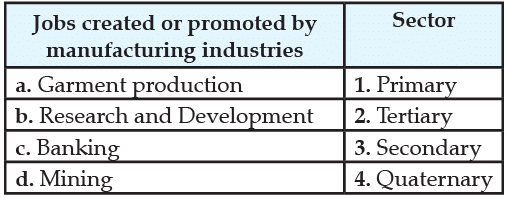 Choose the correct option:
- a)a-1, b-2, c-3, d-4
- b)a-3, b-4, c-2, d-1
- c)a-2, b-3, c-1, d-2
- d)a-4, b-1, c-4, d-3
Correct answer is option 'B'. Can you explain this answer?
Read the text given below and answer the questions that follows:
Manufacturing industries not only help in modernising agriculture, which forms the backbone of our economy, they also reduce the heavy dependence of people on agricultural income by providing them jobs in secondary and tertiary sectors. Industrial development is a precondition for eradication of unemployment and poverty from our country. This was the main philosophy behind public sector industries and joint sector ventures in India. It was also aimed at bringing down regional disparities by establishing industries in tribal and backward areas. Export of manufactured goods expands trade and commerce, and brings in much needed foreign exchange. Countries that transform their raw materials into a wide variety of finished goods of higher value are prosperous. India’s prosperity lies in increasing and diversifying its manufacturing industries as quickly as possible. Agriculture and industry are not exclusive to each other. They move hand in hand. For instance, the agro-industries in India have given a major boost to agriculture by raising its productivity.
Answer the following MCQs by choosing the most appropriate option.
Q. Manufacturing provides job opportunities to reduce dependence on agriculture. Identify which sector the following jobs belong to:
Choose the correct option:
a)
a-1, b-2, c-3, d-4
b)
a-3, b-4, c-2, d-1
c)
a-2, b-3, c-1, d-2
d)
a-4, b-1, c-4, d-3

|
Subset Academy answered |
(a) Garment production belongs to Secondary Sector.
(b) Research and Development belongs to Quaternary Sector.
(c) Banking belongs to Tertiary Sector.
(d) Mining belongs to Primary Sector.
Manufacturing industries includes :- a)Crop production
- b)Fish production
- c)Plantation
- d)Sugar Production
Correct answer is option 'D'. Can you explain this answer?
a)
Crop production
b)
Fish production
c)
Plantation
d)
Sugar Production
|
|
Avantika Ahuja answered |
Manufacturing industries and Sugar Production
Manufacturing industries refer to those industries which involve the production of goods by transforming raw materials into finished products. Industries such as textiles, chemicals, food processing, machinery, etc., are examples of manufacturing industries.
Sugar production is also a manufacturing industry that involves the processing of sugar cane or sugar beet to produce sugar. The production of sugar involves various stages of processing such as extraction, purification, clarification, evaporation, crystallization, and drying.
Importance of Sugar Production
Sugar production is an important industry as it is a major source of employment and revenue for many countries. It is also an important raw material for the food industry, and is used in the production of various food products such as confectionery, beverages, bakery products, and canned foods.
Additionally, sugar is also used in the production of biofuels, which are becoming increasingly important as a source of renewable energy.
Challenges in Sugar Production
The sugar production industry faces several challenges such as fluctuating prices, competition from alternative sweeteners, and environmental concerns. Additionally, the industry also faces issues related to sustainability, as the production of sugar cane and sugar beet requires large amounts of water and energy and can have negative impacts on soil health and biodiversity.
Conclusion
In conclusion, sugar production is an important manufacturing industry that plays a crucial role in the global economy. Despite the challenges it faces, the industry continues to evolve and adapt to changing market conditions and consumer preferences.
Manufacturing industries refer to those industries which involve the production of goods by transforming raw materials into finished products. Industries such as textiles, chemicals, food processing, machinery, etc., are examples of manufacturing industries.
Sugar production is also a manufacturing industry that involves the processing of sugar cane or sugar beet to produce sugar. The production of sugar involves various stages of processing such as extraction, purification, clarification, evaporation, crystallization, and drying.
Importance of Sugar Production
Sugar production is an important industry as it is a major source of employment and revenue for many countries. It is also an important raw material for the food industry, and is used in the production of various food products such as confectionery, beverages, bakery products, and canned foods.
Additionally, sugar is also used in the production of biofuels, which are becoming increasingly important as a source of renewable energy.
Challenges in Sugar Production
The sugar production industry faces several challenges such as fluctuating prices, competition from alternative sweeteners, and environmental concerns. Additionally, the industry also faces issues related to sustainability, as the production of sugar cane and sugar beet requires large amounts of water and energy and can have negative impacts on soil health and biodiversity.
Conclusion
In conclusion, sugar production is an important manufacturing industry that plays a crucial role in the global economy. Despite the challenges it faces, the industry continues to evolve and adapt to changing market conditions and consumer preferences.
Assertion: Textile industry occupies a unique position in the Indian economy.
Reason: It contributes significantly to industrial production.- a)Both A and R are true and R is the correct explanation of A
- b)Both A and R are true but R is not the correct explanation of A
- c)A is correct but R is wrong
- d)A is wrong but R is correct
Correct answer is option 'A'. Can you explain this answer?
Assertion: Textile industry occupies a unique position in the Indian economy.
Reason: It contributes significantly to industrial production.
Reason: It contributes significantly to industrial production.
a)
Both A and R are true and R is the correct explanation of A
b)
Both A and R are true but R is not the correct explanation of A
c)
A is correct but R is wrong
d)
A is wrong but R is correct
|
|
Nitesh Singla answered |
Correct answer is option 'A'
How to manufacture Steel?(i) Pig iron(ii) Blast furnace(iii) Shaping metal(iv) Steel making- a)(ii) - (i) - (iv) - (iii)
- b)(iii) - (i) - (iv) - (ii)
- c)(i) - (iv) - (ii) - (iii)
- d)(ii) - (iii) - (iv) - (i)
Correct answer is option 'A'. Can you explain this answer?
How to manufacture Steel?
(i) Pig iron
(ii) Blast furnace
(iii) Shaping metal
(iv) Steel making
a)
(ii) - (i) - (iv) - (iii)
b)
(iii) - (i) - (iv) - (ii)
c)
(i) - (iv) - (ii) - (iii)
d)
(ii) - (iii) - (iv) - (i)
|
|
Avinash Patel answered |
Steel is made primarily in a two-step process. In the primary steelmaking step, liquid iron is converted into steel by the basic oxygen furnace (BOF) process, or by melting scrap steel or direct reduced iron (DRI) in an electric arc furnace.
Read the text given below and answer the questions that follows:Every litre of waste water discharged by our industry pollutes eight times the quantity of fresh water. How can the industrial pollution of fresh water be reduced ? Some suggestions are-(i) minimising the use of water for processing by reusing and recycling it in two or more successive stages.(ii) harvesting of rainwater to meet water requirements.(iii) treating hot water and effluents before releasing them in rivers and ponds. Treatment of industrial effluents can be done in three phases.(a) Primary treatment by mechanical means it involves screening, grinding, flocculation and sedimentation.(b) Secondary treatment by biological process.(c) Tertiary treatment by biological, chemical and physical processes. This involves recycling of waste water.Overdrawing of ground water reserves by industry where there is a threat to ground water resources also needs to be regulated legally. Particulate matter in the air can be reduced by fitting smoke stacks to factories with electrostatic precipitators, fabric filters, scrubbers and inertial separators. Smoke can be reduced by using oil or gas instead of coal in factories. Machinery and equipment can be used and generators should be fitted with silencers. Almost all machinery can be redesigned to increase energy efficiency and reduce noise. Noise absorbing material may be used apart from personal use of earplugs and earphones. The challenge of sustainable development requires integration of economic development with environmental concerns.Answer the following MCQs by choosing the most appropriate option.Q. How many treatments are there for industrial effluents?- a)3
- b)2
- c)5
- d)4
Correct answer is option 'A'. Can you explain this answer?
Read the text given below and answer the questions that follows:
Every litre of waste water discharged by our industry pollutes eight times the quantity of fresh water. How can the industrial pollution of fresh water be reduced ? Some suggestions are-
(i) minimising the use of water for processing by reusing and recycling it in two or more successive stages.
(ii) harvesting of rainwater to meet water requirements.
(iii) treating hot water and effluents before releasing them in rivers and ponds. Treatment of industrial effluents can be done in three phases.
(a) Primary treatment by mechanical means it involves screening, grinding, flocculation and sedimentation.
(b) Secondary treatment by biological process.
(c) Tertiary treatment by biological, chemical and physical processes. This involves recycling of waste water.
Overdrawing of ground water reserves by industry where there is a threat to ground water resources also needs to be regulated legally. Particulate matter in the air can be reduced by fitting smoke stacks to factories with electrostatic precipitators, fabric filters, scrubbers and inertial separators. Smoke can be reduced by using oil or gas instead of coal in factories. Machinery and equipment can be used and generators should be fitted with silencers. Almost all machinery can be redesigned to increase energy efficiency and reduce noise. Noise absorbing material may be used apart from personal use of earplugs and earphones. The challenge of sustainable development requires integration of economic development with environmental concerns.
Answer the following MCQs by choosing the most appropriate option.
Q. How many treatments are there for industrial effluents?
a)
3
b)
2
c)
5
d)
4
|
|
Rohit Sharma answered |
There are three main stages of the wastewater treatment process, aptly known as primary, secondary and tertiary water treatment.
Direction: In the Following Questions, A Statement Of Assertion Is Followed By A Statement Of Reason. Mark The Correct Choice As:Assertion : Chemical industries are lagging behind in India.Reason : Only small scale industries are present and growth of this industry is very less comparatively.- a)If Both assertion and reason are true and reason is the correct explanation of assertion.
- b)If Both assertion and reason are true but reason is not the correct explanation of assertion.
- c)If Assertion is true but reason is false.
- d)If Both assertion and reason are false.
Correct answer is option 'D'. Can you explain this answer?
Direction: In the Following Questions, A Statement Of Assertion Is Followed By A Statement Of Reason. Mark The Correct Choice As:
Assertion : Chemical industries are lagging behind in India.
Reason : Only small scale industries are present and growth of this industry is very less comparatively.
a)
If Both assertion and reason are true and reason is the correct explanation of assertion.
b)
If Both assertion and reason are true but reason is not the correct explanation of assertion.
c)
If Assertion is true but reason is false.
d)
If Both assertion and reason are false.
|
|
Kiran Mehta answered |
Chemical industries in India are fast growing and diversifying .There is a rapid growth in the manufacture of organic and inorganic chemicals.
Chapter doubts & questions for Manufacturing Industries - Geography for Grade 10 2026 is part of Grade 10 exam preparation. The chapters have been prepared according to the Grade 10 exam syllabus. The Chapter doubts & questions, notes, tests & MCQs are made for Grade 10 2026 Exam. Find important definitions, questions, notes, meanings, examples, exercises, MCQs and online tests here.
Chapter doubts & questions of Manufacturing Industries - Geography for Grade 10 in English & Hindi are available as part of Grade 10 exam.
Download more important topics, notes, lectures and mock test series for Grade 10 Exam by signing up for free.
Geography for Grade 10
17 videos|50 docs|35 tests
|
