
Indian Polity - 4 - Free MCQ Test with solutions for UPSC
MCQ Practice Test & Solutions: Indian Polity - 4 (20 Questions)
You can prepare effectively for UPSC Additional Study Material for UPSC with this dedicated MCQ Practice Test (available with solutions) on the important topic of "Indian Polity - 4". These 20 questions have been designed by the experts with the latest curriculum of UPSC 2026, to help you master the concept.
Test Highlights:
- - Format: Multiple Choice Questions (MCQ)
- - Duration: 20 minutes
- - Number of Questions: 20
Sign up on EduRev for free to attempt this test and track your preparation progress.

Under which Article of the Indian Constitution did the President make a reference to the Supreme Court to seek the Court's opinion on the Constitutional validity of the Election Commission's decision on deferring the Gujarat Assembly elections (in the year 2002)?
Detailed Solution: Question 1
Consider the following statements:
1. While members of the Rajya Sabha are associated with Committees on Public Accounts and Public Undertakings, members of Committee on Estimates are drawn entirely from Lok Sabha.
2. The Ministry of Parliamentary Affairs works under the overall direction of Cabinet Committee on Parliamentary Affairs.
3. The Minister of Parliamentary Affairs nominates Members of Parliament on Committees, Councils, Board and Commissions etc. set up by the Government of India in the various ministries.
Q. Which of these statements are correct?
1. While members of the Rajya Sabha are associated with Committees on Public Accounts and Public Undertakings, members of Committee on Estimates are drawn entirely from Lok Sabha.
2. The Ministry of Parliamentary Affairs works under the overall direction of Cabinet Committee on Parliamentary Affairs.
3. The Minister of Parliamentary Affairs nominates Members of Parliament on Committees, Councils, Board and Commissions etc. set up by the Government of India in the various ministries.
Detailed Solution: Question 2

As per Indian Protocol, who among the following ranks highest in the order of precedence?
Detailed Solution: Question 3
Which one of the following Articles of the Indian Constitution provides that it shall be the duty of the Union to protect every State against external aggression and internal disturbance?
Detailed Solution: Question 4
Consider the following statements: In India, stamp duties on financial transactions are
1. levied and collected by the State Government.
2. appropriated by the Union Government.
Q. Which of these statements is/are correct?
1. levied and collected by the State Government.
2. appropriated by the Union Government.
Q. Which of these statements is/are correct?
Detailed Solution: Question 5
Match List-I with List-II and select the correct answer using the codes given below the lists:
List-I (Item in the Indian Constitution) List-II (Country from which it was derived)
A. Directive Principles of State Policy 1. Australia
B. Fundamental Rights 2. Canada
C. Concurrent List, Union-State Relations 3. Ireland
D. India as a Union of States with greater 4. United Kingdom
powers to the Union 5. United States of America
List-I (Item in the Indian Constitution) List-II (Country from which it was derived)
A. Directive Principles of State Policy 1. Australia
B. Fundamental Rights 2. Canada
C. Concurrent List, Union-State Relations 3. Ireland
D. India as a Union of States with greater 4. United Kingdom
powers to the Union 5. United States of America
Detailed Solution: Question 6
Which one of the following Bills must be passed by each House of the Indian Parliament separately, by special majority?
Detailed Solution: Question 7
Consider the following statements:
The function(s) of the Finance Commission is/are
1. to allow the withdrawal of the money out of the Consolidated Fund of India.
2. to allocate the shares of proceeds of taxes between the States
3. to consider applications for grants-in-aid from States.
4. to supervise and report on whether the Union and State governments are levying taxes in accordance with the budgetary provisions.
Q. Which of these statements is/are correct?
The function(s) of the Finance Commission is/are
1. to allow the withdrawal of the money out of the Consolidated Fund of India.
2. to allocate the shares of proceeds of taxes between the States
3. to consider applications for grants-in-aid from States.
4. to supervise and report on whether the Union and State governments are levying taxes in accordance with the budgetary provisions.
Q. Which of these statements is/are correct?
Detailed Solution: Question 8
Consider the following statements: In the electoral college for Presidential Election in India,
1. the value of the vote of an elected Member of Legislative Assembly = State Population/ (Number of Elected MLAs of the state X 100)
2. the value of the vote of an elected Member of Parliament = Total value of the votes of the elected MLAs/ Total Number of elected MPs
3. there were more than 5000 members in the latest elections.
Q. Which of these statements is/are correct?
1. the value of the vote of an elected Member of Legislative Assembly = State Population/ (Number of Elected MLAs of the state X 100)
2. the value of the vote of an elected Member of Parliament = Total value of the votes of the elected MLAs/ Total Number of elected MPs
3. there were more than 5000 members in the latest elections.
Q. Which of these statements is/are correct?
Detailed Solution: Question 9
Which one of the following schedules of the Indian Constitution lists the names of states and specifies their territories?
Detailed Solution: Question 10
Consider the following statements:
1. The highest criminal court of the district is the Court of District and Sessions Judge.
2. The District Judges are appointed by the Governor in consultation with the High Courts.
3. A person to be eligible for appointment as a District Judge should be an advocate or a pleader of seven years standing or more, or an officer in judicial service of the Union or the State.
4. When the Sessions Judge awards death sentence, it must be confirmed by the High Court before it is carried out.
Q. Which of the statements given above are correct?
1. The highest criminal court of the district is the Court of District and Sessions Judge.
2. The District Judges are appointed by the Governor in consultation with the High Courts.
3. A person to be eligible for appointment as a District Judge should be an advocate or a pleader of seven years standing or more, or an officer in judicial service of the Union or the State.
4. When the Sessions Judge awards death sentence, it must be confirmed by the High Court before it is carried out.
Q. Which of the statements given above are correct?
Detailed Solution: Question 11
Consider the following statements:
1. The Speaker of Lok Sabha has the power to adjourn the House sine die but, on prorogation, it is only the President who can summon the House.
2. Unless sooner dissolved or there is an extension of the term, there is, an automatic dissolution of the Lok Sabha by efflux of time, at the end of the period of five years, even if no formal order of dissolution is issued by the President.
3. The Speaker of Lok Sabha continues in office even after the dissolution of the House and until 'immediately before the first meeting of the House'.
Q. Which of the statements given above are correct?
1. The Speaker of Lok Sabha has the power to adjourn the House sine die but, on prorogation, it is only the President who can summon the House.
2. Unless sooner dissolved or there is an extension of the term, there is, an automatic dissolution of the Lok Sabha by efflux of time, at the end of the period of five years, even if no formal order of dissolution is issued by the President.
3. The Speaker of Lok Sabha continues in office even after the dissolution of the House and until 'immediately before the first meeting of the House'.
Detailed Solution: Question 12
Detailed Solution: Question 13
Which one of the following statements correctly describes the Fourth Schedule of the Constitution of India?
Detailed Solution: Question 14
The resolution for removing the Vice-President of India can be moved in the:
Detailed Solution: Question 15
With reference to the Constitution of India, which one of the following pairs is not correctly matched?
Detailed Solution: Question 16
Consider the following tasks:
1. Superintendence, direction and conduct of free and fair elections
2. Preparation of electoral rolls for all elections to the Parliament, State Legislatures and the Office of the President and the Vice-President
3. Giving recognition to political parties and allotting election symbols to political parties and individuals contesting the election
4. Proclamation of final verdict in the case of election disputes
Q. Which of the above are the functions of the Election Commission of India?
1. Superintendence, direction and conduct of free and fair elections
2. Preparation of electoral rolls for all elections to the Parliament, State Legislatures and the Office of the President and the Vice-President
3. Giving recognition to political parties and allotting election symbols to political parties and individuals contesting the election
4. Proclamation of final verdict in the case of election disputes
Detailed Solution: Question 17
With reference to Indian Parliament, which one of the following is not correct?
Detailed Solution: Question 18
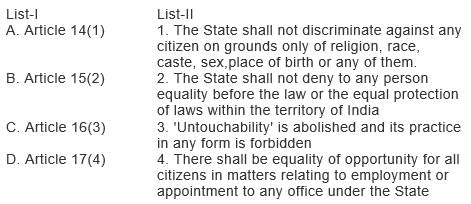
Match List-I (Articles of the Constitution of India) with List-II (Provision) and select the correct answer using the codes given below the lists:
Detailed Solution: Question 19
Which Article of the Constitution of India says, 'No child below the age of fourteen years shall be employed to work in any factory or mine or engaged in any other hazardous employment’?
Detailed Solution: Question 20
18 videos|561 docs|160 tests |
