UPSC Exam  >  UPSC Test  >  Additional Study Material  >  Test: UPSC Prelims (Past Year Questions) Modern History 2015-20 - 2 - UPSC MCQ

UPSC Prelims (Past Year Questions) Modern History 2015-20 - 2 with solutions


MCQ Practice Test & Solutions: Test: UPSC Prelims (Past Year Questions) Modern History 2015-20 - 2 (20 Questions)

You can prepare effectively for UPSC Additional Study Material for UPSC with this dedicated MCQ Practice Test (available with solutions) on the important topic of "Test: UPSC Prelims (Past Year Questions) Modern History 2015-20 - 2". These 20 questions have been designed by the experts with the latest curriculum of UPSC 2026, to help you master the concept.

Test Highlights:

  • - Format: Multiple Choice Questions (MCQ)
  • - Duration: 24 minutes
  • - Number of Questions: 20

Sign up on EduRev for free to attempt this test and track your preparation progress.

Test: UPSC Prelims (Past Year Questions) Modern History 2015-20 - 2 - Question 1

With the reference to educational institutions during rule in India, consider the following pairs:
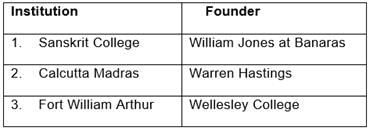
Which of the pairs given below is/are correct? (2018)

Detailed Solution: Question 1

Warren Hastings, himself an intellectual, set up the Calcutta Madrasa in 1781 for the study and learning of Persian and Arabic. In 1791 the efforts of Jonathan Duncan, the British Resident at Benares, bore fruit and a Sanskrit College was opened at Benares. Lord Richard Colley Wellesley (NOT ARTHUR WELLESLEY) took the first step for training of Civil Servants when he founded the fort William College, in Calcutta in November 1800 where the Civil Servants of the Company were to receive training in the literature, science and languages of India.

Test: UPSC Prelims (Past Year Questions) Modern History 2015-20 - 2 - Question 2

Regarding Wood’s Dispatch, which of the following statements are true?

1. Grants-in-Aid system was introduced.

2. Establishment of universities was recommended.

3. English as a medium of instruction at all levels of education was recommended.

Select the correct answer using the code given below: (2018)

Detailed Solution: Question 2

Wood’s Despatch is called Magnacarta of English Education in India. As per this despatch

1. An education department was to be set in every province.

2. Universities on the model of the London University be established in big cities such as Bombay, Calcutta and Madras.

3. At least one government school be opened in every district.

4. Affiliated private schools should be given grant in aid.

5. The Indian natives should be given training in their mother tongue also.

6. In accordance with Wood’s despatch, Education Departments were established in every province and universities were opened at Calcutta, Bombay and Madras in 1857 on the model of the London University.

7. Later more universities were opened in Punjab in 1882 and at Allahabad 1887.

Test: UPSC Prelims (Past Year Questions) Modern History 2015-20 - 2 - Question 3

In the Federation established by The Government of India Act of 1935, residuary powers were given to the (2018)

Detailed Solution: Question 3

Residuary legislative powers were vested in the Governor-General under the Government of India Act of 1935.

Test: UPSC Prelims (Past Year Questions) Modern History 2015-20 - 2 - Question 4

Who among the following was/were associated with the introduction of Ryotwari Settlement in India during the British rule?

1. Lord Cornwallis

2. Alexander Read

3. Thomas Munro

Select the correct answer using the code given below: (2017)

Detailed Solution: Question 4

Statement 1 and 3: The Ryotwari system was devised by Capt. Alexander Read and Thomas Munro at the end of the 18th century. It was later introduced by Thomas Munro when he was governor (1820–27) of Madras.

Statement 2: He is associated with the Cornwallis Code 1793 and could not have been the answer since his tenure preceded the ryotwari settlement regime. The principle behind Roytwari was the direct collection of the land revenue from each individual cultivator by government agents.

Test: UPSC Prelims (Past Year Questions) Modern History 2015-20 - 2 - Question 5

Consider the following statements:

1. The Factories Act, 1881 was passed with a view to fix the wages of industrial workers and to allow the workers to form trade unions.

2. N.M. Lokhande was a pioneer in organizing the labour movement in British India. Which of the above statements is/are correct? (2017)

Detailed Solution: Question 5

Statement 1: It is wrong. The 1881 Act aimed to improve working condtions of labour. It prohibited the employment of children under the age of seven, limited the number of working hours for children below the age of twelve and required that dangerous machinery should be fenced properly.

Statement 2: Lokhande was a pioneer of the labour movement in India. He is remembered not only for ameliorating the working conditions of textile mill-hands in the 19th century but also for his courageous initiatives on caste and communal issues.

Test: UPSC Prelims (Past Year Questions) Modern History 2015-20 - 2 - Question 6

The object of the Butler Committee of 1927 was to? (2017)

Detailed Solution: Question 6

It was also known as the Indian states committee. Relations between the Indian Princes and the crown were not well defined because the extent of sovereignty of the Paramount power was not settled properly. The Indian states committee (under the Chairmanship of Harcourt Butler) in 1927 was appointed to investigate and clarify the relationship between the paramount power and the Princes of princely states.

Test: UPSC Prelims (Past Year Questions) Modern History 2015-20 - 2 - Question 7

Consider the following pairs:

1. Radhakanta Deb — First President of the British Indian Association

2. Gazulu Lakshminarasu Chetty —Founder of the Madras Mahajana Sabha

3. Surendranath Banerjee — Founder of the Indian Association

Which of the above pairs is/are correctly matched? (2017)

Detailed Solution: Question 7

Statement 1: The first committee of the association was composed of: Raja Radhakanta Deb – President, Raja Kalikrishna Deb – Vice-President, Debendranath Tagore – secretary, etc.

Statement 2: In 1884, M. Veeraraghavachariar, G. Subramania Iyer and P. Anandacharlu established the Madras Mahajana Sabha.

Statement 3: I was the first a vowed nationalist organization founded in British India by Surendranath Banerjee and Ananda Mohan Bose in 1876.

Test: UPSC Prelims (Past Year Questions) Modern History 2015-20 - 2 - Question 8

In the context of Indian history, the principle of `Dyarchy (diarchy)’ refers to

Test: UPSC Prelims (Past Year Questions) Modern History 2015-20 - 2 - Question 9

With reference to Indian freedom struggle, consider the following events :

1. Mutiny in Royal Indian Navy

2. Quit India Movement launched

3. Second Round Table Conference

What is the correct chronological sequence of the above events ? (2017)

Detailed Solution: Question 9

Second Round Conference happened in 1931, Quit India Movement in 1942 and Mutiny in Royal Indian Navy in 1946.

Test: UPSC Prelims (Past Year Questions) Modern History 2015-20 - 2 - Question 10

The `Swadeshi’ and ‘Boycott’ were adopted as methods of struggle for the first time during the (2016)

Detailed Solution: Question 10

Straightforward answer.

Test: UPSC Prelims (Past Year Questions) Modern History 2015-20 - 2 - Question 11

Satya Shodhak Samaj organized

Test: UPSC Prelims (Past Year Questions) Modern History 2015-20 - 2 - Question 12

The Montague-Chelmsford Proposals were related to

Detailed Solution: Question 12

They introduced by the British Government in India to introduce self-governing institutions gradually to India. They formed the basis of the Government of India Act 1919.

Test: UPSC Prelims (Past Year Questions) Modern History 2015-20 - 2 - Question 13

Consider the following :

1. Calcutta Unitarian Committee

2. Tabernacle of New Dispensation

3. Indian Reform Association

Keshab Chandra Sen is associated with the establishment of which of the above? (2016)

Detailed Solution: Question 13

Calcutta Unitarian Committee was established in 1823 by Rammohun Roy, Dwarkanath Tagore, and William Adam. So, 1 is wrong. In 1868, Keshub laid the foundation stone of his new church, the Tabernacle of New Dispensation. So, 2 is correct. Indian reform association was founded in 1870 with Keshub Chunder Sen as president. It represented the secular side of the Brahmo Samaj and included many who did not belong to the Brahmo Samaj. So, 3 is correct.

Test: UPSC Prelims (Past Year Questions) Modern History 2015-20 - 2 - Question 14

What was the main reason for the split in the Indian National Congress at Surat in 1907? (2016)

Test: UPSC Prelims (Past Year Questions) Modern History 2015-20 - 2 - Question 15

The plan of Sir Stafford Cripps envisaged that after the Second World War

Test: UPSC Prelims (Past Year Questions) Modern History 2015-20 - 2 - Question 16

With reference to cabinet mission, which of the following statements is/are correct?

1. It recommended a federal government.

2. It enlarged the powers of the Indian courts.

3. It provided for more Indians in the ICS

Select the correct answer using the code given below. (2015)

Detailed Solution: Question 16

The cabinet mission plan of 1946 proposed that there shall be a Union of India which was to be empowered to deal with the defense, foreign affairs and communications.
  • The Union Government and its legislature were to have limited powers, dealing with Finance, Foreign Affairs and Communications. The union would have powers necessary to raise the finances to manage the subjects.

  • All subjects other than the Union Subjects and all the residuary powers would be vested in the provinces.

  • Thus, the Cabinet Mission plan proposed a weak Centre with Provincial autonomy – essentially proposing a federal structure of government.

Test: UPSC Prelims (Past Year Questions) Modern History 2015-20 - 2 - Question 17

Which one of the following movements has contributed to a split in the Indian National Congress resulting in emergence of ‘moderates’ and ‘extremists’? (2015)

Detailed Solution: Question 17

Surat split was due to disagreements between Moderates and extremists regarding the methods for protest against the partition of Bengal (in the Swadeshi Movement). Answer cannot be B, C or D, because moderates and extremists re-united in the Lucknow session, 1916 which was before Non-cooperation/Quit India/Civil Disobedience Movements.

Test: UPSC Prelims (Past Year Questions) Modern History 2015-20 - 2 - Question 18

With reference to Rowlatt Satyagraha, which of the following statements is/are correct?

1. The Rowlatt Act was based on the recommendations of the ‘Sedition Committee’

2. In Rowlatt Satyagraha Gandhiji tried to use the Home Rule League

3. Demonstrations against the Simon Commission coincided with the Rowlatt Satyagraha

Select the correct answer using the code given below. (2015)

Test: UPSC Prelims (Past Year Questions) Modern History 2015-20 - 2 - Question 19

With reference to Congress Socialist Party, consider the following statements:

1. It advocated the boycott of British goods and evasion of taxes.

2. It wanted to establish the dictatorship of proletariat.

3. It advocated separate electorate for minorities and oppressed classes.

Which of the statements given above is/are correct? (2015)

Detailed Solution: Question 19

The CSP advocated decentralized socialism in which co-operatives, trade unions, independent farmers, and local authorities would hold a substantial share of the economic power. As secularists, they hoped to transcend communal divisions through class solidarity. Some, such as Narendra Deva or Basawon Singh (Sinha), advocated a democratic socialism distinct from both Marxism and reformist social democracy.

Test: UPSC Prelims (Past Year Questions) Modern History 2015-20 - 2 - Question 20

The Government of India Act of 1919 clearly defined (2015)

Detailed Solution: Question 20

It relaxed the central control over the provinces by demarcating and separating the central and provincial subjects. The central and provincial legislatures were authorised to make laws on their respective list of subjects. However, the structure of government continued to be centralised and unitary. It further divided the provincial subjects into two parts—transferred and reserved which is what we know as diarchy.

18 videos|561 docs|160 tests
Information about Test: UPSC Prelims (Past Year Questions) Modern History 2015-20 - 2 Page
In this test you can find the Exam questions for Test: UPSC Prelims (Past Year Questions) Modern History 2015-20 - 2 solved & explained in the simplest way possible. Besides giving Questions and answers for Test: UPSC Prelims (Past Year Questions) Modern History 2015-20 - 2, EduRev gives you an ample number of Online tests for practice
Download as PDF