JEE Exam  >  JEE Test  >  Chemistry Main & Advanced  >  s-Block Elements (Alkali and Alkaline Earth Metals) - 2 - JEE MCQ

s-Block Elements (Alkali and Alkaline Earth Metals) - 2 - Free MCQ Test


MCQ Practice Test & Solutions: s-Block Elements (Alkali and Alkaline Earth Metals) - 2 (30 Questions)

You can prepare effectively for JEE Chemistry for JEE Main & Advanced with this dedicated MCQ Practice Test (available with solutions) on the important topic of "s-Block Elements (Alkali and Alkaline Earth Metals) - 2". These 30 questions have been designed by the experts with the latest curriculum of JEE 2026, to help you master the concept.

Test Highlights:

  • - Format: Multiple Choice Questions (MCQ)
  • - Duration: 60 minutes
  • - Number of Questions: 30

Sign up on EduRev for free to attempt this test and track your preparation progress.

s-Block Elements (Alkali and Alkaline Earth Metals) - 2 - Question 1

An alkaline earth metal (M) gives a salt with chlorine, which is soluble in water at room temperature. It also forms an insoluble sulphate whose mixture with a sulphide of a transition metal is called `lithopone'-a white pigment. Metal M is-

Detailed Solution: Question 1

Lithopane is (BaSO4 + ZnS)
white pigment
BaSO4 is insoluble in water

s-Block Elements (Alkali and Alkaline Earth Metals) - 2 - Question 2

The hydroxide of alkaline earth metal, which has the lowest value of solubility product (Ksp) at normal temperature (25°C) is-

Detailed Solution: Question 2
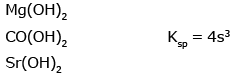
Be(OH)2 down the group solubility increase

s-Block Elements (Alkali and Alkaline Earth Metals) - 2 - Question 3

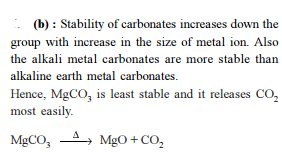
Which of the following carbonate of alkali metals has the least thermal stability ?

Detailed Solution: Question 3

T.S ∞ Ionic character (for polyatomic anion)
Li2CO3 is least ionic or most covalent

s-Block Elements (Alkali and Alkaline Earth Metals) - 2 - Question 4

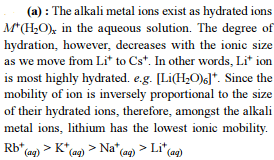
The solubility of metal halides depends on their nature, lattice enthalpy and hydration enthalpy of the individual ions. Amongst fluorides of alkali metals, the lowest solubility of LiF in water is due to

Detailed Solution: Question 4

K2O,    KO2,  K2O2
Rb2O,   RbO2,   Rb2O2
Na, Li from normal oxide

s-Block Elements (Alkali and Alkaline Earth Metals) - 2 - Question 5

The formula of soda ash is

Detailed Solution: Question 5

Soda ash is Na2CO3.

s-Block Elements (Alkali and Alkaline Earth Metals) - 2 - Question 6

The golden yellow colour associated with NaCl to Bunsen flame can be explained on the basis of -

Detailed Solution: Question 6

In frame test thermal excitation deexcitation takes place in cation with low Ionisation potential

s-Block Elements (Alkali and Alkaline Earth Metals) - 2 - Question 7

CsBr3 contains -?

Detailed Solution: Question 7

Cs is highly electropositive & forms ionic bond with Cs+ cation.

s-Block Elements (Alkali and Alkaline Earth Metals) - 2 - Question 8

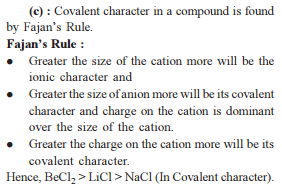
The correct order of solubility is -?

Detailed Solution: Question 8

Evident from Fajan rule

s-Block Elements (Alkali and Alkaline Earth Metals) - 2 - Question 9

When K2O is added to water, the solution becomes basic in nature because it contains a significant concentration of -

Detailed Solution: Question 9

K2O + H2O → KOH

s-Block Elements (Alkali and Alkaline Earth Metals) - 2 - Question 10


Detailed Solution: Question 10


s-Block Elements (Alkali and Alkaline Earth Metals) - 2 - Question 11


Detailed Solution: Question 11


s-Block Elements (Alkali and Alkaline Earth Metals) - 2 - Question 12


Detailed Solution: Question 12


s-Block Elements (Alkali and Alkaline Earth Metals) - 2 - Question 13


Detailed Solution: Question 13


s-Block Elements (Alkali and Alkaline Earth Metals) - 2 - Question 14


Detailed Solution: Question 14


s-Block Elements (Alkali and Alkaline Earth Metals) - 2 - Question 15

Which is not correctly matched ?

(1) Basic strength of oxides     Cs2O< />2O< K2O < Na2O < Li2O

(2) Stability of peroxides    Na2O2 < K2O2 < Rb2O2 < Cs2O2

(3) Stability of bicarbonates    LiHCO3 < NaHCO3 < KHCO3 < RbHCO3 < CsHCO3

(4) Melting point    NaF < NaCl < NaBr < NaI

Detailed Solution: Question 15

Basic strength of the oxides increase in the order Li2O < Na2O < K2O < Rb2O < Cs2O. The increase in basic strength is due to the decrease in I.E. down the group.

The melting point of the halides decrease in the order NaF < NaCl < NaBr < NaI, because of the decrease in lattice energies, as the size of the halide ion increases.

s-Block Elements (Alkali and Alkaline Earth Metals) - 2 - Question 16


Detailed Solution: Question 16


s-Block Elements (Alkali and Alkaline Earth Metals) - 2 - Question 17

The set representing the correct order of first ionization potential is

Detailed Solution: Question 17

Down the group size of atoms increases, therefore, the distance between the nucleus and the valence electron to be removed increases. So the attraction between nucleus and that electron decreases. Hence the ionization potential decreases down the group.

s-Block Elements (Alkali and Alkaline Earth Metals) - 2 - Question 18

Which of the follownig acids will not evolve H2 gas on reaction with alkali metals

Detailed Solution: Question 18

None of the acids evolve H2 gas with alkali metals.

s-Block Elements (Alkali and Alkaline Earth Metals) - 2 - Question 19

The first four ionization potentials (eV) are given for two elements X and Y. Identify them.

X : 8.296, 25.149, 37.92, 259.298

Y : 5.318, 47.29, 71.65, 98.88

Detailed Solution: Question 19

in X, IVth I.P. is very large & in Y second I.P. is very large

s-Block Elements (Alkali and Alkaline Earth Metals) - 2 - Question 20

About alkali metal-liquid NH3 solution which of following statement is not true ?

Detailed Solution: Question 20

Blue colour changes to bronze with increase in concentration of alkali metal due to formation of metal clusters.

s-Block Elements (Alkali and Alkaline Earth Metals) - 2 - Question 21

Select the correct set of statements

(i) Solubility of alkali metal hydroxides is in order

CsOH > RbOH > KOH > NaOH > LiOH

(ii) Solubility of alkali carbonates is in order

Li2CO3 > Na2CO3 > K2CO3 > Rb2CO3> Cs2O3

(iii) Hydrated radii is in order

Li+ < Na+ < K+ < Rb+ < Cs+

(iv) Stability of peroxides is in order

Na2O2 < K2O2 < Rb2O2 < Cs2O2

The options are :

s-Block Elements (Alkali and Alkaline Earth Metals) - 2 - Question 22


Detailed Solution: Question 22


s-Block Elements (Alkali and Alkaline Earth Metals) - 2 - Question 23


Detailed Solution: Question 23


s-Block Elements (Alkali and Alkaline Earth Metals) - 2 - Question 24


Detailed Solution: Question 24


s-Block Elements (Alkali and Alkaline Earth Metals) - 2 - Question 25

The alkali metal hydroxides dissolve freely in water with evolution of much heat on account of :

Detailed Solution: Question 25

True statement.

s-Block Elements (Alkali and Alkaline Earth Metals) - 2 - Question 26

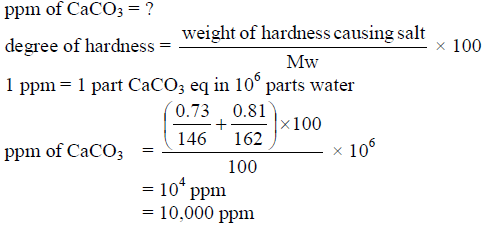
100 mL of a water sample contains 0.81 g of calcium bicarbonate and 0.73 g of magnesium bicarbonate. The hardness of this water sample expressed in terms of equivalents of CaCO3 is - (molar mass of calcium bicarbonate is 162 g mol–1 and magnesium bicarbonate is 146 g mol–1)

Detailed Solution: Question 26

s-Block Elements (Alkali and Alkaline Earth Metals) - 2 - Question 27

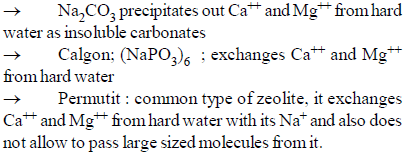
Which of the following is not a water softener?

Detailed Solution: Question 27

s-Block Elements (Alkali and Alkaline Earth Metals) - 2 - Question 28


Detailed Solution: Question 28


s-Block Elements (Alkali and Alkaline Earth Metals) - 2 - Question 29


Detailed Solution: Question 29


s-Block Elements (Alkali and Alkaline Earth Metals) - 2 - Question 30


Detailed Solution: Question 30


335 videos|699 docs|300 tests
Information about s-Block Elements (Alkali and Alkaline Earth Metals) - 2 Page
In this test you can find the Exam questions for s-Block Elements (Alkali and Alkaline Earth Metals) - 2 solved & explained in the simplest way possible. Besides giving Questions and answers for s-Block Elements (Alkali and Alkaline Earth Metals) - 2, EduRev gives you an ample number of Online tests for practice
335 videos|699 docs|300 tests
Download as PDF