
|
 Alligation & Mixture 28 Flashcards |

Start
|

|
What is the Mixture Rule in the context of combining two or more mixtures? |

Card: 1 / 28 |
|
|
The Mixture Rule states that when two different mixtures are combined, the overall concentration of a component can be found using the weighted average of the concentrations of the individual mixtures based on their respective quantities. |
Card: 2 / 28 |
|
|
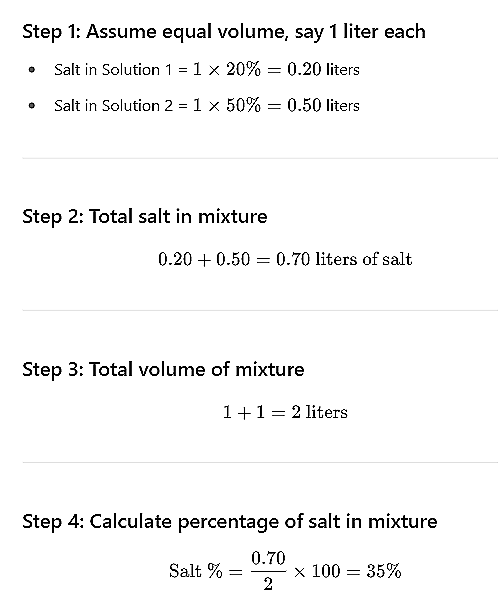
If a solution contains 20% salt and another solution contains 50% salt, how can you find the percentage of salt in the mixture if you combine equal volumes of both solutions? |
Card: 3 / 28 |
|
|
|
Card: 4 / 28 |
|
|
A bottle contains 40 liters of a 25% alcohol solution. How much pure alcohol is in the bottle? |
Card: 5 / 28 |
|
|
To find the amount of pure alcohol, multiply the total volume by the percentage of alcohol: |
Card: 6 / 28 |
|
|
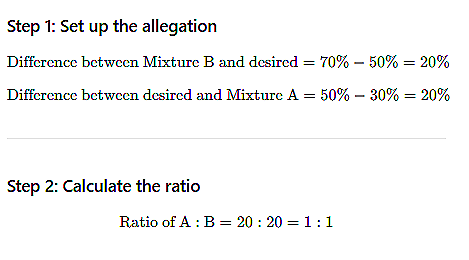
You have two mixtures: Mixture A has 30% sugar and Mixture B has 70% sugar. How much of each mixture do you need to create a new mixture that is 50% sugar? |
Card: 7 / 28 |
|
|
|
Card: 8 / 28 |
|
|
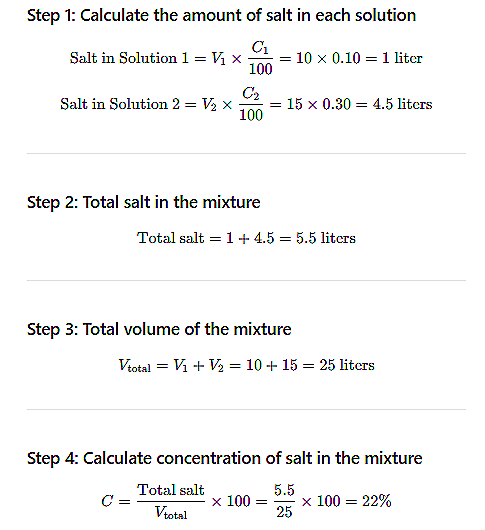
If you mix 10 liters of a 10% salt solution with 15 liters of a 30% salt solution, what is the concentration of salt in the resulting mixture? |
Card: 9 / 28 |
|
|
|
Card: 10 / 28 |
|
|
What is the Allegation Method, and how is it used in mixtures? |
Card: 11 / 28 |
|
|
The Allegation Method is a technique used to determine the ratio in which two or more ingredients at different prices or concentrations must be mixed to achieve a desired concentration. It involves calculating the differences between the concentrations and using those differences to find the ratio. |
Card: 12 / 28 |
|
|
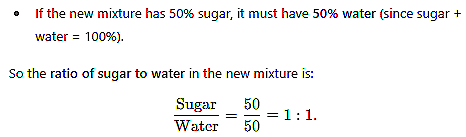
A mixture contains 30% sugar and 70% water. If you want to make a new mixture with 50% sugar, what should be the ratio of sugar to water? |
Card: 13 / 28 |
|
|
|
Card: 14 / 28 |
|
|
 Unlock all Flashcards with EduRev Infinity Plan Starting from @ ₹99 only
|
|
|
|
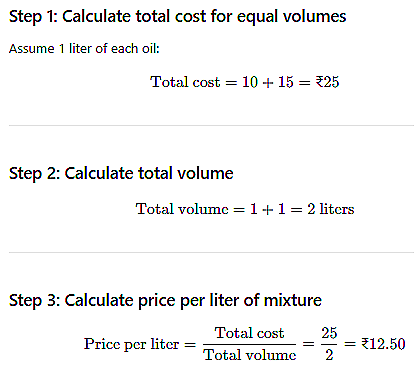
If a company produces a mixture of two oils, one costing ₹10 per liter and the other ₹15 per liter, how do you find the price per liter of a mixture containing equal volumes of both oils? |
Card: 15 / 28 |
|
|
|
Card: 16 / 28 |
|
|
A 10-liter solution contains 20% acid. If 5 liters of a 40% acid solution is added, what is the new concentration of acid in the mixture? |
Card: 17 / 28 |
|
|
First, calculate the total acid in the original solution: 10 liters x 20% = 2 liters of acid. |
Card: 18 / 28 |
|
|
How can the concept of the weighted average help in solving mixture problems? |
Card: 19 / 28 |
|
|
The weighted average allows us to calculate the overall concentration of a mixture by factoring in the proportions of the individual components. It simplifies the process of finding the final concentration based on the individual concentrations and their quantities. |
Card: 20 / 28 |
|
|
What is the formula for calculating the total amount of a substance in a mixture? |
Card: 21 / 28 |
|
|
The total amount of a substance in a mixture can be calculated using the formula: Total Amount = Volume1 x Concentration1 + Volume2 x Concentration2 + ... + VolumeN x ConcentrationN |
Card: 22 / 28 |
|
|
If a mixture consists of 30% chemical A and 70% chemical B, how much of chemical A is in 200 liters of the mixture? |
Card: 23 / 28 |
|
|
To find the amount of chemical A, multiply the total volume by the concentration of chemical A: |
Card: 24 / 28 |
|
|
When mixing two liquids of different densities, how do you determine the density of the resulting mixture? |
Card: 25 / 28 |
|
|
The density of the resulting mixture can be calculated using the formula: |
Card: 26 / 28 |
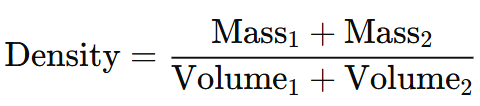 where Mass is determined by multiplying density by volume for each liquid.
|
|
If you have a 25% sugar solution and you want to dilute it to a 10% solution, how do you find the amount of water to add? |
Card: 27 / 28 |
|
|
Let x be the amount of water to add. The equation is: |
Card: 28 / 28 |
 Solving will give you the necessary amount of water to achieve the desired concentration.
|
|
Completed! Keep practicing to master all of them. |

Restart
|












