


Civil Engineering (CE) Exam > Civil Engineering (CE) Questions > A hollow shaft of inner radius 30 mm and oute... Start Learning for Free
A hollow shaft of inner radius 30 mm and outer radius 50 mm is subjected to a twisting moment. If the shear stress developed at inner radius of shaft is 60 N/mm2. What is the maximum shear stress in shaft?
- a)60 N/mm2
- b)75 N/mm2
- c)100 N/mm2
- d)None of these
Correct answer is option 'C'. Can you explain this answer?

Verified Answer
A hollow shaft of inner radius 30 mm and outer radius 50 mm is subject...
As we know, torsional shear stress varies linearly
∴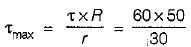
= 100N/mm2
∴
= 100N/mm2
Most Upvoted Answer
A hollow shaft of inner radius 30 mm and outer radius 50 mm is subject...
Given:
Inner radius of shaft (r1) = 30 mm
Outer radius of shaft (r2) = 50 mm
Shear stress at inner radius (τ1) = 60 N/mm^2
To find:
Maximum shear stress in the shaft
Formula:
The shear stress in a hollow shaft can be calculated using the torsion formula:
τ = (T * r) / J
Where:
τ = Shear stress
T = Twisting moment
r = Radial distance from the center
J = Polar moment of inertia
Analysis:
In a hollow shaft, the maximum shear stress occurs at the outer radius (r2). We need to calculate the shear stress at the outer radius using the given shear stress at the inner radius.
Step-by-step solution:
1. Convert the radii from millimeters to meters.
r1 = 30 mm = 0.03 m
r2 = 50 mm = 0.05 m
2. Calculate the polar moment of inertia (J) for a hollow shaft.
J = (π/2) * (r2^4 - r1^4)
3. Since we have the shear stress at the inner radius (τ1) and need to find the maximum shear stress at the outer radius (τ2), we can use the ratio of radii to relate the two stresses.
τ1 / τ2 = r2 / r1
Substitute the given values:
60 / τ2 = 0.05 / 0.03
Cross-multiply and solve for τ2:
τ2 = (60 * 0.03) / 0.05
= 36 N/mm^2
Therefore, the maximum shear stress in the shaft is 36 N/mm^2.
Hence, the correct answer is option C) 36 N/mm^2.
Inner radius of shaft (r1) = 30 mm
Outer radius of shaft (r2) = 50 mm
Shear stress at inner radius (τ1) = 60 N/mm^2
To find:
Maximum shear stress in the shaft
Formula:
The shear stress in a hollow shaft can be calculated using the torsion formula:
τ = (T * r) / J
Where:
τ = Shear stress
T = Twisting moment
r = Radial distance from the center
J = Polar moment of inertia
Analysis:
In a hollow shaft, the maximum shear stress occurs at the outer radius (r2). We need to calculate the shear stress at the outer radius using the given shear stress at the inner radius.
Step-by-step solution:
1. Convert the radii from millimeters to meters.
r1 = 30 mm = 0.03 m
r2 = 50 mm = 0.05 m
2. Calculate the polar moment of inertia (J) for a hollow shaft.
J = (π/2) * (r2^4 - r1^4)
3. Since we have the shear stress at the inner radius (τ1) and need to find the maximum shear stress at the outer radius (τ2), we can use the ratio of radii to relate the two stresses.
τ1 / τ2 = r2 / r1
Substitute the given values:
60 / τ2 = 0.05 / 0.03
Cross-multiply and solve for τ2:
τ2 = (60 * 0.03) / 0.05
= 36 N/mm^2
Therefore, the maximum shear stress in the shaft is 36 N/mm^2.
Hence, the correct answer is option C) 36 N/mm^2.
 | Explore Courses for Civil Engineering (CE) exam |  |
Top Courses for Civil Engineering (CE)View all





Top Courses for Civil Engineering (CE)
Question Description
A hollow shaft of inner radius 30 mm and outer radius 50 mm is subjected to a twisting moment. If the shear stress developed at inner radius of shaft is 60 N/mm2. What is the maximum shear stress in shaft?a)60 N/mm2b)75 N/mm2c)100 N/mm2d)None of theseCorrect answer is option 'C'. Can you explain this answer? for Civil Engineering (CE) 2026 is part of Civil Engineering (CE) preparation. The Question and answers have been prepared according to the Civil Engineering (CE) exam syllabus. Information about A hollow shaft of inner radius 30 mm and outer radius 50 mm is subjected to a twisting moment. If the shear stress developed at inner radius of shaft is 60 N/mm2. What is the maximum shear stress in shaft?a)60 N/mm2b)75 N/mm2c)100 N/mm2d)None of theseCorrect answer is option 'C'. Can you explain this answer? covers all topics & solutions for Civil Engineering (CE) 2026 Exam. Find important definitions, questions, meanings, examples, exercises and tests below for A hollow shaft of inner radius 30 mm and outer radius 50 mm is subjected to a twisting moment. If the shear stress developed at inner radius of shaft is 60 N/mm2. What is the maximum shear stress in shaft?a)60 N/mm2b)75 N/mm2c)100 N/mm2d)None of theseCorrect answer is option 'C'. Can you explain this answer?.
A hollow shaft of inner radius 30 mm and outer radius 50 mm is subjected to a twisting moment. If the shear stress developed at inner radius of shaft is 60 N/mm2. What is the maximum shear stress in shaft?a)60 N/mm2b)75 N/mm2c)100 N/mm2d)None of theseCorrect answer is option 'C'. Can you explain this answer? for Civil Engineering (CE) 2026 is part of Civil Engineering (CE) preparation. The Question and answers have been prepared according to the Civil Engineering (CE) exam syllabus. Information about A hollow shaft of inner radius 30 mm and outer radius 50 mm is subjected to a twisting moment. If the shear stress developed at inner radius of shaft is 60 N/mm2. What is the maximum shear stress in shaft?a)60 N/mm2b)75 N/mm2c)100 N/mm2d)None of theseCorrect answer is option 'C'. Can you explain this answer? covers all topics & solutions for Civil Engineering (CE) 2026 Exam. Find important definitions, questions, meanings, examples, exercises and tests below for A hollow shaft of inner radius 30 mm and outer radius 50 mm is subjected to a twisting moment. If the shear stress developed at inner radius of shaft is 60 N/mm2. What is the maximum shear stress in shaft?a)60 N/mm2b)75 N/mm2c)100 N/mm2d)None of theseCorrect answer is option 'C'. Can you explain this answer?.
Solutions for A hollow shaft of inner radius 30 mm and outer radius 50 mm is subjected to a twisting moment. If the shear stress developed at inner radius of shaft is 60 N/mm2. What is the maximum shear stress in shaft?a)60 N/mm2b)75 N/mm2c)100 N/mm2d)None of theseCorrect answer is option 'C'. Can you explain this answer? in English & in Hindi are available as part of our courses for Civil Engineering (CE). Download more important topics, notes, lectures and mock test series for Civil Engineering (CE) Exam by signing up for free.
Here you can find the meaning of A hollow shaft of inner radius 30 mm and outer radius 50 mm is subjected to a twisting moment. If the shear stress developed at inner radius of shaft is 60 N/mm2. What is the maximum shear stress in shaft?a)60 N/mm2b)75 N/mm2c)100 N/mm2d)None of theseCorrect answer is option 'C'. Can you explain this answer? defined & explained in the simplest way possible. Besides giving the explanation of A hollow shaft of inner radius 30 mm and outer radius 50 mm is subjected to a twisting moment. If the shear stress developed at inner radius of shaft is 60 N/mm2. What is the maximum shear stress in shaft?a)60 N/mm2b)75 N/mm2c)100 N/mm2d)None of theseCorrect answer is option 'C'. Can you explain this answer?, a detailed solution for A hollow shaft of inner radius 30 mm and outer radius 50 mm is subjected to a twisting moment. If the shear stress developed at inner radius of shaft is 60 N/mm2. What is the maximum shear stress in shaft?a)60 N/mm2b)75 N/mm2c)100 N/mm2d)None of theseCorrect answer is option 'C'. Can you explain this answer? has been provided alongside types of A hollow shaft of inner radius 30 mm and outer radius 50 mm is subjected to a twisting moment. If the shear stress developed at inner radius of shaft is 60 N/mm2. What is the maximum shear stress in shaft?a)60 N/mm2b)75 N/mm2c)100 N/mm2d)None of theseCorrect answer is option 'C'. Can you explain this answer? theory, EduRev gives you an ample number of questions to practice A hollow shaft of inner radius 30 mm and outer radius 50 mm is subjected to a twisting moment. If the shear stress developed at inner radius of shaft is 60 N/mm2. What is the maximum shear stress in shaft?a)60 N/mm2b)75 N/mm2c)100 N/mm2d)None of theseCorrect answer is option 'C'. Can you explain this answer? tests, examples and also practice Civil Engineering (CE) tests.
| Explore Courses for Civil Engineering (CE) exam | |
Top Courses for Civil Engineering (CE)
Explore Courses
Signup for Free!
Signup to see your scores go up within 7 days! Learn & Practice with 1000+ FREE Notes, Videos & Tests.


