


Electrical Engineering (EE) Exam > Electrical Engineering (EE) Questions > The rectification efficiency of a single pha... Start Learning for Free
The rectification efficiency of a single phase Half Wave Controlled Rectifier having a resistive load and the delay angle of π/2 is _______%. (correct upto two decimal places
Correct answer is '20.23'. Can you explain this answer?

Most Upvoted Answer
The rectification efficiency of a single phase Half Wave Controlled R...
Given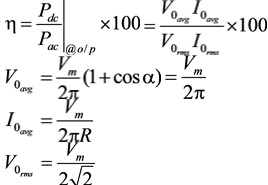 ,
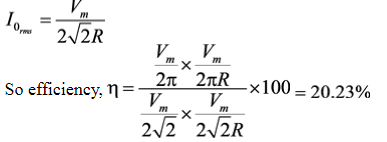
,
Single phase Half Wave Controlled Rectifier
Resistive load
∝= π/2
Rectification efficiency 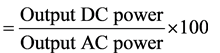
,Free Test
FREE
| Start Free Test |
Community Answer
The rectification efficiency of a single phase Half Wave Controlled R...
The rectification efficiency of a single-phase half-wave controlled rectifier can be calculated using the following formula:
η = (Vdc / Vac) × 100
Where:
η is the rectification efficiency
Vdc is the DC output voltage
Vac is the AC input voltage
In a half-wave controlled rectifier, the output voltage is given by the equation:
Vdc = (2 / π) * Vac * (1 - cos(α))
Where:
α is the delay angle
To calculate the rectification efficiency, we need to substitute the values into the equations and solve for η.
Given:
Delay angle (α) = π/2
1. Calculate the DC output voltage (Vdc):
Vdc = (2 / π) * Vac * (1 - cos(π/2))
= (2 / π) * Vac * (1 - 0)
= (2 / π) * Vac
2. Calculate the rectification efficiency (η):
η = (Vdc / Vac) × 100
= [(2 / π) * Vac / Vac] × 100
= (2 / π) × 100
≈ 20.23%
Therefore, the rectification efficiency of the single-phase half-wave controlled rectifier with a resistive load and a delay angle of π/2 is approximately 20.23%.
Note: The rectification efficiency represents the percentage of AC power converted into DC power. In this case, since we are using a half-wave rectifier, only half of the AC input waveform is utilized, resulting in a lower rectification efficiency compared to full-wave rectifiers. The delay angle determines the point in the AC cycle at which the rectifier starts conducting, and a delay angle of π/2 means the rectifier conducts from the peak of the AC waveform.
η = (Vdc / Vac) × 100
Where:
η is the rectification efficiency
Vdc is the DC output voltage
Vac is the AC input voltage
In a half-wave controlled rectifier, the output voltage is given by the equation:
Vdc = (2 / π) * Vac * (1 - cos(α))
Where:
α is the delay angle
To calculate the rectification efficiency, we need to substitute the values into the equations and solve for η.
Given:
Delay angle (α) = π/2
1. Calculate the DC output voltage (Vdc):
Vdc = (2 / π) * Vac * (1 - cos(π/2))
= (2 / π) * Vac * (1 - 0)
= (2 / π) * Vac
2. Calculate the rectification efficiency (η):
η = (Vdc / Vac) × 100
= [(2 / π) * Vac / Vac] × 100
= (2 / π) × 100
≈ 20.23%
Therefore, the rectification efficiency of the single-phase half-wave controlled rectifier with a resistive load and a delay angle of π/2 is approximately 20.23%.
Note: The rectification efficiency represents the percentage of AC power converted into DC power. In this case, since we are using a half-wave rectifier, only half of the AC input waveform is utilized, resulting in a lower rectification efficiency compared to full-wave rectifiers. The delay angle determines the point in the AC cycle at which the rectifier starts conducting, and a delay angle of π/2 means the rectifier conducts from the peak of the AC waveform.
 | Explore Courses for Electrical Engineering (EE) exam |  |
Top Courses for Electrical Engineering (EE)View all




Top Courses for Electrical Engineering (EE)
Question Description
The rectification efficiency of a single phase Half Wave Controlled Rectifier having a resistive load and the delay angle of π/2 is _______%. (correct upto two decimal placesCorrect answer is '20.23'. Can you explain this answer? for Electrical Engineering (EE) 2026 is part of Electrical Engineering (EE) preparation. The Question and answers have been prepared according to the Electrical Engineering (EE) exam syllabus. Information about The rectification efficiency of a single phase Half Wave Controlled Rectifier having a resistive load and the delay angle of π/2 is _______%. (correct upto two decimal placesCorrect answer is '20.23'. Can you explain this answer? covers all topics & solutions for Electrical Engineering (EE) 2026 Exam. Find important definitions, questions, meanings, examples, exercises and tests below for The rectification efficiency of a single phase Half Wave Controlled Rectifier having a resistive load and the delay angle of π/2 is _______%. (correct upto two decimal placesCorrect answer is '20.23'. Can you explain this answer?.
The rectification efficiency of a single phase Half Wave Controlled Rectifier having a resistive load and the delay angle of π/2 is _______%. (correct upto two decimal placesCorrect answer is '20.23'. Can you explain this answer? for Electrical Engineering (EE) 2026 is part of Electrical Engineering (EE) preparation. The Question and answers have been prepared according to the Electrical Engineering (EE) exam syllabus. Information about The rectification efficiency of a single phase Half Wave Controlled Rectifier having a resistive load and the delay angle of π/2 is _______%. (correct upto two decimal placesCorrect answer is '20.23'. Can you explain this answer? covers all topics & solutions for Electrical Engineering (EE) 2026 Exam. Find important definitions, questions, meanings, examples, exercises and tests below for The rectification efficiency of a single phase Half Wave Controlled Rectifier having a resistive load and the delay angle of π/2 is _______%. (correct upto two decimal placesCorrect answer is '20.23'. Can you explain this answer?.
Solutions for The rectification efficiency of a single phase Half Wave Controlled Rectifier having a resistive load and the delay angle of π/2 is _______%. (correct upto two decimal placesCorrect answer is '20.23'. Can you explain this answer? in English & in Hindi are available as part of our courses for Electrical Engineering (EE). Download more important topics, notes, lectures and mock test series for Electrical Engineering (EE) Exam by signing up for free.
Here you can find the meaning of The rectification efficiency of a single phase Half Wave Controlled Rectifier having a resistive load and the delay angle of π/2 is _______%. (correct upto two decimal placesCorrect answer is '20.23'. Can you explain this answer? defined & explained in the simplest way possible. Besides giving the explanation of The rectification efficiency of a single phase Half Wave Controlled Rectifier having a resistive load and the delay angle of π/2 is _______%. (correct upto two decimal placesCorrect answer is '20.23'. Can you explain this answer?, a detailed solution for The rectification efficiency of a single phase Half Wave Controlled Rectifier having a resistive load and the delay angle of π/2 is _______%. (correct upto two decimal placesCorrect answer is '20.23'. Can you explain this answer? has been provided alongside types of The rectification efficiency of a single phase Half Wave Controlled Rectifier having a resistive load and the delay angle of π/2 is _______%. (correct upto two decimal placesCorrect answer is '20.23'. Can you explain this answer? theory, EduRev gives you an ample number of questions to practice The rectification efficiency of a single phase Half Wave Controlled Rectifier having a resistive load and the delay angle of π/2 is _______%. (correct upto two decimal placesCorrect answer is '20.23'. Can you explain this answer? tests, examples and also practice Electrical Engineering (EE) tests.
| Explore Courses for Electrical Engineering (EE) exam | |
Top Courses for Electrical Engineering (EE)
Explore Courses
Signup for Free!
Signup to see your scores go up within 7 days! Learn & Practice with 1000+ FREE Notes, Videos & Tests.


