Class 10 Exam  >  Class 10 Notes  >  Mathematics (Maths) Class 10  >  Facts that Matter: Introduction to Trigonometry

Facts that Matter: Introduction to Trigonometry | Mathematics (Maths) Class 10 PDF Download

Trigonometric Ratios

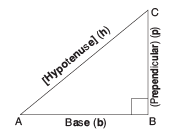
In a right-angled triangle, certain ratios of the lengths of its sides depend only on the angle considered. These ratios are called trigonometric ratios. Consider triangle ABC with ∠B = 90°. For angle A, the sides are referred to as follows:

  • Hypotenuse: the side opposite the right angle; it is the longest side.
  • Opposite side (to ∠A): the side opposite angle A.
  • Adjacent side (to ∠A): the side next to angle A (other than the hypotenuse).

The six primary trigonometric ratios for angle A are:

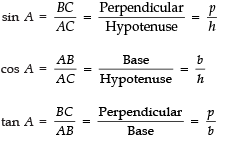
  • sin A = (length of opposite side) ÷ (length of hypotenuse)
  • cos A = (length of adjacent side) ÷ (length of hypotenuse)
  • tan A = (length of opposite side) ÷ (length of adjacent side)
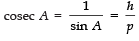
  • cosec A = (length of hypotenuse) ÷ (length of opposite side)
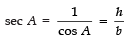
  • sec A = (length of hypotenuse) ÷ (length of adjacent side)
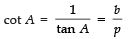
  • cot A = (length of adjacent side) ÷ (length of opposite side)

The last three are simply the reciprocals of the first three:

  • cosec A = 1 ÷ sin A
  • sec A = 1 ÷ cos A
  • cot A = 1 ÷ tan A

NOTE:

  • 'sin θ' is a single symbol and the letters 'sin' cannot be detached from 'θ'. sin θ is not equal to sin × θ.
  • The values of trigonometric ratios of an angle depend only on the magnitude of the angle and not on the actual size of the triangle.
  • Since the hypotenuse is the longest side in a right-angled triangle, the value of sin A or cos A is always less than or equal to 1.

Trigonometric Ratios of Some Specific Angles

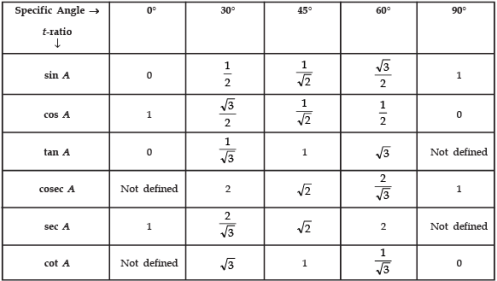
The commonly used specific angles are , 30°, 45°, 60° and 90°. Their trigonometric ratios are given in the following table:

NOTE:

  • The value of sin A increases from 0 to 1 as A increases from 0° to 90°.
  • The value of cos A decreases from 1 to 0 as A increases from 0° to 90°.
  • The value of tan A increases from 0 to ∞ as A increases from 0° to 90°.
  • Approximate values: √2 = 1.414 and √3 = 1.732.

Trigonometric Identities

An equation involving trigonometric ratios of an angle that is true for all permissible values of the angle is called a trigonometric identity. The following are the most important identities used at this level:

  • cos2A + sin2A = 1
  • 1 + tan2A = sec2A
  • cot2A + 1 = cosec2A

Derivation of the Pythagorean Identity

From triangle ABC with ∠B = 90°, by the Pythagorean theorem:

AB2 + BC2 = AC2

Divide each term by AC2:

(AB ÷ AC)2 + (BC ÷ AC)2 = 1

Recognise the ratios:

cos A = AB ÷ AC

sin A = BC ÷ AC

Therefore:

cos2A + sin2A = 1

Derivation of 1 + tan2A = sec2A

Start from the Pythagorean identity:

cos2A + sin2A = 1

Divide every term by cos2A:

1 + (sin2A ÷ cos2A) = 1 ÷ cos2A

Recognise the ratios:

sin ÷ cos = tan and 1 ÷ cos = sec

Thus:

1 + tan2A = sec2A

Derivation of cot2A + 1 = cosec2A

Start from the Pythagorean identity:

cos2A + sin2A = 1

Divide every term by sin2A:

(cos2A ÷ sin2A) + 1 = 1 ÷ sin2A

Recognise the ratios:

cos ÷ sin = cot and 1 ÷ sin = cosec

Therefore:

cot2A + 1 = cosec2A

Examples

Example 1 - Value of sin 30°

Using an equilateral triangle of side 2 units and dropping a perpendicular from one vertex to the opposite side gives two congruent right triangles with hypotenuse 2 and base 1.

The height of each right triangle is √(22 - 12) = √3.

For angle 30° in the right triangle, opposite side = 1 and hypotenuse = 2.

Therefore:

sin 30° = 1 ÷ 2 = 1/2

Example 2 - Value of tan 45°

In an isosceles right triangle where the two legs are equal, opposite and adjacent sides to 45° are equal.

Therefore tan 45° = opposite ÷ adjacent = 1.

tan 45° = 1

Applications

  • Trigonometric ratios are used to find heights and distances when direct measurement is difficult; measure an angle of elevation or depression and one side, then use an appropriate ratio.
  • They are used in geometry, surveying, architecture, navigation and in solving many problems involving right triangles.

Summary: Trigonometric ratios relate the angles of a right-angled triangle to ratios of its sides. The six ratios - sin, cos, tan and their reciprocals cosec, sec, cot - depend only on the angle. Key identities such as cos2A + sin2A = 1 and its derived forms are essential tools for solving trigonometric problems.

The document Facts that Matter: Introduction to Trigonometry | Mathematics (Maths) Class 10 is a part of the Class 10 Course Mathematics (Maths) Class 10.
All you need of Class 10 at this link: Class 10
127 videos|585 docs|79 tests

FAQs on Facts that Matter: Introduction to Trigonometry - Mathematics (Maths) Class 10

1. What are trigonometric ratios?
Ans. Trigonometric ratios are mathematical functions that relate the angles of a right triangle to the ratio of the lengths of its sides. The three primary trigonometric ratios are sine (sin), cosine (cos), and tangent (tan).
2. How can trigonometric ratios be used to find missing side lengths in a right triangle?
Ans. Trigonometric ratios can be used to find missing side lengths in a right triangle through the use of inverse trigonometric functions. For example, if we know the angle and one side length, we can use the sine function to find the length of another side.
3. What are the trigonometric ratios for the angles 0°, 30°, 45°, 60°, and 90°?
Ans. The trigonometric ratios for the angles 0°, 30°, 45°, 60°, and 90° are as follows: - For 0°: sin(0°) = 0, cos(0°) = 1, tan(0°) = 0. - For 30°: sin(30°) = 1/2, cos(30°) = √3/2, tan(30°) = √3/3. - For 45°: sin(45°) = √2/2, cos(45°) = √2/2, tan(45°) = 1. - For 60°: sin(60°) = √3/2, cos(60°) = 1/2, tan(60°) = √3. - For 90°: sin(90°) = 1, cos(90°) = 0, tan(90°) = undefined.
4. Can trigonometric ratios be negative?
Ans. Yes, trigonometric ratios can be negative. The sign of a trigonometric ratio depends on the quadrant in which the angle is located. In the first quadrant, all trigonometric ratios are positive. In the second quadrant, only the sine ratio is positive. In the third quadrant, only the tangent ratio is positive. In the fourth quadrant, only the cosine ratio is positive.
5. How are trigonometric ratios used in real-life applications?
Ans. Trigonometric ratios have various applications in real life, including: - Navigation and GPS systems use trigonometry to calculate distances and angles. - Architects and engineers use trigonometry to design and construct buildings, bridges, and other structures. - Astronomers use trigonometry to study celestial objects and calculate distances between them. - Trigonometry is used in physics and engineering to analyze and model periodic phenomena, such as waves and vibrations. - Trigonometry is also applied in fields like computer graphics, music, and biology.
Related Searches

practice quizzes

,

mock tests for examination

,

video lectures

,

Facts that Matter: Introduction to Trigonometry | Mathematics (Maths) Class 10

,

MCQs

,

Summary

,

ppt

,

pdf

,

Facts that Matter: Introduction to Trigonometry | Mathematics (Maths) Class 10

,

Facts that Matter: Introduction to Trigonometry | Mathematics (Maths) Class 10

,

Free

,

Extra Questions

,

Exam

,

Objective type Questions

,

study material

,

Semester Notes

,

past year papers

,

Important questions

,

Viva Questions

,

Sample Paper

,

Previous Year Questions with Solutions

,

shortcuts and tricks

;