Mathematics Olympiad Previous Year Paper - 3 | Mathematics Olympiad for Class 3 PDF Download

Note: The questions provided in this document are similar to the questions that were asked in the actual Olympiad exam. So, we recommend you study these for your Olympiad preparation.
Logical Reasoning
Q1: Which of the following letters is not hidden in the given figure?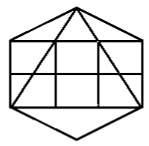 (a) A
(a) A(b) Q
(c) I
(d) H
 View Answer
Ans: (b)
Q is not there in the figure.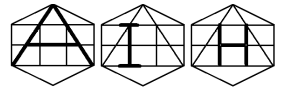
Q2: Find the odd one out.
(a) Milk
(b) Honey
(c) Ice
(d) Coffee
View Answer Ans: (c)
Except ice, everything is a liquid.
Q3: If 'home' is called 'pizza', 'pizza' is called 'glass', 'glass' is called 'cycle', and 'cycle' is called 'car', then Ravi will eat ______ with his friend.
(a) home
(b) glass
(c) pizza
(d) cycle
View Answer Ans: (b)
Ravi will eat pizza, but pizza is coded as 'glass'. So, Ravi will eat glass.
Q4: In a park, 35 students are sitting in a line. Raveena is sitting in the middle. What is her position from the left end?
(a) 19th
(b) 18th
(c) 17th
(d) 16th
View Answer Ans: (b)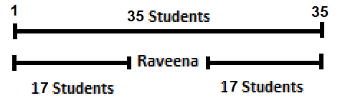
In the above diagram, it is clear that Raveena is sitting exactly in the middle of the line.
So, Raveena is at the 18th position from the left end of the line.
Q5: Given below is a series of numbers, which follows a certain pattern:
19, 28, 37, 46, ?
If the pattern continues in the same way, what will be the next number?
(a) 49
(b) 53
(c) 55
(d) 57
View Answer Ans: (c)
The pattern followed is: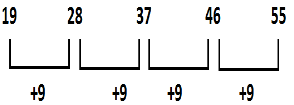
Q6: There is a certain relationship between the numbers of the pair on either side of the symbol (: :). Identify the relationship of the given pair and find the missing number.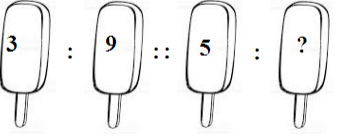 (a) 10
(b) 13
(c) 15
(d) 20
View Answer Ans: (c)
The relation between the numbers of the pair to the left side of (: :) is 3 x 3 = 9.
Similarly, the relation between the numbers to the right side of (: :) is 5 x 3 = 15.
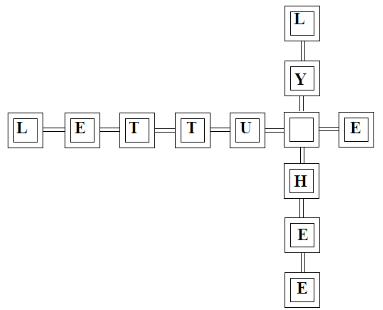
Q7: Which letter from the given options will replace the question mark (?) to form the name of a vegetable and the name of a fruit?
(a) A
(b) I
(c) S
(d) C
View Answer Ans: (d)
The name of the fruit is LYCHEE and the name of the vegetable is LETTUCE.
So, letter 'C' will replace the question mark.
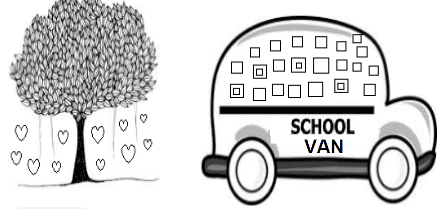
Q8: How many more squares are there in the picture than hearts?
(a) 15
(b) 14
(c) 13
(d) 12
View Answer Ans: (a)
Number of squares in the picture = 26
Number of hearts in the picture = 11
Difference = 26 -11 = 15
So, there are 15 more squares than hearts in the picture.
Q9: Identify the category of the word formed after arranging the given letters.
GNAOM
(a) Flower
(b) Animal
(c) Fruit
(d) Food
View Answer Ans: (c)
The meaningful word formed from the letters G, N, A, O and M is MANGO, which is the name of a fruit.
Q10: Which of the following words cannot be formed from the letters of the given word?
COMMUNICATION
(a) Cat
(b) Onion
(c) Coconut
(d) Munich
View Answer Ans: (d)
In COMMUNICATION, there is no H. So, MUNICH cannot be formed.
Mathematical Reasoning
Q11: How many times should the number 9 be subtracted from 90 to get 0?(a) 10
(b) 9
(c) 8
(d) 7
View Answer Ans: (a)
According to question:
90 - 9 = 81 (1 time)
81 - 9 = 72 (2 times)
72 - 9 = 63 (3 times)
63 - 9 = 54 (4 times)
54 - 9 = 45 (5 times)
45 - 9 = 36 (6 times)
36 - 9 = 27 (7 times)
27 - 9 = 18 (8 times)
18 - 9 = 9 (9 times)
9 - 9 = 0
Hence, the answer is 10.
Q12: Division is the inverse of
(a) multiplication
(b) addition
(c) subtraction
(d) None of these
View Answer Ans: (a)
- The four main mathematical operations are addition, subtraction, multiplication and division.
- The inverse of addition is subtraction and vice versa.
- The inverse of multiplication is division and vice versa.
Q13: What number should be added to 99,999 to get the smallest 6-digit number?
(a) 1
(b) 2
(c) 3
(d) 5
View Answer Ans: (a)
It is only 1 which can be added to 99,999 to get the smallest 6-digit number.
99,999 + 1= 1,00,000
So, the correct answer is option A.
Q14: Look at the number sentence given below:
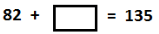
Which of the following numbers will make the above sentence true?
(a) 53
(b) 64
(c) 71
(d) 85
View Answer Ans: (a)
The correct answer is 53.
82 + ? = 135
? = 135 - 82 = 53
Q15: Which of the shapes given as options is missing in the figure below?
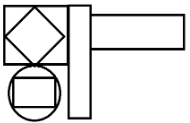
(a) Square
(b) Hexagon
(c) Circle
(d) Rectangle
View Answer Ans: (b)
In the given figure, we have a square, a rectangle and a circle, but there is no hexagon.
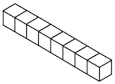
Q16:  is a cube. How many such cubes are needed to make the figure below?
(a) 4
(b) 5
(c) 6
(d) 8
Ans: (d)
View Answer 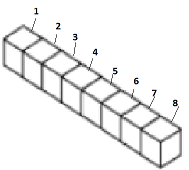
It can be easily seen that there is only one line and it contains 8 cubes.
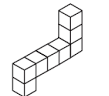
Q17: is a cube. How many such cubes are needed to make the figure below?
(a) 4
(b) 8
(c) 12
(d) 16
View Answer Ans: (d)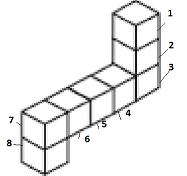
We can see from the figure that there are five cubes in the middle line, two attached above the cube at one end and one attached below the cube at the other end.
So, there are 8 cubes in total.
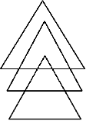
Q18: How many corner points are there in the figure given below?
 (a) 15
(b) 12
(c) 11
(d) 10
View Answer Ans: (a)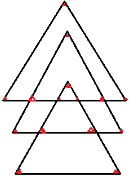
There are 3 corners in each triangle, which makes a total of 9 corners.Then, there are 2 corners formed by the sides of the second triangle and the base of the first triangle.
Also, there are 2 corners formed by the sides of the third triangle and the base of the first triangle.And, there are 2 corners formed by the sides of the third triangle and the base of the second triangle.
So, total number of corners = 9 + 2 + 2 + 2 = 15
Q19: There are 1,39,230 students in a school. If 63,596 students are absent on a particular day, how many students are present on that day?
(a) 75,634
(b) 70,634
(c) 65,634
(d) 60,634
View Answer Ans: (a)
Total number of students = 1,39,230
Number of students who are absent = 63,596\
So, number of students who are present = (1,39,230 - 63,596) = 75,634
Q20: Arpit travelled from point A to point B and covered 1750 km. While returning, he took a shortcut, in which he just travelled 1250 km. What is the difference between the two distances travelled?
(a) 400 km
(b) 450 km
(c) 500 km
(d) 550 km
View Answer Ans: (c)
Distance travelled while returning = 1250 km
Distance travelled from point A to point B = 1750 km
So, required difference = (1750 – 1250) km = 500 km
Q21: There are 467 bird families living near a mountain. If 32 bird families fly away for winter, how many bird families are left near the mountain?
(a) 147
(b) 227
(c) 425
(d) 435
View Answer Ans: (d)
Total number of bird families = 467
Number of bird families that fly away = 32
Number of bird families left = 467 - 32 = 435
Q22: What fraction of the given figure is unshaded?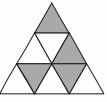
(a) 4/9
(b) 2/5
(c) 5/9
(d) 1/2
View Answer Ans: (c)
Total parts in the figure = 9
Number of unshaded parts = 5
Fraction of unshaded parts = 5/9
Q23: Which of the following is true?
(a) 2016 - 1290 = 726
(b) 3206 - 1256 = 1850
(c) 2407 - 1265 = 1042
(d) Both (1) and (3)
View Answer Ans: (a)
This is the correct option as 2016 - 1290 = 726.
Q24: If A × A = 49, A + B = 19, then find the value of A × B.
(a) 19
(b) 68
(c) 82
(d) 84
View Answer Ans: (d)
As,
A × A = 49 = 7 × 7
So, A = 7
Now, A + B = 19 and A = 7
So, B = 12
Therefore, A × B = 7 × 12 = 84
Q25: Manish thinks of a number and then adds 5 to it. The answer that he gets is 14. What is the number he thought of?
(a) 9
(b) 10
(c) 8
(d) 7
View Answer Ans: (a)
Let the missing number be A.
So, according to the question,
A + 5 = 14
So, A = 14 - 5 = 9
A is equal to 9.
Q26: The difference between 367 tens and ______ is 1367.
Which of the following numbers will come in the blank space?
(a) 2560
(b) 1734
(c) 2303
(d) 4520
View Answer Ans: /c)
367 tens - ____ = 3670
3670 - ____ = 1367
____ = 3670 - 1367
____ = 2303
Q27: Mr Ajay wrote a problem on the blackboard as shown in the given box.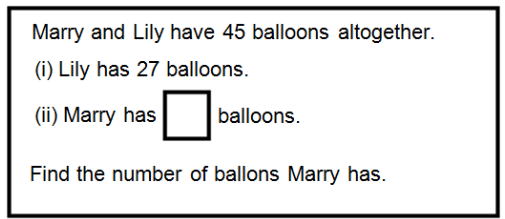
Which of the following number sentences matches the problem?
(a) 45 ÷ __ = 27
(b) 27 + __ = 45
(c) __ x 27 = 45
(d) 45 x 27 = __
View Answer Ans: (b)
According to question:
Total balloons = 45
If Lilly has 27 balloons, total would be 27 + __ = 45.
Q28: Miss Sunita wants to give one pen to each student.
(i) There are 42 students in her class.
(ii) The pens come in packs of 7.
Which of the following can be used to find the number of boxes of pens Miss Sunita needs?
(a) 42 + 7
(b) 42 ÷ 7
(c) 42 - 7
(d) 42 x 7
View Answer Ans: (b)
The total number of students is 42 and the pens come in packs of 7.
Total number of pens needed = 42
42 ÷ 7 = 6
Q29: If Jug + Jug + Jug + Jug + Jug = 775 ml, then Jug = _________.
(a) 165 ml
(b) 155 ml
(c) 145 ml
(d) 135 ml
View Answer Ans: (b)
Jug + Jug + Jug + Jug + Jug = 775 ml
Or, 5 Jugs = 775 ml
Jug = 775 ÷ 5 = 155 ml
Q30: If 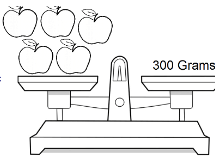 , then the weight of each apple is ________.
(a) 30 g
(b) 40 g
(c) 50 g
(d) 60 g
View Answer Ans: (d)
Number of apples = 5
Total weight = 300 grams
Weight of 1 apple = 300 ÷ 5 = 60 grams
Achievers Section
Q31: Rahul went to buy groceries. He purchased 3 pineapples, 2 pumpkins and 2 watermelons. How much weight would he have to carry home?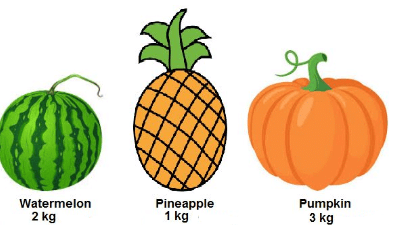 (a) 13 kg
(b) 16 kg
(c) 17 kg
(d) 18 kg
View Answer Ans: (a)
Weight of one watermelon = 2 kg
Weight of two watermelons = 2 x 2 = 4 kg
Weight of one pineapple = 1 kg = 3 x 1 kg = 3 kg
Weight of one pumpkin = 3 kg
Weight of two pumpkins = 2 x 3 kg = 6 kg
So, total weight Rahul would have to carry = 4 + 3 + 6 = 13 kg
Q32: In a hotel, different combinations of food items are available as follows.
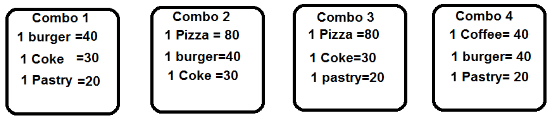
Which of the given combinations costs least?
(a) Combo 2
(b) Combo 1
(c) Combo 3
(d) Combo 4
View Answer Ans: (b)
Cost of Combo 1 = 40 + 30 + 20 = Rs. 90
Cost of Combo 2 = 80 + 40 + 30 = Rs. 150
Cost of Combo 3 = 80 + 30 + 20 = Rs. 130
Cost of Combo 4 = 40 + 40 + 20 = Rs. 100
Therefore, Combo 1 will cost the least.
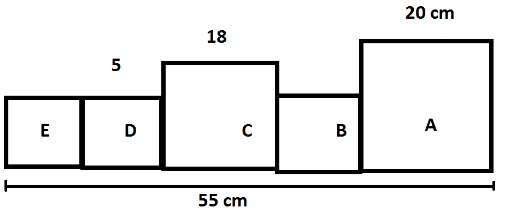
Q33: A figure containing 5 squares is given below. Find the length of each side of square B.
(a) 5 cm
(b) 6 cm
(c) 7 cm
(d) 8 cm
View Answer Ans: (c)
Total length of all the squares joined together = 55 cm
Side of square A = 20 cm
Side of square B = ?
Side of square C = 18 cm
Side of square D = 5 cm
Side of square E = Side of square D = 5 cm
Therefore, 20 + B + 18 + 5 + 5 = 55
B + 48 = 55
B = 7 cm
Q34: Find the 4-digit number.
(i) It is an odd number
(ii) The tens digit is the smallest one-digit number.
(iii) The hundreds digit is the tens digit of 2500 - 563.
(iv) The thousands digit is the largest one-digit number.
(a) 1931
(b) 2356
(c) 9311
(d) 9513
View Answer Ans: (c)
The tens digit is the smallest one-digit number = 1.
The hundreds digit is the tens digit of 2500 - 563 = 1937 = 3.
The thousands digit is the largest one-digit number = 9.
Therefore, the required 4-digit odd number is 9311.
Q35: A play is scheduled in a theatre for the third Thursday of August. A magic show is scheduled to be held 8 days prior to that. For which date is the magic show scheduled?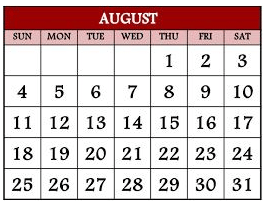
(a) August 4
(b) August 7
(c) August 9
(d) August 11
View Answer Ans: (b)
The play is scheduled for third Thursday, which happens to be August 15.
8 days before August 15 = August 7
So, the magic show is scheduled for August 7.
|
36 videos|72 docs|49 tests
|
FAQs on Mathematics Olympiad Previous Year Paper - 3 - Mathematics Olympiad for Class 3
| 1. What topics are typically covered in the Class 3 Mathematics Olympiad? |  |
| 2. How can students prepare effectively for the Class 3 Mathematics Olympiad? | |
| 3. What is the format of the Class 3 Mathematics Olympiad exam? | |
| 4. Are there any specific strategies to tackle logical reasoning questions in the Olympiad? | |
| 5. What should parents do to support their children in preparing for the Mathematics Olympiad? | |


Exam
,Mathematics Olympiad Previous Year Paper - 3 | Mathematics Olympiad for Class 3
,mock tests for examination
,Viva Questions
,past year papers
,video lectures
,shortcuts and tricks
,Objective type Questions
,ppt
,MCQs
,study material
,Sample Paper
,Summary
,Previous Year Questions with Solutions
,practice quizzes
,Mathematics Olympiad Previous Year Paper - 3 | Mathematics Olympiad for Class 3
,Mathematics Olympiad Previous Year Paper - 3 | Mathematics Olympiad for Class 3
,Free
,Extra Questions
,Semester Notes
,Important questions
;



Mathematics Olympiad Previous Year Paper - 3 Free PDF Download
Importance of Mathematics Olympiad Previous Year Paper - 3
Mathematics Olympiad Previous Year Paper - 3 Notes
Mathematics Olympiad Previous Year Paper - 3 Class 3 Questions
Study Mathematics Olympiad Previous Year Paper - 3 on the App
|
© EduRev
|
Education Revolution
|


|




within 7 days!