Ramesh Singh Summary: Banking in India- 1


Introduction
The banking sector holds a central position in shaping the economic landscape of a country, and India is no exception. Understanding the historical evolution, regulatory frameworks, and the role of banks in economic development is crucial for comprehending the broader financial dynamics of the nation. From its historical roots to contemporary initiatives, this brief overview aims to provide insights into the pivotal role of banking institutions in India's economic journey.
NBFCs
- NBFCs (Non-Banking Financial Companies) are fast emerging as an important segment of Indian financial system. It is an heterogeneous group of institutions (other than commercial and co-operative banks) performing financial intermediation in a variety of ways, like accepting deposits, making loans and advances, leasing, hire purchase, etc.
- They cannot have certain activities as their principal business- agricultural, industrial and sale-purchase or construction of immovable property.
- They raise funds from the public, directly or indirectly, and lend them to ultimate spenders.
- They advance loans to the various whole sale and retail traders, small-scale industries and self-employed persons. Thus, they have broadened and diversified the range of products and services offered by a financial sector.
- To promote financial inclusion through direct interaction between small lenders and small borrowers together with addressing consumer protection, during 2017-18 , RBI introduced two new categories of the NBFC- Peer to Peer [P2P] and Account Aggregators [AA].
Reserve Bank of India
- The Reserve Bank of India, was set up on April 1,1935 in accordance with the provisions of the RBI Act, 1934, in Calcutta [got shifted to Bombay in 1937].
- Set up under private ownership like a bank it was given two extra functions- regulating banking industry and being the banker of the Government. To better serve the purpose, during mid-1940s, a view emerged across the world in favour of a government-owned central bank- and governments started taking them over.
- As per the changing needs of time, the RBI Nationalisation Act of 1949 has been amended several times by the Government and its functions broadened. Its current functions may be summarised objectively in the following way-
(i) Monetary Authority : It includes formulation, implementation and monitoring of the monetary policy. The broad objective is - maintaining price stability keeping in mind the objective of growth.
(ii) Currency Authority : It includes issuing of new currency notes and coins (except the currency and coins of rupee one or its denominations, which are issued by Ministry of Finance itself) as well as exchanging or destroying those ones which are not fit for circulation This function includes the distribution responsibility of the currencies and coins also (of those ones also which are issued by the Ministry of Finance). The broad objective is - keeping adequate supplies of quality currencies and coins.
(iii) Regulator and Supervisor of the Financial System : It includes prescribing broad parameters of banking operations with in which the banking and financial system operates.
(iv) Manager of Foreign Exchange : In includes broad functions like - managing the FEMA (Foreign Exchange Management Act, 1999 ]; keeping the Forex (foreign exchange) reserves of the country ; stabilising the exchange rate of rupee; and representing the Government of India in the IMF and World Bank.
(v) Regulator and Supervisor of Payment and Settlement Systems : It includes functions like introducing and upgrading safe and efficient modes of payment systems in the country to meet the requirements of the public at large. The objective is maintaining public confidence in payment and settlement system.
(vi) Banker of the Governments and Banks : It includes three category of functions- firstly, performing the Merchant Banking functions for the central and state governments; secondly, acting as their Bankers; and thirdly, maintaining banking accounts of the SCBs.
(vii) Developmental Functions : Unlike most of the central banks in the world, the RBI was given some developmental functions also. Playing this role, it did set up developmental banks like- IDBI, SIDBI, NABARD, NEDB (North Eastern Development Bank), Exim Bank, NHB.
Monetary Policy
The primary objective of monetary policy is to maintain price stability while keeping in mind the objective of growth. Price stability is a necessary precondition for sustainable growth. To maintain price stability, inflation needs to be controlled. The government of India sets an inflation target for every five years. RBI has an important role in the consultation process regarding inflation targeting. The current inflation-targeting framework in India is flexible in nature.
Cash Reserve Ratio
- Banks operating in the country are under regulatory obligation to maintain 'reserve ratios' of two kinds, one of it being the cash reserve ratio (the other being 'statutory liquidity ratio').
- Under it, all scheduled commercial banks operating in the country are supposed to maintain a part of their total deposits with the RBI in cash form as the cash reserve ratio (CRR).
- The RBI could fix it between 3 to 15 per cent of the 'net demand and time liabilities' (NDTL) of the banks.
- In the wake of the ongoing process of banking reforms, certain changes were affected by the RBI in relation to the ratio since late 1990s-
(i) Aimed at enabling banks to lend more and cut interest rates on loans they offer, in 1999-2000, the RBI started paying banks an interest income on their CRR. The payment of interest was discontinued by late 2007 in the wake of rising prices.
(ii) The ratio which used to be generally on the higher side, was drastically cut down to 4.5 per cent in 2003.
(iii) A major development came in 2007 when by an amendment (in the RBI Act, 1949), the Government abolished the lower ceiling (called 'floor') on the CRR and gave the RBI greater flexibility in fixing this ratio.
Statutory Liquidity
- Ratio Banks operating in the country are under regulatory obligation to maintain 'reserve ratios' of two kinds, one of it being the statutory liquidity ratio (the other being the 'cash reserve ratio').
- Under it, all scheduled commercial banks operating in the country are supposed to maintain a part of their total deposits (i.e., their NDTL) with themselves in non-cash form (i.e., in 'liquid assets')- the ratio could be fixed by the RBI between 25 to 40 per cent.
Bank Rate
- The interest rate which the RBI charges on its long-term lendings is known as the Bank Rate.
- The clients who borrow through this route are the Government of India, state governments, banks, financial institutions, co-operative banks, NBFCs, etc.
- The rate has direct impact on long term lending activities of the concerned lending bodies operating in the Indian financial system.
Repo Rate
- The rate of interest the RBI charges from its clients on their short-term borrowing is the repo rate in India. Basically, this is an abbreviated form of the 'rate of repurchase' and in western economies it is known as the 'rate of discount'.
- In practice it is not called an interest rate but considered a discount on the dated government securities, which are deposited by institution to borrow for the short term.
- When they get their securities released from the RBI, the value of the securities is lost by the amount of the current repo rate.
Long Term
- Repo Aimed at promoting enhanced lending and cutting the cost of short-term funds for the banks, in a first of its kind move, in February 2020 (6th Bi-monthly Monetary Policy of 2019-20), the RBI announced to offer long term repo operation (LTRO) of Rs. 1.50 lakh crores at a fixed rate (i.e., at the Repo rate).
- The tenure of the LTRO will be from one to three years.
- This was aimed at ensuring permanent and deeper liquidity in the financial system together with enhancing lending by cutting cost of funds for the banks (enabling them to lend cheaper loans).
Reverse Repo Rate
- It is the rate of interest the RBI pays to its clients who offer short-term loan to it.
- In 2022-23, it was converted into fixed reverse repo rate and by March 2023, it was at 3.35 percent.
- In April 2022, this window of the LAF was replaced by the Standing Deposit Facility (SDF) by the RBI.
- In practice, financial institutions operating in India park their surplus funds with the RBI for short-term period and earn money.
- It has a direct bearing on the interest rates charged by the banks and the financial institutions on their different forms of loans.
Marginal Standing Facility (MSF)
- MSF is a new scheme announced by the RBI in its Monetary Policy, 2011-12 which came into effect from May, 2011.
- Under this scheme, banks can borrow overnight upto 1 per cent of their net demand and time liabilities (NDTL) from the RBI, at the interest rate 1 per cent (100 basis points) higher than the current repo rate.
- In an attempt to strengthen rupee and checking its falling exchange rate, the RBI increased the gap between 'repo' and MSF to 3 per cent (late July 2013).
- By March 2023 it was at 6.25 percent.
Other Tools
Other than the above-given instruments, RBI uses some other important, too to activate the right kind of the credit and monetary policy-
- Call Money Market : The call money market is an important segment of the money market where borrowing and lending of funds take place on over night basis. Participants in the call money market in India currently include scheduled commercial banks (SCBs) -excluding regional rural banks), cooperative banks (other than land development banks), insurance. Prudential limits, in respect of both outstanding borrowing and lending transactions in the call money market for each of these entities, are specified by the RBI.
- Open Market Operations (OMOs) : OMOs are conducted by the RBI via the sale/purchase of government securities (G-Sec) to/from the market with the primary aim of modulating rupee liquidity conditions in the market. OMOs are an effective quantitative policy tool in the armoury of the RBI, but are constrained by the stock of government securities available with it at a point in time.
- Liquidity Adjustment Facility (LAF) : The LAF is the key element in the monetary policy operating framework of the RBI (introduced in June 2000). On daily basis, the RBI stands ready to lend to or borrow money from the banking system, as per the need of the time, at fixed interest rates (repo and reverse repo rates). Together with moderating the fund-mismatches of the banks, LAF operations help the RBI to effectively transmit interest rate signals to the market.
- Market Stabilisation Scheme (MSS) : This instrument for monetary management was introduced in 2004 . Surplus liquidity of a more enduring nature a rising from large capital inflows is absorbed through sale of short-dated government securities and treasury bills. The mobilised cash is held in a separate government account with the Reserve Bank. The instrument thus has features of both, SLR and CRR.
- Standing Deposit Facility Scheme (SDFS) : The new scheme has been proposed by the Union Budget 2018-19 . Such a tool was proposed by the RBI in November 2015 itself. The scheme is aimed at helping RBI to manage liquidity in a better way, especially when the economy is flush with excess fund.
Base Rate
- Base Rate is the interest rate below which Scheduled Commercial Banks (SCBs) will lend no loans to its customers- its means it is like prime lending rate (PLR) and the bench mark prime lending Rate (BPLR) of the past and is basically a floor rate of interest.
- It replaced the existing idea of BPLR on 1 July, 2010.
- The BPLR system (while the existing system was of PLR), introduced in 2003, fell short of its original objective of bringing transparency to lending rates.
- This was mainly because under this system, banks could lend below BPLR.
- This made a bargaining by the borrower with bank ultimately one borrower getting cheaper loan than the other, and blurred the attempts of bringing in transparency in the lending business.
- For the same reason , it was also difficult to assess the transmission of policy rates (i.e., repo rate, reverse repo rate, bank rate) of the Reserve Bank to lending rates of banks. The Base Rate system is aimed at enhancing transparency in lending rates of banks and enabling better assessment of transmission of monetary policy.
MCLR
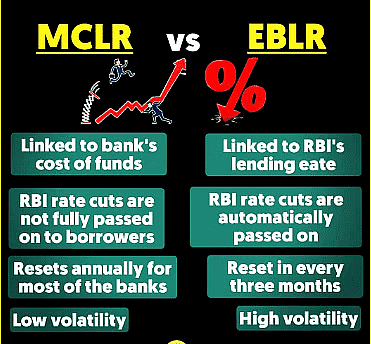
From the financial year 2016 - 17 (i.e., from 1st April, 2016), banks in the country have shifted to a new methodology to compute their lending rate. The new methodology- MCLR (Marginal Cost of funds based Lending Rate)- which was articulated by the RBI in December 2015. The main features of the MCLR are-
(i) It will be a tenor linked internal benchmark , to be reset on annual basis.
(ii) Actual lending rates will be fixed by adding a spread to the MCLR.
(iii) To be reviewed every month on a pre-announced date.
(iv) Existing borrowers will have the option to move to it.
(v) Banks will continue to review and publish 'Base Rate' as hitherto.
EBLR
Following the initiation of the Marginal Cost of Fund-Based Lending Rates (MCLR), which did not significantly enhance monetary transmission, the Reserve Bank of India (RBI) introduced the External Benchmarks-Based Lending Rate (EBLR) for banks in December 2018. Under this system, banks were given the choice to link their lending rates to one of the specified external benchmarks:
- Repo rate
- 91-day Treasury Bill yield
- 182-day Treasury Bill yield
- Any other benchmark produced by Financial Benchmarks India Private Ltd (FIBIL)
Monetary Tranmission
- Monetary policy plays a very vital role in the allocation of funds from the financial system. For this, lending rates decided by the banks must be sensitive to the policy rates (i.e., repo, reverse repo, MSF and bank rate) announced by the central bank - known as 'monetary transmission '.
- Till April 2020, steps like enforcing the MCLR and extern al benchmarks on banks for deciding their lending rates, have been taken by the RBI. But monetary transmission has been weak in 2019 also- on all three accounts, namely - Rate Structure, Quantity of Credit, and Term Structure.
Liquidity Management Framework
- A liquidity management framework (LMF) was provisioned by the RBI in 2014 to check volatility in the inter-bank call money market (CMM) and allow banks manage their needs of short-term capital.
- In a push to bring in more 'stability' and better 'interest rate signalling' in the loan market, the RBI has been trying to inspire banks to think in longer term in their operations. Aimed at making banks follow prudential norms, the Basel III norms also has put a clear check on short-termism followed by banking industry.
Global Monetary Tightening & India
In 2022, high inflation made a comeback, affecting both advanced and emerging economies, marking a significant shift after nearly four decades. The repercussions led to an unprecedented, simultaneous, and rapid series of monetary tightening measures across various countries. According to the Economic Survey 2022-23, central banks globally implemented substantial increases in policy rates, with the US Federal Reserve leading the way with the steepest rate hikes since the 1970s. By March 2023, the Federal Reserve had raised policy rates by 4.25%, while the European Central Bank (ECB) and the Bank of England (BoE) implemented increases of 3.00% and 2.50%, respectively.
Meanwhile, the Monetary Policy Committee (MPC) of India maintained a status quo on the repo rate, having reduced it by 1.15% between March 2020 and May 2020. In January 2022, when the headline/retail inflation (CPI-C) surpassed the upper limit (6%) of RBI's tolerance band, signaling a serious risk to price stability, the RBI initiated a monetary tightening cycle in April 2022. The central bank shifted its monetary policy stance from 'accommodative' to 'accommodative and focused on the withdrawal of accommodation while supporting growth.'
Since then, up to December 2022, the RBI increased the policy repo rate by 2.25% (further raised by 1% in the bi-monthly monetary policy in February 2023).
Nationalisation and Development of Banking India
Emergence of the SBI
- The Government of India, with the enactment of the SBI Act, 1955 partially nationalised the three Imperial Banks and named them the State Bank of India - the first public sector bank emerged in India.
- The RBI had purchased 92 per cent of the shares in this partial nationalisation. Satisfied with the experiment, the government in are lated move partially nationalised eight more private banks (with good regional presence) via the SBI (Associates) Act, 1959 and named them as the Associates of the SBI- the RBI had acquired 92 per cent stake in the mas well.
Emergence of Nationalised Banks
- After successful experimentation in the partial nationalisations the government decided to go for complete nationalisation. With the help of the Banking Nationalisation Act, 1969.
- The nationalisation of banks the government stopped opening of banks in the private sector though some foreign private banks were allowed to operate in the country to provide the external currency loans.
- After India ushered in the era of the economic reforms, the government started a comprehensive banking system reform in the fiscal 1992-93.
- As a general principle, the public sector and the nationalised banks are to be converted into private sector entities.
- The policy of bank consolidation is still being followed by the government, so that these banks could broaden their capital base and emerge as significant players in the global banking competition.
Consolidation of Banks
In line with the financial reform recommendations (M. Narasimham, 1991, and 1998), a broader banking consolidation process for Public Sector Banks (PSBs) began in 1993-94 in India. The objective was to enhance PSBs' global significance by broadening their capital base. To achieve this, the government took the following actions:
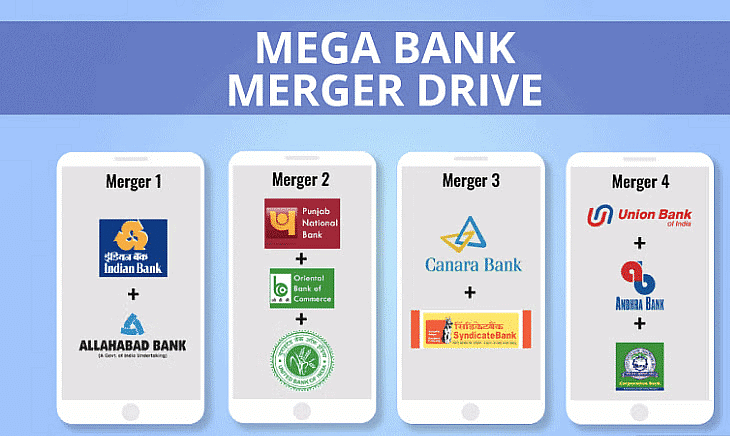
- Merger: The focus was on creating larger and stronger banks, reducing operational costs, and expanding the capital base. Starting with the merger of the Associates of SBI, a major consolidation occurred in August 2019 when 10 PSBs were merged into four, bringing the total number down to 12. As of the Union Budget 2021-22, two to three more banks were planned for merger in 2021-22.
- Disinvestment: The government adopted two routes for disinvestment: 'minority' stake sale and 'strategic,' which could lead to privatization. This move aimed to inject fresh capital and enhance managerial professionalism. In the Union Budget 2021-22, the government announced its intention to privatize all 'non-strategic' public sector enterprises, including some PSBs, while retaining control in 'strategic' ones, limited to only four (including a few PSBs and other financial institutions).
- Strategic Partners: The government had earlier decided to sell majority stakes to a 'strategic partner' during privatization, ensuring the banks benefit from world-class experience. Although a specific announcement on strategic disinvestment was not made until April 2021, it was anticipated.
Recent Developments in Indian Banking
1. Key Monetary Indicators
- The repo rate stands at 5.25 percent, while the Cash Reserve Ratio (CRR) has been reduced to 3.00 percent.
- The Statutory Liquidity Ratio (SLR) remains unchanged at 18 percent.
- The Standing Deposit Facility (SDF) rate is 5.00 percent, and the Marginal Standing Facility (MSF) rate is 5.50 percent.
- The Monetary Policy Committee (MPC) continues to maintain a neutral stance.
- The Consumer Price Index (CPI) inflation for FY26 is projected at around 2.1 percent, which is well
- within the RBI's target range.
The RBI has projected India's GDP growth for FY26 at 7.4 percent.
2. Digital Banking Developments
Unified Payments Interface (UPI)
- UPI has emerged as the backbone of India's digital payment system, recording 185.8 billion transactions in FY 2024-25 and 228.3 billion transactions in calendar year 2025.
- It accounts for approximately 83.7 percent of total digital transaction volume in India.
- The platform handles an average of nearly 698 million transactions per day.
- UPI has expanded globally and is currently operational in more than seven countries, with a target of reaching 20 countries by FY 2028-29.
Central Bank Digital Currency (CBDC / e-Rupee)
- The digital rupee has reached approximately 60 lakh users, with a total value of ₹1,016 crore in circulation.
- Around 17 banks are participating in the CBDC pilot.
- The system supports programmable payments, enabling targeted use for sectors such as education, healthcare, and fuel.
Other Key Digital Initiatives
- The RBI has introduced the Unified Lending Interface (ULI) to enable seamless and frictionless credit delivery.
- It has also launched the RBIDATA app to provide easy access to financial and macroeconomic data.
- The RBI-CRIS platform has been introduced to manage climate-related financial risks.
- From April 2025, all banks are required to adopt the ".bank.in" domain to enhance cybersecurity and reduce fraud.
3. Financial Inclusion Initiatives
Pradhan Mantri Jan Dhan Yojana (PMJDY)
- As of present, the total number of PMJDY accounts has crossed 56.16 crore, with total deposits reaching ₹2.67 lakh crore.
- Approximately 56 percent of account holders are women, and about 67 percent of accounts are in rural and semi-urban areas.
Pradhan Mantri Mudra Yojana (PMMY)
- Under PMMY, a total of 52.07 crore loans have been sanctioned, amounting to ₹33.19 lakh crore since inception.
- The loan limit under the Tarun Plus category has been increased to ₹20 lakh.
Financial Inclusion Index
The RBI's Financial Inclusion Index has improved to 67.0 in March 2025, reflecting enhanced access, usage, and quality of financial services.
4. Asset Quality and NPA Trends
India's banking sector has witnessed a significant improvement in asset quality, with the Gross Non-Performing Asset (GNPA) ratio declining to 2.1 percent in 2025, which is a multi-decade low.
The Net NPA ratio has reduced to approximately 0.5 percent.
Public Sector Banks recorded a record net profit of ₹1.41 lakh crore in FY24.
5. Monetary Policy Developments
- During 2025, the RBI reduced the repo rate cumulatively by 125 basis points.
- The repo rate was reduced to 6.25 percent in February 2025, further to 6.00 percent in April 2025, and then to 5.50 percent in June 2025.
- After remaining unchanged for some time, it was finally reduced to 5.25 percent in December 2025, where it currently stands.
6. Regulatory and Structural Reforms
Banking Laws (Amendment) Act, 2025
The Act increased the number of nominees for bank deposits from one to four.
It also raised the threshold for substantial interest from ₹5 lakh to ₹2 crore.
The tenure limit for directors in cooperative banks has been increased from 8 years to 10 years.
RBI Leadership
Sanjay Malhotra became the 26th Governor of RBI on December 10, 2024, succeeding Shaktikanta Das.
NBFC Sector Developments
The RBI revised the risk weight on bank lending to NBFCs from 125 percent to 100 percent, thereby easing credit flow.
Flipkart has also received an NBFC licence, enabling it to directly provide loans.
7. Green and Sustainable Banking
- Indian banks issued approximately ₹1 lakh crore worth of green bonds in 2024.
- The RBI has introduced the Climate Risk Information System (RBI-CRIS) to address climate-related financial risks.
- Banks are now required to integrate climate risk into their risk management frameworks.
8. Global Integration of Banking
- India's UPI system is now linked with international payment systems such as Singapore's PayNow and UAE's Aani.
- The RBI is also working towards integrating UPI with the European Central Bank's TARGET Instant Payment Settlement (TIPS) system.
- India aims to expand UPI to 20 countries by FY 2028-29.
9. Additional Important Developments
- The RBI withdrew the ₹2,000 denomination notes in May 2023, and by May 2024, about 97.82 percent of these notes had returned to the banking system.
- The RBI's Digital Payments Index (DPI) stood at 465.33 in September 2024, reflecting rapid digitalisation.
- The Standing Deposit Facility (SDF) is an important tool that allows RBI to absorb liquidity without providing collateral.
- The Emergency Credit Line Guarantee Scheme (ECLGS) was closed in March 2023 and is no longer active.
Impact and Future Implications
These developments have positioned the Indian banking sector as a global leader in digital innovation and financial inclusion. The focus on digital infrastructure, sustainable finance, and robust regulation ensures resilience against global economic uncertainties. By April 2025, bank credit growth is projected at 13-15% annually, driven by retail, MSME, and infrastructure lending. The RBI's Vision 2025 roadmap emphasizes inclusive growth, climate resilience, and global competitiveness, paving the way for Indian banks to support India's $5 trillion economy goal.
FAQs on Ramesh Singh Summary: Banking in India- 1
| 1. What is the role of commercial banks in India's financial system? |  |
| 2. How did banking in India evolve from the pre-independence era to modern times? | |
| 3. What's the difference between scheduled and non-scheduled banks in India? | |
| 4. Why did India nationalise banks, and what was the impact on banking services? | |
| 5. What functions do regional rural banks perform in India's banking structure? | |





