The Noun Numbers | English Grammar Class 7 PDF Download

Points to be Remembered
- Only countable nouns have plural forms. Singular countable nouns can be made plural usually by adding the suffix–s or es.
- Nouns that are made plural by adding–s or es are called regular nouns. For example: table –tables, glass–glasses.
- However the plural form of some nouns are made differently. Such nouns are called irregular nouns
The Plural of a Noun formed by adding s to the Singular
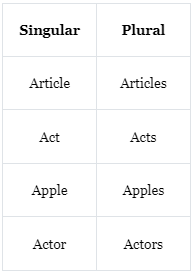
Singular to Plural using es
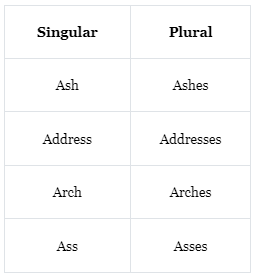
Singular Nouns ending in s, ss, sh, ch, x or z become Plural by adding es to them.
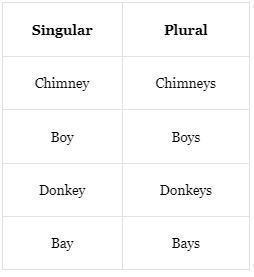
If a Singular Noun ends in y with a vowel before it, the plural is formed by adding s only.
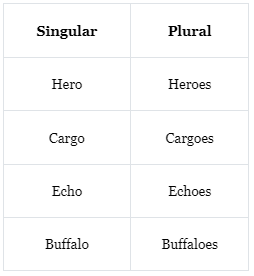
If a Singular Noun ends in o with a consonant before o, the plural is formed by adding es.
Plural of Noun by a change of inside vowels
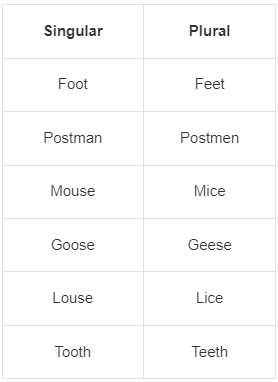
Nouns used only in singular
abuse, advice, luggage, machinery, money, poetry, jewellery, scenery, vacation, word, furniture, fruit, meal, fun, freedom, music, joy, permission, progress, rice, wheat, bread, milk, butter, glass, silver, gold, education, homework, employment, etc.
Nouns used as both the numbers, the singular and the plural
Committee, govt, police, wages, jury, means, politics, pains, publics etc.
- The jury was unanimous in its opinion.
- The jury were divided in their opinion.
- The committee has agreed on this issue.
- The committee are divided on this issue.
|
39 videos|288 docs|61 tests
|
FAQs on The Noun Numbers - English Grammar Class 7
| 1. What are prime numbers? |  |
| 2. How do you determine if a number is prime? | |
| 3. What is the largest prime number known to date? | |
| 4. Are there infinitely many prime numbers? | |
| 5. What is the significance of prime numbers in cryptography? | |




Exam
,past year papers
,mock tests for examination
,shortcuts and tricks
,Important questions
,Extra Questions
,Free
,The Noun Numbers | English Grammar Class 7
,practice quizzes
,MCQs
,video lectures
,Previous Year Questions with Solutions
,ppt
,Semester Notes
,study material
,Sample Paper
,Summary
,The Noun Numbers | English Grammar Class 7
,Viva Questions
,Objective type Questions
,The Noun Numbers | English Grammar Class 7
;




The Noun Numbers Free PDF Download
Importance of The Noun Numbers
The Noun Numbers Notes
The Noun Numbers Class 7 Questions
Study The Noun Numbers on the App
|
© EduRev
|
Education Revolution
|


|




