Visualising Shapes Class 7 Worksheet Maths

Q.1. Net of dice is given below, answer the following questions:
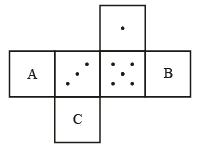
(i) Find the number of dots on the face C of the dice?
(ii) Find the number of dots on the face B of the dice?
(iii) Find the sum of dots on faces A and B in the given figure.
 View Answer
Ans. (i) 6
(ii) 4
(iii) 6
Q.2. How many rectangles are in the net of rectangular prism?
View Answer Ans. 6
Q.3. State whether the given statements are 'True' or 'False'.
(i) In the oblique sketch of the solid, the measurements are kept proportional.
(ii) The measurements are of exact size in an isometric sketch.
(iii) While a sphere is a 2-D figure, the circle is a 3-D figure.
(iv) The circle, the square, the rectangle, and the triangle are examples of plane figures.
View Answer Ans. (i) False, In oblique sketches, measurements are not necessarily kept proportional.
(ii) True
(iii) False, A sphere is a 3D figure, while a circle is a 2D figure.
(iv) True
Q.4. Fill up the blanks :
(i) The solid with one circular face, one curved surface, and one vertex is called ...........
(ii) Total no. of edges a cylinder are .......................
(iii) A solid with no vertex is ....................
(iv) The common portion of two adjacent faces of a cuboid is called .................
View Answer Ans. (i) Cone
(ii) 2
(iii) Sphere
(iv) Edge
Q.5. Complete the following table :
Figure
| No. of Faces
.........................
.........................
.........................
......................... | No. of Edges
.........................
.........................
.........................
......................... | No. of Vertices
.........................
.........................
.........................
......................... |
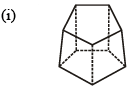
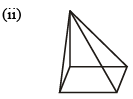
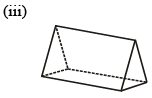
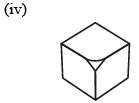 View Answer
 Ans.
Figure
| No. of Faces
7
5
5
7 | No. of Edges
15
8
9
15 | No. of Vertices
10
5
6
10 |
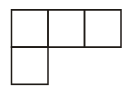
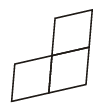
Q.6. Draw the top, the front, and the side views of the given solid made up of cubes.
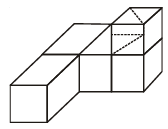
View Answer Ans.
Top view
Front view
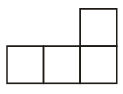
Side view (right)
Q.7. Draw an isometric view of a cuboid 5 cm × 3 cm × 2 cm.
View Answer Ans. Three different isometric sketches of the given cuboid are shown below: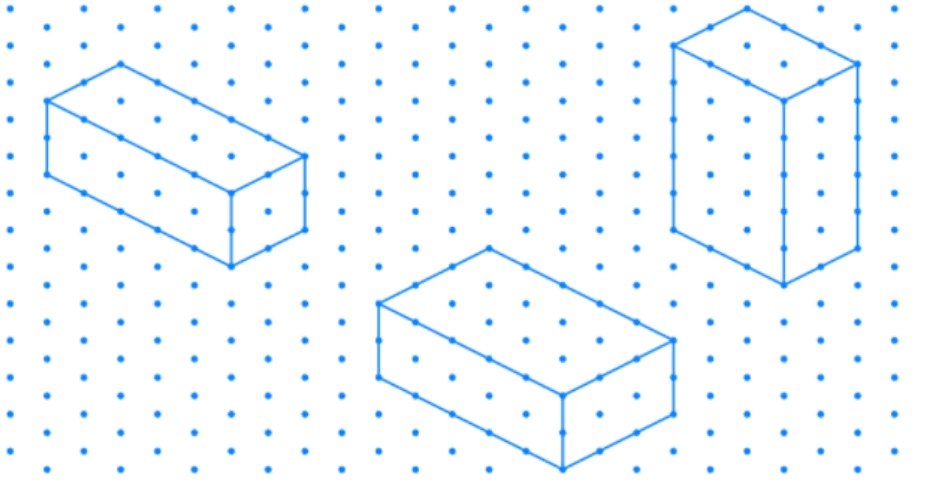
Q.8. Form the above figure answer the following questions:
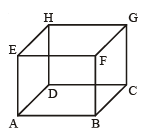
(i) Which edge is the intersection of faces EFGH and EFBA?
(ii) Which faces intersect at edge FB?
(iii) Give all the edges that are per pendicular to edge AB.
(iv) Give four vertices that do not all lie in one plane.
(v) If we subtract......from 53214 than the number so obtained is divisible by 8.
View Answer Ans.
(i) EF
(ii) ABFE, BFGC
(iii) AE, BF, AD, BC
(iv) A, E, C, B (Group of pains may differ)(v) 6
|
76 videos|452 docs|39 tests
|
FAQs on Visualising Shapes Class 7 Worksheet Maths
| 1. What are some common shapes that students should be able to visualize? |  |
| 2. How can visualizing shapes help in solving math problems? | |
| 3. What strategies can students use to improve their shape visualization skills? | |
| 4. Are there specific tools or resources that can assist with visualizing shapes? | |
| 5. Why is it important for students to learn about visualizing shapes in early education? | |




practice quizzes
,Visualising Shapes Class 7 Worksheet Maths
,Viva Questions
,Sample Paper
,Visualising Shapes Class 7 Worksheet Maths
,Free
,ppt
,video lectures
,Exam
,Semester Notes
,Important questions
,Visualising Shapes Class 7 Worksheet Maths
,past year papers
,study material
,MCQs
,Summary
,shortcuts and tricks
,Extra Questions
,mock tests for examination
,Previous Year Questions with Solutions
,Objective type Questions
;




Worksheet Question & Answers : Visualising Shapes Free PDF Download
Importance of Worksheet Question & Answers : Visualising Shapes
Worksheet Question & Answers : Visualising Shapes Notes
Worksheet Question & Answers : Visualising Shapes Class 7 Questions
Study Worksheet Question & Answers : Visualising Shapes on the App
|
© EduRev
|
Education Revolution
|


|




