Q1: Two statements are given below. They are Assertion (A) and Reason (R). Read both the statements carefully and choose the correct option: (1 Mark) Assertion (A): Minerals are an indispensable part of our lives. Reason (R): All living things need minerals. Options: (a) Both (A) and (R) are true and (R) is the correct explanation of (A). (b) Both (A) and (R) are true, but (R) is not the correct explanation of (A). (c) (A) is true, but (R) is false. (d) (A) is false, but (R) is true.
Solution:
Ans: (a)
Minerals are indeed indispensable to our lives because everything we use - from buildings to vehicles and even the food we eat - contains minerals. Moreover, all living things need minerals for vital life processes, making the reason a correct explanation of the assertion.
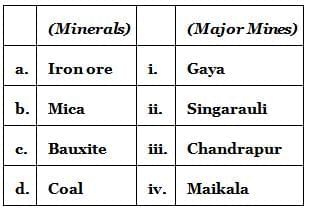
Q2: Match Column I with Column II and choose the correct option: (1 Mark)Options: (a) a-iii, b-i, c-iv, d-ii (b) a-iii, b-i, c-ii, d-iv (c) a-ii, b-iii, c-i, d-iv (d) a-ii, b-iii, c-iv, d-i
Solution:
Ans: (a)
Iron ore → Chandrapur (iii) - found in Durg-Bastar-Chandrapur belt of Chhattisgarh and Maharashtra.
Mica → Gaya (i) - major mica belt lies in Koderma-Gaya-Hazaribagh region of Jharkhand.
Bauxite → Maikala (iv) - bauxite deposits occur in the Maikal Hills and Amarkantak Plateau.
Coal → Singrauli (ii) - important coalfield located in Madhya Pradesh and Uttar Pradesh.
Thus, the correct option is (a) a-iii, b-i, c-iv, d-ii.
Q3:Match Column I with Column II and choose the correct option: (1 Mark)
Talcher → Odisha (ii) - an important thermal power plant located in Odisha.
Ramagundam → Telangana (i) - one of India's largest thermal power stations.
Bhusawal → Maharashtra (iv) - located in Jalgaon district, Maharashtra.
Vijayawada → Andhra Pradesh (iii) - a major thermal power station in Andhra Pradesh.
Q4:Read the given source and answer the questions that follow: (4 Marks) Iron Ore Iron ore is the basic mineral and the backbone of industrial development. India is endowed with fairly abundant resources of iron ore. India is rich in good quality iron ores. Magnetite is the finest iron ore with a very high content of iron up to 70 per cent. It has excellent magnetic qualities, especially valuable in the electrical industry. Hematite ore is the most important industrial iron ore in terms of the quantity used, but has a slightly lower iron content than magnetite (50 - 60 per cent). In 2018 - 19, almost the entire production of iron ore (97%) accrued from Odisha, Chhattisgarh, Karnataka, and Jharkhand. The remaining production (3%) was from other states.
(i) In which iron ore is the maximum iron content found? (1 Mark)
Solution:
Ans: The maximum iron content is found in Magnetite, which contains up to 70% iron.
(ii) Which is the most important industrial iron ore? (1 Mark)
Solution:
Ans: The most important industrial iron ore is Hematite.
(iii) "Iron ore is a basic mineral." Support the statement. (2 Marks)
Solution:
Ans:Iron ore is a basic mineral because it forms the backbone of industrial development. It is the raw material for producing steel, which is essential for manufacturing machinery, tools, vehicles, buildings, railways, and other industrial goods. Thus, iron ore supports the growth of almost all major industries in India.
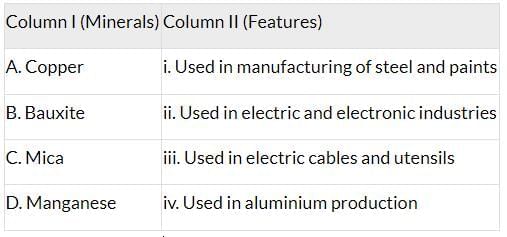
Q5:Match Column I with Column II and choose the correct option: (1 Mark)
Copper → (ii) Used in electric cables and utensils because it is a good conductor of electricity and heat.
Bauxite → (iv) Used in aluminium production as aluminium is extracted from bauxite ore.
Mica → (iii) Used in electric and electronic industries due to its insulating properties and heat resistance.
Manganese → (i) Used in manufacturing of steel and paints and also for making ferro-manganese alloys.
Q6: "It would be beneficial to develop sustainable ways to meet the growing energy demand in India." Support the statement by giving suitable arguments. (5 Marks)
Solution:
Ans: Yes, it is beneficial to develop sustainable waysto meet the growing energy demand in India because of the following reasons:
Limited and Exhaustible Conventional Resources: Most of India's energy resources like coal, petroleum, and natural gas are non-renewable and getting depleted rapidly. The geological formation of these resources takes millions of years, but they are being consumed much faster.
Environmental Concerns: Burning fossil fuels causes air pollution, global warming, and acid rain, leading to serious environmental problems. Sustainable energy sources like solar, wind, and biogas are clean and eco-friendly.
Energy Security and Self-Reliance: India imports a large amount of petroleum and natural gas. Developing renewable sources will reduce dependence on imports and strengthen the country's energy security.
Economic Development: Non-conventional sources such as solar and wind energy have low recurring costs once established. Promoting these will create new employment opportunities and support rural electrification.
Future Sustainability: Using renewable energy ensures that future generations also have access to energy resources. Energy saved is energy produced, so promoting energy conservation and efficient use supports sustainable development.
Conclusion: Therefore, developing sustainable and renewable energy sources is essential to ensure environmental protection, economic stability, and long-term energy security for India.
Q7: "We have to use a planned and sustainable manner to conserve our minerals." Support the statement by giving suitable arguments. (5 Marks)
Solution:
Ans: Yes, it is essential to use our minerals in a planned and sustainable manner, because mineral resources are finite and non-renewable. The following points support this statement:
Limited Availability: The total volume of workable mineral deposits is only about 1% of the Earth's crust. Minerals take millions of years to form, but they are being extracted and consumed rapidly, making them exhaustible resources.
Slow Rate of Formation: The geological processes of mineral formation are extremely slow, so replenishment cannot match the present rate of consumption. Once exhausted, these resources cannot be replaced easily.
Increasing Extraction Costs: Continuous mining leads to the depletion of high-grade ores, forcing extraction from greater depths or lower-grade deposits, which increases costs and environmental degradation.
Environmental Impact: Mining causes land degradation, deforestation, water pollution, and air contamination. Sustainable use helps reduce environmental damage and maintain ecological balance.
Need for Future Generations: To ensure that future generations also benefit from these valuable resources, we must recycle metals, use scrap, and develop substitute materials where possible.
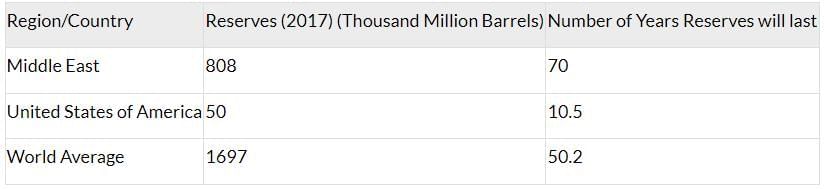
Q8:Study the given table and answer the question that follows: (1 Mark) CRUDE OIL RESERVES
Read the following possible outcomes from the table and choose the correct option: I. If crude oil continues to be extracted at the present pace, it would be exhausted in about 50 years. II. In Middle Eastern Countries it may take longer than average of the world. III. To ensure the availability of crude oil in future, its reuse and recycle policy should be adopted. IV. In United States of America, Crude oil is likely to run out in just about 10 years. (a) Only I, III and IV are correct. (b) Only I, II and III are correct. (c) Only II, III and IV are correct. (d) Only I, II and IV are correct.
Solution:
Ans: (D) Only I, II and IV are correct.
Based on the data typically provided in the "Crude Oil Reserves" table (often sourced from BP Statistical Review of World Energy), the statements are evaluated as follows:
Statement I is correct: The world average number of years reserves will last is approximately 50.2 years.
Statement II is correct: Middle Eastern reserves are projected to last about 70 years, which is significantly longer than the world average.
Statement IV is correct: Crude oil reserves in the United States are estimated to last for approximately 10.5 years, fitting the description of "just about 10 years"
Q9: Two statements are given below. They are Assertion (A) and Reason (R). Read both the statements and choose the correct option: Assertion (A): Certain minerals may occur as alluvial deposits in sands of valley floors and the base of hills. Reason (R): These are usually minerals, that are not corroded by water. (1 Mark) (A) Both (A) and (R) are true and (R) is the correct explanation of (A). (B) Both (A) and (R) are true but (R) is not the correct explanation of (A). (C) (A) is true but (R) is false. (D) (A) is false but (R) is true.
Solution:
Ans: (A) Both (A) and (R) are true and (R) is the correct explanation of (A).
Certain minerals occur as alluvial or placer deposits in the sands of valley floors and at the base of hills. These minerals, such as gold, silver, tin, and platinum, are not corroded by water, which explains why they accumulate in such deposits. Hence, both the Assertion and the Reason are true, and the Reason correctly explains the Assertion.
Therefore, option (A) is correct.
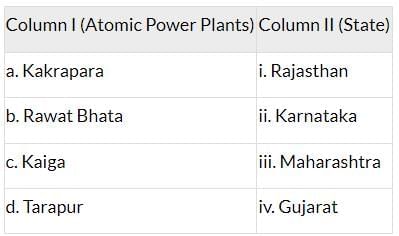
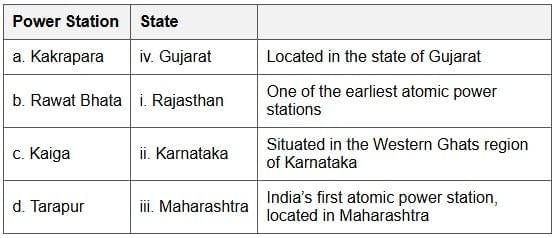
Q10:Match Column I with Column II and choose the correct option: (1 Mark)
The table below shows the correct matching of atomic power plants with their states:
Thus, option (C) is correct.
Q11: Read the characteristics given in the box and identify the type of coal from the options given below: (1 Mark) This is low grade brown coal. The principal reserves are in Neyveli in Tamil Nadu. It is soft with high moisture content. (A) Pit Coal (B) Anthracite Coal (C) Lignite Coal (D) Bituminous Coal
Solution:
Ans: (C) Lignite Coal
According to the chapter, Lignite is a low-grade brown coal, soft in texture, and has a high moisture content. Its principal reserves are found in Neyveli, Tamil Nadu, where it is mainly used for electricity generation.
Q12: Why is the conservation of conventional sources of energy significant? Explain any two reasons. (2 Marks)
Solution:
Ans: The conservation of conventional sources of energy is significant because:
They are non-renewable and exhaustible: Conventional sources like coal, petroleum, and natural gas take millions of years to form. Their reserves are limited and may get exhausted soon if overused.
They cause environmental pollution: Excessive use of these fuels leads to air pollution, global warming, and ecological imbalance. Conserving them reduces environmental damage and helps maintain a clean and sustainable environment.
Q13: Why is it necessary to adopt non-conventional sources of energy? Explain. (2 Marks)
Solution:
Ans: It is necessary to adopt non-conventional sources of energy because:
Exhaustion of conventional resources: Conventional energy sources like coal, petroleum, and natural gas are limited and non-renewable. To meet the growing energy demand sustainably, we must use renewable alternatives such as solar, wind, and biogas.
Environment-friendly and sustainable: Non-conventional sources are clean and pollution-free, reducing problems like air pollution and global warming. They ensure a sustainable and eco-friendly supply of energy for the future.
Q14: Suggest any two ways for the conservation of minerals. (2 Marks)
Solution:
Ans: Two ways for the conservation of minerals are:
Recycling and reuse of metals: Scrap metals and used materials should be recycled and reused to reduce the need for new mineral extraction.
Use of substitutes and improved technology: Developing substitute materials and using improved mining technologies help in reducing wastage and allow the use of low-grade ores efficiently.
Previous Year Questions 2024
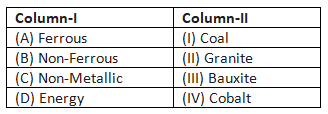
Q1: Match Column-I with Column-II and choose the correct option. (CBSE 2024) (a) (A)-(II), (B)-(IV), (C)-(III), (D)-(I) (b) (A)-(IV), (B)-(III), (C)-(II), (D)-(I) (c) (A)-(I), (B)-(II), (C)-(IV), (D)-(III) (d) (A)-(III), (B)-(IV), (C)-(II), (D)-(I)
Solution:
Ans: (b)
(A) Ferrous matches with (IV) Cobalt, as ferrous materials are related to iron and cobalt is a metal used in various alloys.
(B) Non-Ferrous matches with (III) Bauxite, since bauxite is a non-ferrous ore primarily used to produce aluminum.
(C) Non-Metallic matches with (II) Granite, because granite is a type of rock and not a metal.
(D) Energy matches with (I) Coal, as coal is a major source of energy.
Q2: (A) How is energy a basic requirement for economic development? Explain. (CBSE 2024) OR (B) How are conventional sources of energy different from non- conventional sources? Explain.
Solution:
Ans: (A) Energy is a fundamental requirement for economic development because it powers industries, transportation, communication, and daily life. Here's how energy drives economic growth:
Industrial Growth: Industries rely on energy to operate machinery, manufacture goods, and process raw materials. Without a stable energy supply, industrial productivity declines, hindering economic growth.
Infrastructure Development: Energy is essential for building and maintaining infrastructure such as roads, bridges, and buildings. Construction equipment and materials production depend heavily on energy.
Transportation and Trade: Energy fuels transportation systems, including cars, trucks, ships, and airplanes, enabling the movement of goods and people. Efficient transportation networks are vital for trade and commerce, which are key components of economic development.
Technological Advancement: Modern technologies, including computers, telecommunications, and medical equipment, require energy to function. Technological innovation drives productivity and economic growth, making energy indispensable.
Agriculture and Food Production: Energy is crucial for agricultural activities, such as irrigation, harvesting, and food processing. It also powers the transportation and storage of food, ensuring food security and supporting rural economies.
Employment and Income Generation: The energy sector itself creates jobs in production, distribution, and maintenance. Additionally, reliable energy access enables the growth of other sectors, leading to increased employment opportunities and income generation.
Quality of Life: Energy improves the quality of life by powering homes, schools, hospitals, and public services. Access to electricity enhances education, healthcare, and overall well-being, which are essential for a productive workforce.
In summary, energy is a cornerstone of economic development as it supports industrial activities, infrastructure, transportation, technology, agriculture, employment, and quality of life. Without adequate and reliable energy, economic progress would be severely constrained. OR (B) Conventional sources of energy and non-conventional sources of energy are different in the following ways: 1. Source:
Conventional Sources: These are traditional sources of energy that have been used for a long time, such as coal, petroleum (oil), natural gas, and hydropower.
Non-Conventional Sources: These are newer or alternative sources of energy that are not widely used yet, like solar energy, wind energy, biomass, tidal energy, and geothermal energy.
2. Renewability:
Conventional Sources: These sources are mostly non-renewable, meaning they are finite and can run out over time. For example, coal and petroleum are limited and take millions of years to form.
Non-Conventional Sources: These are usually renewable, meaning they can be replenished naturally and are not likely to run out, like solar and wind energy.
3. Environmental Impact:
Conventional Sources: They often cause pollution and harm the environment. Burning fossil fuels like coal and petroleum releases harmful gases, contributing to air pollution and climate change.
Non-Conventional Sources: These sources are generally cleaner and have less impact on the environment. Solar and wind energy, for example, produce little to no pollution.
4. Availability:
Conventional Sources: These sources are available in specific regions. For example, coal is found in large quantities in some countries, while oil is concentrated in others.
Non-Conventional Sources: These sources can be found anywhere, as long as the natural conditions are right, like sunlight for solar energy or wind for wind energy.
5. Cost:
Conventional Sources: They tend to be cheaper initially but can lead to higher long-term costs due to pollution, health effects, and resource depletion.
Non-Conventional Sources: They may be expensive to set up initially (like installing solar panels or wind turbines), but they have lower operational costs and are more sustainable in the long run.
In summary, conventional sources are traditional, non-renewable, and polluting, while non-conventional sources are modern, renewable, and environmentally friendly.
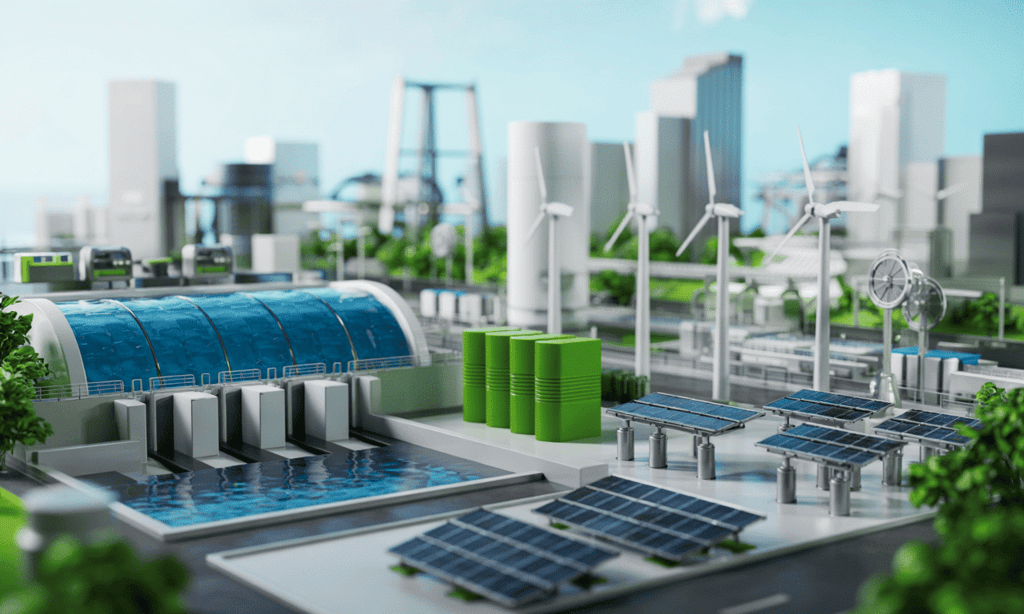
Sustainable Energy
Previous Year Questions 2023
Q3: Which one of the following is an example of the Ferrous Metal? (CBSE 2023) (a) Copper (b) Tin (c) Bauxite (d) Nickel
Solution:
Ans: (d) Nickel is considered a ferrous metal because it is often used in the production of alloys with iron, which enhances the strength and resistance of steel. In contrast, copper and tin are non-ferrous metals, and bauxite is an ore of aluminum, not a metal itself.
Q4: Read the given case and answer the questions that follow: (2023) CONSERVATION OF ENERGY RESOURCES Energy is a basic requirement for economic development. Every sector of the national economy - agriculture, industry, transport, commercial and domestic - needs inputs of energy. The economic development plans implemented since independence necessarily required increasing amounts of energy to remain operational. As a result, consumption of energy In all forms has been steadily rising all over the country. In this background, there is an urgent need to develop a sustainable path of energy development. Promotion of energy conservation and increased use of renewable energy sources are the twin planks of sustainable energy. India is presently one of the least energy-efficient countries in the world. We have to adopt a cautious approach for the judicious use of our limited energy resources. For example, as concerned citizens, we can do our bit by using public transport systems instead of individual vehicles; switching off electricity when not in use, using power-saving devices and using non-conventional sources of energy. At last "Energy Saved is energy produced". (i) Why is sustainable energy a key to sustainable development? (ii) Why is consumption of energy rising in all over India? (iii) Explain 'Energy saved is energy produced.'
Solution:
Ans: (i) Sustainable energy is a key to sustainable development, as sustainability demands that resource reserves including exhaustible, natural and environmental resources, be maintained. (ii)After getting independence development of all sectors like agriculture, industry, transport, domestic needs etc. necessarily required to remain in operation, hence consumption of energy in all forms has increased all over India. (iii)Energy saved is energy produced. We cannot keep on producing non-renewable energy like petrol, diesel and electricity. So the need of the hour is the better utilisation of existing resources. We have to adopt cautions approach for the judicious use of our limited energy resources.
Previous Year Questions 2020
Q5: Classify metallic minerals with an example of each. (2020 C)
Solution:
Ans:
Ferrous minerals: Iron ore, manganese
Non-ferrous minerals: Copper, lead, bauxite
Precious minerals: Gold, silver, platinum
Q6: "Minerals occur in various forms". Support this statement with examples. (2020)
Solution:
Ans:
Minerals can occur in igneous and metamorphic rocks as veins and lodes. Examples include tin, copper, zinc, and lead.
Minerals can also occur in sedimentary rocks as beds or layers. Examples include gypsum, potash salt, and sodium salt.
Some minerals are formed through the decomposition of surface rocks, leaving behind residual material. Bauxite is an example.
Alluvial deposits in sands can also contain minerals. Gold, silver, tin, and platinum are examples.
Q7: "Minerals are an indispensable part of our lives". Support this statement with examples. (2020)
Solution:
Ans:
Minerals are used in the construction of buildings and infrastructure, such as iron ore for steel.
Minerals are used in transportation systems, such as copper for electrical wiring.
Minerals are used in electronic devices, such as lithium for batteries.
Minerals are used in everyday items, such as gold and silver for jewelry.
Minerals Q8: Differentiate between anthracite and bituminous coal on the basis of quality. (2020 C)
Solution:
Ans:
Anthracite coal is of higher quality, while bituminous coal is comparatively lower grade in quality.
Anthracite coal has a higher carbon content, causing less pollution compared to bituminous coal.
Anthracite coal is available in small quantities in India, while bituminous coal is available in abundance.
Q9: In which of the following states is Kalpakkam nuclear power plant located ? (2020) (a) Gujarat (b) Odisha (c) Kerala (d) Tamil Nadu
Solution:
Ans: (d) The Kalpakkam nuclear power plant is located in Tamil Nadu, near the town of Kalpakkam, which is close to Chennai. This plant is significant as it contributes to India's energy needs by generating electricity through nuclear power.
Q10: In which of the following States is Narora Nuclear Power Plant located? (2020) (a) Karnataka (b) Kerala (c) Tamil Nadu (d) Uttar Pradesh
Solution:
Ans: (d) The Narora Nuclear Power Plant is located in Uttar Pradesh, near the town of Narora, which is about 200 kilometers from Delhi. This plant plays an important role in generating nuclear energy to meet the electricity demands of the region.
Q11: Fill in the blank: ________ is well known for effective use of wind energy in Rajasthan. (2020)
Solution:
Ans:Jaisalmer is well known for the effective use of wind energy in Rajasthan.
Q12: Suggest any one way to enhance the use of natural gas in India. (2020)
Solution:
Ans:Use of natural gas: Making people aware about the importance of using this clean energy resources because this gas is considered environment friendly.
Q13: Fill in the blanks: 'Gobar gas plants' provide twin benefits to the farmers in the form of_______and________ (2020)
Solution:
Ans: 'Gobar gas plants' provide twin benefits to the farmers in the form of energy and manure.
Q14: Suggest any one way to maximize the use of nuclear energy in the field of medicine. (2020)
Solution:
Ans: Nuclear medicine use radio-active substances, mostly to diagnose cancer as well as cardiac and other diseases.
Previous Year Questions 2019
Q15: In which of the following state is the Narora Nuclear Power Plant located ? (a) Karnataka (b) Kerala (c) Tamil Nadu (d) Uttar Pradesh (CBSE 2019)
Solution:
Ans: (d) The Narora Nuclear Power Plant is located in the state of Uttar Pradesh in India. It is situated on the banks of the Ganges River in the Bulandshahr district. This plant is one of India's key nuclear power facilities, generating electricity through nuclear energy. Thus, the correct answer is (d) Uttar Pradesh.
Q16: "India has fairly rich and varied mineral resources across different regions". Support the statement with examples. (CBSE 2019) OR "Minerals occur in various forms." Support this statement with examples. (CBSE 2019)
Solution:
Ans: (1) Minerals occur in the cracks, crevices, faults or joints in igneous rocks and metamorphic rocks in the form of small occurrences of veins and large occurrences called lodes. Tin and zinc are obtained from veins and lodes. (2) Sedimentary Rocks are found in nodes and layers. Minerals like gypsum, coal, iron ore are formed. (3) Minerals are also formed by decomposition of surface rocks, and the removal of soluble constituents, leaving a residual mass of weathered material containing ores. For example, bauxite
Q17: 'Energy saved is energy produced.' Assess the statement. (CBSE 2019, 17)
Solution:
Ans: This statement can be supported in the following ways: (1) Promotion of energy conservation and increased use of renewable energy sources is an important measure to save resources for the upcoming generations. (2) A judicious use in using our limited energy resources is of utmost significance to encourage development without any threat to survival in the future generations. (3) Public transport systems can help save fuel and other important energy resources. Fuel will last for a longer time. (4) Using power-saving devices and using nonconventional sources of energy helps in preventing excessive usage of conventional energy resources.
Previous Year Questions 2017
Q18: Describe any three characteristics of the Ballari-Chitradurga, Chikkamagaluru-Tumakuru iron-ore belt in India. (Foreign 2017)
Solution:
Ans:
The Ballari-Chitradurga, Chikkamagaluru-Tumakuru iron-ore belt is located in Karnataka.
The Kudremukh mines in this belt, located in the Western Ghats, are a 100% export unit.
The Kudremukh deposits are known to be one of the largest in the world.
The ore from these mines is transported as slurry through a pipeline to a port near Mangaluru.
Q19: Describe any three characteristics of the Durg-Bastar-Chandrapur iron-ore belt in India. (AI 2017)
Solution:
Ans:
The Durg-Bastar-Chandrapur iron-ore belt is located in Chhattisgarh and Maharashtra.
It provides very high-grade hematite iron ore from the famous Bailadila range of hills in the Bastar district of Chhattisgarh.
The iron ore deposits in this belt have the best physical properties needed for steel making.
Iron ore from these mines is exported to Japan and South Korea via Vishakhapatnam port.
Q20: Describe any three characteristics of the 'Odisha-Jharkhand belt' of iron ore in India. (Delhi 2017)
Solution:
Ans:
The Odisha-Jharkhand belt is known for high-grade haematite ore.
In Odisha, the iron ore is found in Badampahar mines in the Mayurbhanj and Kendujhar districts.
In Jharkhand, haematite iron ore is mined in Gua and Noamundi.
These mines supply iron ore to the steel industry in the eastern and other parts of India.
Q21: Why is it necessary to conserve mineral resources? Explain any four ways to conserve mineral resources. (AI2017)
Solution:
Ans: It is necessary to conserve mineral resources because they are limited in availability and the process of mineral formation is slow. Additionally, minerals are non-renewable and exhaustible. Four ways to conserve mineral resources are: 1. Using minerals in a planned and sustainable manner. 2. Evolving improved technology to allow the use of low-grade ore at a low cost. 3. Practicing recycling of minerals. 4. Using alternative renewable substitutes.
Q22: 'Energy saved is energy produced.' Assess the statement. (2017)
Solution:
Ans: The statement "Energy saved is energy produced" emphasizes the importance of conserving energy. By reducing energy wastage and using energy-efficient practices, we can save energy and reduce the need for additional energy production. This approach is beneficial for the environment as it reduces the consumption of fossil fuels and decreases greenhouse gas emissions.
Q23: Why should we use renewable energy resources? Explain with arguments. (Foreign 2017)
Solution:
Ans: There are several reasons why we should use renewable energy resources: 1. Non-renewable resources are limited and will eventually get exhausted. In contrast, renewable energy resources such as solar power and wind energy are inexhaustible, making them a sustainable choice for long-term energy needs. 2. The depletion of non-renewable resources like coal and petroleum has taken millions of years to occur. By using renewable energy resources, we can avoid further depletion and preserve these non-renewable resources for future generations. 3. Fossil fuels, which are non-renewable resources, contribute to pollution and environmental degradation. Renewable energy sources, on the other hand, are cleaner and emit fewer greenhouse gases, thus mitigating the impact of climate change. 4. The cost of extracting and using non-renewable resources is increasing as these resources become harder to find. In contrast, the cost of renewable energy technologies, such as solar panels and wind turbines, has been decreasing over time. Investing in renewable energy can help reduce energy costs in the long run.
Q24: Why is energy needed? Write one reason. (CBSE 2017)
Solution:
Ans: Energy is required for all kinds of activities like cooking, lighting and heating, propelling vehicles and enabling smooth working of machinery in industries.
Q25: "Natural gas is an important source of energy." Support the statement. (CBSE 2017)
Ans: Natural gas is an important source of energy because: (1) It is an industrial raw material in the petrochemical industry. (2) It helps build fertiliser plants and encourages the use of fertilisers. It can boost agricultural production. (3) It can be easily transported through pipelines
Q26: Which state is the largest producer of manganese in India? Mention any two uses of manganese. (CBSE 2017)
Solution:
Ans: The nation's top producer of manganese is Madhya Pradesh. (1) Manganese manufactures steel and ferro-manganese alloy. Nearly 10 kgs of manganese is used in manufacturing one tonne of steel. (2) It is used in the production of bleaching powder, insecticides and paints
Q27: "Minerals are an indispensable part of our lives." Support the statement with examples. (CBSE 2017)
Solution:
Ans: (1) Minerals are used to create or produce almost everything we use everyday. This includes our technology, equipment etc., which are made of steel, silicon, aluminium, copper, gold, silver. Needles, Utensils, Clothes, Jewellery, and containers are all made of minerals. (2) Transportation was made possible because of minerals. The railway lines and tarmac (paving) of the roads, cars, buses, trains, airplanes are manufactured from minerals. (3) Even the food that we eat contains minerals. Minerals are produced when we digest it and even when we excrete it.
Q28: "There is a pressing need for using renewable energy sources in India." Justify the statement. (CBSE 2017)
Solution:
Ans: There is a pressing need to use renewable energy resources because: (1) The growing consumption of energy has resulted in the country becoming increasingly dependent on fossil fuels such as coal, oil and gas. (2) The rising prices of oil and gas and their potential shortages have raised uncertainties about the security of energy supply in future. (3) It has serious repercussions on the growth of the national economy. (4) The increasing use of fossil fuels also causes serious environmental problems. (5) Non-renewable energy resources take millions of years to regenerate.
Previous Year Questions 2016
Q29: Why are there a wide range of colours, hardness, crystal forms, lustre and density found in minerals? (Delhi 2016)
Solution:
Ans: The varied colours, hardness, crystal forms, lustre, and density found in minerals are due to their chemical composition and the parameters such as temperature, pressure, rate of cooling, etc., present during their formation.
Q30: How is iron-ore transported from Kudremukh mines to a port near Mangaluru? (CBSE 2016)
Solution:
Ans: Iron ore is transported from Kudremukh mines to a port near Mangaluru as slurry through pipelines.
Q31: Why should the use of cattle cake as fuel be discouraged? (Al 2016)
Solution:
Ans: The use of cattle cake as fuel should be discouraged because it creates pollution and by burning it, a valuable manure resource is destroyed, which could otherwise improve soil fertility.
Q32: How are 'Gobar Gas Plants' beneficial to the farmers? (CBSE 2016)
Solution:
Ans: 'Gobar Gas Plants' are beneficial to the farmers in two ways. Firstly, they provide a clean fuel for domestic cooking and lighting. Secondly, they produce high-quality manure that can be used to enhance soil fertility.
Q33: "India is an important iron and steel producing country in the world. Yet we are not able to perform to our full potential." Suggest and explain any three measures to reach our full potential. (Foreign 2016)
Solution:
Ans:
Modernizing technology and machinery in the iron and steel industry to improve efficiency and productivity.
Streamlining the supply of inputs such as iron ore and coke to ensure a steady and sufficient availability.
Developing a supportive infrastructure, such as adequate electricity capacity, to meet the demands of the industry.
Implementing effective customer demand and supply management strategies to optimize production and distribution.
Q34: 'Consumption of energy in all forms has been rising all over the country. There is an urgent need to develop a sustainable path of energy development and energy saving.' Suggest and explain any three measures to solve this burning problem. (AI 2016)
Solution:
Ans:
Increase the use of renewable energy resources like solar power, wind power, biogas, tidal energy, and geothermal energy. This will reduce dependence on non-renewable sources and promote sustainable energy development.
Promote energy conservation by encouraging the judicious use of energy resources. This can be achieved through awareness campaigns, energy-efficient practices, and the use of power-saving devices.
Improve energy efficiency in industries, transportation, and buildings by adopting energy-saving technologies and practices. This can be done through government regulations, incentives, and public-private partnerships.
Q35: "There is a pressing need to use renewable energy resources." Justify the statement with suitable arguments. (AI 2016)
Solution:
Ans:
The growing consumption of energy has led to increased dependence on fossil fuels like coal, oil, and gas, which are finite resources. The use of renewable energy resources can help reduce this dependence and ensure a sustainable energy future.
Rising prices and potential shortages of fossil fuels have raised concerns about the security of energy supply. Renewable energy resources are more abundant and can provide a more reliable and secure source of energy.
The use of renewable energy resources can help mitigate the adverse environmental impacts of fossil fuel use, such as air pollution and greenhouse gas emissions. Renewable energy sources like solar, wind, and hydroelectric power are cleaner and have a lower carbon footprint.
Investing in renewable energy technologies can stimulate economic growth and create jobs in sectors like manufacturing, installation, and maintenance.
Q36: Which minerals are used to obtain nuclear energy? Name all the six nuclear power stations of India. (AI 2016)
Solution:
Ans:
The minerals used to obtain nuclear energy are uranium and thorium.
The six nuclear power stations in India are: Narora Nuclear Power Station, Kakrapara Nuclear Power Station, Tarapur Nuclear Power Station, Kaiga Nuclear Power Station, Rawat Bhata Nuclear Power Station, and Kalpakkam Nuclear Power Station.
Q37: Explain the importance of conservation of minerals. Highlight any three measures to conserve them. (AI2016)
Solution:
Ans: Conservation of minerals is important for the following reasons: 1. Minerals are the backbone of the economy and are essential for various industries. 2. The total volume of workable mineral deposits is very limited, representing only 1% of the Earth's crust. 3. Mineral resources are being consumed at a rapid rate, while the geological processes of mineral formation are slow. This means that the rate of consumption far exceeds the rate of replenishment. Three measures to conserve minerals are: 1. Using minerals in a sustainable manner by planning their extraction and usage. 2. Developing improved technologies that allow the use of low-grade ore at a lower cost. 3. Promoting recycling and reuse of minerals to reduce the demand for new extraction.
Q38: Highlight the importance of petroleum. Explain the occurrence of petroleum in India. (CBSE 2016)
Solution:
Ans: The importance of petroleum can be highlighted as follows: 1. Petroleum is a major source of energy in India, providing fuel for heat, lighting, and transportation. 2. It serves as a lubricant for machinery, ensuring their smooth operation. 3. Petroleum is a crucial raw material for various manufacturing industries. 4. Petroleum refineries play a significant role in supporting industries such as synthetic, textile, fertilizer, and chemical industries. In India, petroleum occurs in the following ways: 1. Most petroleum reserves in India are associated with anticlines and fault traps. 2. In regions of folding anticlines or domes, petroleum is trapped in the crust of the upfold. 3. Petroleum is also found in fault traps between porous and non-porous rocks.
Q39: Suggest and explain any three measures through which every citizen can help to conserve energy resources. (CBSE 2016)
Solution:
Ans: Three ways in which citizens can help conserve energy resources are: (1) Reduction in usage of individual vehicles. (2) Minimisation of electricity usage. (3) Reduction in usage of water resources
Previous Year Questions 2015
Q40: Why does aluminium metal have great importance? (2015)
Solution:
Ans: Aluminium metal has great importance because it combines the properties of great strength, lightness, malleability, and conductivity.
Q41: "Natural gas is considered an environment-friendly fuel." Explain the statement in two points. (AI 2015)
Solution:
Ans:
Natural gas is considered an environment-friendly fuel because it causes less pollution compared to other fossil fuels like coal and oil. It has a lower carbon content and emits fewer greenhouse gases when burned, reducing the impact on climate change.
Natural gas is a clean-burning fuel that produces fewer air pollutants such as sulfur dioxide, nitrogen oxide, and particulate matter. This improves air quality and reduces the health risks associated with pollution.
Q42: How is geothermal energy produced? Explain. (AI 2015)
Solution:
Ans:
Geothermal energy is produced by harnessing the heat from the Earth's interior.
In areas with high geothermal gradients, where temperatures increase with depth, groundwater absorbs heat from the rocks and becomes hot.
This hot water or steam rises to the Earth's surface and can be used to drive turbines and generate electricity.
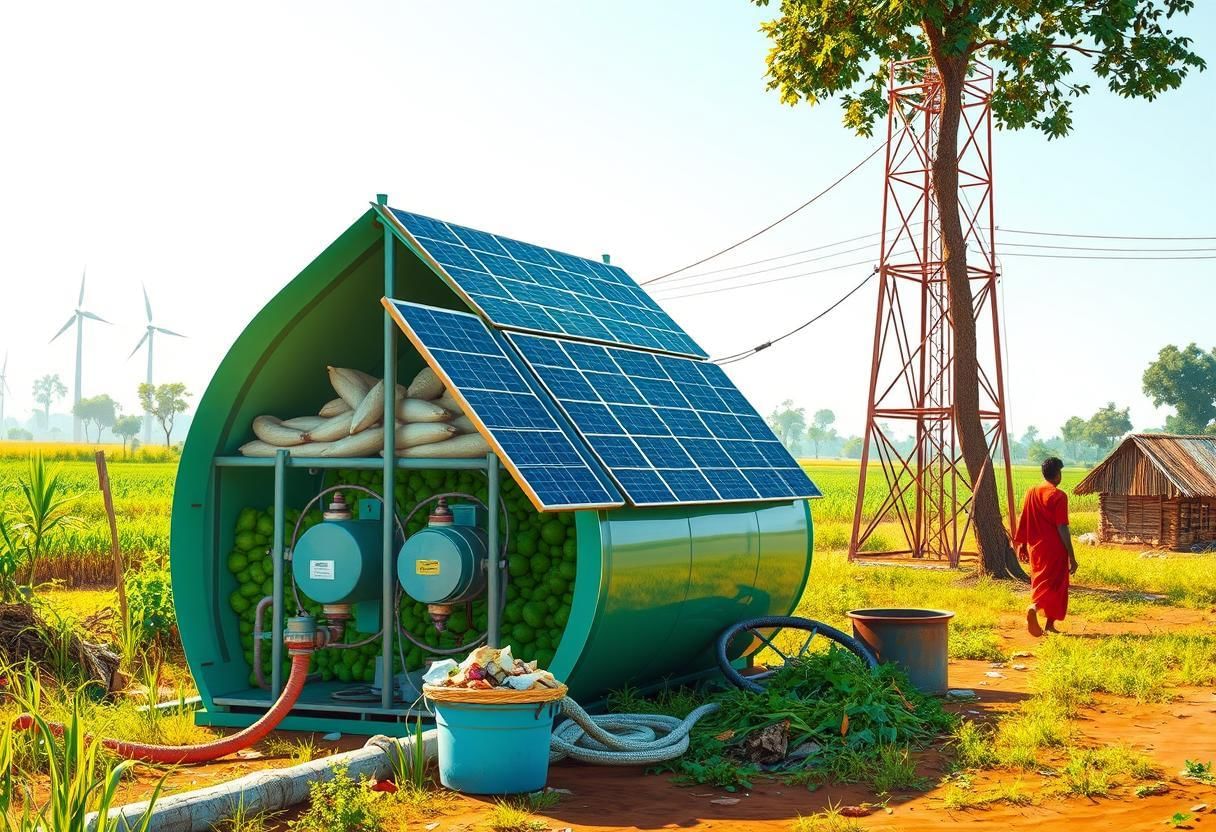
Q43: How can biogas solve the energy problem mainly in rural India? Give your suggestions. (AI 2015)
Solution:
Ans:
Biogas can solve the energy problem in rural India by providing a renewable source of energy that is readily available.
The raw materials for biogas production, such as agricultural waste, animal manure, and kitchen waste, are abundant in rural areas.
By promoting the use of biogas plants, rural communities can generate their own energy for cooking, lighting, and other domestic uses, reducing their dependence on traditional sources like firewood and kerosene.
Biogas production also has environmental benefits, as it helps in waste management by converting organic waste into a useful energy resource and reducing greenhouse gas emissions.
Biogas Energy
Q44: Describe any three features of ferrous minerals found in India. (Foreign 2015)
Solution:
Ans:
Ferrous minerals in India account for approximately three-fourths of the total value of metallic mineral production.
They provide a strong foundation for the expansion of metallurgical industries in the country.
India is a leading exporter of ferrous minerals, with magnetite and hematite being some of the common ferrous minerals.
States like Odisha, Chhattisgarh, and Maharashtra are rich in ferrous mineral deposits.
Q45: How is the mining activity injurious to the health of the miners and the environment? Explain. (Delhi 2015)
Solution:
Ans:
Mining activities can lead to respiratory diseases and other health issues for miners due to the inhalation of dust and toxic fumes.
The roofs and walls of mines can pose a risk of collapsing, leading to accidents and injuries.
Flooding and fire hazards are common risks in mining operations.
Mining can result in the contamination of water bodies with mineral dust, affecting aquatic life and human consumption.
The dumping of waste and slurry from mining operations can degrade the land and contribute to environmental pollution.
Q46: How can solar energy solve the energy problem to some extent in India? Give your opinion. (CBSE 2015)
Solution:
Ans: Solar energy can contribute to solving the energy problem in India in the following ways: 1. India receives abundant sunlight throughout the year, especially in rural and remote areas. Harnessing solar energy through solar panels and solar power plants can provide a reliable source of electricity in these areas. 2. Establishing solar plants in rural and remote areas can help minimize the dependence on traditional sources of energy such as firewood and dung cakes. This, in turn, contributes to environmental conservation and reduces indoor air pollution. 3. Solar energy can provide electricity for various applications, including lighting, cooking, and powering electronic devices. By utilizing solar energy, India can reduce its reliance on fossil fuels and decrease greenhouse gas emissions, thereby mitigating climate change.
FAQs on Previous Year Questions: Minerals & Energy Resources
1. What are the main types of minerals that appear in CBSE Class 10 exams?
Ans. Minerals are classified into metallic minerals (containing metals like iron, copper, and aluminium) and non-metallic minerals (like limestone, mica, and phosphate). Ferrous minerals contain iron, while non-ferrous minerals don't. Understanding these categories helps students answer previous year questions on mineral distribution and industrial uses across India's geography.
2. Why do certain energy resources like coal and petroleum get more weightage in board exams?
Ans. Coal and petroleum dominate exam questions because they're India's primary conventional energy sources, accounting for major economic and environmental concerns. Previous year questions frequently test students on coal mining regions (Chhattisgarh, Odisha), petroleum reserves, and their role in India's development. These topics directly link geography, economics, and sustainability-core exam themes.
3. How do I identify mineral-rich regions in India for exam answers?
Ans. Mineral distribution in India follows geological patterns: iron ore concentrates in Odisha and Chhattisgarh; copper in Rajasthan and Madhya Pradesh; bauxite in Odisha and Gujarat. Previous year questions often ask students to map resources or explain regional advantages. Refer to mind maps and flashcards to memorise state-wise mineral locations quickly for exam preparation.
4. What's the difference between renewable and non-renewable energy resources in Class 10 Social Studies?
Ans. Non-renewable resources (coal, petroleum, natural gas) deplete with use, while renewable resources (solar, wind, hydroelectric) regenerate naturally. Exam questions test this distinction alongside India's energy crisis and sustainability challenges. Students often confuse fossil fuels with non-conventional energy; this conceptual clarity is essential for scoring marks on energy resource questions.
5. Which previous year questions about minerals and energy appear most frequently in CBSE exams?
Ans. Recurring exam topics include: mineral classification, India's major mining regions, coal production and distribution, petroleum exploration, and renewable versus non-renewable comparisons. Questions often combine map-based identification with written explanations. Reviewing actual previous year questions helps students recognise patterns and prepare targeted answers for both short and long-answer formats.
mock tests for examination, Previous Year Questions: Minerals & Energy Resources, video lectures, Exam, practice quizzes, Important questions, Summary, Free, Previous Year Questions: Minerals & Energy Resources, shortcuts and tricks, Semester Notes, Previous Year Questions with Solutions, past year papers, Sample Paper, Extra Questions, MCQs, Objective type Questions, Viva Questions, study material, Previous Year Questions: Minerals & Energy Resources, pdf , ppt;


 Options: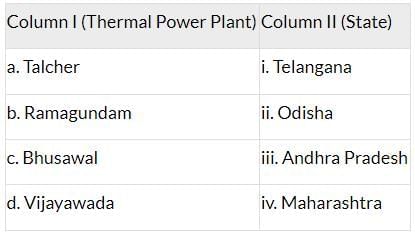
 (a) (A)-(II), (B)-(IV), (C)-(III), (D)-(I)
 Sustainable Energy
 Minerals
 Biogas Energy





