Revision Notes: The President & the Vice President | Indian Polity for UPSC CSE PDF Download
| Table of contents |

|
| The President |
|
| Facts to be Remembered |
|
| Parliamentary Terms |
|
| The Vice-President |
|
| Facts To Be Remembered |
|

The President
The President is the executive head of the state.
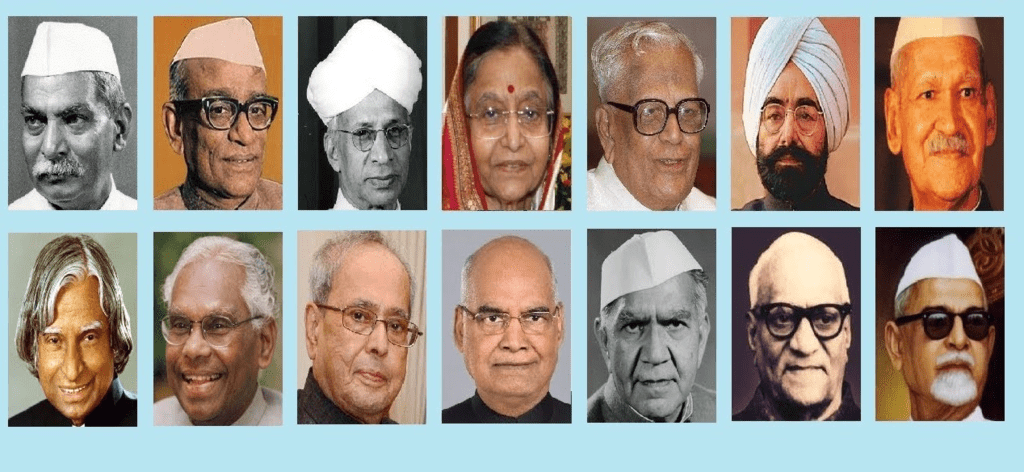 Presidents of India
The Constitution vests all the executive powers of the Union Government in him. He exercises these powers either directly or through officers subordinate to him.
Qualifications for election as President
To be eligible for election as President, a person:
- must be a citizen of India;
- must have completed the age of 35 years;
- must be qualified for election as a Member of the Lok Sabha; and
- must not be holding any office of profit under the Government of India or the Government of any State or under any local authority subject to the control of any of these Governments.
But a sitting President or Vice-President of the Union or the Governor of any State or a Minister either for the Union or for any State is not disqualified for election as President (Art. 58).
Procedure of Election
The procedure of the Presidential election is contained in Articles 54 and 55. While Art. 54 provides for the creation of an electoral college consisting of all the elected M.L.As. and M.Ps., Art. 55 provides for the formula of uniformity in the scale of representation of different States, as far as practicable, by incorporating the method of proportional representation with a single transferable vote system.
The total number of votes of an elected M.L.A.

No person can be declared elected as the President unless he secures more than half of the total votes cast. To ensure this, the system of single transferable votes is adopted. The members of the electoral college indicate their preference on the ballot paper. If none of the candidates secures a majority of votes cast, the candidate with the least number of votes is eliminated, and his votes transferred to the candidates of the second choice of voters. This exercise is continued till one of the candidates secures an absolute majority of a total number of votes cast.
Term of Office
The President holds his office for a term of five years. He is eligible for re-election. According to a procedure laid down in the Constitution, he vacates his office
- by retirement,
- by death,
- by resignation, or
- he may be removed from office by impeachment for violating the Constitution.
Salaries and Allowances
The President receives a salary of ₹500,000 (including allowances) per month. In addition to this, he is entitled to other allowances and privileges including a free official residence with free electricity and water, telephone, car facilities and secretarial assistance. The President of India will get Rs. 1.5 lakh/month as a pension. The salary and allowances being given to the President cannot be curtailed during the term of office.
Powers
The President enjoys the following powers:
A. Executive Powers:
- The President executes laws passed by the Parliament.
- The President appoints all the important constitutional functionaries of the Union. He appoints the leader of the majority party as the Prime Minister and on his advice the Council of Ministers. He appoints Governors of States, Ambassadors, Chief Justice and Judges of the Supreme Court and the High Courts, Attorney-General, Comptroller and Auditor-General, Chairman and the Members of the U.P.S.C., Members of the Election Commission, the Finance Commission and other such Commissions.
- He holds the supreme command of India’s defence forces and has the power of declaring war and peace.
- He governs the Union Territories through Lt. Governors, Administrators, or Chief Commissioners, who are appointed by him.
- He receives foreign dignitaries.
- He has also the power to remove the ministers and other chief dignitaries of the State. But his power in this respect is highly restrained by the conditions laid down in the Constitution. He can remove a minister only on the advice of the Prime Minister and a Judge of the Supreme Court or High Court on the advice of the Parliament.
B. Legislative Powers:
- The President has the power to summon, adjourn or prorogue the Parliament and dissolve the Lok Sabha. In case of a deadlock between the two Houses of Parliament, the President can summon a joint sitting of the two, i.e., Lok Sabha and Rajya Sabha.
- He has the power to address the two Houses of Parliament at the first joint session after each general election and at the commencement of the first joint session every year.
- He nominates to the Rajya Sabha 12 members distinguished in arts, science, literature and social sciences and can nominate to the Lok Sabha two members from the Anglo-Indian community if it is not adequately represented there.
- All bills passed by the Parliament are submitted to the President for his assent. He may give his assent to a Bill, or send it back to the Parliament for reconsideration, or veto it. In case a Bill is sent back for reconsideration and is again passed in original or modified form, it is obligatory on the part of the President to give his assent to it. The President can exercise an absolute veto only in the case of a Private Member’s Bill. In the case of legislation conducted by the Cabinet, the President can exercise only a suspensive veto.
- The President can promulgate an ordinance at any time when the Parliament is not in session, but such an ordinance has to be ratified by the Parliament when it reassembles.
C. Financial Powers
- The President causes the annual budget and other important reports to be laid before the Parliament.
- Money Bills can be introduced in the Lok Sabha only on the President’s recommendation.
- He has the power to operate the Contingency Fund of India to meet any unforeseen expenses although such expenses have later to be approved by the Parliament.
- Any demand for a grant can be made only on the recommendation of the President.
D. Judicial Powers:
The President has the power to grant pardon, reprieve or remission of punishment or commute a death sentence. It should be noted that while the Governor of a State has certain powers of pardon, the President is the only authority who can pardon a death sentence.
E. Emergency Powers:
The President has the power to issue a proclamation of emergency arising out of
- external aggression or internal disorder (National emergency),
- failure of the constitutional machinery in the States (Constitutional emergency), or
- threat to financial stability (Financial emergency). In an emergency, the President enjoys enormous powers.

Schedules In The Constitution
- Schedule I: Territories of the 25 States and 7 Union Territories of India.
- Schedule II: Salaries, allowances etc. of the President, Vice-President, Speaker of the Lok Sabha, Comptroller and Auditor-General.
- Schedule III: Forms of the oath of affirmation.
- Schedule IV: Allotment of seats in the Rajya Sabha to States and U.Ts.
- Schedules V and VI: Provisions relating to the administration of Scheduled Areas and Tribal Areas.
- Schedule VII: Union List, State List and Concurrent List.
- Schedule VIII: 18 Languages.
- Schedule IX: Acts, rules etc. that are protected by Article 31B (i.e. they can not be questioned in a court of law).
- Schedule X: Important provision to prohibit any act of political defection.
- Schedule XI: This schedule lists 29 subjects, on which the Panchayats have been given administrative control.
- Schedule XII: This schedule lists 18 subjects, on which the municipalities shall have administrative control
Impeachment
- In case the President is guilty of the violation of the Constitution, he can be removed from office before the expiry of his term.
- A resolution for his impeachment can be moved in either House of Parliament and must be passed by a majority of not less than two-thirds of the total membership of that House.
- Thereafter, the second House should investigate the charges and should pass a resolution by the same type of majority that the charges against the President have been proved.
- Once the second resolution is passed, the President stands removed from his office.
- To start the proceedings, a 14 days’ notice signed by not less than one-fourth of the Members in either House of Parliament has to be given.
- During the investigation, the President has the right to defend himself.
The Constitutional Position of the President
- In India, the President is the Head of the State and not the Head of the Government. It is the Prime Minister who is the Head of the Government.
- Once the Prime Minister has been elected and the council of Ministers formed, the President is bound to act in accordance with their advice as long as they enjoy the confidence of the Parliament.
- The President of India exercises more or less nominal powers like the King or Queen of England and is not like the President of the U.S.A., who is the real executive.
Facts to be Remembered
- In which year were the Indian states reorganised on a linguistic basis? — 1956
- Panchayati Raj institutions depend for funds mainly on government finances.
- The Governor of a state is appointed by the President on the advice of the Prime Minister.
- Who decides whether a bill is a money bill? — speaker of the Lok Sabha.
- India follows a policy of non-alignment which implies neutrality towards power blocs.
- Panchayati Raj is based on the ideology of democratic decentralisation.
- Democracy exists in India. Without the people's participation and co-operation, democracy would fail. This implies that people should participate and cooperate with the government.
- In a parliamentary democracy, the executive is responsible to the Parliament.
- The Supreme Court of India gave the verdict that the original structure of the Constitution as embodied in the preamble could not be changed under any circumstances in the Keshavanand Bharti Case.
- The vice-chairman of the Rajya Sabha can be removed by members of the Rajya Sabha.
- After retirement, a judge of the Supreme Court can take up private practice in no court within Indian territory.
- These political parties emerge in India in the following Chronological order — BKD, BLD, CFD, DMKP
- The writ of mandamus can be issued by the Supreme Court asking an official to perform a public duty.
- The seventh schedule of the Constitution deals with three lists regarding subjects of legislation
- The deputy chairman of the Rajya Sabha can be removed by a resolution passed by a majority of the member of the Rajya Sabha with the President's assent.
Parliamentary Terms
- Question Hour: The day’s business normally begins with the Question Hour during which questions asked by the members are answered by the Ministers.
- Starred Question is one for which an oral answer is required to be given by the Minister on the floor of the House.
- Supplementary questions may be asked based on the Minister’s reply. The Speaker decides if a question should be answered orally or otherwise. One member can ask only one starred question on a day.
- Unstarred Question is one for which the Minister lays on the table a written answer. A 10-day notice has to be given to ask such questions and no supplementary questions can be asked with regard to such questions.
- Short Notice Question can be asked by members on matters of the public importance of an urgent nature. It is for the Speaker to decide whether the matter is of urgent nature or not. The member has also to state reasons for asking the question while serving notice.
- Zero Hour: This period follows the Question Hour and it generally begins at noon. Usually, the time is used by members to raise various issues for discussion.
- Cut Motions: A motion that seeks a reduction in the amount of a demand presented by the government is known as a cut motion. Such motions are admitted at the Speaker’s discretion. It is a device through which members can draw the attention of the government to a specific grievance or problem.
- Calling Attention Motion: A member may, with prior permission of the Speaker, call the attention of a Minister to any matter of urgent public importance and the Minister may make a brief statement regarding the matter or ask for time to make a statement.
- Privilege Motion: A motion moved by a member if he feels that a Minister has committed a breach of privilege of the House or of any one or more of its members by withholding facts of a case or by giving a distorted version of facts.
- Point of Order: A member may raise a point of order if the proceedings of the House do not follow the normal rules.
- The presiding officer decides whether the point of order raised by the member should be allowed.
- Vote on Account: As there is usually a gap between the presentation of the budget and its approval, the vote on account enables the government to draw some amount from the Consolidated Fund of India to meet the expenses in the intervening period.
- Quorum: It is the minimum number of members whose presence is essential to transact the business of the House. Article 100 provides that the quorum of either House shall be one-tenth of the total number of members of the House.
- Censure Motion: A motion that seeks to censure the government for its ‘lapses’. If the motion is passed in the popular house the Cabinet resigns.
The Vice-President

Qualifications for election as Vice-President.
To be eligible for election as Vice-President, a person:
- must be a citizen of India,
- must have completed the age of 35 years,
- must be qualified for election as a Member of the Rajya Sabha,
- must not hold any office of profit under the Union Government or the Government of a State or any local authority,
- he should also not be a Member of either House of Parliament or of a State Legislature,
- he should not have been convicted by a court of law, and
- he should not be insolvent or of unsound mind.
Election
The Vice-President is elected by an electoral college consisting of all the Members of both the Houses of Parliament by the system of proportional representation by means of a single transferable vote through secret ballot.
Term
The Vice President remains in office for five years. He is eligible for re-election. He can be removed from office by an absolute majority of the Rajya Sabha if the decision is agreed to by a simple majority of the Lok Sabha provided 14 days’ advance notice has been given for this purpose.
Emoluments
The Vice-President is entitled to a salary of ₹400,000 (including allowances) in the capacity of his being Chairman of the Rajya Sabha. When he acts as President, he is entitled to emoluments equivalent to that of the President.
Functions
- The Vice-president is the ex-officio Chairman of the Rajya Sabha.
- He officiates as President in case of death, resignation or removal of the latter till the new President is elected. This period cannot exceed six months.
- He discharges the functions of the President if the latter is unable to discharge his functions owing to absence, illness or any other causes.
Facts To Be Remembered
- By a simple majority and by the ordinary legislative process, Parliament may form new States or alter the boundaries of States, provided the following procedure is followed:
- No bill for the purpose shall be introduced, except on the recommendation of the President.
- Before making such a recommendation, the President is required to refer the Bill to the Legislature of the State, likely to be affected by the provisions of the Bill for explaining its viewpoint on the proposed changes, within the period specified by the President.
- The President is, however, not bound by the views of the State legislature. A mere reference to the State concerned will satisfy the Law.
|
154 videos|998 docs|260 tests
|
FAQs on Revision Notes: The President & the Vice President - Indian Polity for UPSC CSE
| 1. What are the qualifications required to become the President of a country? |  |
| 2. How is the President elected in a parliamentary system? | |
| 3. What is the role of the Vice-President in a country? | |
| 4. How long is the term of the President and the Vice-President? | |
| 5. Can the President and Vice-President be from different political parties? | |




shortcuts and tricks
,Sample Paper
,practice quizzes
,Exam
,Objective type Questions
,ppt
,past year papers
,study material
,Viva Questions
,MCQs
,Previous Year Questions with Solutions
,mock tests for examination
,Free
,video lectures
,Semester Notes
,Revision Notes: The President & the Vice President | Indian Polity for UPSC CSE
,Revision Notes: The President & the Vice President | Indian Polity for UPSC CSE
,Important questions
,Extra Questions
,Summary
,Revision Notes: The President & the Vice President | Indian Polity for UPSC CSE
;




Revision Notes: The President & the Vice President Free PDF Download
Importance of Revision Notes: The President & the Vice President
Revision Notes: The President & the Vice President
Revision Notes: The President & the Vice President UPSC Questions
Study Revision Notes: The President & the Vice President on the App
|
© EduRev
|
Education Revolution
|


|




within 7 days!