Structural Changes & India: A Mixed Economy


Structural Changes
Structural change refers to long-term shifts in the relative importance of broad sectors of the economy (primary, secondary and tertiary) in national income, employment and production. In a low level of economic development the primary sector (agriculture and allied activities) predominates in both output and employment. As development proceeds, the relative share of the primary sector normally falls while the shares of the secondary (manufacturing and industry) and tertiary (services) sectors rise. Structural change is measured using indicators such as sectoral composition of national income, occupational distribution and investment patterns.
- During the planning period the Indian economy not only expanded in size but also underwent important structural changes.
- Economic structure denotes the interrelationship among different productive sectors: primary (agriculture and allied), secondary (industry and manufacturing) and tertiary (services). A developed economy shows a declining importance of the primary sector and growing shares of secondary and tertiary sectors.
- Predominance of a sector is judged from its share in national income (GDP) and the occupational distribution of the population.
- An economy is considered predominated by the primary sector when that sector contributes the largest share to national income and when a majority of the population depends on it for subsistence.
- As development proceeds, the importance of the primary sector (in terms of GDP share and employment) tends to decline and the importance of the secondary and tertiary sectors increases. The main structural changes in India during the planning period include changes in sectoral composition of GDP, occupational stability/movement, expansion of basic capital goods industries, growth of social infrastructure and changes in banking and financial intermediation.

Sectoral Composition of National Income
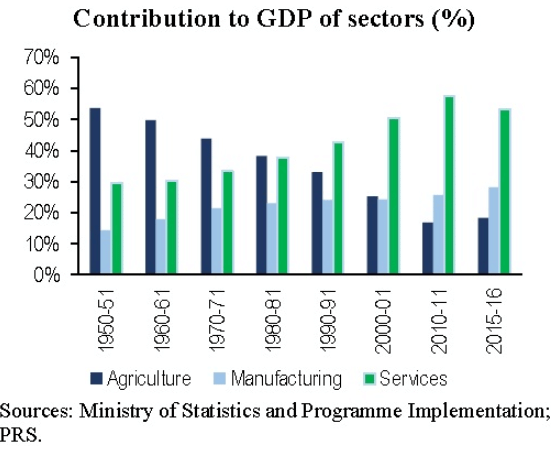
- A key measure of development is the steady decline in the share of the primary sector in GDP and a corresponding rise in the shares of secondary and tertiary sectors.
- In 1950-51 the primary sector contributed 56.5 percent of India's GDP; since then this contribution fluctuated but showed a long-run decline.
- According to the note in the source, the primary sector's contribution fluctuated between 56.5 and 31.3 percent during the early decades; since 1970-71 a steadier decline is reported with the primary sector at 28.6 percent in 1995-96.
- The secondary sector's share rose from 15 percent in 1950-51 to 29.2 percent in 1995-96, driven by industrial growth and development of basic capital goods industries.
- The tertiary (service) sector's share rose from 28.5 percent in 1950-51 to 41.2 percent in 1995-96.
- Using the new national accounts series (constant 2011-12 prices) for 2014-15, the sectoral shares were: Agriculture and allied - 17.6%, Industry - 29.7%, and Services - 52.7%. These numbers show the continued decline of agriculture's share and the dominance of services in recent decades.
Why sectoral shares change
- Structural change typically follows productivity differences across sectors: as productivity and incomes rise in non-farm sectors, a larger share of output and employment moves away from agriculture.
- Industrialisation, investments in basic capital goods, urbanisation and expansion of services increase the shares of secondary and tertiary sectors.
- Demographic growth, technological change, and policy choices (public investment, subsidies, trade and industrial policy) influence the pace and direction of structural change.
- Models such as the Lewis two-sector model explain structural transformation as movement of surplus labour from a low-productivity agricultural sector to higher-productivity industry and services, raising overall productivity.
Stable Occupational Distribution
- Occupational distribution refers to the proportion of the workforce employed in primary, secondary and tertiary activities.
- In many developing economies occupational distribution shifts markedly from primary to secondary and tertiary sectors as industrialisation progresses.
- However, in India the occupational distribution has not changed as rapidly as the sectoral composition of GDP. Employment in agriculture has remained high even while agriculture's share in GDP declined - a phenomenon often described as slow structural transformation.
- V. K. R. V. Rao described India's occupational structure as showing "structural retrogression" - meaning that despite economic growth occupational shifts away from agriculture were limited. The commonly cited reasons include:
- Rapid population growth, which added more labour to the primary sector.
- Relatively slow productivity increases and limited structural change in agriculture in earlier decades.
- Absence of very rapid industrialisation and limited generation of large-scale industrial employment in the same period.
Remember the Facts
| Remember The Facts |
|
Development of Basic Capital Goods
- At independence the Indian industrial structure was deficient in basic capital goods industries (heavy engineering, machinery, steel), which are necessary to support growth across the economy.
- Only a few capital goods industries existed and their share in total industrial production was about 25 percent in the early years after independence.
- The Second Five Year Plan (as stated in the source) emphasised development of basic capital goods industries because of their role in providing the machinery and inputs required for broad-based industrial growth.
- Following the Plan, a large number of capital goods industries were established and their share rose substantially; according to the input they now (by the reference period) account for more than 50 percent of total industrial production.
- The expansion of the capital goods sector improved the ability of the economy to invest, produce intermediate inputs and support further industrialisation.
Social Capital Formation
- Social capital means public goods and infrastructure such as transport, energy, education and health which raise the productive capacity of the economy.
- Investments in social capital accelerate and sustain economic growth by lowering transaction costs, facilitating mobility, and improving human capital.
- During the planning period India's transport system increased in capacity and underwent modernisation; electricity generation and irrigation also expanded rapidly.
- However, expansion of education and health services did not keep pace with requirements in many periods and regions, producing long-term challenges for human development.
Banking and Financial Intermediation; the Social Sector
- Since independence the organisation of money and capital markets improved, specialised financial institutions for industry were created, and banking services expanded into small towns and rural areas.
- After the nationalisation of banks in 1969 there was a marked change in credit policy and financial deepening: more funds were channelled to priority sectors such as agriculture, small-scale industry and transport.
- Bank nationalisation and branch expansion increased formal credit availability, which supported rural credit access and investment in productive activities.
- The Indian economy exhibits a dualistic character: a modern sector (large-scale industries, mines, plantations) operating with fixed technical coefficients and capital-intensive techniques exists alongside a traditional rural sector (peasant cultivation, handicrafts, small-scale industries) that uses labour-intensive techniques and a wide range of alternative production methods.
- Features of the traditional rural sector include: predominance of peasant cultivation, handicrafts and small-scale production; variable technical coefficients that permit many alternative labour-capital combinations; and labour abundance that makes labour-intensive methods common.
- The modern sector is characterised by larger units, fixed technical coefficients, and relatively capital-intensive production.

India: A Mixed Economy
- The term mixed economy describes an economic system in which both the state and private enterprise play important roles in production, investment and distribution. In India some production and allocation decisions are made by the state (through public sector enterprises and planning) and others are left to private enterprise and market forces.
- The mixed economy principle integrates features from capitalist and socialist systems: it allows private ownership and market mechanisms while enabling the state to plan, regulate and run essential industries in the public interest.
- This principle is reflected in the Government of India's Industrial Policy Resolutions of 1948 and 1956, which defined the roles of the public and private sectors.
- The Second Five Year Plan (referenced in the source as 1957-62) envisaged planned development on a "socialist pattern of society", emphasising social gain rather than private profit as the guiding objective for large parts of the economy.
- Planning in India has sometimes been identified with socialism because many socialist countries adopted central planning earlier; however Indian planning is distinct in having a capitalist framework with limited compulsion and coexistence of private enterprise and public ownership.
- Two characteristic features that differentiate India from a pure capitalist economy are: the significant public sector and the presence of economic planning.
- While India pursued planning and public ownership, planning instruments were generally less coercive than in socialist countries; targets were largely indicative and implementation relied on administrative and policy measures rather than centralised compulsion.
Features of India's Mixed Economy
- Private ownership of means of production exists alongside state ownership.
- Predominance of market mechanism though not completely free from state control and regulation.
- Growing monopoly tendencies in some industries (increasing concentration and large business houses).
- Presence of a large public sector operating together with private (free) enterprise.
- Economic planning is followed, but it operates within a capitalistic economic framework and differs from the planning systems in fully socialist economies.
Concluding summary
In sum, India's planning period witnessed clear structural change: a steady decline in the primary sector's share of GDP, growth of secondary and tertiary sectors, expansion of basic capital goods industries, rising social infrastructure and strengthening of banking and financial intermediation. However, occupational change lagged behind output shifts, producing persistent dualism between modern and traditional sectors. The adoption of a mixed economy model-combining state planning, a large public sector and private enterprise-has been a defining feature of India's post-independence development strategy.
FAQs on Structural Changes & India: A Mixed Economy
| 1. What are the structural changes in India's mixed economy? |  |
| 2. How has the liberalization of the Indian economy impacted its mixed economy? | |
| 3. What role does privatization play in India's mixed economy? | |
| 4. How have market-oriented reforms contributed to India's mixed economy? | |
| 5. What are the challenges faced by India's mixed economy in implementing structural changes? | |





