Knowing Our Numbers- 1 Class 6 Worksheet Maths
| Table of contents |

|
| Fill in the blanks |
|
| Match the Following |
|
| Multiple Choice Questions |
|
| Solve the following problems |
|

Fill in the blanks
Q1: The number name of 45,678 in the Indian system of numeration is ________.
Ans: The number name of 45,678 in the Indian system of numeration is Forty-five thousand, six hundred seventy eight.
 View Answer
In the Indian system of numeration, numbers are grouped by sets of two digits beyond the hundreds place, and "and" is used before the last two digits. So, 45,678 is read as "forty-five thousand, six hundred seventy-eight."
Q2: Place value of 4 in ‘56743’ is ________.
Ans: Place value of 4 in ‘56743’ is 40.
View Answer In the number 56743, the digit 4 is in the tens place, which means its place value is 40 (4 × 10).
Q3: The number name of 756,432 in the international system of numeration is ________.
Ans: The number name of 756,432 in the international system of numeration is Seven hundred fifty six thousand, four hundred thirty two.
View Answer In the international system of numeration, numbers are grouped by sets of three digits beyond the thousands place. So, 756,432 is read as "seven hundred fifty-six thousand, four hundred thirty-two."
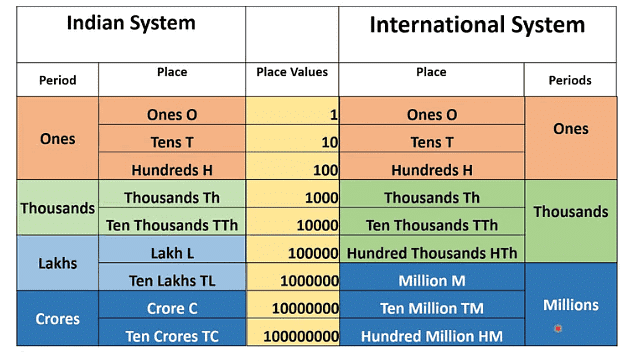
Q4: In the Indian System of Numeration, the number 61711682 is written, using commas, as __________.
Ans: In the Indian System of Numeration, the number 61711682 is written, using commas, as 6,17,11,682.
View Answer In the Indian numbering system, numbers are grouped starting from the rightmost digit. The first group consists of three digits (hundreds), and subsequent groups consist of two digits each.
For the number 61711682:
- Start from the right, the first group is 682 (the hundreds place).
- The next group is 11 (thousands).
- The last group is 17 (lakhs).
- Finally, there is 6 (crores).
Thus, we place the commas accordingly: 6,17,11,682.
Therefore, in the Indian system of numeration, the number 61711682 is written using commas as 6,17,11,682.
Q5: The smallest 4-digit number with different digits is __________ .
Ans: The smallest 4-digit number with different digits is 1023
View Answer The smallest digit, other than 0, at the thousand place to make the smallest 4 digit number is 1. As 1 is already used, the smallest digit (0) can be used at hundred place.
Similarly, we can place 2 at the tenth position and 3 at the unit position.
So, the smallest 4-digit number is 1023.
Match the Following
Q6: Match the correct options
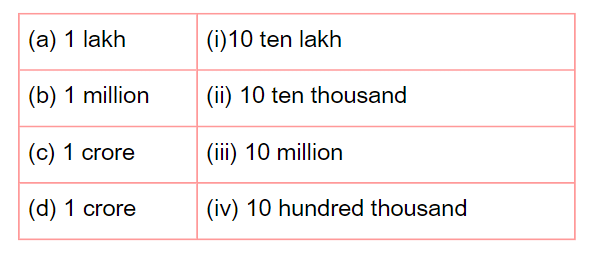 Ans:
Ans:
(a) 1 lakh = (ii) 10 ten thousand.
(b) 1 million = (iv) 10 hundred thousand.
(c) 1 crore = (i) 10 ten lakh.
(d) 1 crore = (iii) 10 million.
View Answer (a) 1 lakh = (ii) 10 ten thousand
Explanation: 1 lakh is equal to 100,000, and 10 ten thousand is also equal to 100,000.(b) 1 million = (iv) 10 hundred thousand
Explanation: 1 million is equal to 1,000,000, and 10 hundred thousand is also equal to 1,000,000.(c) 1 crore = (i) 10 ten lakh
Explanation: 1 crore is equal to 10,000,000, and 10 ten lakh is also equal to 10,000,000.(d) 1 crore = (iii) 10 million
Explanation: 1 crore is equal to 10 million (10,000,000).
Multiple Choice Questions
Q 7: 1 billion is equal to
(a) 100 million
(b) 10 millions
(c) 1000 lakhs
(d) 10000 lakhs
Ans: The correct answer is (d) 10000 lakhs.
View Answer 1 billion is equivalent to 1000 million. And 1 million is equal to 10 lakhs. So, 1000 million is equal to 10,000 lakhs.
Q8: Which number is the smallest among the following?
(a) 2836
(b) 4927
(c) 7492
(d) 9024
Ans: (a) 2836
View Answer To find the smallest number, compare the options digit by digit, starting from the leftmost digit. The smallest digit in the thousands place is 2 (in 2836), making 2836 the smallest number among the options.
Q9: Which is the greatest 4-digit number you can form using the digits 2, 8, 7, and 4?
(a) 2847
(b) 8742
(c) 4728
(d) 7284
Ans: (b) 8742
View Answer Arrange the digits in descending order to form the largest number. Sorting the digits 2, 8, 7, and 4 from highest to lowest gives 8742, which is the greatest 4-digit number that can be formed.
Q10: Which number is greater in the comparison of 4875 and 4542?
(a) 4875
(b) 4542
(c) Both are equal
(d) Not determinable
Ans: (a) 4875
View Answer Compare the numbers digit by digit starting from the leftmost digit. Since 4875 has a higher hundred place digit (8) compared to 4542, 4875 is the greater number.
Q11: If the digit 7 is always at the ones place, what is the greatest 4-digit number you can form with the digits 7, 8, 9, and 3?
(a) 9837
(b) 9873
(c) 9378
(d) 9738
Ans: (a) 9837
View Answer To form the greatest 4-digit number with 7 fixed at the ones place, arrange the remaining digits (9, 8, and 3) in descending order. This gives the number 9837.
Solve the following problems
Q12: A box contains 5,00,000 medicine tablets, each weighing 50 mg. What is the total weight of all the tablets in the box in grams and in kilograms?
Ans: Weight of each tablet = 50 mg
Weight of box containing 5,00,000 tablets = 5,00,000 × 50 mg.
= 2,50,00,000 mg
= 2,50,00,000 mg/1000 = 25000 g
= 25000 g/1000 = 25 kg
Q13: The population of Shivaji park was 2,35,471 in the year 2002. In the year 2012, it was found to be increased by 72,958. What was the population of the city in 2012?
Ans: Population of Shivaji park in the year 2002 = 2,35,471
Increase in the population in the year 2012 = 72,958
Total population of the city in the year 2012 = 2,35,471 + 72,958 = 3,08,429
Q14: The town newspaper is published every day. One copy has 12 pages. Every day 12,000 copies are printed. How many total pages are printed every day?
Ans: Number of pages in each copy = 12
Number of pages in 12,000 copies = 12,000 × 12 = 1,44,000
Therefore, number of pages printed every day = 1,44,000
Q15: Starting from the greatest 5-digit number, write the previous five numbers in descending order.
Ans: The largest 5-digit number is 99999.
The previous five numbers starting with 99999 in descending order are:
99999, 99998, 99997, 99996, 99995
Q16: Write 527864 using commas in Indian as well as International System of Numeration.
Ans: The given number is 527864
Indian system of numeration = 5,27,864
International system of numeration = 527,864
Q17: In Mumbai, the number of bicycles sold in the year 2011-2012 was 7,43,000. In the year 2012-2013, the number of bicycles sold was 8,00,100. In which year, more bicycles were sold and by how many?
Ans: The number of bicycles sold in the year 2011-2012 = 7,43,000
The number of bicycles sold in the year 2012-2013 = 8,00,100
We observe that 8,00,100 > 7,43,000
That is, in the year 2012-2013, more bicycles were sold by (8,00,100 – 7,43,000) = 57,100
Q18: Write 8945673 using commas in Indian as well as International System of Numeration.
Ans: The given number is 8945673
Indian system of numeration = 89,45,673
International system of numeration = 8,945,673
Q19: The number of sheets of paper available for making notebooks is 25,000. Each sheet makes 12 pages of a notebook. Each notebook contains 300 pages. How many notebooks can be made from the paper available?
Ans: Number of sheets of paper available = 2,5000
Number of pages can be made with 1 sheet of paper = 12
Number of pages can be made with 2,5000 sheets of paper = 2,5000 × 12 = 3,00,000
Number of pages in each notebook = 300
Number of notebooks that can be prepared with the paper available = 3,00,000/300
= 1000 notebooks
Q20: The distance between the school and the house of a student is 1 km 875 m. Every day she walks both ways. Find the total distance covered by her in 15 days.
Ans: Distance between the school and the house = 1 km 875 m
= 1000 m + 875 m
= 1,875 m.
Distance travelled by the student both ways, every day = 1,875 m × 2 = 3,750 m
Distance travelled by the student in 15 days = 3,750 m × 15
= 56,250 m
= 56 km 250 m
FAQs on Knowing Our Numbers- 1 Class 6 Worksheet Maths
| 1. What are the basic number concepts that Class 6 students should know? |  |
| 2. How can I help my child improve their number skills at home? | |
| 3. What types of problems can students expect in a "Knowing Our Numbers" worksheet? | |
| 4. Are there any online resources available for practicing number concepts for Class 6? | |
| 5. How can understanding numbers benefit students in real life? | |




Important questions
,video lectures
,Semester Notes
,shortcuts and tricks
,Sample Paper
,Extra Questions
,Knowing Our Numbers- 1 Class 6 Worksheet Maths
,past year papers
,Knowing Our Numbers- 1 Class 6 Worksheet Maths
,Free
,Viva Questions
,Objective type Questions
,MCQs
,mock tests for examination
,practice quizzes
,Knowing Our Numbers- 1 Class 6 Worksheet Maths
,Previous Year Questions with Solutions
,Exam
,Summary
,study material
,ppt
;




Worksheet Solutions: Knowing Our Numbers- 1 Free PDF Download
Importance of Worksheet Solutions: Knowing Our Numbers- 1
Worksheet Solutions: Knowing Our Numbers- 1 Notes
Worksheet Solutions: Knowing Our Numbers- 1 Class 6 Questions
Study Worksheet Solutions: Knowing Our Numbers- 1 on the App
|
© EduRev
|
Education Revolution
|


|




