Class 6 Science Chapter 9 Question Answers - Electricity and Circuits
Short Q & A:
Q1: What will happen if we join two terminals of electric cell directly through a wire?
Ans: If we join two terminals of electric cell directly through a wire, the chemical in an electric cell get used up very fast and the cell will stop working.
Q2: What is an electric circuit?
Ans: Arrangement that provides a complete path for electricity to pass (current to flow) is known as electric circuit.
Q3: Explain how the bulb glows in circuit when it is connected to an electric cell?
Ans: When the terminals of the bulb are connected with that of electric cell by wires, a current pass through the filament of the bulb and it makes the bulb glow.
Q4: How can an electric bulb get fused?
Ans: An electric bulb may get fused due to break in its filament. A break in the filament of bulb means break in the path of current between the terminals of electric cell.
Q5: Why rubbers and plastic used to cover electric wires and plug tops?
Ans: Rubbers and plastic are used to cover electric wires and plug tops because they are insulators and do not allow electric current to pass when we touch plugs and switches.
Q6: Why is distilled water used in the batteries and not the tap water?
Ans: Because distilled water acts as an insulator as it is purest water. Whereas tap water has salts and impurities and acts as a conductor.
Q7: Why is handle of tools like screw driver, pliers are covered with plastic or rubber?
Ans: Because they are insulators and avoid direct contact with electric current while touching electric wires.
Q8: Generally what can be components of an electric circuit?
Ans:
Components of electric circuit can be following:
- A cell or a battery
- Connecting wires made of copper or aluminium
- Switch
- Bulb or other electric device
Q9: Would bulb glow in the circuit given blow? Why or why not?
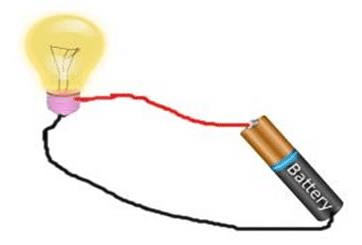
Ans : Yes, bulb will glow because current will flow from two terminals of the bulb.
Q10: What is the function of an electric switch?
Ans: It is a simple device that either breaks the circuit or completes it. For example-in a microwave or toy cars we have switches to turn it ON or OFF.
Q11: What is an electric cell? How many terminals it has?
Ans: An electric cell is a device that converts chemical energy into electrical energy. It has two metal plates indicating two terminals-negative and positive. It has chemical inside it.
Q12: Statement is true or false:
a. Bulb has one terminal.
b. Electrolyte is present in the cell.
c. Copper is good conductor of electricity.
d. Circuit shows the path of current.
Ans:
- False
- True
- True
- True.
Q13: Match the following:
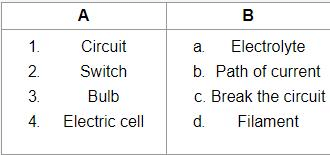
Ans:
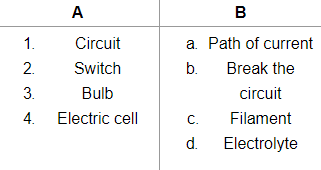
Q14: Draw a diagram to show a circuit.
Ans:
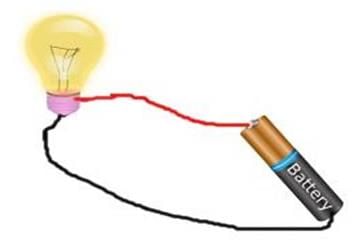
Q15: Explain why bulb will glow in the arrangement shown:
Ans:
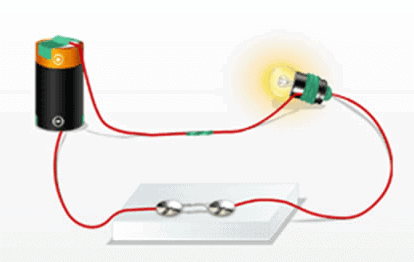
Yes, the current will flow because this is a closed circuit and the wires are connected through key in ON position with the battery.
Q16:Classify the following as conductor or insulator: Eraser, coin, glass, pencil, needle, key, iron nail, plastic scale
Ans:
Conductor- coin, needle, key, iron nail.
Insulator- eraser, glass, pencil, plastic scale.
Long Q & A :
Q1: What is the difference between conductor and an insulator? Explain with examples.
Ans: Materials that allow electric current to pass through them are called conductors. For example iron, copper, sea water etc. Metals are good conductors.
Materials that do not allow electric current to pass through them are called insulators. For example- rubber, plastic etc.
|
100 videos|261 docs|49 tests
|
FAQs on Class 6 Science Chapter 9 Question Answers - Electricity and Circuits
| 1. What is electricity? |  |
| 2. What is a circuit? | |
| 3. How does electricity flow in a circuit? | |
| 4. What are conductors and insulators in a circuit? | |
| 5. What are the basic components of a circuit? | |

|
2.8K Views |

|
4.64/5 Rating |

|
Dec 23, 2024 Last updated |

|
Explore Courses for Class 6 exam
|

|
study material
,ppt
,Sample Paper
,MCQs
,Free
,Previous Year Questions with Solutions
,video lectures
,Semester Notes
,Summary
,Class 6 Science Chapter 9 Question Answers - Electricity and Circuits
,Exam
,Viva Questions
,Class 6 Science Chapter 9 Question Answers - Electricity and Circuits
,mock tests for examination
,Important questions
,practice quizzes
,Class 6 Science Chapter 9 Question Answers - Electricity and Circuits
,past year papers
,shortcuts and tricks
,Objective type Questions
,Extra Questions
;




Short & Long Question Answers: Electricity & Circuits Free PDF Download
Importance of Short & Long Question Answers: Electricity & Circuits
Short & Long Question Answers: Electricity & Circuits Notes
Short & Long Question Answers: Electricity & Circuits Class 6 Questions
Study Short & Long Question Answers: Electricity & Circuits on the App
|
© EduRev
|
Education Revolution
|


|


