Worksheet Solutions: Practical Geometry | Mathematics & Pedagogy Paper 2 for CTET & TET Exams - CTET & State TET PDF Download

Q.1. Choose suitable units for the following measurements :
(a) Lenght of your pencil (cm or km) cm _(_fo_r_ e_x_a_m__p_le)
(b) Your height (cm or km) __________
(c) Distance by road between Delhi and Jaipur (cm or km) __________
(d) Lenght of your feet (cm or km) __________
(e) Length of rice grain (mm or km) __________
(f) Length of cloth needed to make your long raincoat (m or km) __________
Ans.
(a) cm
(b) cm
(c) km
(d) cm
(e) mm
(f) m
Q.2. In the figure, OA = AB = BC = CD Fill in the blanks :
(i) A is the mid point of line segment __________.
(ii) B is the mid point of line segment __________ and line segment __________ also.
(iii) OC + CD = __________ (iv) OC – OA = __________
(v) Name the line segment whose length is equal to 3 times OA.
Ans.
(i) OB
(ii) AC and OD
(iii) OD
(v) AC
(v) OC
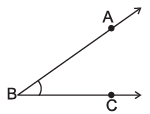
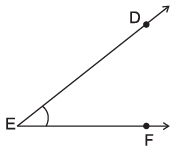
Q.3. Which angle is bigger? ∠ABC or ∠DEF?
Ans. Both angle, are equal, ∠ABC = ∠DEF
Q.4. Using ruler and compass to construct angles of following measures :
(a) 135°
(b) 90°
(c) 180°
(d) 15°
Ans. Angle construction.
Q.5. Draw an angle measuring 54° using protractor. Now, without using protractor, construct
(a) a copy of this angle.
(b) an angle measuring 27°.
Ans. Angle construction.
Q.6. Draw a line segment AB of length 10 cm. By drawing its perpendicular bisector repeatedly, obtain a line segment of length  AB.
AB.
Ans. 

Q.7. Draw a circle with centre X and radius 4 cm. Draw any chord  Construct the perpendicular bnisector of and check whether it passes through X. (Yes/No).
Ans. Yes and construction.
Q.8. Draw a line segment  of length 7 cm. Take any point, M, not on it. Through M, draw a perpendicular to , using ruler and compasses.
Ans. Construction.
Q.9. Draw a line segment AB of length 8 cm. At each end point of this line segment, draw a line perpendicular to AB. Are these two lines parallel? (Yes/No)
Ans. Construction, Yes.
Q.10. If AB = 7.5 cm and CD = 1.5 cm, construct a line segment whose length is equal to
(i) 2 CD
(ii) AB + CD
(iii) AB – CD
Ans. Construction.
|
82 videos|273 docs|69 tests
|
FAQs on Worksheet Solutions: Practical Geometry - Mathematics & Pedagogy Paper 2 for CTET & TET Exams - CTET & State TET
| 1. What are the basic principles of practical geometry? |  |
| 2. How can I construct a triangle using practical geometry? | |
| 3. How do I bisect an angle using practical geometry? | |
| 4. Can I construct a circle with any given radius using practical geometry? | |
| 5. How do I measure the area of a rectangle using practical geometry? | |





Extra Questions
,study material
,Exam
,Objective type Questions
,past year papers
,mock tests for examination
,Previous Year Questions with Solutions
,MCQs
,Worksheet Solutions: Practical Geometry | Mathematics & Pedagogy Paper 2 for CTET & TET Exams - CTET & State TET
,Worksheet Solutions: Practical Geometry | Mathematics & Pedagogy Paper 2 for CTET & TET Exams - CTET & State TET
,Sample Paper
,Important questions
,Summary
,Worksheet Solutions: Practical Geometry | Mathematics & Pedagogy Paper 2 for CTET & TET Exams - CTET & State TET
,video lectures
,shortcuts and tricks
,practice quizzes
,Free
,Semester Notes
,ppt
,Viva Questions
;



Worksheet Solutions: Practical Geometry Free PDF Download
Importance of Worksheet Solutions: Practical Geometry
Worksheet Solutions: Practical Geometry Notes
Worksheet Solutions: Practical Geometry CTET & State TET Questions
Study Worksheet Solutions: Practical Geometry on the App
|
© EduRev
|
Education Revolution
|


|




within 7 days!