Numbers and Number System - 2

Division Algorithm
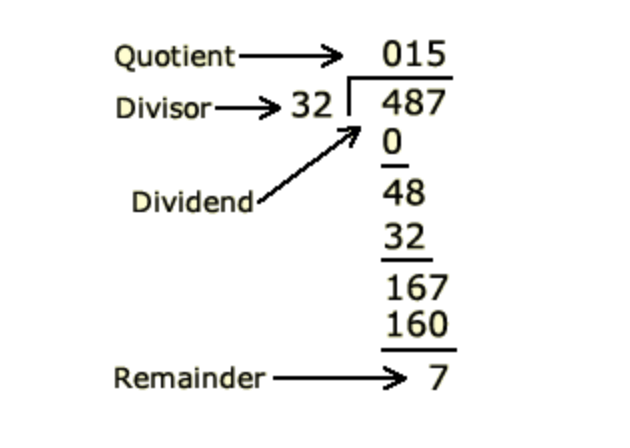
The division algorithm describes how any integer dividend can be expressed in terms of a divisor, a quotient and a remainder. In arithmetic form:
Dividend = Divisor × Quotient + Remainder
Equivalently,
Quotient = (Dividend - Remainder) ÷ Divisor
and
Divisor = (Dividend - Remainder) ÷ Quotient
When working with integers, the precise statement (Division Theorem) is:
For any integers a and b with b > 0, there exist unique integers q and r such that
a = bq + r with 0 ≤ r < b.
This q is called the quotient and r the remainder. The uniqueness follows because if a = bq + r = bq' + r' with 0 ≤ r, r' < b then b(q - q') = r' - r which forces q = q' and r = r'.
In long division we obtain q and r by successive subtraction or standard division algorithm.
Examples on Division Algorithm and Remainders
Example 1. The quotient arising from the division of 23456 by a certain number is 89 and the remainder is 49. What is the divisor?
Solution:
Use the division identity Dividend = Divisor × Quotient + Remainder.
Substitute the given values: 23456 = Divisor × 89 + 49.
Rearrange to find the divisor: Divisor = (23456 - 49) ÷ 89.

Compute (23456 - 49) = 23407 and 23407 ÷ 89 = 263.
So the divisor is 263.
Example 2. What least number must be subtracted from 5931 to make it exactly divisible by 94?
Solution:
Divide 5931 by 94 to find the remainder.
5931 ÷ 94 gives remainder 9.
Therefore subtracting the remainder 9 will make the number divisible by 94.
Answer: 9.
Example 3. What least number must be added to 5931 to make it exactly divisible by 94?
Solution:
Divide 5931 by 94 to obtain the remainder 9.
The least number to be added = Divisor - Remainder = 94 - 9 = 85.
Answer: 85.
Note: To obtain the least number to be subtracted, subtract the remainder. To obtain the least number to be added, take the difference between the divisor and the remainder (unless the remainder is zero, in which case no addition is required).
Example 4. Find the least five-digit number which is exactly divisible by 129.
Solution:
The least five-digit number is 10000.
Divide 10000 by 129 to find quotient and remainder.
10000 ÷ 129 gives remainder 67.
Adding (129 - 67) = 62 to 10000 gives the least five-digit multiple of 129.
So the required number is 10000 + 62 = 10062.
Example 5. Find the greatest five-digit number which is exactly divisible by 129.
Solution:
The greatest five-digit number is 99999.
Divide 99999 by 129 to find remainder 24.
Subtract the remainder from 99999 to get a multiple: 99999 - 24 = 99975.
Note: To find the least number ≥ a bound divisible by d, add (d - remainder) unless that makes the number smaller than the bound. To find the greatest number ≤ a bound divisible by d, subtract the remainder.
Example 6. A number when divided by 296 leaves remainder 75. What will be the remainder if the same number is divided by 37?
Solution:
Check whether 296 is exactly divisible by 37.
296 ÷ 37 = 8, so 296 is divisible by 37.
When the original number gives remainder 75 upon division by 296, write the number as 296k + 75.
Since 296 is a multiple of 37, 296k is divisible by 37 and contributes 0 remainder; so the remainder on division by 37 is the remainder of 75 ÷ 37.
75 ÷ 37 gives remainder 1.
Answer: 1.
Example 7. A number when divided by 114 leaves remainder 21. If the same number is divided by 19, then what will be the remainder?
Solution:
Check whether 114 is divisible by 19.
114 ÷ 19 = 6, so 114 is divisible by 19.
Write the number as 114k + 21. The term 114k is divisible by 19; so remainder upon division by 19 is remainder of 21 ÷ 19.
21 ÷ 19 gives remainder 2.
Answer: 2.
Note: This reduction method works only when the first divisor is a multiple of the second divisor. Otherwise remainder behaviour is not directly transferable in this simple way.
Unit-digit of Powers (Last digit rules)
Example 8. Find the number in the unit place in
- (321)45
- (322)57
- (323)76
- (324)41
- (325)95
- (326)91
- (327)31
- (328)43
- (329)87
Solution:
To find the unit digit of pn it suffices to look at the unit digit of the base p and its pattern under successive powers. The cycle length depends only on the last digit. We illustrate patterns and then apply them to each case.
Observations used frequently
If the base ends in 1, 5 or 6, then every positive power ends in the same digit:
1k ends in 1 for all k; 5k ends in 5 for all k; 6k ends in 6 for all k.
Solution for items (i), (v) and (vi)
(i) Base 321 ends in 1, so (321)45 ends in 1.
(v) Base 325 ends in 5, so (325)95 ends in 5.
(vi) Base 326 ends in 6, so (326)91 ends in 6.
Case (ii): (322)57
Consider last digit 2. Powers of 2 repeat with period 4 in their last digits: 2, 4, 8, 6, then repeat.
List: 21 → 2; 22 → 4; 23 → 8; 24 → 6; 25 → 2; ...
Compute 57 mod 4 = 1, so last digit corresponds to power 1 in the cycle: 2.
Case (iii): (323)76
Consider last digit 3. Powers of 3 repeat in cycle 4: 3, 9, 7, 1, then repeat.
Compute 76 mod 4 = 0, which corresponds to the 4th element in the cycle: last digit 1.
Case (iv): (324)41
Consider last digit 4. Powers of 4 have cycle 2: 4, 6, 4, 6, ...
If exponent is odd → last digit 4; if even → last digit 6.
Since 41 is odd, last digit is 4.
Case (vii): (327)31
Last digit 7. Powers of 7 have cycle 4: 7, 9, 3, 1, then repeat.
Compute 31 mod 4 = 3, so last digit is the 3rd element: 3.
Case (viii): (328)43
Last digit 8. Powers of 8 have cycle 4: 8, 4, 2, 6, then repeat.
Compute 43 mod 4 = 3, so last digit is the 3rd element: 2.

Case (ix): (329)87
Last digit 9. Powers of 9 cycle with length 2: 9, 1, 9, 1, ...
If exponent is odd → last digit 9; if even → last digit 1.
Since 87 is odd, last digit is 9.
Rules for Counting Numbers and Series
Natural numbers (1, 2, 3, ...) are called counting numbers. The following standard formulae are used frequently in arithmetic and algebra problems.
Rule 1. Sum of the first n counting numbers
The sum of the first n natural numbers is given by the well-known formula
1 + 2 + 3 + ... + n = n(n + 1) ÷ 2

Example: The sum of the first 50 counting numbers is 1 + 2 + ... + 50 = 50 × 51 ÷ 2 = 1275.


Rule 2. Sum of the first n odd numbers
The sum of the first n odd numbers equals n2.
So 1 + 3 + 5 + ... + (2n - 1) = n2.
Example: Sum of first 25 odd numbers (1 to 49) is 252 = 625.
Rule 3. Sum of the first n even numbers
The sum of the first n even numbers equals n(n + 1).
So 2 + 4 + 6 + ... + 2n = n(n + 1).
Example: Sum of first 25 even numbers = 25 × 26 = 650.
Note: These rules hold when we are summing the first n terms starting from the first natural numbers. For sums over an interval that does not start at 1, adjust by subtracting the sum up to the lower limit minus one.
Worked Example: Find
- The sum of the first 100 counting numbers.
- The sum of all odd numbers from 1 to 100.
- The sum of all even numbers from 1 to 100.
- The sum of all even numbers from 40 to 100.
Solution:
(1) Sum of first 100 natural numbers: n = 100 so sum = 100 × 101 ÷ 2 = 5050.
(2) Odd numbers between 1 and 100: these are the first 50 odd numbers, so n = 50 and sum = 502 = 2500.
(3) Even numbers between 1 and 100: these are the first 50 even numbers, so n = 50 and sum = 50 × 51 = 2550.
(4) Sum of even numbers from 40 to 100: compute as (sum of even numbers from 1 to 100) - (sum of even numbers from 1 to 38).
Number of even terms from 1 to 100 is 50; from 1 to 38 is 19.
Sum = 50 × 51 - 19 × 20 = 2550 - 380 = 2170.
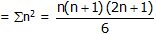
Rule 4. Sum of squares of first n natural numbers
The sum of the squares of the first n natural numbers is
12 + 22 + 32 + ... + n2 = n(n + 1)(2n + 1) ÷ 6
Rule 5. Sum of cubes of first n natural numbers
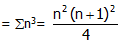
The sum of the cubes of the first n natural numbers is the square of the sum of the first n numbers:
13 + 23 + 33 + ... + n3 = [n(n + 1) ÷ 2]2
Useful Algebraic Identities
These identities are often used to simplify expressions and to solve arithmetic problems.
- (a + b)2 = a2 + 2ab + b2
- (a - b)2 = a2 - 2ab + b2
- (a + b)(a - b) = a2 - b2
- (a + b)3 = a3 + b3 + 3ab(a + b)
- (a - b)3 = a3 - b3 - 3ab(a - b)
- a3 + b3 = (a + b)(a2 + b2 - ab) = (a + b)3 - 3ab(a + b)
- a3 - b3 = (a - b)(a2 + b2 + ab) = (a - b)3 + 3ab(a - b)
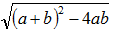
- a + b =
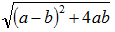
- a - b =
FAQs on Numbers and Number System - 2
| 1. What is the Division Algorithm? |  |
| 2. How does the Division Algorithm work? | |
| 3. What is the significance of the Division Algorithm? | |
| 4. Can the Division Algorithm be used for non-integer numbers? | |
| 5. Are there any limitations or conditions for using the Division Algorithm? | |