Commerce Exam  >  Commerce Notes  >  Accountancy Class 12  >  Issue of Debentures ( Part - 1)

Issue of Debentures ( Part - 1) | Accountancy Class 12 - Commerce PDF Download

Page No 9.51

Question 1

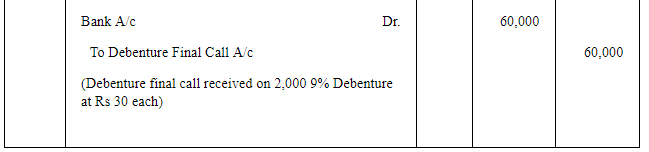
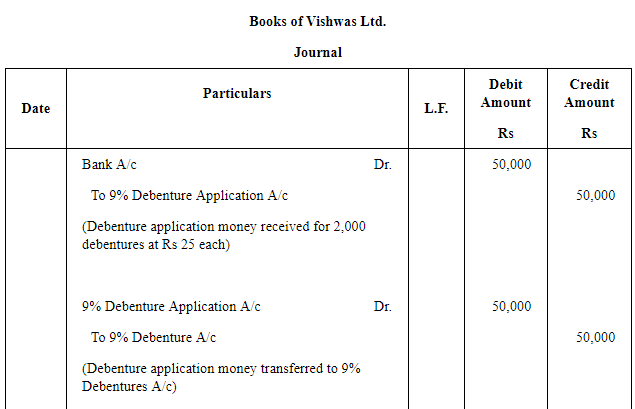
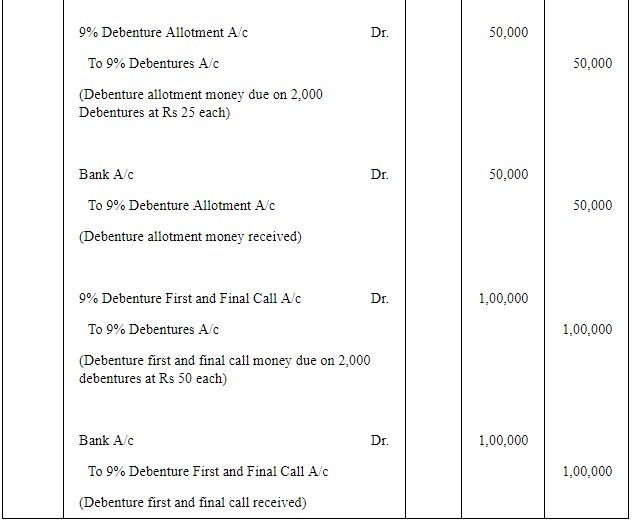
Vishwas Ltd. issued 2,000; 9% Debentures of ₹100 each payable as follows:

₹25 on application; ₹25 on allotment and ₹50 on first and final call.

Applications were received for all the debentures along with the application money did allotment was made . Call money was also received on the due date.

Pass necessary Journal entries in the books of the company.

ANSWER:
Question 1
Question 1

Question 2

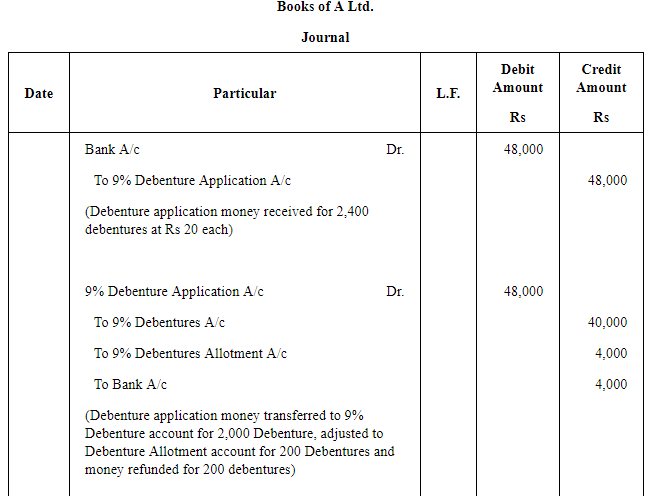
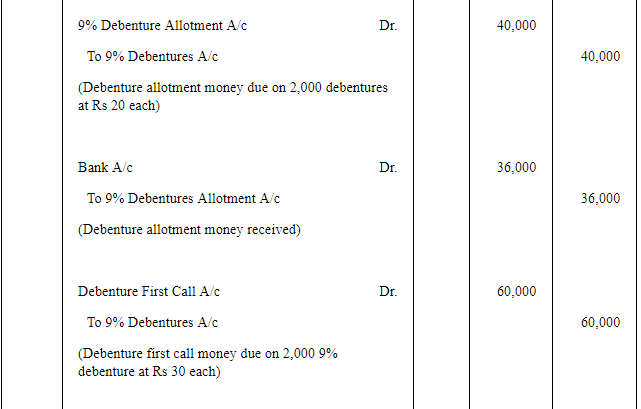
A Ltd. issued 2,000; 9% Debentures of ₹100 each on the following terms:

₹20 on applications; ₹20 on allotment; ₹30 on first call ; ₹30 on final call.

The public applied for 2,400 debentures. Applications for 1,800 debentures were accepted in full. Applications for 400 debentures were allotted 200 debentures  and applications for 200 debentures were rejected . Pass necessary Journal entries .

ANSWER:
Question 2
Question 2
Question 2

Question 3

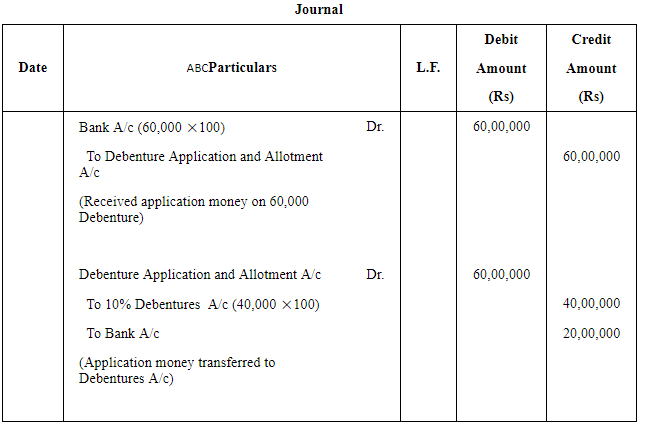
ABC Ltd. issued 40,000; 10% Debentures of ₹100 each at par for cash payable in full along with the application. Applications  were received for 60,000 debentures. Debentures were allotted and excess application money was refunded. Pass Journal entries in the books of the company.

ANSWER:
Question 3

Page No 9.52

Question 4

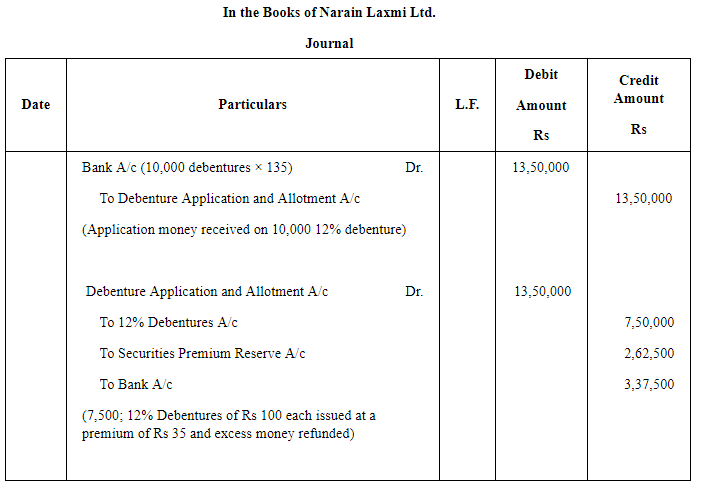
Narain Laxmi Ltd. invited applications for issuing 7,500; 12% Debentures of ₹100 each at a premium of ₹35 per debenture . The full amount was payable on application. Applications were received for 10,000 Debentures. Allotment was made to all the applications on pro rata.

Pass necessary Journal entries for the above transactions in the books of Narain Laxmi Ltd.

ANSWER:
Question 4

Question 5

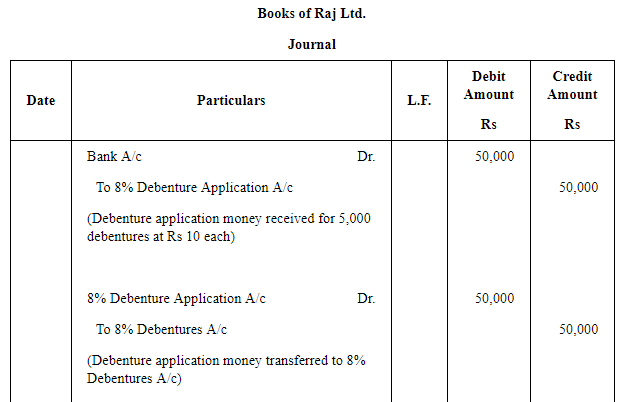
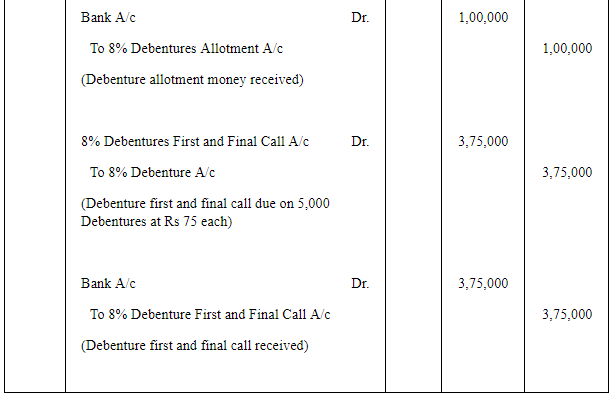
Raj Ltd. issued 5,000;  8% Debentures of ₹100 each at a premium of 5% payable as follows:

₹10 on application; ₹20 along with premium on allotment and balance on first and final call.

Pass necessary Journal entries.

ANSWER:
Question 5
Question 5

Question 6

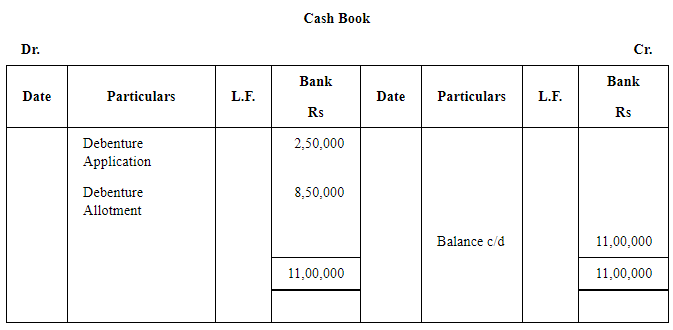
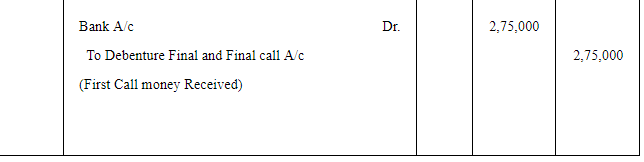
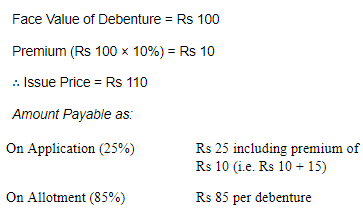
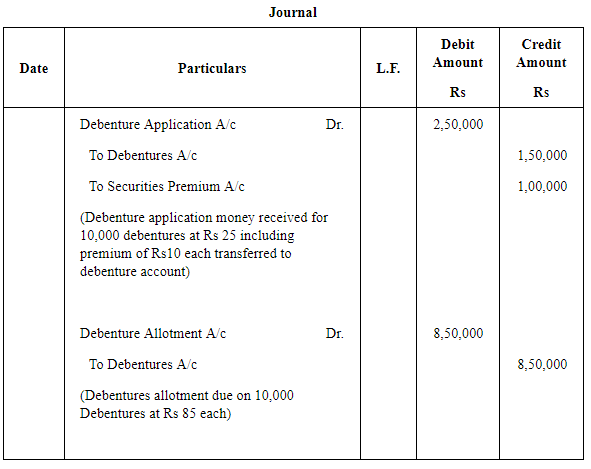
Nipa Limited issued ₹10,00,000 Debentures of ₹100 each at a premium of 10% , payable 25% on application (including premium) and the balance on allotment. The debentures were applied for and the amount was dully received.

You are required to give Journal entries and prepare Cash Book.

ANSWER:
Question 6
Question 6
Question 6

Question 7

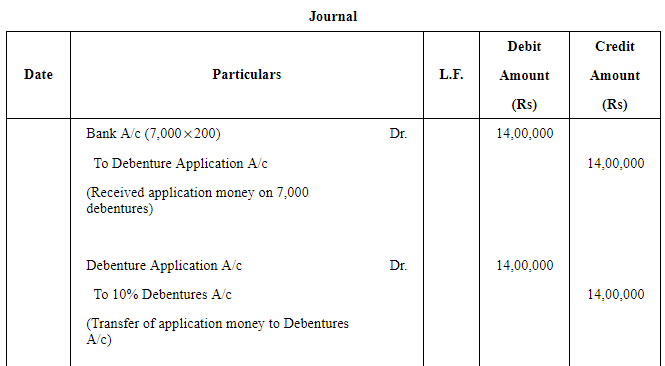
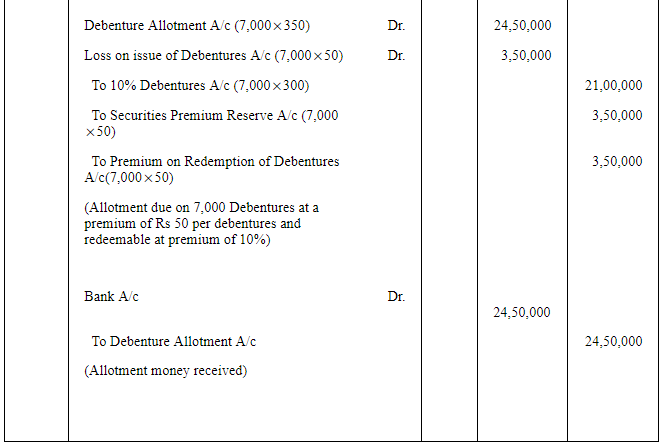
Alok Ltd. issued 7,000, 10% Debentures of ₹500 each at a premium of ₹50 per debenture redeemable at a premium of 10% after 5 years. According to the terms of issue, ₹200 was payable on application and balance on allotment.

Record necessary Journal entries at the time of issue of 10% Debentures.

ANSWER:
Question 7
Question 7

Question 8

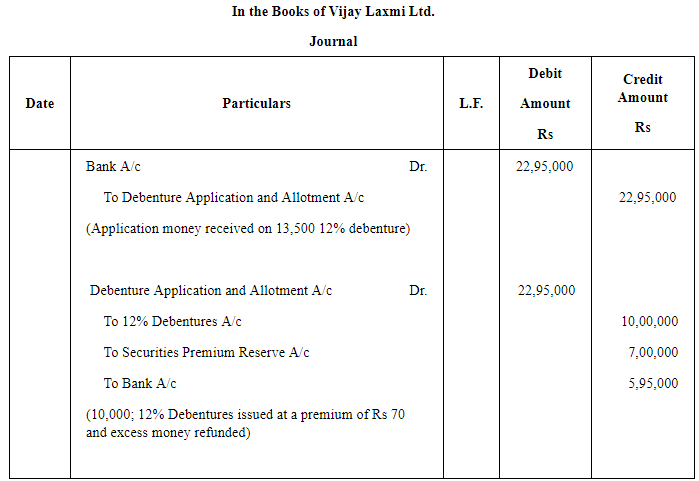
Vijay Laxmi Ltd. invited applications for 10,000; 12% Debentures of ₹100 each at a premium of ₹70 per debenture .The full amount was payable on application.

Applications were received for 13,500 debentures. Applications for 3,500 debentures were rejected  and application money was refunded. Debentures were allotted to the remaining applications.

ANSWER:
Question 8

Question 9

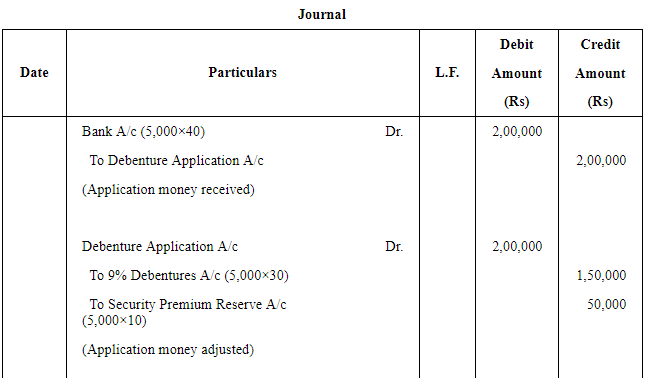
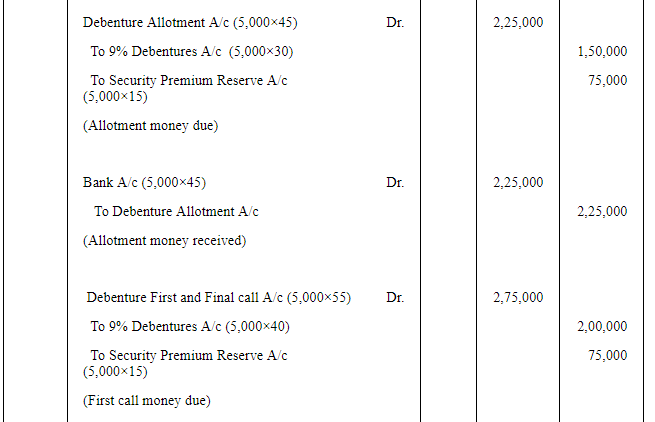
Iron Products Ltd. issued 5,000; 9% Debentures of ₹100 each at a premium of ₹40 payable as follows;

(i) ₹40, including premium of ₹10 on applications;

(ii) ₹45, including premium of ₹15 on allotment; and

(iii) Balance as first and final call.

The issue was subscribed and allotment made. Calls were made and due amount  was received.

Pass Journal entries.

ANSWER:
Question 9
Question 9
Question 9

Question 10

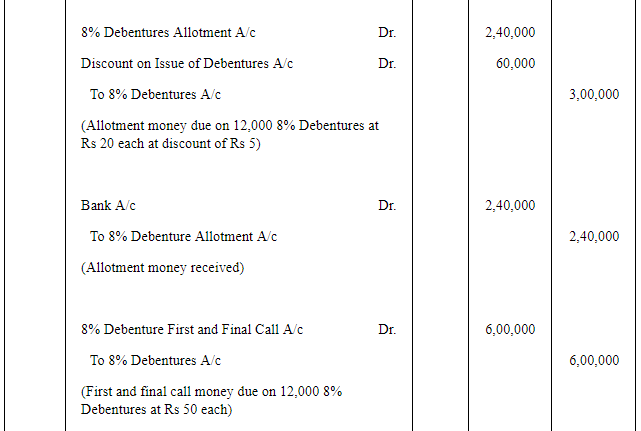
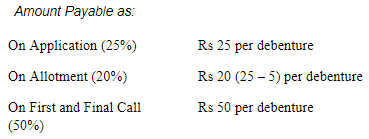
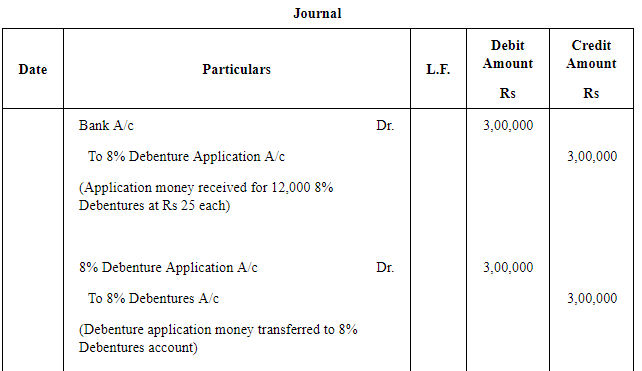
X Ltd . issued 12,000; 8% Debentures of ₹ 100 each at a discount of 5% payable as 25% on application;20% on allotment and balance after three months.

Pass Journal entries.

ANSWER:

Face Value of Debenture = Rs 100

Discount (Rs 100 × 5%) = Rs 5

∴ Issue Price = Rs 95
Question 10
Question 10
Question 10
Question 10

Question 11

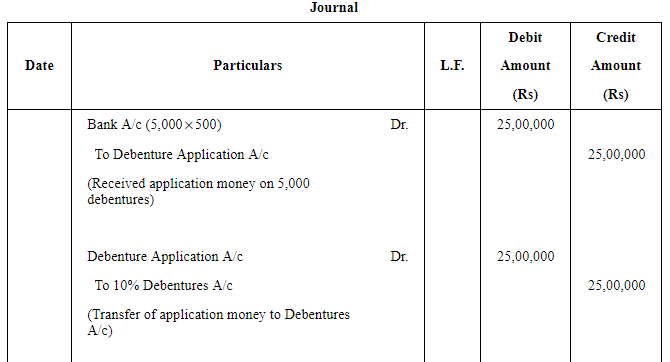
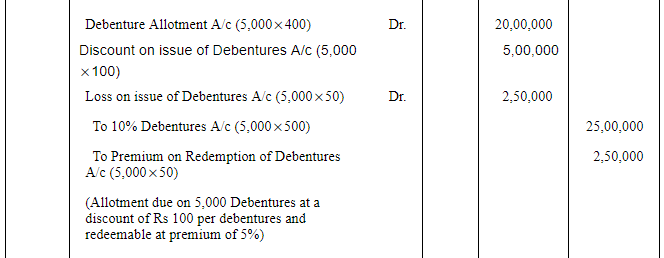
Alka Ltd. issued 5,000, 10% Debentures of ₹ 1,000 each at a discount of 10% redeemable at a premium of 5% after 5 years. According to the terms of issue ₹ 500 was payable  on application and the balance amount on allotment of debentures. Record necessary entries regarding issue of 10% Debentures.

ANSWER:
Question 11
Question 11
Question 11

Page No 9.53

Question 12

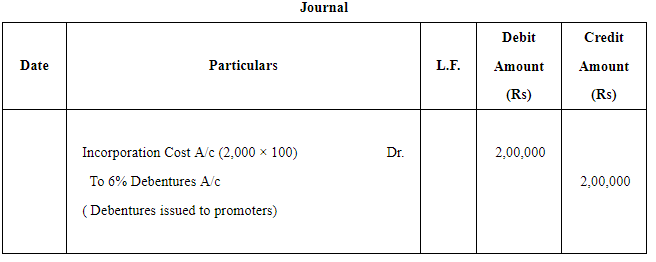
Amrit Ltd. was promoted by Amrit and Bhaskar with an authorised capital of ₹ 10,00,000 divide into 1,00,000 shares of ₹ 10 each.

The company decided to issue 1,000,6% Debentures of ₹ 100 each to Amrit and Bhaskar  each for their services in incorporating the company.

Pass journal entry.

ANSWER:
Question 12

Question 13

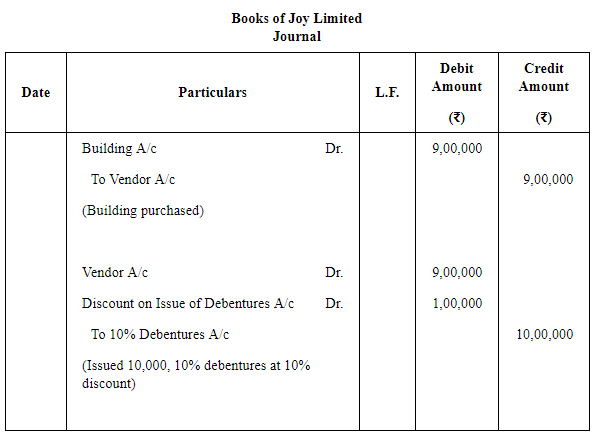
Joy Ltd. company bought a Building for ₹ 9,00,000 and the consideration was paid by issuing 10% Debentures of the normal (face) value of ₹100 each at a discount of 10%.

Give Journal entries.

ANSWER:

Question 13
Question 13

Question 14

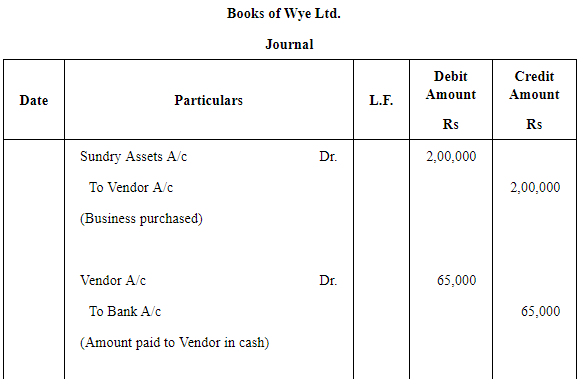
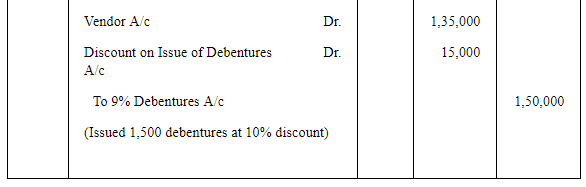
Wye Ltd. purchased an established business for ₹ 2,00,000 payable as ₹ 65,000 by cheque and the balance by issuing 9% Debentures of ₹ 100 each at a discount of 10%.

Give journal entries  in the books of Wye Ltd.

ANSWER:
Question 14
Question 14
Question 14

Question 15

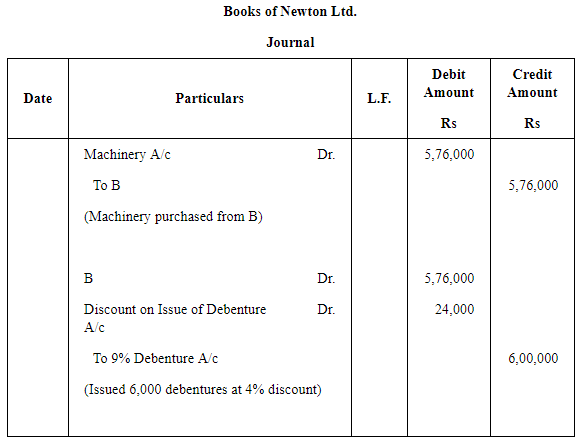
Newton Ltd. purchased a Machinery from B for ₹ 5,76,000 to be paid by the issue of 9% Debentures of ₹ 100 each at 4% discount. Journalise the trasactions.

ANSWER:

Question 15
Question 15

Concepts, Accounting Treatment and Standard Journal Entries — Issue of Debentures (Part 1)

  • Definition:
    • Debentures are long-term debt instruments issued by a company to raise funds. Holders of debentures are creditors of the company and receive fixed interest (coupon) as per terms.
  • Types of Debentures (by nature and terms):
    • By security: Secured (e.g., mortgage debentures), Unsecured (also called naked debentures).
    • By convertibility: Convertible and Non-convertible.
    • By repayment terms: Redeemable and Irredeemable (perpetual).
    • By issue price: At par, at premium, or at discount.
  • Terms commonly used in problems:
    • Face value (nominal value) — the value printed on each debenture (e.g., ₹100, ₹500, ₹1,000).
    • Rate of interest — e.g., 9%, 10% etc.
    • Issue price — face value adjusted for premium or discount.
    • Premium — amount above face value received from investor; credit to Securities Premium Account.
    • Discount — shortfall from face value; debited to Discount on Issue of Debentures (a loss or deferred expense).
  • Procedure & Stages of Issue (typical):
    1. Advertisement / issue of prospectus (if required) and invitation for applications.
    2. Receiving applications with application money (may be full or part amounts depending on terms).
    3. Allotment of debentures — full allotment, pro rata allotment on oversubscription, or rejection of some applications.
    4. Refund of excess application money where applications are rejected or oversubscribed and not allotted fully.
    5. Calls on debentures — where amounts are payable in instalments (application, allotment, calls).
    6. Receipt of final call money.
  • Basic Journal Entries — Templates and Explanation:
    • 1. On receiving application money (when application money is part of issue price):
      • Bank A/c Dr. — Amount of application money received
      •     To Debenture Application A/c — Amount
    • 2. On allotment (transfer application to allotment and account for premium/discount):
      • Debenture Application A/c Dr. — Total application money
      •     To Debentures A/c — Face value of debentures allotted (only when debentures are issued at par; see note below)
      •     To Securities Premium A/c — Premium component (if any)
      •     To Bank A/c — Refund (if application money to be refunded)
      • Note: Often application is transferred to Debenture Allotment A/c or directly adjusted with Bank A/c depending on format. Many textbooks record: Debenture Application A/c Dr. To Debenture Allotment A/c; then on allotment Debenture Allotment A/c Dr. To Debentures A/c, Securities Premium A/c, Bank A/c (for excess), etc.
    • 3. For amounts due on allotment and calls:
      • Allotment A/c Dr. — Amount due on allotment
      •     To Debentures A/c — Face value portion (if allotted at par)
      •     To Securities Premium A/c — Premium on allotment (if payable on allotment)
      • On receipt of allotment money:
      • Bank A/c Dr. — Amount received
      •     To Allotment A/c — Amount
      • Similar entries are made for first call, final call:
      • Calls A/c Dr. — Amount due on call
      •     To Debentures A/c — Face value portion (if maintaining Debentures A/c in instalments)
      • Bank A/c Dr. — On receipt of call money
      •     To Calls A/c — Amount received
    • 4. On issue at premium (when premium is received on a particular stage):
      • Bank A/c Dr. — Total amount (including premium)
      •     To Debenture Application/Allotment/Call A/c — Principal component
      •     To Securities Premium A/c — Premium component
    • 5. On issue at discount:
      • Bank A/c Dr. — Cash received (issue price)
      • Discount on Issue of Debentures A/c Dr. — Discount amount (face value less issue price)
      •     To Debentures A/c — Face value
      • When discount is to be written off over years, it is transferred to Profit & Loss A/c over appropriate years (if required). For many problems discount is simply debited to Discount on Issue A/c and shown as deduction from Share/Debenture Capital.
    • 6. Issue in satisfaction of consideration (e.g., purchase of asset, business, or incorporation services):
      • When debentures are issued to pay for an asset or business:
      • Asset/Business A/c Dr. — Agreed consideration
      •     To Debentures A/c — Face value of debentures issued
      • If debentures issued at discount or premium, record Discount on Issue A/c or Securities Premium A/c accordingly.
  • Oversubscription and Pro rata Allotment:
    • When applications exceed issue, allotment is often made on pro rata basis.
    • Excess application money for unsuccessful portion must be refunded — record Bank A/c Dr. To Debenture Application A/c (refund) or directly adjust.
    • Pro rata calculation: Allotted quantity = (Number of debentures applied by applicant × Total debentures offered) ÷ Total applications received.
  • Recording Cash Book for Debenture Issue (brief):
    • Cash Book (Receipts side) will record receipts on account of application, allotment and calls as they are banked.
    • Any refunds are recorded on Payments side as 'Refund of application money'.
    • Cash Book balances must agree with Bank A/c entries shown in journal.
  • Practical Tips for Solving Numerical Questions:
    1. Read terms carefully: note amounts payable at each stage and whether premium/discount is included in that stage.
    2. Compute total amounts for each stage: number of debentures allotted × amount payable per debenture at that stage.
    3. When oversubscription occurs, compute accepted applications, rejected applications and refund amounts precisely.
    4. Label ledger accounts clearly in journal entries: e.g., Debenture Application A/c, Debenture Allotment A/c, First Call A/c, Debentures A/c, Securities Premium A/c, Discount on Issue of Debentures A/c, Bank A/c.
    5. Maintain order: Record receipts (Bank), transfer application to allotment, record allotment, record calls and receipts on calls.
  • Common Journal Entry Formats — Quick Reference:
    • On receipt of application money:
      • Bank A/c Dr.
      •     To Debenture Application A/c
    • On allotment (where allotment money due and debentures are allotted):
      • Debenture Application A/c Dr. (total application money)
      •     To Debenture Allotment A/c
      • Debenture Allotment A/c Dr. (amount due on allotment)
      •     To Debentures A/c (face value)
      •     To Securities Premium A/c (premium, if any)
      • Bank A/c Dr. (on receipt)
      •     To Debenture Allotment A/c
    • On first and final call:
      • First & Final Call A/c Dr.
      •     To Debentures A/c
      • Bank A/c Dr. (on receipt)
      •     To First & Final Call A/c
    • On issue at discount:
      • Bank A/c Dr.
      • Discount on Issue of Debentures A/c Dr.
      •     To Debentures A/c
    • On issue at premium:
      • Bank A/c Dr.
      •     To Debentures A/c
      •     To Securities Premium A/c
  • Examples & Applications (connected to provided questions):
    • When debentures are issued at par and payable in instalments (Questions 1, 2, 3): follow staged recording — Application → Allotment → Calls.
    • When issued at premium payable on a particular stage (Questions 5, 6, 7, 9): allocate premium to the stage on which it is payable and credit Securities Premium A/c accordingly.
    • When issued at discount (Questions 10, 11, 13–15): record Discount on Issue of Debentures A/c as a debit for the discount amount and debit Bank for cash received.
    • When debentures are issued as consideration for assets, business purchase, or to promoters (Questions 12–15): record asset or business account with the agreed consideration and credit Debentures A/c for face value along with proper treatment for discount/premium.
  • Summary (brief):
    • Identify terms and stages from question.
    • Compute amounts due at each stage and the number of debentures allotted.
    • Use standard journal templates to record receipts, transfers (application → allotment), allotment, calls, refunds, and accounting for premium/discount.
    • Keep Bank/Cash Book entries consistent with journal entries.
The document Issue of Debentures ( Part - 1) | Accountancy Class 12 - Commerce is a part of the Commerce Course Accountancy Class 12.
All you need of Commerce at this link: Commerce
41 videos|226 docs|37 tests

FAQs on Issue of Debentures ( Part - 1) - Accountancy Class 12 - Commerce

1. What is a debenture?
Ans. A debenture is a type of debt instrument issued by a company or government entity to raise funds. It represents a loan agreement between the issuer and the investor, where the issuer promises to repay the principal amount along with interest on a specified date.
2. How are debentures different from shares?
Ans. Debentures and shares are both financial instruments, but they have some key differences. A debenture represents a loan, while a share represents ownership in a company. Debenture holders are creditors and have no voting rights, whereas shareholders are owners and have voting rights.
3. What are the types of debentures?
Ans. There are several types of debentures, including convertible debentures, non-convertible debentures, secured debentures, unsecured debentures, redeemable debentures, and irredeemable debentures. Each type has its own features and terms.
4. How are debentures issued?
Ans. Debentures can be issued through a public issue or a private placement. In a public issue, the company offers debentures to the general public through a prospectus. In a private placement, debentures are offered to a select group of investors, such as financial institutions or high net worth individuals.
5. What are the advantages of investing in debentures?
Ans. Investing in debentures offers several advantages, such as regular income through interest payments, fixed returns, lower risk compared to equity investments, and priority in repayment in case of bankruptcy or liquidation of the company. Additionally, debentures can provide diversification in an investment portfolio.
Related Searches
ppt, Important questions, Semester Notes, MCQs, video lectures, Issue of Debentures ( Part - 1) | Accountancy Class 12 - Commerce, Exam, shortcuts and tricks, pdf , Free, mock tests for examination, Issue of Debentures ( Part - 1) | Accountancy Class 12 - Commerce, practice quizzes, Viva Questions, Issue of Debentures ( Part - 1) | Accountancy Class 12 - Commerce, study material, past year papers, Extra Questions, Sample Paper, Objective type Questions, Summary, Previous Year Questions with Solutions;