| Table of contents |
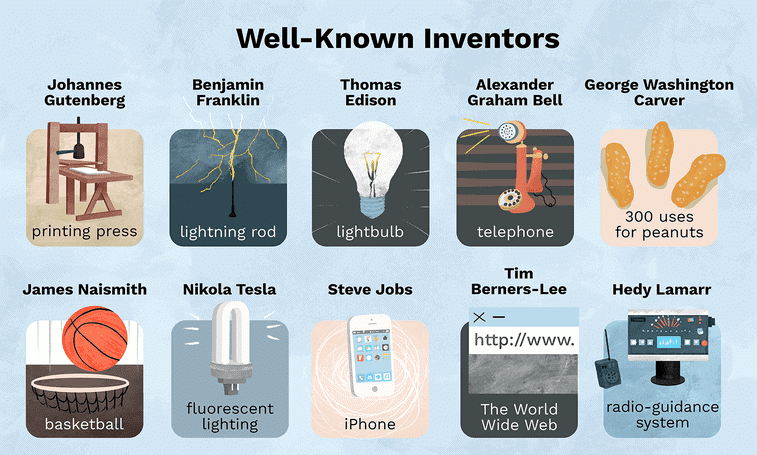
Throughout history, inventors have changed the world a little at a time with their innovations and creations.
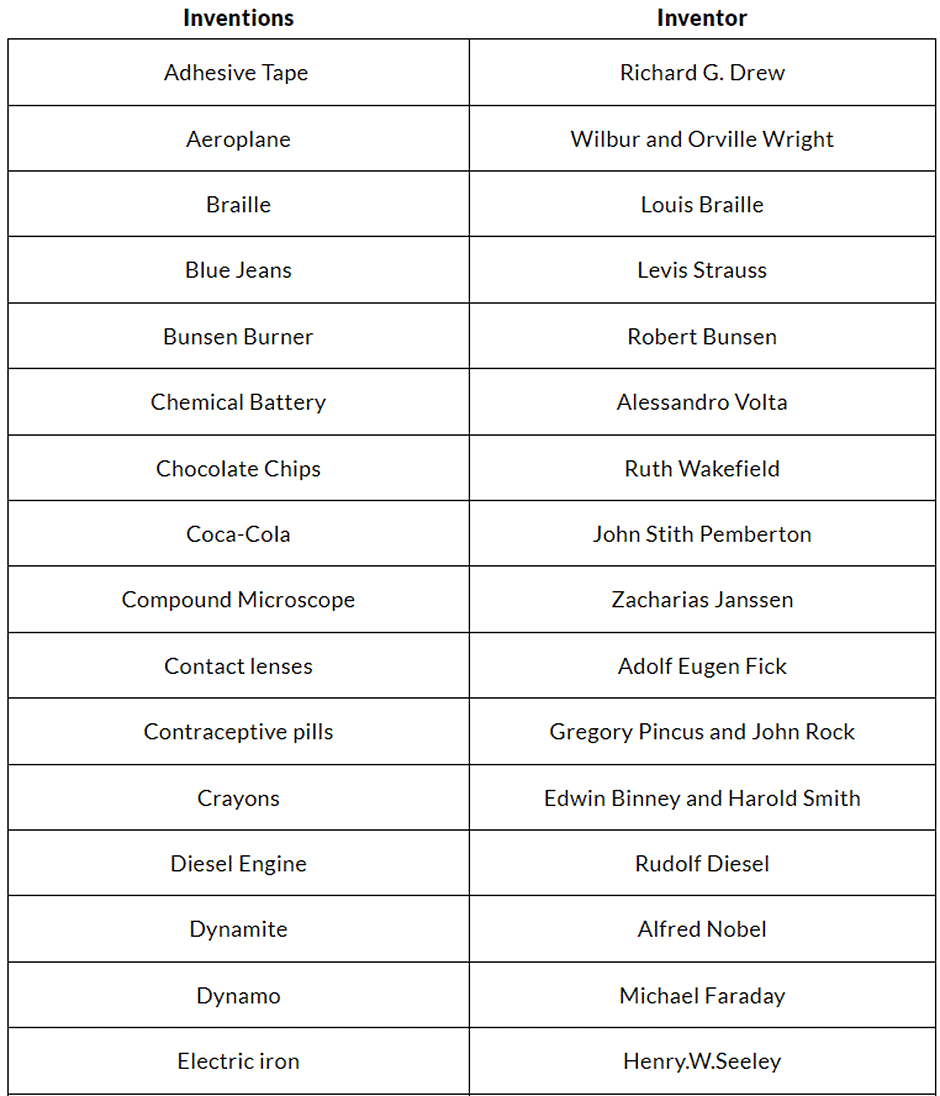
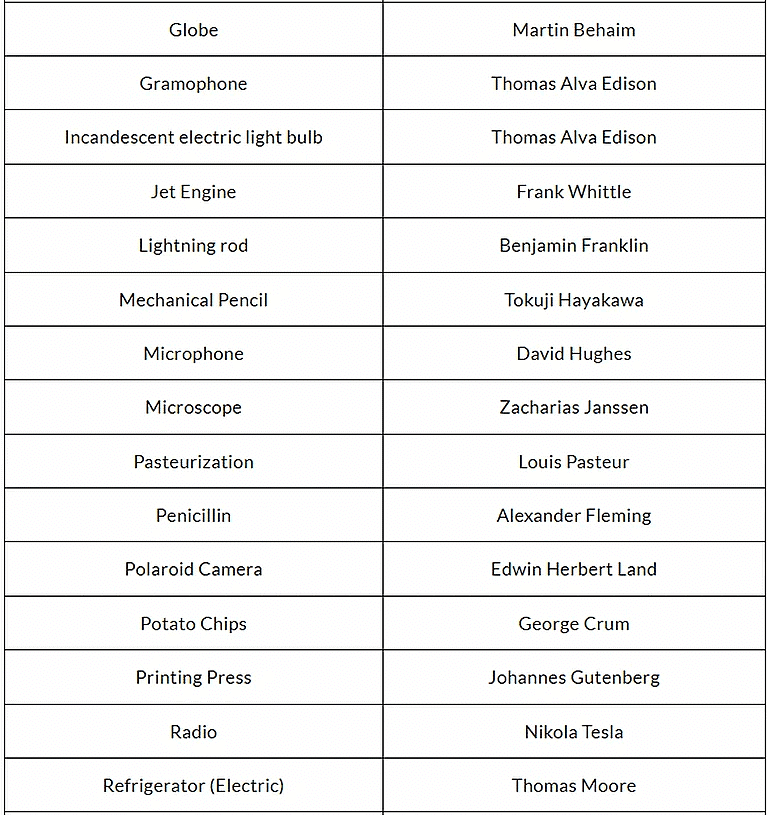
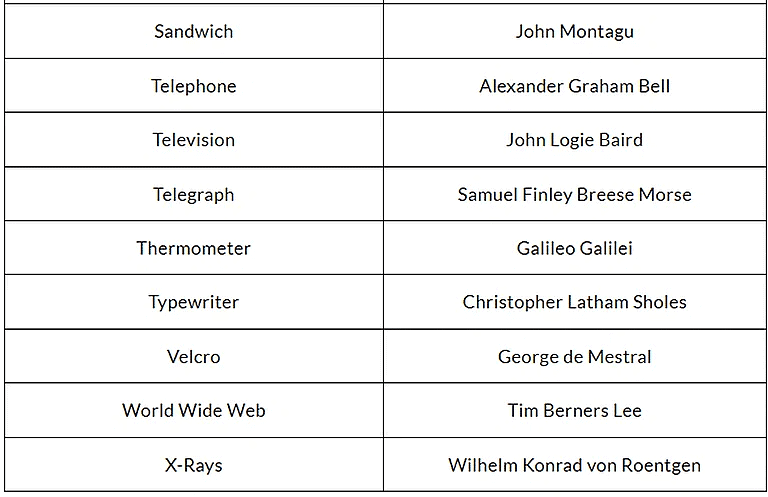
It is necessary for students preparing for CLAT to know about the creators of some of the world's most important inventions:-


Now find out the answers to these questions: CLAT GK - Inventors & Inventions
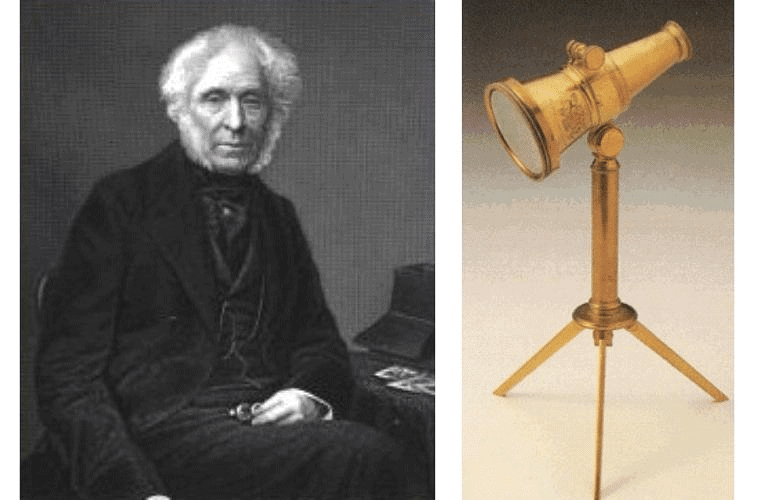
1. Who invented the kaleidoscope?
Ans: The kaleidoscope was invented by the Scottish scientist David Brewster and first publicly announced in 1817.
2. Who invented the Band aid?
Ans: Earle Dickson, a cotton buyer, invented the BAND-AID® Brand adhesive bandage.
3. Who is credited with the invention of bifocals?
Ans: Benjamin Franklin is generally credited with the invention of bifocals. However, historians have occasionally suggested that others may have preceded him in creating divided-lens spectacles.
4. Who is credited with the invention of the dry cell?
Ans: A dry cell is a type of electrochemical cell developed by the German scientist Carl Gassner in 1886.
The following list highlights important inventors and inventions that are commonly asked in general-awareness sections and are relevant to students of engineering (Civil, Computer Science, Electrical). Each entry gives the inventor, the invention, a brief explanation, and its application or relevance.
Explanation: Patented in 1824, Portland cement is the most common type of cement used worldwide and is the basic ingredient of concrete.
Application: Foundation work, concrete structures, bridges, roads and all major civil construction.
Explanation: Smeaton introduced engineering as an applied science in the 18th century; his work on hydraulic lime and lighthouse construction set early standards for durable construction in water.
Application: Principles of material selection, durability assessment and structural design.
Explanation: Brunel designed major early railways, bridges and ship technology, applying large-scale engineering solutions.
Application: Inspires modern large-span bridge design and civil project planning.
Explanation: Eiffel's structural designs demonstrated use of metal frameworks for tall structures.
Application: Modern steel structures, truss design and wind-load considerations in tall buildings.
Explanation: Conceptual design of a programmable mechanical computer in the 19th century; considered a forerunner of modern computers.
Application: Foundations of algorithmic thinking and programmable machines.
Explanation: Wrote notes on Babbage's analytical engine that included an algorithm intended to be processed by a machine; often called the first computer programmer.
Application: Early concept of algorithmic programs and software logic.
Explanation: Introduced formal models of computation and decidability; his work underpins theoretical computer science.
Application: Complexity theory, algorithms, and cryptography.
Explanation: Proposed a stored-program computer architecture where both instructions and data reside in memory.
Application: Basis for most modern digital computers and instruction execution models.
Explanation: Created UNIX operating system and the C programming language; influenced portable software development and OS design.
Application: Operating systems, embedded systems, systems programming.
Explanation: Invented the Web and protocols (HTTP, HTML, URLs) that enabled information sharing on the internet.
Application: Web development, distributed information systems and networked applications.
Explanation: Pioneered automatic programming and popularised compilers and high-level languages.
Application: High-level language design, compilers and software engineering methodology.
Explanation: Discovered principles of electromagnetic induction that enable electric generators and transformers.
Application: Power generation, motors, transformers and electromagnetic devices.
Explanation: Unified theory of electricity and magnetism describing electromagnetic waves.
Application: Radio, microwave engineering, antenna theory and wave propagation.
Explanation: Developed AC generation and distribution systems and practical induction motors.
Application: Modern power systems and AC motor drives in industry.
Explanation: Developed a practical incandescent lamp and improved distribution for electric lighting.
Application: Electrification, lighting and early power distribution systems.
Explanation: Demonstrated long-distance radio communication and practical wireless systems.
Application: Wireless communication, radio engineering and early telecommunication networks.
Explanation: Invented an early wet cell battery that became the basis for later portable cells.
Application: Foundations of portable electrical power and later development of dry cells by others.
This chapter lists selected inventors and their inventions that are often asked in general-awareness sections and are directly useful for students of Civil, Computer Science and Electrical Engineering. Remember the inventor, the core idea of the invention, and at least one modern application. Use grouping and timelines to revise efficiently.
366 videos|719 docs|149 tests |
| 1. Who is considered one of the greatest inventors of all time? | ![]() |
| 2. What is the significance of Nikola Tesla's inventions? | ![]() |
| 3. What invention is attributed to Alexander Graham Bell? | ![]() |
| 4. What is the invention that revolutionized the printing industry? | ![]() |
| 5. What major invention is associated with the Wright brothers? | ![]() |