Key Notes: Prepositions | English Grammar Basic - Class 10 PDF Download

Prepositions
Prepositions are essential words in English that typically come before nouns or pronouns to indicate various relationships such as time, place, direction, and more. They play a crucial role in sentence structure, and using them incorrectly can alter the meaning of a sentence. Common examples of prepositions include on, in, before, and after.
Types of Prepositions
1. Preposition of Time: Describing time relationships, examples are "since," "before," and "by."
Example: The tradition has been followed since time immemorial.
2. Preposition of Place: Describing spatial relationships, examples are "outside," "far," and "between."
Example: A hangout cafe is just outside the building.
3. Preposition of Direction: Indicating movement or orientation, examples are "across," "over," and "towards."
Example: We need to move across the city to reach there.
4. Prepositions for Time: Expressing time relationships, using words like "at," "on," and "by."
Example: We are leaving for Delhi on the morning of the tenth of July.
Remember:
- Prepositions can govern other parts of speech used as nouns, such as: "from here," "before now," "for good," "in short," and "about to go."
- They can govern phrases and clauses, as in: "I shall go to the place from where you have come."
- Phrase prepositions or prepositional phrases are phrases used as prepositions, like: "on account of," "instead of," "in spite of," "by means of," "owing to," "by dint of," and "in accordance with."
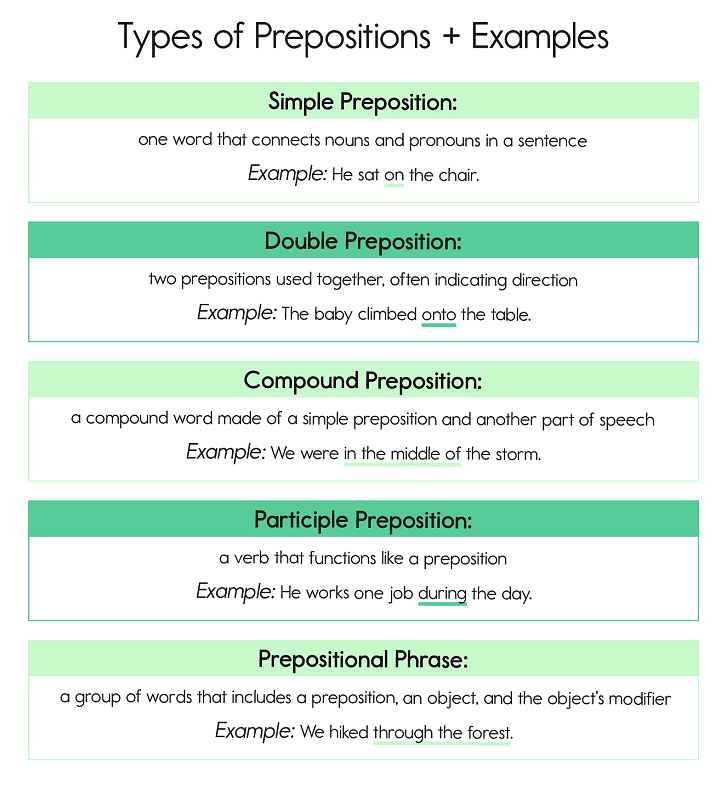
Various Functions of Prepositions
- Prepositions for Time: Prepositions indicating the temporal relationship between nouns in a sentence.
For Example:
We are leaving for Delhi on the morning of the tenth of July.
I’ll complete the work by 2 p.m. - Prepositions for Place: Prepositions describing the spatial orientation of one thing or person relative to another.
For Example:
The hotel is on your right.
The river flows under the bridge.
He lives among the hills. - Use of Prepositions after Adjectives: Placing prepositions immediately following adjectives.
For Example:
He is qualified for the post.
She is fond of cooking.
He is not interested in the job.
He is angry with me. - Use of Prepositions for Tools, Agency, Description, etc.: Prepositions of agency or description explaining the cause or origin of another object in a phrase.
For Example:
I have no money with me.
Cut the apple into two with a knife.
Call the boy in blue. - Use of Prepositions after Verbs: Prepositions connecting certain verbs to their objects.
For Example:
She climbed up the stairs.
His eyes blazed with anger.
The dog is walking down the stairs.
He objected to my proposal. - Use of Prepositions after Nouns: Utilizing prepositions with nouns to specify location or method.
For Example:
Have you got the details about the game?
He is an honour to the profession.
He covered his face with a mask.
Everyone admires her strength of character.
|
20 videos|143 docs|18 tests
|
FAQs on Key Notes: Prepositions - English Grammar Basic - Class 10
| 1. What are prepositions and why are they important in English grammar? |  |
| 2. Can you give examples of common prepositions used in sentences? | |
| 3. How do I know which preposition to use in a sentence? | |
| 4. Are there any rules for using prepositions correctly? | |
| 5. How can I improve my understanding and usage of prepositions? | |




MCQs
,Exam
,practice quizzes
,ppt
,Semester Notes
,shortcuts and tricks
,mock tests for examination
,Key Notes: Prepositions | English Grammar Basic - Class 10
,Sample Paper
,Important questions
,Previous Year Questions with Solutions
,past year papers
,Free
,Objective type Questions
,Viva Questions
,Key Notes: Prepositions | English Grammar Basic - Class 10
,Extra Questions
,video lectures
,Key Notes: Prepositions | English Grammar Basic - Class 10
,Summary
,study material
,



Key Notes: Prepositions Free PDF Download
Importance of Key Notes: Prepositions
Key Notes: Prepositions
Key Notes: Prepositions Class 10 Questions
Study Key Notes: Prepositions on the App
|
© EduRev
|
Education Revolution
|


|




within 7 days!