UPSC Exam > UPSC Notes > History for UPSC CSE > First Carnatic War: Carnatic Wars
First Carnatic War: Carnatic Wars | History for UPSC CSE PDF Download

≫ FACTS ABOUT THE FIRST CARNATIC WAR
- Fought between: English and French forces.
- People involved: Joseph François Dupleix (French Governor-General), Major Stringer Lawrence (British), Anwaruddin Khan (Nawab of the Carnatic).
- When: 1746 – 1748
- Where: Carnatic region, Southern India
- Result: Inconclusive.
≫ Course of the First Carnatic War
- France and Britain were on opposite sides of the camp at the War of Austrian Succession that had broken out in Europe in 1740.
- This Anglo-French rivalry led to their trading companies in India vying with each other for supremacy.
- The French Governor of Pondicherry Dupleix had raised an army of Indian sepoys under French officers in India.
- The French East India Company was nationalized in 1720 and France had imperialistic designs on India.
- In 1745, there was a naval attack on a French fleet by Britain in which even Pondicherry in danger.
- Dupleix, along with additional French troops from Mauritius defended against this attack and captured Madras, which had been controlled by the English.
- The English made another attack on Pondicherry but instead faced a heavy loss. The English sought help from the Nawab of Carnatic (Arcot) Anwaruddin Khan.
- The Nawab asked the French to return Madras to the British.
- Dupleix tried convincing the Nawab unsuccessfully that Madras would be handed over to him at a later stage.
- Then, the Nawab sent a huge army to fight the French forces. This army was defeated by the relatively small number of French forces in Mylapore (in modern-day Chennai) in 1746.
- This exposed the weakness of the armies of the Indian rulers vis-à-vis the efficiently trained armies of the European powers.
- The war ended in 1748 with the Treaty of Aix-la-Chapelle also called Treaty of Aachen.
≫ Effects of the First Carnatic War
- Madras was given back to the English in exchange for Louisburg in North America to France.
- Dupleix understood the superiority of the European armies who used this advantage to influence Indian princes and establish French hegemony in South India.
≫ FACTS ABOUT THE SECOND CARNATIC WAR
- Fought between: Different claimants to the posts of the Nizam of Hyderabad, and the Nawab of the Carnatic; each claimant being supported either by the British or the French.
- People involved: Muhammad Ali and Chanda Sahib (for the Nawabship of the Carnatic or Arcot); Muzaffar Jung and Nasir Jung (for the post of the Nizam of Hyderabad).
- When: 1749 – 1754
- Where: Carnatic (Southern India)
- Result: Muzaffar Jung became Hyderabad’s Nizam. Muhammad Ali became the Nawab of the Carnatic.
≫ Course of the Second Carnatic War
- The first Carnatic War demonstrated the power of the well-trained European army vis-à-vis the less than efficient armies of the Indian princes.
- The French Governor-General Dupleix wanted to take advantage of this and assert influence and authority over the Indian kingdoms, so as to make way for a French Empire in India. So, he was looking to interfere in the internal power struggles among Indian chiefs.
- Even though England and France were officially at peace with each other as there was no fighting in Europe, the political climate in Southern Indian at that time led their companies to fight in the subcontinent.
- The Nizam of Hyderabad, Asaf Jah I died in 1748 starting a power struggle between his grandson (through his daughter) Muzaffar Jung, and his son Nasir Jung.
- Anwaruddin Khan, the Nawab of the Carnatic supported Nasir Jung’s claim to the throne of the Nizam.
- This led Muzaffar Jung to instigate war with French support against Anwaruddin, called the Battle of Ambur.
- Anwaruddin Khan had died in the Battle of Ambur in 1749.
- Now there was a tussle for the Nawabship of Carnatic between Muhammad Ali (son of Anwaruddin) and Chanda Sahib (son-in-law of Dost Ali Khan, a former Nawab of the Carnatic).
- This led to a tripartite understanding among the various powers. This is explained in the table below:
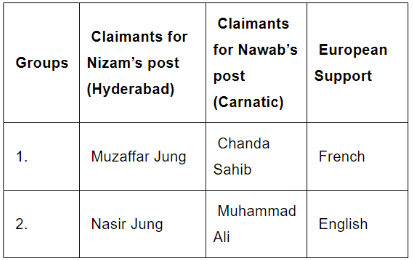
- After Anwaruddin Khan’s death, his son Muhammad Ali fled to Trichy. Then, Chanda Sahib was proclaimed the Nawab of the Carnatic.
- Then, French forces marched on to the Deccan and fought and killed Nasir Jung.
- Subsequently, Muzaffar Jung was installed as the Nizam of Hyderabad.
- However, Muzaffar Jung was killed a couple of months later and the French installed Salabat Jung (another son of Asaf Jah I) as the Nizam.
- In return, the French acquired from the Nizam four rich districts on the Coromandel Coast (Northern Sircars).
- At this time, Trichy was under the control of Chanda Sahib and the French. But the Trichy Fort was held by Muhammad Ali.
- To undermine the growing French power in the region, the English decided to support Muhammad Ali.
- Robert Clive (later Governor of Bengal) attacked Arcot, the capital of the Carnatic, as a divisionary tactic. This is called the Siege of Arcot, in which the British won.
- After this many battles were fought and Chanda Sahib was killed in one of them.
- Thus, Muhammad Ali was installed as the Nawab of the Carnatic.
- The war ended with the Treaty of Pondicherry in 1754.
Effects of the Second Carnatic War
- Although the French gained the Northern Sircars, Dupleix was criticised by the French authorities because of heavy losses to the French company.
- Dupleix was called back to France. He was replaced by Charles-Robert Godeheu who signed the Treaty of Pondicherry.
- As per the treaty, the English and the French were to indulge only in commercial activities in India and not interfere in sub-continental political affairs.
The document First Carnatic War: Carnatic Wars | History for UPSC CSE is a part of the UPSC Course History for UPSC CSE.
All you need of UPSC at this link: UPSC
|
110 videos|653 docs|168 tests
|
FAQs on First Carnatic War: Carnatic Wars - History for UPSC CSE
| 1. What was the cause of the First Carnatic War? |  |
Ans. The First Carnatic War was caused by a dispute over the succession of the throne of the Carnatic region in South India. The British East India Company supported the claim of Chanda Sahib, while the French East India Company supported the claim of Mohamed Ali.
| 2. Who were the major players involved in the First Carnatic War? | |
Ans. The major players involved in the First Carnatic War were the British East India Company and the French East India Company. They supported different claimants to the Carnatic throne and fought against each other to establish their influence in the region.
| 3. What were the major battles of the First Carnatic War? | |
Ans. The major battles of the First Carnatic War included the Battle of St. Thome, the Battle of Madras, the Battle of Ambur, and the Battle of Cuddalore. These battles were fought between the British and the French forces, and their outcomes played a significant role in determining the course of the war.
| 4. How did the First Carnatic War impact the power dynamics in South India? | |
Ans. The First Carnatic War resulted in the French gaining an upper hand in South India initially, as they were able to capture key British settlements and establish their influence in the Carnatic region. However, with the arrival of reinforcements from Britain, the British were able to regain control and eventually emerged as the dominant power in the region.
| 5. What were the consequences of the First Carnatic War? | |
Ans. The consequences of the First Carnatic War were significant. It marked the beginning of a series of conflicts known as the Carnatic Wars between the British and the French in South India. The war also highlighted the growing influence of European powers in Indian politics and set the stage for future power struggles in the region.
About this Document

4.88/5
Rating

Oct 06, 2025
Last updated
Related Exams
Document Description: First Carnatic War: Carnatic Wars for UPSC 2025 is part of History for UPSC CSE preparation.
The notes and questions for First Carnatic War: Carnatic Wars have been prepared according to the UPSC exam syllabus. Information about First Carnatic War: Carnatic Wars covers topics
like and First Carnatic War: Carnatic Wars Example, for UPSC 2025 Exam. Find important definitions, questions, notes, meanings, examples, exercises and tests below for First Carnatic War: Carnatic Wars.
Introduction of First Carnatic War: Carnatic Wars in English is available as part of our History for UPSC CSE
for UPSC & First Carnatic War: Carnatic Wars in Hindi for History for UPSC CSE course.
Download more important topics related with notes, lectures and mock test series for UPSC
Exam by signing up for free. UPSC: First Carnatic War: Carnatic Wars | History for UPSC CSE
Description
Full syllabus notes, lecture & questions for First Carnatic War: Carnatic Wars | History for UPSC CSE - UPSC | Plus excerises question with solution to help you revise complete syllabus for History for UPSC CSE | Best notes, free PDF download
Information about First Carnatic War: Carnatic Wars
In this doc you can find the meaning of First Carnatic War: Carnatic Wars defined & explained in the simplest way possible. Besides explaining types of
First Carnatic War: Carnatic Wars theory, EduRev gives you an ample number of questions to practice First Carnatic War: Carnatic Wars tests, examples and also practice UPSC
tests


Related Searches
First Carnatic War: Carnatic Wars | History for UPSC CSE
,Important questions
,mock tests for examination
,Viva Questions
,MCQs
,ppt
,Objective type Questions
,Free
,study material
,Exam
,past year papers
,First Carnatic War: Carnatic Wars | History for UPSC CSE
,Summary
,video lectures
,Previous Year Questions with Solutions
,Sample Paper
,practice quizzes
,Semester Notes
,shortcuts and tricks
,First Carnatic War: Carnatic Wars | History for UPSC CSE
,Extra Questions
;



Additional Information about First Carnatic War: Carnatic Wars for UPSC Preparation
First Carnatic War: Carnatic Wars Free PDF Download
The First Carnatic War: Carnatic Wars is an invaluable resource that delves deep into the core of the UPSC exam.
These study notes are curated by experts and cover all the essential topics and concepts, making your preparation more efficient and effective.
With the help of these notes, you can grasp complex subjects quickly, revise important points easily,
and reinforce your understanding of key concepts. The study notes are presented in a concise and easy-to-understand manner,
allowing you to optimize your learning process. Whether you're looking for best-recommended books, sample papers, study material,
or toppers' notes, this PDF has got you covered. Download the First Carnatic War: Carnatic Wars now and kickstart your journey towards success in the UPSC exam.
Importance of First Carnatic War: Carnatic Wars
The importance of First Carnatic War: Carnatic Wars cannot be overstated, especially for UPSC aspirants.
This document holds the key to success in the UPSC exam.
It offers a detailed understanding of the concept, providing invaluable insights into the topic.
By knowing the concepts well in advance, students can plan their preparation effectively.
Utilize this indispensable guide for a well-rounded preparation and achieve your desired results.
First Carnatic War: Carnatic Wars Notes
First Carnatic War: Carnatic Wars Notes offer in-depth insights into the specific topic to help you master it with ease.
This comprehensive document covers all aspects related to First Carnatic War: Carnatic Wars.
It includes detailed information about the exam syllabus, recommended books, and study materials for a well-rounded preparation.
Practice papers and question papers enable you to assess your progress effectively.
Additionally, the paper analysis provides valuable tips for tackling the exam strategically.
Access to Toppers' notes gives you an edge in understanding complex concepts.
Whether you're a beginner or aiming for advanced proficiency, First Carnatic War: Carnatic Wars Notes on EduRev are your ultimate resource for success.
First Carnatic War: Carnatic Wars UPSC Questions
The "First Carnatic War: Carnatic Wars UPSC Questions" guide is a valuable resource for all aspiring students preparing for the
UPSC exam. It focuses on providing a wide range of practice questions to help students gauge
their understanding of the exam topics. These questions cover the entire syllabus, ensuring comprehensive preparation.
The guide includes previous years' question papers for students to familiarize themselves with the exam's format and difficulty level.
Additionally, it offers subject-specific question banks, allowing students to focus on weak areas and improve their performance.
Study First Carnatic War: Carnatic Wars on the App
Students of UPSC can study First Carnatic War: Carnatic Wars alongwith tests & analysis from the EduRev app,
which will help them while preparing for their exam. Apart from the First Carnatic War: Carnatic Wars,
students can also utilize the EduRev App for other study materials such as previous year question papers, syllabus, important questions, etc.
The EduRev App will make your learning easier as you can access it from anywhere you want.
The content of First Carnatic War: Carnatic Wars is prepared as per the latest UPSC syllabus.
|
© EduRev
|
Education Revolution
|


|




Signup to see your scores
go up
within 7 days!
within 7 days!
Takes less than 10 seconds to signup