UPSC Exam  >  UPSC Notes  >  History CSE  >  The Battle of Plassey (1757)

The Battle of Plassey (1757) - History for UPSC CSE PDF Download

Introduction

The Battle of Plassey (1757) was a decisive military and political event that marked the beginning of sustained British ascendancy in large parts of India. It was fought between the forces of the East India Company, led by Robert Clive, and the army of the Nawab of Bengal, Siraj-ud-Daulah. The clash took place during the later years of the Mughal period while Alamgir II was the Mughal emperor. The result of the battle enabled the Company to intervene decisively in Bengal's politics, install a puppet Nawab, and set the foundations for territorial and fiscal control that transformed the subcontinent's political economy.

Battle of Plassey

The confrontation at Plassey (also spelled Palashi) was symptomatic of rising tensions between a trading corporation with growing military capability and a regional ruler seeking to protect sovereignty and revenue. Repeated abuses of trade privileges, refusal or evasion of duties, and fortification and military preparations by Company servants in Bengal agitated the Nawab. The immediate chain of events included the seizure of Calcutta by Siraj-ud-Daulah in June 1756 and the detention of several British prisoners in the episode known as the Black Hole of Calcutta. In response, Company forces under Clive planned a campaign that culminated in the encounter at Plassey.

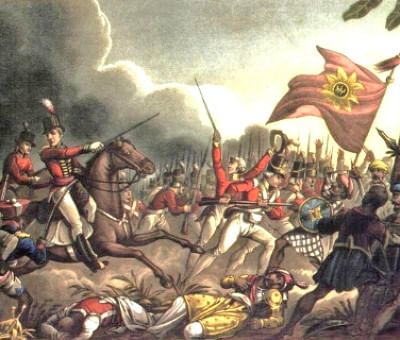
Battle of PlasseyBattle of Plassey

Date and place

  • The battle was fought at Palashi (Plassey) on the banks of the Bhagirathi branch of the Ganges.
  • The commonly cited date of the battle is 23 June 1757.

Background (brief)

  • The East India Company had established strong commercial settlements at Fort William (Calcutta), Fort St. George (Madras) and Bombay Castle, and enjoyed trading privileges in Bengal.
  • Company officials often ignored local revenue rules and claimed extraterritorial rights; these practices inflamed local authorities and the Nawab.
  • Relations broke down after Siraj-ud-Daulah moved against British fortifications in Calcutta and detained Company personnel; this incident is referred to as the Black Hole of Calcutta (June 1756).
  • Robert Clive and other Company leaders organised a military response and simultaneously plotted with disaffected elements within the Nawab's court and army.

Causes of The Battle of Plassey

  • Commercial abuses and privileges: Misuse of trade concessions granted to the East India Company by local authorities and failure to comply with duties and customs rules.
  • Fortification and military posture: The Company fortified Calcutta and prepared military defences without the Nawab's permission, provoking suspicion and hostility.
  • Political mistrust and asylum granted: The Nawab was angered that the Company gave refuge to his political enemies and interfered in internal affairs.
  • Immediate provocation - the Black Hole episode: The imprisonment and deaths of British prisoners in Calcutta (June 1756) increased pressure within the Company to reassert authority.
  • Internal conspiracy and treachery: Key nobles and commanders within the Nawab's circle, notably the commander-in-chief, were bribed or induced to withhold support during battle; this conspiracy played a central role in the final outcome.

Course of The Battle

The campaign combined military action with political intrigue. Robert Clive advanced with a relatively small, disciplined force that included European soldiers and Indian sepoys. Siraj-ud-Daulah's army was larger but its cohesion was undermined by secret agreements made by some commanders with the Company. During the fighting on the field at Plassey, several key commanders refused to engage fully or withdrew their contingents; this absence of support undermined the Nawab's operational strength and contributed decisively to the collapse of his forces. Contemporary reports by British officers give low British casualties and higher losses for the Nawab's side, though exact numbers vary by source.

  • Duration and weather: Fighting lasted only a few hours on the day of engagement; contemporary accounts note that rains affected the fighting, complicating the use of gunpowder and artillery.
  • Casualties (reported by Robert Clive): 22 British dead and 50 wounded; the Nawab's army reported higher losses (figures vary; one often-cited figure is about 500 dead). These figures are taken from period reports and are sometimes contested by later historians.
  • Result: A clear military victory for the East India Company; Siraj-ud-Daulah fled the field and was later captured and killed as the Company and its allies established a new political arrangement in Bengal.

Who Fought The Battle of Plassey?

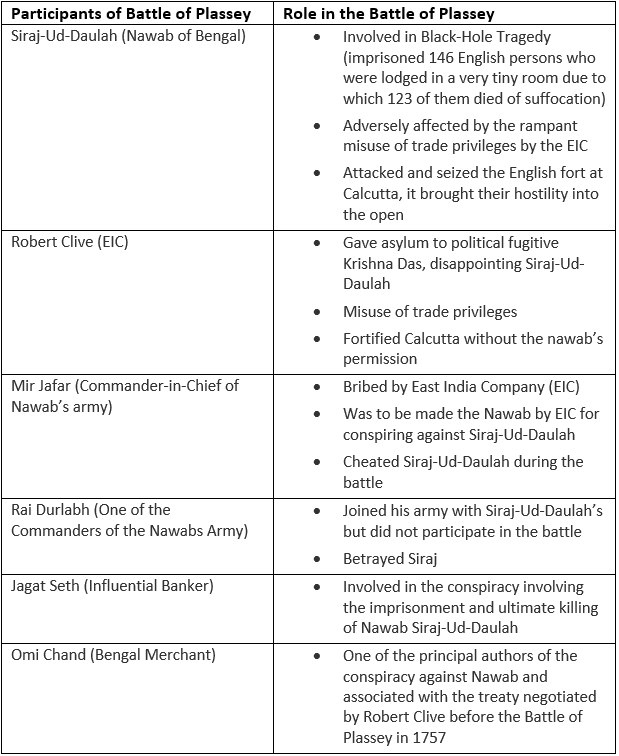
The principal participants and their roles were as follows:

  • East India Company - Commanded by Robert Clive; force included European troops and Indian sepoys.
  • Siraj-ud-Daulah - Nawab of Bengal; nominal commander of the Bengal forces, supported by artillery, infantry and war elephants.
  • Mir Jafar - Commander-in-chief of the Nawab's forces who entered into a secret agreement with the Company and did not give active support during the battle.
  • Other conspirators and intermediaries - Several court nobles, wealthy merchant bankers and intermediaries played roles in negotiating and financing the conspiracy against Siraj-ud-Daulah.
  • French assistance - There were limited French military personnel and advisers in Bengal at the time; their role during the battle was marginal compared with earlier Franco-British rivalry in southern and coastal India.
Who Fought The Battle of Plassey?

Effects and Immediate Aftermath

The outcome of Plassey had far-reaching political and economic consequences for Bengal and for the subcontinent as a whole. These effects are commonly grouped as political, economic and administrative.

Political effects

  • Removal and replacement of the Nawab: Following Siraj-ud-Daulah's defeat, the Company supported and installed Mir Jafar as a nominal Nawab of Bengal.
  • End of immediate French influence in Bengal: The British victory weakened French political and military influence in Bengal, consolidating British predominance among European powers in the region.
  • Consolidation of Company power: The victory transformed the East India Company from a primarily commercial concern into an active territorial power by making it the decisive political arbiter in Bengal.
  • Further conflicts and changes of Nawabs: Dissatisfaction with Mir Jafar and subsequent political developments led the Company to replace him with other puppet Nawabs (the input mentions Mir Qasim as one such later figure installed by the British).
  • Regional military engagements: The struggle between European powers and native states continued; for example, other confrontations such as those between the Dutch and the British occurred in the period that followed (the input records the Battle of Chinsura on 25 November 1759 as one such engagement).
  • Honours for Company officers: Important Company leaders, notably Robert Clive, gained titles and political influence in Britain (historical sources record honours and parliamentary seats for Clive following his Indian successes).

Economic effects

  • Company control over revenues: Although direct revenue rights (Diwani) were not immediately formalised at Plassey, the victory allowed the Company to exercise effective control over Bengal's administration and finances through its nominees.
  • Exploitation of Bengal's resources: The Company and its employees extracted wealth through monopolies, trade privileges, and arrangements with puppet rulers; Bengal's economy and revenue system were progressively subordinated to Company interests.
  • Burden on the populace: Changes in fiscal administration and the extractive practices of Company officials placed heavier burdens on peasants, zamindars and towns, altering agrarian relations and commercial patterns.

Administrative and longer-term effects

  • Transition from trade to territorial power: Plassey marks the beginning of the East India Company's transformation from a commercial enterprise into a territorial and administrative power in India.
  • Puppet regimes and indirect rule: The Company relied on dependent Nawabs and local intermediaries to govern while extracting revenues; this pattern shaped British expansion during the next decades.
  • Prelude to later treaties and battles: Events following Plassey set the context for later military and diplomatic confrontations, including further conflicts with Indian states and other European powers that eventually led to formal revenue rights and expanded territorial control.

Significance

  • Turning point: The Battle of Plassey is widely regarded as the turning point that allowed the East India Company to become the principal power in Bengal and subsequently a major ruler in India.
  • Combination of military skill and political intrigue: The victory underlines that military success on the battlefield combined with court conspiracies, bribery and political manipulation produced outcomes far beyond the immediate tactical victory.
  • Foundation for colonial rule: The political and fiscal control established after Plassey provided the resources and leverage for further expansion of Company authority across India.

Conclusion

The Battle of Plassey (23 June 1757) was not only a military encounter but a critical intersection of commercial ambition, political conspiracy and military force. While the Company's forces under Robert Clive were numerically smaller than Siraj-ud-Daulah's army, the conspiracy of key Bengal elites and the failure of the Nawab's commanders to support him decisively determined the result. The immediate outcome was the installation of a pliant Nawab and de facto Company control over Bengal's resources; the longer-term consequence was the emergence of the Company as the dominant political power in India, setting the stage for colonial rule and profound economic and social changes in the subcontinent.

The document The Battle of Plassey (1757) - History for UPSC CSE is a part of the UPSC Course History for UPSC CSE.
All you need of UPSC at this link: UPSC
132 videos|714 docs|171 tests

FAQs on The Battle of Plassey (1757) - History for UPSC CSE

1. What was the significance of the Battle of Plassey in 1757?
Ans. The Battle of Plassey in 1757 was a pivotal event in Indian history as it marked the beginning of British East India Company's control over Bengal. It resulted in the defeat of the Nawab of Bengal, Siraj ud-Daulah, and established British dominance in India.
2. Who were the key participants in the Battle of Plassey?
Ans. The key participants in the Battle of Plassey were the British East India Company, led by Robert Clive, and the forces of the Nawab of Bengal, Siraj ud-Daulah. The battle also involved other local rulers and their armies who were allied with either side.
3. How did the British East India Company gain victory in the Battle of Plassey?
Ans. The British East India Company gained victory in the Battle of Plassey through a combination of military strategy and political maneuvering. Robert Clive formed alliances with local rulers who were dissatisfied with the Nawab's rule and secured their support. Additionally, the British forces managed to capture and secure important positions, ultimately leading to the defeat of the Nawab's army.
4. What were the consequences of the Battle of Plassey for Bengal?
Ans. The Battle of Plassey had significant consequences for Bengal. It resulted in the British East India Company gaining control over Bengal's wealth and resources. The Nawab's defeat also led to political instability in the region, with the British gradually expanding their influence and ultimately establishing colonial rule over a large part of India.
5. How did the Battle of Plassey contribute to the decline of the Mughal Empire?
Ans. The Battle of Plassey contributed to the decline of the Mughal Empire by weakening its authority and reducing its control over Bengal. The defeat of the Nawab of Bengal, who was a Mughal vassal, undermined the Mughal Empire's influence in the region. This battle marked one of the early instances of British encroachment on Mughal territories, leading to the gradual decline of Mughal power in India.
Related Searches
shortcuts and tricks, Exam, pdf , past year papers, practice quizzes, video lectures, The Battle of Plassey (1757) - History for UPSC CSE, Extra Questions, Previous Year Questions with Solutions, Objective type Questions, The Battle of Plassey (1757) - History for UPSC CSE, Important questions, Viva Questions, Summary, Free, Sample Paper, MCQs, Semester Notes, mock tests for examination, study material, The Battle of Plassey (1757) - History for UPSC CSE, ppt;