UPSC Exam  >  UPSC Notes  >  History CSE  >  First War of Independence against British: The Revolt of 1857

First War of Independence against British: The Revolt of 1857

First War of Independence against British: The Revolt of 1857

Introduction

The Revolt of 1857 was a large-scale, pan-Indian uprising against the rule of the British East India Company. It began as a mutiny by Indian sepoys (soldiers) in the Company's army and expanded into a wider rebellion that involved taluqdars, dispossessed rulers, peasants, artisans and urban notables. The event is variously described as the First War of Indian Independence, the Sepoy Mutiny and the Indian Rebellion of 1857. The immediate outbreak took place on 10 May 1857 at Meerut; the rising continued through 1857-58 before it was suppressed. The revolt led to the end of Company rule and the direct assumption of authority by the British Crown in 1858.

Immediate Cause

The spark that ignited the widespread uprising was the controversy over the new Pattern 1853 Enfield rifle cartridges. The cartridges were rumoured to be greased with animal fats (cow and pig fat). To prepare the cartridge for firing, a soldier had to bite off the end; this practice offended both high-caste Hindu and Muslim sepoys. The issue, combined with other incidents and grievances to produce an open rebellion. The episode of Mangal Pandey at Barrackpore (29 March 1857) is generally regarded as an immediate precursor: his attack on British officers and subsequent execution heightened tensions.

Long-term Causes

Political Causes

  • Doctrine of Lapse and Annexations: The Company's expansionist policies - notably the Doctrine of Lapse (Lord Dalhousie) - and the annexation of Indian states weakened the traditional ruling classes. Annexation of Awadh (1856) on grounds of alleged misgovernment offended many taluqdars and nobles.
  • Subsidiary Alliances and Loss of Sovereignty: Indian rulers were progressively subordinated through subsidiary alliances and political manoeuvring, producing widespread resentment among dispossessed princes, chiefs and aristocrats.

Economic Causes

  • Land-revenue and agrarian distress: Revenue settlements and commercial pressures led to increased peasant suffering, indebtedness and loss of traditional rights. Changes in land relations undermined older social balances.
  • Deindustrialisation and artisan distress: British commercial and industrial policy undermined handloom weaving, handicrafts and traditional cottage industries, causing unemployment and impoverishment of urban artisans.
  • Perceived economic exploitation: The general idea of a "drain of wealth" and exploitation by Company officials contributed to popular anger.

Social and Religious Causes

  • Missionary activity and social reform: Christian missionary activities and the association of the Company with social reforms (for example, earlier bans on certain customs), generated fears of forced conversion and erosion of religious traditions.
  • Racial attitudes and cultural interference: European racial attitudes and perceived contempt for Indian customs, dress and religion offended both elites and common people.

Military Causes

  • Grievances within the Bengal Army: Indian soldiers faced discrimination in pay, promotions, pensions and conditions of service compared with European soldiers.
  • Reorganisation and recruitment changes: Changes in recruitment, the unequal distribution of European troops and the introduction of new rules (for example, the General Service enlistment requirement for new recruits to serve overseas) created discontent and a sense of insecurity among sepoys.

Earlier Uprisings and Immediate Precursors

  • Vellore Mutiny (1806): An earlier military uprising in the Madras Presidency (10 July 1806) that resulted from dress and religious issues. It is often cited as an early warning of soldierly discontent.
  • Santhal Rebellion (1855-56):. tribal uprising against revenue and money-lending abuses in Bihar and Bengal, which signalled rural unrest immediately before 1857.
  • Mangal Pandey and Barrackpore (March 1857): The act by Mangal Pandey and other incidents of 1857 at Barrackpore are commonly treated as immediate forerunners of the Meerut outbreak.

Course of the Revolt: Key Events and Chronology

  1. Meerut and Delhi (10-11 May 1857)

    On 10 May 1857, mutinous sepoys in Meerut attacked their British officers, freed imprisoned comrades and marched to Delhi, where they proclaimed the ageing Mughal emperor Bahadur Shah Zafar II as the symbolic leader of the rebellion. Delhi became a major centre of the revolt.

  2. Spread across North India (May-July 1857)

    The revolt spread rapidly through present-day Uttar Pradesh, Bihar, parts of Madhya Pradesh and north-west India. Key centres included Kanpur (Cawnpore), Lucknow, Bareilly, Jhansi and Bundelkhand.

  3. Kanpur (Cawnpore) and Nana Sahib

    Nana Sahib (the adopted son of the deposed Peshwa) declared himself leader in Kanpur. The siege of Cawnpore, the massacre at the Satichaura Ghat and the subsequent killing of survivors (September 1857) were notorious incidents that intensified British reprisals.

  4. Lucknow and Begum Hazrat Mahal

    Lucknow saw a prolonged siege of the Residency and strong resistance led by figures such as Begum Hazrat Mahal and later relief efforts by British columns under Sir Henry Havelock and Sir Colin Campbell. The city changed hands after severe fighting.

  5. Jhansi and Rani Lakshmibai

    Rani Lakshmibai of Jhansi became a symbol of courageous resistance. Jhansi fell to the British, but the Rani escaped and continued to fight; she was killed in battle in June 1858 at Gwalior.

  6. Tantia Tope and guerrilla warfare

    Tantia Tope conducted an effective guerrilla campaign in central India, including a notable action at the Capture of Cawnpore (recapture attempts) and later campaigns before being captured and executed in 1859.

  7. Suppression and aftermath (late 1857-1859)

    By mid-1858, the rebellion had been largely suppressed by better-organised and well-supplied British forces. Bahadur Shah II was captured, tried and exiled to Rangoon (1858). Many rebel leaders were executed, imprisoned or pursued into remote areas; the last pockets of resistance were mopped up by 1859.

Reasons for Failure

  • Lack of unified leadership: The rebels did not have a single, coherent command structure or unified political programme that could replace British administration.
  • Regional and social fragmentation: The uprising was strongest in parts of northern India; many regions (Bombay, Madras presidencies, much of southern India and the Punjab) remained largely unaffected or loyal.
  • Absence of adequate resources: The rebels lacked sufficient arms, ammunition, centralised logistics and the administrative apparatus required for prolonged warfare and governance.
  • British military superiority and organisation: The East India Company had better artillery, more disciplined European regiments and access to reinforcements from Britain and other presidencies.
  • Failure to attract some key groups: Many communities (notably the Sikhs and sections of the Punjab) sided with the British, partly due to recent conflicts with the Mughal and Maratha powers and in the hope of reward.

Consequences and Impact

Political and Administrative Changes

  • Abolition of the East India Company: The Government of India Act 1858 transferred power from the Company to the British Crown. The office of the Secretary of State for India (assisted by the India Council) was created, and the Viceroy administered India on behalf of the Crown.
  • Royal Proclamation and policy towards princes: The Crown promised non-interference in religious matters and a more respectful policy towards Indian princes - in practice, the British became more cautious in annexation and interference.

Military Reorganisation

  • Army restructuring: The British reduced the proportion of Indian troops in favour of more European regiments, reorganised recruitment to favour groups considered loyal (the so-called "martial races"), and increased the ratio of artillery and cavalry under direct European command.
  • Garrisoning and internal security: The British strengthened lines of communication (railways and telegraph), built more cantonments and ensured quicker troop mobilisation.

Economic and Social Effects

  • Repression and recovery: Harsh reprisals, confiscations and punitive measures affected many communities. At the same time, the Crown sought to stabilise revenue and administration to restore confidence among landlords and traders.
  • Impact on modern political consciousness: The revolt, though unsuccessful militarily, fostered new political awareness among Indians and is often seen as the beginning of a modern national movement.

Significance

  1. The revolt marked the end of the Company's rule and the beginning of the British Raj under the Crown (1858-1947).
  2. It demonstrated the depth of Indian opposition to certain Company policies and forced the British to reassess administrative and military policies in India.
  3. Although regionally limited and lacking unity, the rebellion left a legacy that fed into later movements for reform and independence.

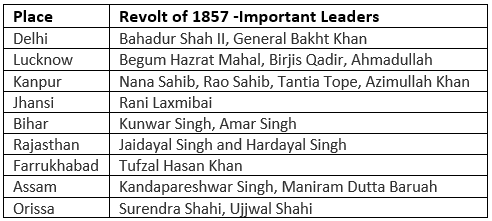
Important Leaders and Key Figures

The following were the principal leaders and notable personalities associated with the revolt. (Briefer descriptors are given for orientation.)

  • Bahadur Shah Zafar II: The Mughal emperor was proclaimed as the symbolic leader in Delhi.
  • Mangal Pandey: Sepoy of the 34th Bengal Native Infantry whose action at Barrackpore (March 1857) is widely recognised as a precursor.
  • Rani Lakshmibai of Jhansi: Leader of Jhansi, famed for her valour and resistance; died in battle (June 1858).
  • Nana Sahib (Dhondu Pant): Leader at Kanpur (Cawnpore) who opposed British reoccupation.
  • Tantia Tope (Ramachandra Pandurang Tope): Key military leader and guerrilla commander in central India.
  • Begum Hazrat Mahal: Led the revolt in Lucknow; a principal figure among women leaders.
  • Kunwar Singh: Zamindar and leader from Bihar who fought successfully against Company forces for a period.
  • Other notable figures: Maulvi Ahmadullah of Faizabad, Nana Sahib's associates, various taluqdars and local chiefs who rose in different provinces.

Important Leaders and Key Figures

The document First War of Independence against British: The Revolt of 1857 is a part of the UPSC Course History for UPSC CSE.
All you need of UPSC at this link: UPSC

FAQs on First War of Independence against British: The Revolt of 1857

1. What was the cause of the Revolt of 1857?
Ans. The Revolt of 1857, also known as the First War of Independence, was primarily caused by the Indian soldiers' discontent with British rule. It was triggered by the introduction of the new Enfield rifle, which required soldiers to bite off the cartridge, rumored to be greased with animal fat. This offended both Hindu and Muslim soldiers, leading to widespread anger and rebellion.
2. Who were the key leaders of the Revolt of 1857?
Ans. The Revolt of 1857 saw the emergence of several key leaders who played crucial roles in the rebellion. Some of the notable leaders included Rani Lakshmibai of Jhansi, Mangal Pandey, Tatya Tope, Bahadur Shah II, Nana Sahib, and Kunwar Singh. These leaders mobilized their forces and fought against the British in different regions of India.
3. What were the major battles fought during the Revolt of 1857?
Ans. The Revolt of 1857 witnessed several significant battles between the Indian rebels and the British forces. Some of the major battles include the Siege of Delhi, Battle of Jhansi, Battle of Lucknow, Battle of Kanpur, and Battle of Gwalior. These battles were crucial in determining the outcome of the revolt and the subsequent British response.
4. Did the Revolt of 1857 achieve independence for India?
Ans. Despite being called the First War of Independence, the Revolt of 1857 did not lead to the immediate independence of India. The rebellion was eventually suppressed by the British, and they further tightened their control over India. However, the revolt played a pivotal role in laying the foundation for future independence movements and strengthening the Indian national consciousness.
5. How did the Revolt of 1857 impact the British rule in India?
Ans. The Revolt of 1857 had a profound impact on the British rule in India. It shattered the myth of British invincibility and exposed their vulnerability. The rebellion led to significant reforms in the administration of India, including the transfer of power from the East India Company to the British Crown. It also marked the beginning of a more direct and repressive British rule in India, as they sought to prevent any further uprisings.
Explore Courses for UPSC exam
Get EduRev Notes directly in your Google search
Related Searches
shortcuts and tricks, Exam, Extra Questions, Viva Questions, ppt, Semester Notes, Free, First War of Independence against British: The Revolt of 1857, mock tests for examination, pdf , Objective type Questions, MCQs, practice quizzes, Sample Paper, Important questions, study material, Summary, past year papers, video lectures, First War of Independence against British: The Revolt of 1857, Previous Year Questions with Solutions, First War of Independence against British: The Revolt of 1857;