Laxmikanth Summary: Amendment of the Constitution

Introduction
The Constitution of India, like others, allows for amendments to adapt to changing conditions. Unlike the flexibility in Britain or the rigidity in the USA, India's Constitution is a synthesis of both. Article 368 outlines the parliamentary powers to amend the Constitution through addition, variation, or repeal. However, amendments cannot touch the 'basic structure,' a concept established by the Supreme Court in the Kesavananda Bharati case (1973). This makes the Indian Constitution neither entirely flexible nor rigid but strikes a balance between the two.
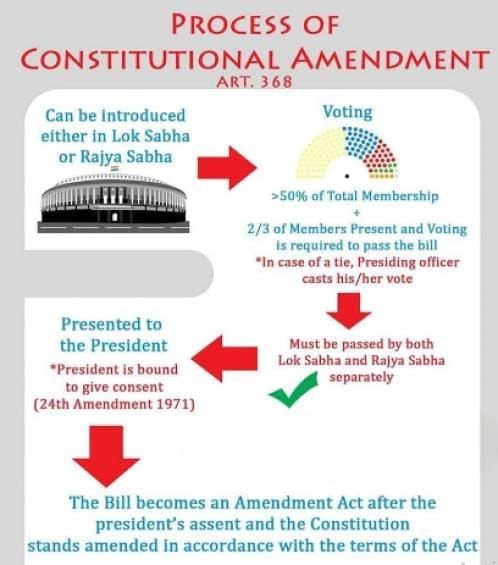
Procedure for Amendment
- Initiation of Amendment:
- The process of amending the Constitution is initiated solely by Parliament.
- The process begins with a bill introduced in either House of Parliament.
- Introduction and Approval:
- The bill can be introduced by either a minister or a private member.
- No prior permission from the President is needed.
- It must be approved by a special majority in each House:
i) A majority of the total members of the House.
ii) A two-thirds majority of members present and voting.
- Separate Approval:
- Each House of Parliament must pass the bill separately.
- No provision for a joint sitting if there's a disagreement.
- Ratification by States (if applicable):
- If amending federal provisions, it needs ratification by half of the states.
- Ratification requires a simple majority in state legislatures.
- Assent by the President:
- After approval by Parliament and states (if needed), the bill goes to the President.
- The President must give assent; no withholding or sending it back.
- Becoming an Act:
- Once the President assents, the bill becomes a constitutional amendment act.
- The Constitution is then amended as per the provisions of the act.
Types of Amendments
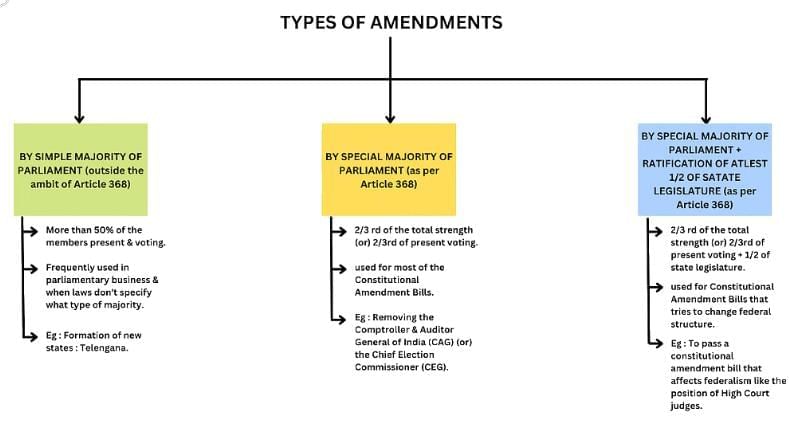
Article 368 of the Indian Constitution outlines three ways to amend its provisions:
- Amendment by Simple Majority of Parliament:
- This applies to certain provisions and involves a simple majority of the members of each House present and voting.
- This process is similar to the ordinary legislative process.
- Not considered amendments for the purposes of Article 368.
- Amendment by Special Majority of Parliament:
- Special majority is needed, which includes both a majority of the total membership of each House and a two-thirds majority of members present and voting.
- Applicable to Fundamental Rights, Directive Principles of State Policy, and provisions not covered by the first and third categories.
- Amendment by Special Majority of Parliament and Ratification by States:
- Pertains to provisions related to the federal structure of the country.
- Involves a special majority in Parliament and the consent of at least half of the state legislatures by a simple majority.
- No time limit for states to provide their consent.
- Relevant for matters such as the election of the President, distribution of legislative powers, and specific councils.
By Simple Majority of Parliament
Several provisions in the Constitution can be amended by a simple majority of both Houses of Parliament, and this process is not governed by Article 368. These provisions include:
- Admission or establishment of new states.
- Formation of new states and alteration of areas, boundaries, or names of existing states.
- Abolition or creation of legislative councils in states.
- Second Schedule - Emoluments, allowances, privileges, etc., of the President, governors, Speakers, judges, etc.
- Quorum in Parliament.
- Salaries and allowances of members of Parliament.
- Rules of procedure in Parliament.
- Privileges of Parliament, its members, and its committees.
- Use of the English language in Parliament.
- Number of puisne judges in the Supreme Court.
- Conferment of more jurisdiction on the Supreme Court.
- Use of the official language.
- Citizenship - acquisition and termination.
- Elections to Parliament and state legislatures.
- Delimitation of constituencies.
- Union territories.
- Fifth Schedule - Administration of scheduled areas and scheduled tribes.
- Sixth Schedule - Administration of tribal areas.
These amendments require a simple majority, meaning more members voting in favor than against, without the need for a special majority or the involvement of state legislatures.
By Special Majority of Parliament
- Special Majority Needed: To amend most parts of the Constitution, a special majority is required in Parliament. This means more than half of all members in both the Lok Sabha and Rajya Sabha need to agree. Also, two-thirds of the members present and voting must support the change.
- Total Membership Matters: When we say 'total membership,' it means all the members in the House, regardless of whether some seats are empty or members are absent.
- Special Majority at Third Reading: Technically, this special majority is mainly needed when the Parliament votes on the proposed changes for the third and final time. However, as a precaution, this requirement is applied to all significant stages of the process, as mentioned in the rules of the Houses.
- Categories of Provisions: The Constitution has different types of rules. The ones that can be changed this way include:
(i) Fundamental Rights: These are important rights granted to citizens.
(ii) Directive Principles of State Policy: These are guidelines for the government to create laws and
(iii) Other Provisions: Anything not covered by the first two categories can also be amended using this special majority.
In simple terms, changing these parts of the Constitution needs a big agreement from the Parliament members, ensuring that the process is thorough and widely supported.
By Special Majority of Parliament and Consent of States
- Federal Structure Amendments: Changes to parts of the Constitution related to the federal structure (how power is divided between the central government and states) need a special majority in Parliament and the approval of half of the state legislatures.
- Consent from States: For these changes, if at least half of the states agree, the process is considered complete. It doesn't matter if some states don't give their opinion. There's no time limit for states to decide.
- Amendable Provisions Include:
- Election of the President: The rules about how the President is elected.
- Executive Power: How much authority the Union (central government) and states have.
- Supreme Court and High Courts: Rules regarding these important courts.
- Legislative Powers: How the power to make laws is divided between the Union and states.
- Goods and Services Tax (GST) Council: The body that decides on GST matters.
- Seventh Schedule Lists: Lists categorizing subjects for legislation.
- Representation of States: How states are represented in Parliament.
- Parliament's Power to Amend the Constitution: Procedures outlined in Article 368 itself.
Criticism of the Amendment Procedure
Critics have criticised the amendment procedure of the Constitution on the following grounds:
- No Special Body for Amendments: Unlike the USA, India doesn't have a special body like a Constitutional Convention. The power to amend the Constitution is mainly with the Parliament, and sometimes with state legislatures.
- Parliament Initiates Amendments: Only Parliament can start the process of amending the Constitution. State legislatures can't propose changes, except in one case related to legislative councils.
- Amendment Power of Parliament: Most of the Constitution can be amended by Parliament alone, either with a special majority or a simple majority. In some cases, the consent of half of the state legislatures is needed, not three-fourths as in the USA.
- No Time Frame for State Consent: The Constitution doesn't set a time limit for state legislatures to approve or reject an amendment. It also doesn't clarify if states can change their approval.
- No Joint Sitting for Amendments: If there's a disagreement in passing a constitutional amendment, there's no provision for a joint sitting of both Houses of Parliament, unlike in the case of ordinary bills.
- Amendment Process Similar to Legislation: Except for the special majority, the process of amending the Constitution is similar to passing regular bills in Parliament.
- Sketchy Amendment Provisions: The details about the amendment procedure are not very clear, leaving room for legal interpretation. This might lead to matters being taken to the judiciary.
- Balancing Flexibility and Rigidity: Despite some drawbacks, the amendment process strikes a balance between flexibility and rigidity. It's not so flexible that it can be changed easily by ruling parties, nor is it so rigid that it can't adapt to changing needs.
- Facile Procedure for Amendments: The Constitution provides a relatively easy process for amending itself, allowing changes to meet evolving needs. This approach is different from some other countries like Canada, the USA, or Australia.
In simpler terms, while India's amendment process may have some complexities, it allows for necessary changes without being too rigid or too flexible. The aim is to balance stability with the ability to adapt to the nation's growth and changing circumstances.
FAQs on Laxmikanth Summary: Amendment of the Constitution
| 1. What are the different types of constitutional amendments under Articles 368 in the Indian Constitution? |  |
| 2. Why can't the basic structure of the Constitution be amended even with parliamentary majority? | |
| 3. How do constitutional amendments requiring state ratification differ from those needing only parliamentary approval? | |
| 4. What happens when an amendment bill is introduced but faces constitutional validity challenges during Laxmikanth revision? | |
| 5. Can amendments to fundamental rights and directive principles be made with the same procedure in Indian polity? | |





