Laxmikanth Summary: Official Language


Part XVII of the Constitution deals with the official language in Articles 343 to 351. Its provisions are grouped under four main heads - Language of the Union, Regional languages, Language of the judiciary and texts of laws, and Special directives. These provisions regulate the choice and use of languages for Union and State purposes, protection of linguistic minorities, and the promotion and development of Hindi.
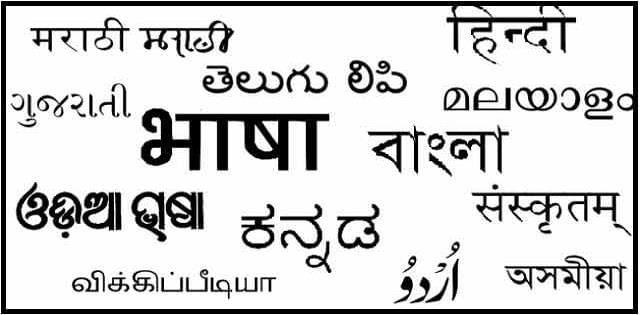
Language of the Union
The Constitution provides a framework for the official language of the Union and the role of English. Key constitutional and statutory features are:
- Official language: Hindi, written in the Devanagari script, is specified as the official language of the Union.
- Numerals: The form of numerals to be used for official purposes is the international form of Indian numerals (not Devanagari numerals).
- Transitional use of English: English was to continue for all official purposes of the Union for a period of fifteen years from 26 January 1950 (that is, until 1965).
- Post-1965 arrangement: After the initial fifteen-year period, Parliament is empowered to decide the further use of English for specific official purposes.
- Presidential commission on language: The Constitution provides for a commission to be appointed by the President to make recommendations on the progressive use of Hindi, restrictions on the use of English, and related matters.
- Parliamentary committee: A parliamentary committee examines the recommendations of the commission and reports its views to the President, enabling Parliament and the Executive to take decisions.
Historical Measures and Statutes
- Official Language Commission (1955-56): The President appointed an Official Language Commission under B. G. Kher in 1955; the commission submitted its report in 1956.
- Parliamentary examination (1957): A Parliamentary committee chaired by Gobind Ballabh Pant examined the commission's report in 1957.
- Official Languages Act, 1963: This Act provided for the continued use of English along with Hindi for official purposes of the Union. It set out practical arrangements for language use between the Centre and the States and governed use of English where Hindi was not adopted.
- Amendment (1967): The Official Languages Act was amended in 1967 to make the use of English, in addition to Hindi, compulsory in certain specified cases and to remove a time-limit for the use of English in those contexts.
Regional Languages (Languages of the States)
The Constitution gives each State legislature freedom to choose its official language(s). The main points are:
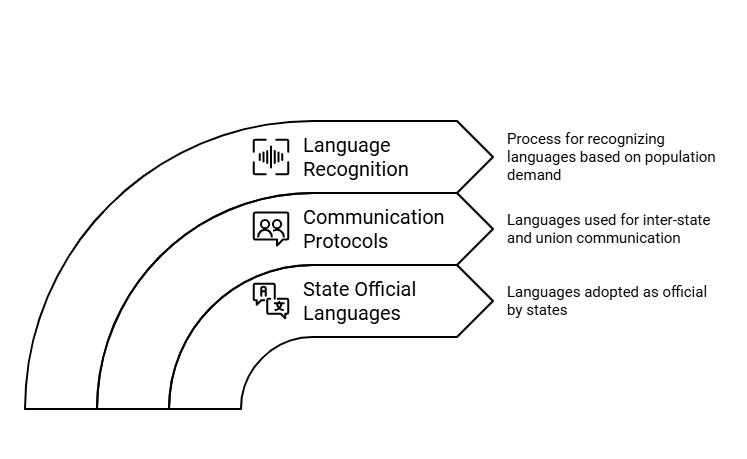
- State choice: The legislature of a State may adopt any one or more of the languages in use in the State or Hindi as the official language of that State.
- Interim use of English: Until a State adopts its official language(s), English continues to be the official language of that State for official purposes.
- Not limited to Eighth Schedule: States are not restricted to the languages listed in the Eighth Schedule when choosing their official language(s); most States have adopted their principal regional language.
- Communication between Union and States: English remains the link language for official communication between the Union and States and between States, unless a different arrangement is agreed upon.
- Use of Hindi between States: Two or more States may agree to use Hindi for inter-state communication instead of English.
- Official Languages Act, 1963 (inter-state communication): The Act specifies that English is to be used for communication between the Union and non-Hindi States; if Hindi is used by a Hindi State in communication with a non-Hindi State, it should be accompanied by an English translation.
- Recognition on demand: If a significant portion of a State's population demands official recognition of a language, the President may direct that such a language be officially recognised in that State to protect linguistic interests of minorities.
Language of the Judiciary and Texts of Laws
The Constitution and subsequent statutes regulate the language used in courts and the authoritative texts of legislation. Important provisions and practice include:
- Proceedings in superior courts: English is to be used in all proceedings in the Supreme Court and in every High Court, unless Parliament provides otherwise.
- Authoritative texts of legislation: The authoritative texts of all bills, acts, ordinances, orders, rules, regulations, and bylaws of the Centre and the States are published in English; where other languages are used, translations are required for authoritative or official purposes as provided by law.
- Use of Hindi or state languages in High Courts: The Governor of a State, with the consent of the President, can authorise the use of Hindi or any other official language of the State for proceedings in that State's High Court. However, judgements, decrees, and orders ordinarily continue to be in English, unless Parliament provides otherwise.
- State legislation in other languages: A State legislature may prescribe the use of any language (other than English) for bills, acts, ordinances, orders, rules, regulations, or bylaws; a translation in English must be published to make their meaning accessible at the Union level.
- Governor's authority for High Court judgments: With the President's consent, the Governor may permit judgements, decrees, and orders of the High Court to be in Hindi or another State language, provided an English translation is also available.
- Supreme Court practice: The Supreme Court has continued to function using English as the language of proceedings and records; no general provision has been made by the Court for the use of Hindi in its proceedings.
- Authorised Translations (Central Laws) Act, 1973: This Act declares that a translation of a Central Act, ordinance, order, rule, regulation, or bylaw published in the Official Gazette under the authority of the President in a regional language specified in the Eighth Schedule (other than Hindi) is to be treated as the authoritative text in that language. Under the Act, every bill introduced in Parliament must be accompanied by a Hindi translation, and in specified cases a Hindi translation of State acts or ordinances is also required.
Special Directives: Protection and Promotion
The Constitution contains special directives designed to protect linguistic minorities and to promote Hindi. These directives are primarily implemented through safeguards and administrative arrangements.
Protection of linguistic minorities
- Right to submit representations: Any aggrieved person has the right to submit a representation to an officer or authority of the Union or a State in any of the languages used in the Union or the State; the representation cannot be rejected merely because it is not in the official language.
- Instruction in mother-tongue: Every State and local authority is required to provide adequate facilities for instruction in the mother-tongue at the primary stage of education for children belonging to linguistic minority groups. The President may issue directions to ensure these facilities are provided.
- Special Officer for Linguistic Minorities: The President is to appoint a special officer for linguistic minorities whose duty is to investigate matters relating to constitutional safeguards for linguistic minorities, report findings to the President, and furnish copies of such reports to Parliament and the appropriate State governments for action.
Development of the Hindi Language
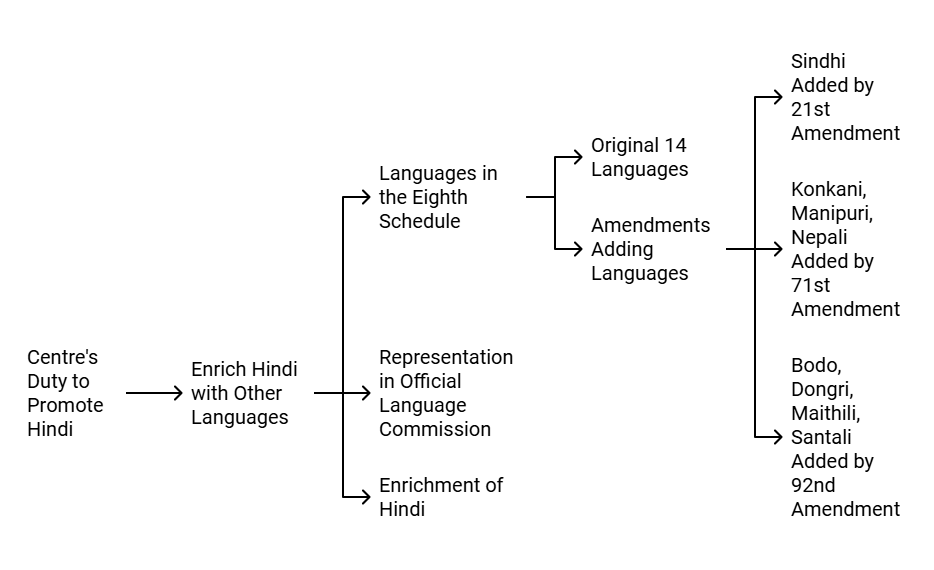
The Constitution imposes a duty on the Centre to promote and develop Hindi, and it sets out objectives for enriching Hindi through contact with other Indian languages.
- Duty to promote Hindi: The Centre is mandated to promote the spread and development of Hindi so that it becomes a linguistic link in the composite culture of India.
- Enrichment of Hindi: The Centre is directed to enrich Hindi by assimilating forms, styles, and expressions from Hindustani and other languages specified in the Eighth Schedule. The vocabulary of Hindi should be drawn primarily from Sanskrit and secondarily from other languages.
- Languages in the Eighth Schedule: The Eighth Schedule currently specifies 22 languages. These are: Assamese, Bengali, Bodo, Dogri, Gujarati, Hindi, Kannada, Kashmiri, Konkani, Maithili, Malayalam, Manipuri, Marathi, Nepali, Odia, Punjabi, Sanskrit, Santali, Sindhi, Tamil, Telugu, Urdu.
- Amendments to the Eighth Schedule:The Constitution has been amended to include additional languages in the Eighth Schedule as follows:
- Sindhi was added by the 21st Amendment Act, 1967.
- Konkani, Manipuri, and Nepali were added by the 71st Amendment Act, 1992.
- Bodo, Dogri, Maithili, and Santali were added by the 92nd Amendment Act, 2003.
- Objectives behind specifying languages: Representation of these languages in bodies such as the Official Language Commission and the use of their forms, styles, and expressions for the enrichment of Hindi are among the objectives of specifying languages in the Eighth Schedule.
Committee of Parliament on Official Language
The Official Languages Act, 1963 envisaged institutional mechanisms to monitor the implementation of official language policy. Parliament set up a committee to review progress and recommend measures.
- Purpose of the Committee: To review the use of Hindi for official work in the Union Government and to evaluate implementation of official language policy.
- Constitution and timing: The Committee was constituted in practice following the provisions of the official language policy; it was set up ten years after certain implementation measures and began functioning from 26 January 1976.
- Composition: The Committee consists of 30 members of Parliament: 20 from the Lok Sabha and 10 from the Rajya Sabha.
- Functions: The Committee reviews progress in the use of Hindi for official purposes by Central Government departments, examines instructions, circulars and other official documents, and submits a report to the President with recommendations.
- Follow-up: The President places the Committee's report before Parliament and circulates it to the State Governments for their views; the President may issue directions based on the Committee's report and the views received.
- Chairmanship and Secretariat: The Chairman of the Committee is elected by its members; the Union Home Minister has traditionally served as Chairman. The Committee's Secretariat is headed by a Secretary and is housed in the Department of Official Language, Ministry of Home Affairs.
- Scope of review: The Committee also examines the use of Hindi in educational institutions and in recruitment and departmental examinations for Central Government services, and recommends measures to strengthen implementation and training.
Classical Language Status
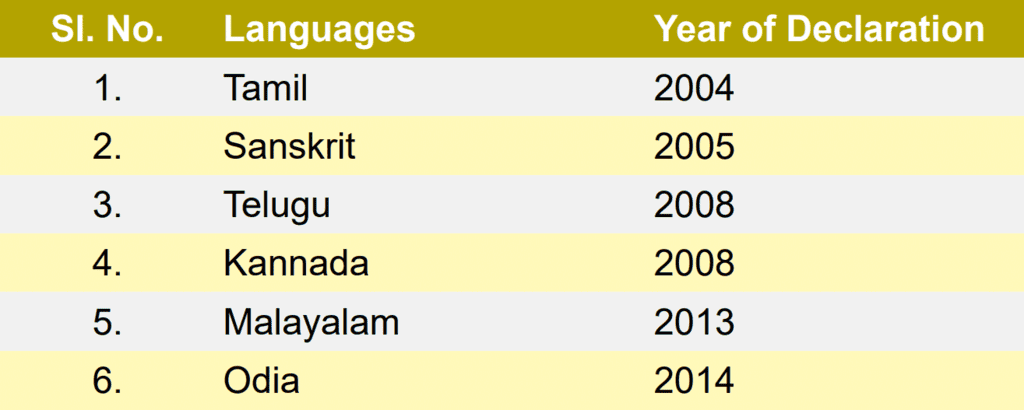
To recognise languages with a rich and ancient heritage, the Government of India introduced the category of Classical Languages in 2004. The designation is given after a careful assessment against prescribed criteria.
Benefits of Classical Language Status
- Annual international awards are conferred on scholars for outstanding work in Classical Indian Languages.
- A Centre of Excellence is established for advanced study and research in Classical Languages.
- The University Grants Commission (UGC) supports the creation of Professorial Chairs in Central Universities to promote scholarship in Classical Languages.
Criteria for Classification as a Classical Language
- The language must possess a recorded history or early texts spanning approximately 1500-2000 years.
- There must exist a body of ancient literature that is recognised as a valuable heritage by successive generations of speakers.
- The language's literary tradition should be original and not borrowed from another linguistic community.
- There should be a demonstrable distinction between the classical language and its modern forms, showing a historical discontinuity between classical and later forms or offshoots.
These constitutional provisions, statutes and administrative mechanisms together aim to balance the promotion of Hindi, the practical use of English where necessary, the protection of linguistic minorities, and the recognition and encouragement of India's diverse languages for educational, judicial and official purposes.
FAQs on Laxmikanth Summary: Official Language
| 1. भारत की आधिकारिक भाषाएँ कौन-कौन सी हैं ? |  |
| 2. संविधान के अनुसार, आधिकारिक भाषा का उपयोग कहाँ किया जाता है ? | |
| 3. क्या राज्य अपनी आधिकारिक भाषाएँ निर्धारित कर सकते हैं ? | |
| 4. संविधान की आठवीं अनुसूची में कितनी भाषाएँ शामिल हैं ? | |
| 5. क्या केंद्र शासित प्रदेशों में भी आधिकारिक भाषाएँ होती हैं ? | |





