Ramesh Singh Summary: Sustainability and Climate Change: India and The World- 1 | Indian Economy for UPSC CSE PDF Download
| Table of contents |

|
| Introduction |
|
| Sustainable Development Goals |
|
| India and The SDGs |
|
| COP 27 |
|
| Recent Developments |
|

Introduction
The primary goal of nations and world bodies has long been improving living standards for humanity. However, over the past two decades, defining development has proven challenging. One major challenge now stands out—the impact of "climate change."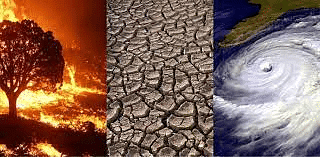
Regardless of the development efforts undertaken, there are repercussions on nature, and achieving a global consensus on how to address and reverse climate change is a significant dilemma.
A global survey indicates that people worldwide, including those in India, are increasingly concerned about sustainable development and climate change. Despite this concern, the challenges are formidable, particularly in terms of securing the necessary resources given economic conditions. Climate science has gained importance, grappling with uncertainties as extreme events become more frequent.
Since 2010, the world has faced a growing number of natural disasters and extreme weather conditions, often making headlines. Policymakers are under pressure to address issues like clean air, water, energy, poverty, and hunger, especially in developing nations.
In 2005, two significant international events occurred—the historic climate change agreement under the UNECCC in Paris and the adoption of the Sustainable Development Goals (SDGs). The Paris Agreement aims to limit the rise in global temperatures, promoting a low-carbon, resilient, and sustainable future. The SDGs, replacing the Millennium Development Goals (MDGs), outline the development agenda for the next fifteen years. In simpler terms, these agreements set the course for a more environmentally friendly and equitable world.
Sustainable Development Goals
In September 2015, during its 17th session, the UN General Assembly introduced a set of 17 Sustainable Development Goals (SDGs) and 169 targets that will guide global action for the next 15 years. These goals replaced the expiring Millennium Development Goals (MDGs) and aimed to address areas where progress was incomplete.
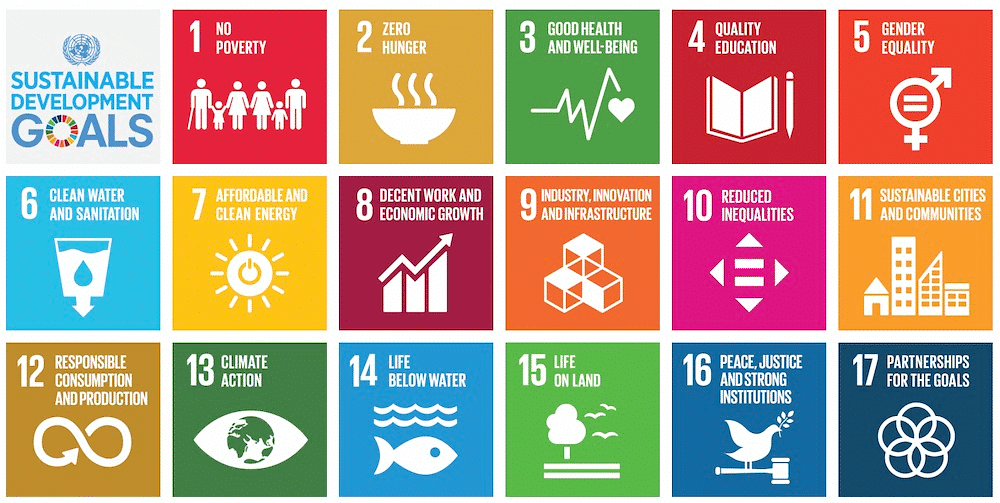 17 Sustainable Development Goals
The SDGs were developed through extensive consultations, starting with proposals in the United Nations Conference on Sustainable Development (Rio+20) in June 2012. They are set to be effective from 2016 to 2030.
The 17 SDGs are:
- No Poverty
- Zero Hunger
- Good Health and Well-being
- Quality Education
- Gender Equality
- Clean Water and Sanitation
- Affordable and Clean Energy
- Decent Work and Economic Growth
- Industry, Innovation, and Infrastructure
- Reduced Inequality
- Sustainable Cities and Communities
- Responsible Consumption and Production
- Climate Action
- Life Below Water
- Life on Land
- Peace, Justice, and Strong Institutions
- Partnerships to Achieve the Goals
Unlike the MDGs, the SDGs are comprehensive, with a total of 169 targets. Achieving these targets is a challenging task for countries, requiring effective monitoring mechanisms, financial resources, stakeholder participation, and administrative structures.
India and The SDGs
India has actively incorporated the Sustainable Development Goals (SDGs) into its national and sub-national policies and programs through various initiatives:
SDG India Index: This is a tool created by NITI Aayog to measure the progress of states and union territories in achieving the SDGs. It uses 100 indicators across different goals, assigning scores between 0 and 100. India's performance improved from an overall score of 60 in 2019-20 to 66 in 2020-21, according to the Economic Survey 2021-22.
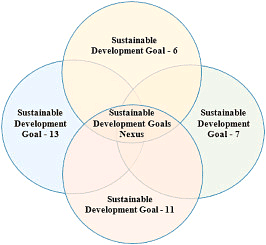 SDGs Nexus
SDGs Nexus: Recognizing the interconnections between SDGs and various social indicators (like education, electricity, health, and energy), India has adopted a 'nexus approach.' This involves aligning its sectoral schemes and initiatives with the goals to ensure a comprehensive approach.

Voluntary National Review (VNR): India presented its second VNR to the United Nations High-Level Political Forum on Sustainable Development in July 2020. This review highlighted India's achievements and showcased its model for localizing SDGs, incorporating stakeholder perspectives, business integration, and means of implementation.
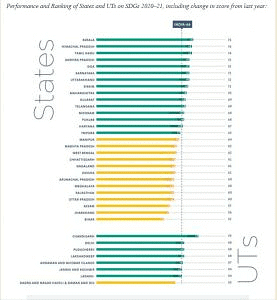 SDG India Index2020-21
Localization: Recognizing the importance of implementing SDGs at the local level, India uses tools like the SDG India Index and DASH (Data for Action and Strategic Heights), developed by NITI Aayog. These tools help connect local entities, measure their performance, and monitor progress toward SDGs.
COVID-19 Response: In response to the pandemic, the Indian government took measures to safeguard livelihoods and sustainability. Initiatives included providing free food, agricultural and MSME reforms, directly or indirectly linked to SDG goals.
- Financial Implementation: Efforts are being made to carry out financial activities linked to certain tasks or responsibilities, like programs or projects.
- Other Activities: There are additional actions or processes involving considerations such as efficiency and a summary of some kind.
- Diversification in Actions: Mention of diversifying activities related to something called VIRINITY B, which could be a term or project. It involves various actions and potential significance.
- Sustainability: There's a mention of sustaining a particular aspect, possibly related to finance or some form of operation, for five years.
- Compliance Mechanism Establishment: This mechanism operates in a cooperative and non-punitive way, suggesting a collaborative approach.
COP 27
The COP 27, a conference under the United Nations Framework Convention on Climate Change (UNFCCC), occurred from November 6 to 20, 2022, in Sharm el-Sheikh, Egypt. Alongside COP 27, significant meetings like CAMI'17, CMAS, SBSTA, and SB1 were held to discuss various aspects of climate change.
The outcomes of COP 27, titled the Sharm el-Sheikh Implementation Plan, are briefly summarized below.
Lifestyle and Consumption Shift: People need to change their lifestyles and consumption habits to live sustainably. The focus is on moving away from thoughtless and wasteful consumption to using natural resources more consciously.
Global Movement Invitation: India has invited all countries to join a movement called "Lifestyle for Environment," which aims to encourage pro-people and pro-planet efforts to address climate change.
Just Transition and Mitigation Program: There's a plan to establish a program that focuses on a fair transition and mitigation efforts related to climate change.
Agriculture and Food Security Action: Over the next four years, there will be joint efforts to implement climate actions specifically related to agriculture and ensuring food security.
New Fund for Vulnerable Countries: A fund will be set up to assist developing countries that are vulnerable to the damaging effects of climate change. A committee will be established to work out the details.
Challenge in Achieving Funding Target: The target of creating a fund of $100 billion per year has not been met yet. Before 2025, a new goal for climate finance called the New Collective Quantified Goal (NCQG), will be established, with a minimum of $100 billion per year.
COP 27 emphasized the need to pay attention to scientific guidance when taking action against climate change.
- There's a plan to double funds to help communities better handle the challenges posed by climate change.
- Countries had discussions about making sure that money flows in ways that support eco-friendly practices, especially in development projects funded by Multilateral Development Banks (MDB).
- There were discussions about making sure that the way money is used supports practices that don't produce a lot of greenhouse gas emissions.
- COP 27 stressed the importance of getting money from various sources, including new and additional funds, to support projects addressing climate issues.
Green Finance

In recent years, the term 'green finance' has become popular worldwide. It was first introduced at the UN Conference on Sustainable Development in 2012.
Green finance generally refers to investing money in projects and efforts that support a more environmentally friendly economy.
There's no one-size-fits-all definition for green finance, but it typically involves investing in projects that promote sustainable development. Different organizations, like China's People's Bank, Climate Bonds, the International Development Finance Club, and the World Bank, have their ways of describing it.
India and Green Development

In India, the concept of green finance is still growing. Achieving goals like the solar energy target, building solar cities, setting up wind power projects, developing smart cities, and supporting green activities like sanitation under the Clean India initiative all require green finance. India started the National Clean Energy Fund (NCEF) in 2010-11, using money from a tax on coal to support clean energy projects and research in the field.
Projects Financed by the National Clean Energy Fund
- Green Energy Corridor: The fund supports the creation of a 'green energy corridor' to enhance the transmission sector, making it more environmentally friendly.
- Solar Initiatives: Projects include installing solar photovoltaic (SPV) lights and small capacity lights under the Jawaharlal Nehru National Solar Mission (JNNSM). It also involves setting up SPV water pumping systems, SPV power plants, and rooftop SPV power plants.
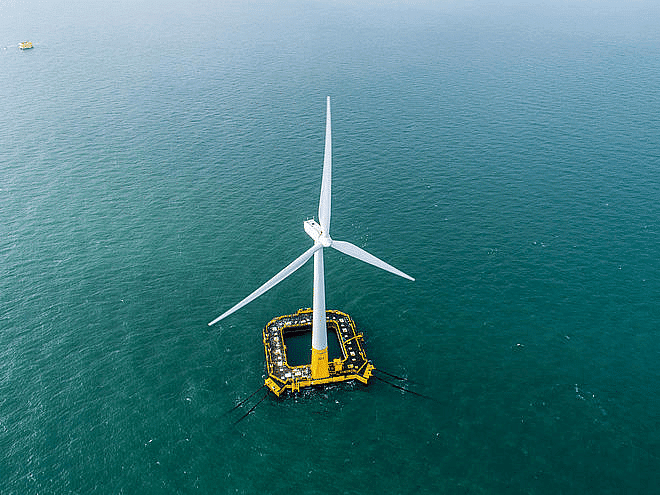 Wind Power Pilot Project
 - Wind Power Pilot Project: A pilot project has been initiated to assess the potential of wind power as a renewable energy source.
Green Bonds in India

By April 2023, many banks in India had issued green bonds. The money raised from these bonds is mainly used to fund renewable energy projects such as solar, wind, and biomass. Additionally, funds are directed toward other sectors like infrastructure, with a focus on sustainability and energy efficiency. These projects are considered 'green' as a whole.
Guidelines for Green Bonds: In 2016, the Securities and Exchange Board of India (SEBI) approved guidelines for green bonds, ensuring that certain environmental standards are met in projects funded by these bonds.
Guidelines for Green Investments in India
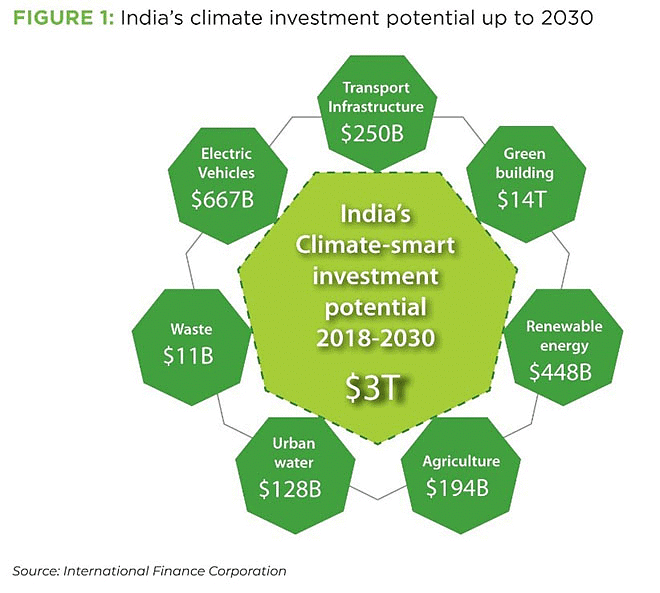 Green Financing Investments
Balancing Priorities: India must focus on reducing poverty and promoting development while also investing in cleaner energy. Efforts should improve coal technology to make it more environmentally friendly.
Managing Risks: Green bonds are new and come with higher risks. It's important to find ways to lower these risks, making them more appealing to investors.
Global Agreement on Green Financing: There's a need for a worldwide agreement on what counts as green financing to avoid confusion and ensure accurate reporting.
Realistic Risk Assessment: While assessing environmental risks is crucial, it's equally important not to overestimate these risks when providing green finance. Finding the right balance is essential.
Considering Consumption Patterns: Green finance should discourage excessive consumption and unsustainable lifestyles, particularly in developed countries.
Climate Finance
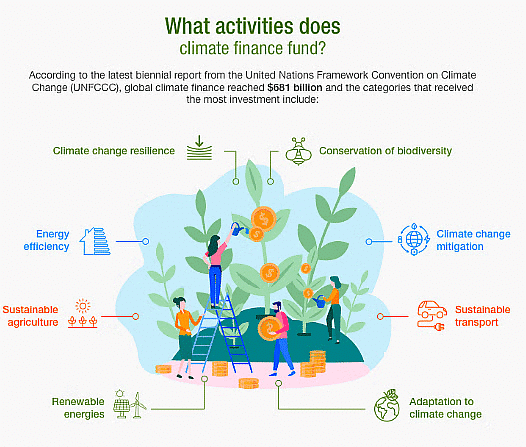
Climate Finance
Importance of Tracking Climate Finance: It's crucial to keep track of climate finance to ensure that funds are used effectively. However, the lack of a clear definition for climate finance has led to disagreements in recent estimates.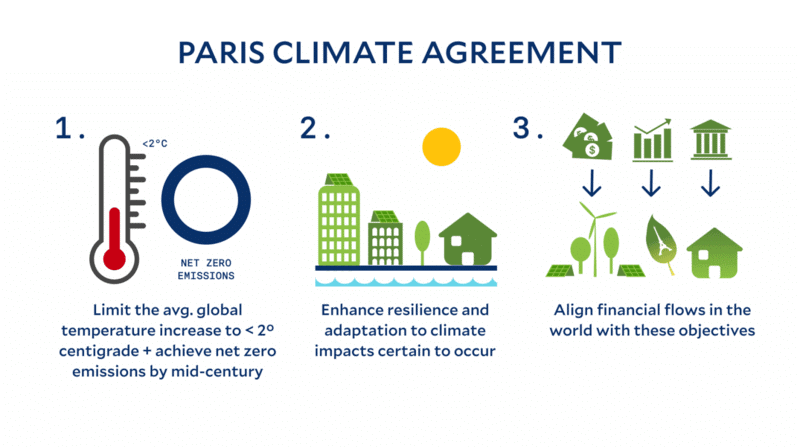 Paris Agreement Requirements: The Paris Agreement requires developed countries to transparently share information about the support they provide for developing countries. This includes financial support and efforts to mobilize resources through public interventions.
When determining what qualifies as climate finance, certain basic elements need consideration:
Sources, Terms, and Purpose: It's important to know where the money comes from, the conditions for using it, and the intended purpose. This includes funds committed, disbursed, or newly allocated.
Setting Boundaries: Defining climate finance should also specify what cannot be considered as part of it.
Excluding Development Aid: Money intended for general development should not be counted as climate finance.
Identifying Climate Change Share: When funds serve multiple purposes, only the portion directly addressing climate change should be considered under climate finance.
Avoiding Double Counting: Systems should be in place to prevent counting the same funds twice or incorrectly labeling Official Development Assistance (ODA) as climate finance.
Green Climate Fund
The Green Climate Fund (GCF) is a global fund created to help developing countries tackle the challenges of climate change. It supports these nations in reducing greenhouse gas emissions and adapting to the impacts of climate change. The goal is to encourage a shift towards development that is both low in emissions and resilient to climate changes, especially focusing on countries highly vulnerable to these impacts.
- Creation and Goals: Established in 2010 by 194 countries under the UNFCCC, the GCF aims to provide equal amounts of funding for both reducing emissions (mitigation) and adapting to climate change. It plays a significant role in supporting the objectives of the Paris Climate Agreement, which aims to keep global warming well below 2 degrees Celsius.
- Funding and Contributions: Launched in 2014 with an initial pledge of $10.3 billion from public and private sectors, the GCF received contributions from various countries, with the United States, Japan, the United Kingdom, France, and Germany making the highest pledges. In 2019, the GCF Board approved $5.2 billion for 111 climate projects in 99 developing countries.
- Replenishment and Recent Discussions: For its first replenishment process (2020-2023), 28 countries pledged resources totaling $9.7 billion. In recent climate discussions, there was intense debate on limiting temperature rise, but resolving climate finance issues, a crucial aspect for achieving these goals, faced challenges.
Understanding the Global Environment Facility
The Global Environment Facility (GEF) was created just before the 1992 Rio Earth Summit to help primarily developing countries tackle the world's most urgent environmental challenges. It operates with contributions from both developed and developing nations (39 donors in total), and its funds are replenished every four years. The latest replenishment, known as GEF-7, secured a fund of $7.1 billion for the period 2019 to 2023.
Today, the GEF is an international partnership involving 183 countries, international institutions, civil society organizations, and the private sector.
By March 2019, it had provided over $17.9 billion in grants and mobilized an additional $93.2 billion in co-financing for more than 4,500 projects in 170 countries.
Recent Developments
Since 2023, India and the global community have advanced efforts to address climate change and achieve the Sustainable Development Goals (SDGs). These developments, critical for UPSC aspirants, reflect India’s enhanced climate ambition and new financial mechanisms.
SDG India Index Update
The SDG India Index 2023-24, published by NITI Aayog, reports India’s overall score at 71, up from 66 in 2020-21. Significant progress has been made in SDG 1 (No Poverty), SDG 3 (Good Health), and SDG 7 (Affordable and Clean Energy), driven by schemes like PM Garib Kalyan Anna Yojana and PM Suryaghar Yojana.
COP 28 and COP 29 Outcomes
- COP 28 (Dubai, 2023): The Global Stocktake urged countries to triple renewable energy capacity by 2030. The Loss and Damage Fund
- COP 29 (Baku, 2024): Finalized the New Collective Quantified Goal (NCQG), setting a $1 trillion annual climate finance target for developing countries. Advanced carbon market frameworks under Article 6 of the Paris Agreement.
India’s Enhanced Climate Commitments
India reaffirmed its Panchamrit goals at COP28, targeting 500 GW non-fossil energy, 50% renewable capacity by 2030, and net-zero emissions by 2070. The Lifestyle for Environment (LiFE) initiative, launched at COP27, has been integrated into school curricula and urban planning, with 20 countries adopting it by 2025.
New Schemes for Sustainability
- PM Suryaghar Yojana (2024): Aims to provide free electricity via rooftop solar to 100 million households by 2027, with subsidies and net-metering benefits.
- National Green Hydrogen Mission (2021, expanded 2024): Targets 5 million tonnes of green hydrogen production by 2030, with ₹20,000 crore allocated in 2024.
- Mangrove Initiative for Shoreline Habitats & Tangible Incomes (MISHTI, 2023): Promotes mangrove restoration to enhance coastal resilience and livelihoods.
Green Finance Advancements
India launched the Sovereign Green Bonds Framework in 2022, raising ₹24,000 crore by 2024 for green infrastructure projects. The Green Credit Programme (2023) incentivizes eco-friendly projects through tradable credits, promoting private sector participation.
Green Climate Fund and Global Environment Facility Updates
- Green Climate Fund (GCF): The second replenishment (2024-2027) secured $12.8 billion, with India receiving $1.2 billion for 15 projects, including coastal adaptation and renewable energy.
- Global Environment Facility (GEF): GEF-8 (2023-2027) pledged $5.3 billion, with India allocated $500 million for biodiversity conservation and renewable energy projects.
Climate-Resilient Agriculture
The Union Budget 2024 allocated ₹2,000 crore for climate-resilient seeds, expanding the National Mission for Sustainable Agriculture. Initiatives like zero-budget natural farming and drought-resistant crops enhance food security under SDG 2 (Zero Hunger).
|
108 videos|425 docs|128 tests
|
FAQs on Ramesh Singh Summary: Sustainability and Climate Change: India and The World- 1 - Indian Economy for UPSC CSE
| 1. What are the Sustainable Development Goals (SDGs) and how do they relate to India? |  |
| 2. How is India contributing to the fight against climate change through initiatives like COP 27? | |
| 3. What is Green Finance and how does it play a role in addressing climate change? | |
| 4. How does India's Green Climate Fund (GCF) contribute to global efforts to combat climate change? | |
| 5. What are India's Intended Nationally Determined Contributions (INDCs) and how do they align with global climate change goals? | |




video lectures
,Extra Questions
,study material
,Ramesh Singh Summary: Sustainability and Climate Change: India and The World- 1 | Indian Economy for UPSC CSE
,shortcuts and tricks
,Previous Year Questions with Solutions
,MCQs
,Objective type Questions
,Exam
,Ramesh Singh Summary: Sustainability and Climate Change: India and The World- 1 | Indian Economy for UPSC CSE
,mock tests for examination
,practice quizzes
,past year papers
,Ramesh Singh Summary: Sustainability and Climate Change: India and The World- 1 | Indian Economy for UPSC CSE
,ppt
,Important questions
,Viva Questions
,Free
,Summary
,Sample Paper
,Semester Notes
;



Ramesh Singh Summary: Sustainability and Climate Change: India and The World- 1 Free PDF Download
Importance of Ramesh Singh Summary: Sustainability and Climate Change: India and The World- 1
Ramesh Singh Summary: Sustainability and Climate Change: India and The World- 1 Notes
Ramesh Singh Summary: Sustainability and Climate Change: India and The World- 1 UPSC Questions
Study Ramesh Singh Summary: Sustainability and Climate Change: India and The World- 1 on the App
|
© EduRev
|
Education Revolution
|


|




