Mechanical Engineering Exam  >  Mechanical Engineering Notes  >  Industrial Engineering  >  GATE Past Year Questions: Network Models

GATE Past Year Questions: Network Models

MULTIPLE CHOICE QUESTION

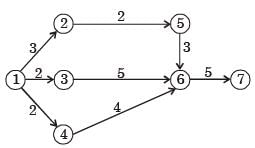
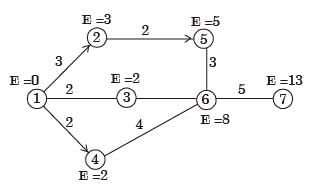
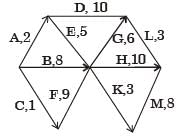
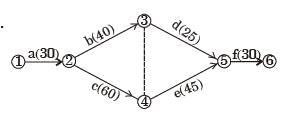
Try yourself: Consider the given project network, where numbers along various activities represent normal time. The free float on activity 4-6 and the project duration, respectively, are

GATE Past Year Questions: Network Models

[2014]

A

2 and 13

B

0 and 12

C

–2 and 13

D

2 and 12

MULTIPLE CHOICE QUESTION

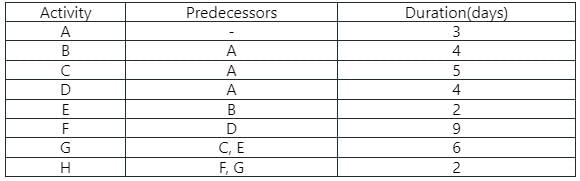
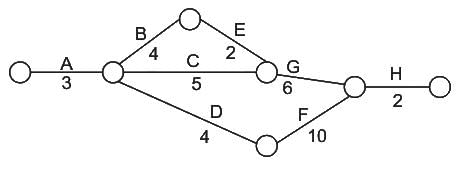
Try yourself: For a particular project, eight activities are to be carried out. Their relationships with other activities and expected durations are mentioned in the table below.

GATE Past Year Questions: Network Models

If duration of activity f is changed to 10 days, then the critical path for the project is

[2012]
A

Critical path remains the same and the total duration to complete the project changes to 19 days.

B

Critical path and the total duration to complete the project remains the same.

C

Critical path changes but the total duration to complete the project remains the same.

D

Critical path changes and the total duration to complete the project changes to 17 days.

MULTIPLE CHOICE QUESTION

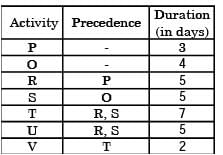
Try yourself: The  project activities, precedence relationships and durations are described in the table. The critical path of the project is

GATE Past Year Questions: Network Models

[2010]

A

P–R–T–V

B

Q–S–T–V

C

P–R–U–W

D

Q–S–U–W

MULTIPLE CHOICE QUESTION

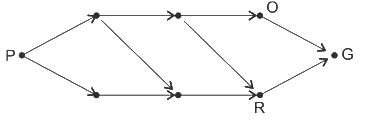
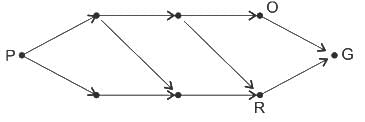
Try yourself:  For the network below, the objective is to find the length of the shortest path from node P to node G. Let dij be the length of directed arc from node i to node j.Let sj, be the length of the shortest path from P to node j. Which of the following equations can be used to find SG?

GATE Past Year Questions: Network Models

[2008]

A

SG = Min {SQ, SR]

B

SG = Mn {SQ–dQG, SR–dRG}

C

SG = Min [SQ + dQG, SR + dRG]

D

SG = Mn [SQG – dRG]

MULTIPLE CHOICE QUESTION

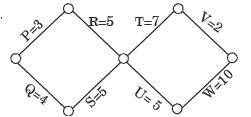
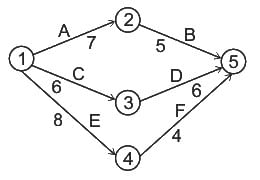
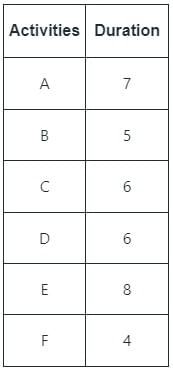
Try yourself: A project has six activities (A t o F ) w it h respective activity durations 7,5,6,6,8,4 days.The network has three path A-B, C-D and EF. All the activities can be crashed with the same crash cost per day.The number of activities that need to be crashed to reduce the project duration by 1 day is

[2005]
A

1

B

2

C

3

D

6

MULTIPLE CHOICE QUESTION

Try yourself: An assembly activity is represented on an Operation Process Chart by the symbol

[2005]

A

X

B

A

C

D

D

O

MULTIPLE CHOICE QUESTION

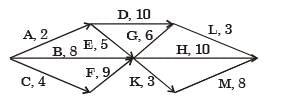
Try yourself:  A project consists of activities A to M shown in the net in the following figure with the duration of the activities marked in daysThe project can be completed
GATE Past Year Questions: Network Models

[2003]

A

between 18,19 days

B

between 20, 22 days

C

between 24, 26 days

D

between 60,70 days

MULTIPLE CHOICE QUESTION

Try yourself: The symbol used for Transport in work study is

[2003]

A

B

T

C

GATE Past Year Questions: Network Models

D

GATE Past Year Questions: Network Models

MULTIPLE CHOICE QUESTION

Try yourself: In the construction of networks , dummy activities are introduced in order to

[1990]

A

Compute the slack on all events

B

Transfer resources, if necessary, during monitoring

C

Clearly designate a precedence relationship

D

Simplify the crashing plan

MULTIPLE CHOICE QUESTION

Try yourself: In PERT chart, the activity time distribution is

[2016]

A

Normal

B

Binomial

C

Poisson

D

Beta

MULTIPLE CHOICE QUESTION

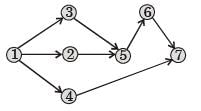
Try yourself: Consider the following PERT network:
GATE Past Year Questions: Network Models

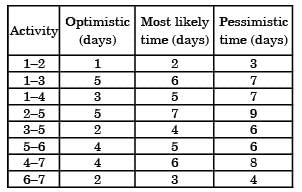
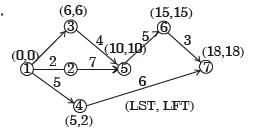
The optimistic time, most likely time and pessimistic time of all the activities are given in the table below:The critical path duration of the network (in days) is
GATE Past Year Questions: Network Models

[2009]

A

11

B

14

C

17

D

18

MULTIPLE CHOICE QUESTION

Try yourself: The expected time (te) of a PERT activity in terms of optimistic time (t0), pessimistic time (tp) and most likely time (tl) is given by

[2006]

A

GATE Past Year Questions: Network Models

B

GATE Past Year Questions: Network Models

C

GATE Past Year Questions: Network Models

D

GATE Past Year Questions: Network Models

MULTIPLE CHOICE QUESTION

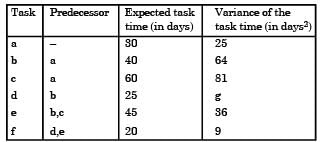
Try yourself: Consider a PERT network for a project involving six tasks (a to f)
GATE Past Year Questions: Network Models

The expected completion time of the project is

[2006]
A

238 days

B

224 days

C

171 days

D

155 days  

MULTIPLE CHOICE QUESTION

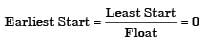
Try yourself:  In PERT analysis a critical activity has

[2004]
A

maximum float    

B

zero float

C

maximum cost    

D

minimum cost

MULTIPLE CHOICE QUESTION

Try yourself: A dummy activity is used in PERT network to describe

A

Precedence relationship

B

Necessary time delay

C

Resource restriction

D

Resource idleness

MULTIPLE CHOICE QUESTION

Try yourself:  In PERT, the distribution of activity times is assumed to be

[1995]

A

Normal

B

Gamma

C

Beta

D

Exponential

The document GATE Past Year Questions: Network Models is a part of the Mechanical Engineering Course Industrial Engineering.
All you need of Mechanical Engineering at this link: Mechanical Engineering

FAQs on GATE Past Year Questions: Network Models

1. What are the key concepts of network models in mechanical engineering?
Ans. Network models in mechanical engineering primarily focus on the analysis and optimization of systems using graphical representations. Key concepts include nodes (representing components or junctions), edges (representing connections or interactions), and flow (representing the transfer of resources or information). Techniques such as linear programming, critical path method (CPM), and program evaluation and review technique (PERT) are often employed to solve complex problems in project management and system design.
2. How are network models applied in project management?
Ans. In project management, network models are used to visualize the sequence of tasks and their interdependencies. Tools like CPM and PERT help in scheduling project activities, estimating the project duration, and identifying the critical path, which is essential for timely project completion. These models allow managers to allocate resources efficiently and minimize costs while ensuring project goals are met.
3. What is the significance of critical path analysis in network models?
Ans. Critical path analysis is significant in network models as it identifies the longest sequence of dependent tasks that determine the minimum project duration. By analyzing the critical path, project managers can focus on essential tasks that, if delayed, will impact the entire project timeline. This method also helps in resource allocation and prioritization of activities, ensuring that the project remains on schedule.
4. Can network models be used for optimization in mechanical engineering systems?
Ans. Yes, network models can be effectively used for optimization in mechanical engineering systems. They help in identifying the most efficient configurations and pathways for resource flow, whether it be material, energy, or information. By applying optimization techniques such as linear programming, engineers can minimize costs, maximize efficiency, and improve system performance.
5. What types of problems can be solved using network models in mechanical engineering?
Ans. Network models can solve a variety of problems in mechanical engineering, including project scheduling, resource allocation, supply chain management, and system reliability analysis. They are particularly useful in scenarios where multiple interrelated tasks or components need to be analyzed for their interactions and efficiencies, helping engineers make informed decisions.
Explore Courses for Mechanical Engineering exam
Get EduRev Notes directly in your Google search
Related Searches
GATE Past Year Questions: Network Models, Summary, Previous Year Questions with Solutions, Exam, ppt, past year papers, practice quizzes, GATE Past Year Questions: Network Models, pdf , study material, GATE Past Year Questions: Network Models, shortcuts and tricks, MCQs, mock tests for examination, Free, Objective type Questions, Extra Questions, Semester Notes, Viva Questions, video lectures, Important questions, Sample Paper;