UPSC Exam > UPSC Notes > Class 6 to 12 NCERT Mindmaps Preparation > Mind Map: Natural vegetation and wildlife
Mind Map: Natural vegetation and wildlife

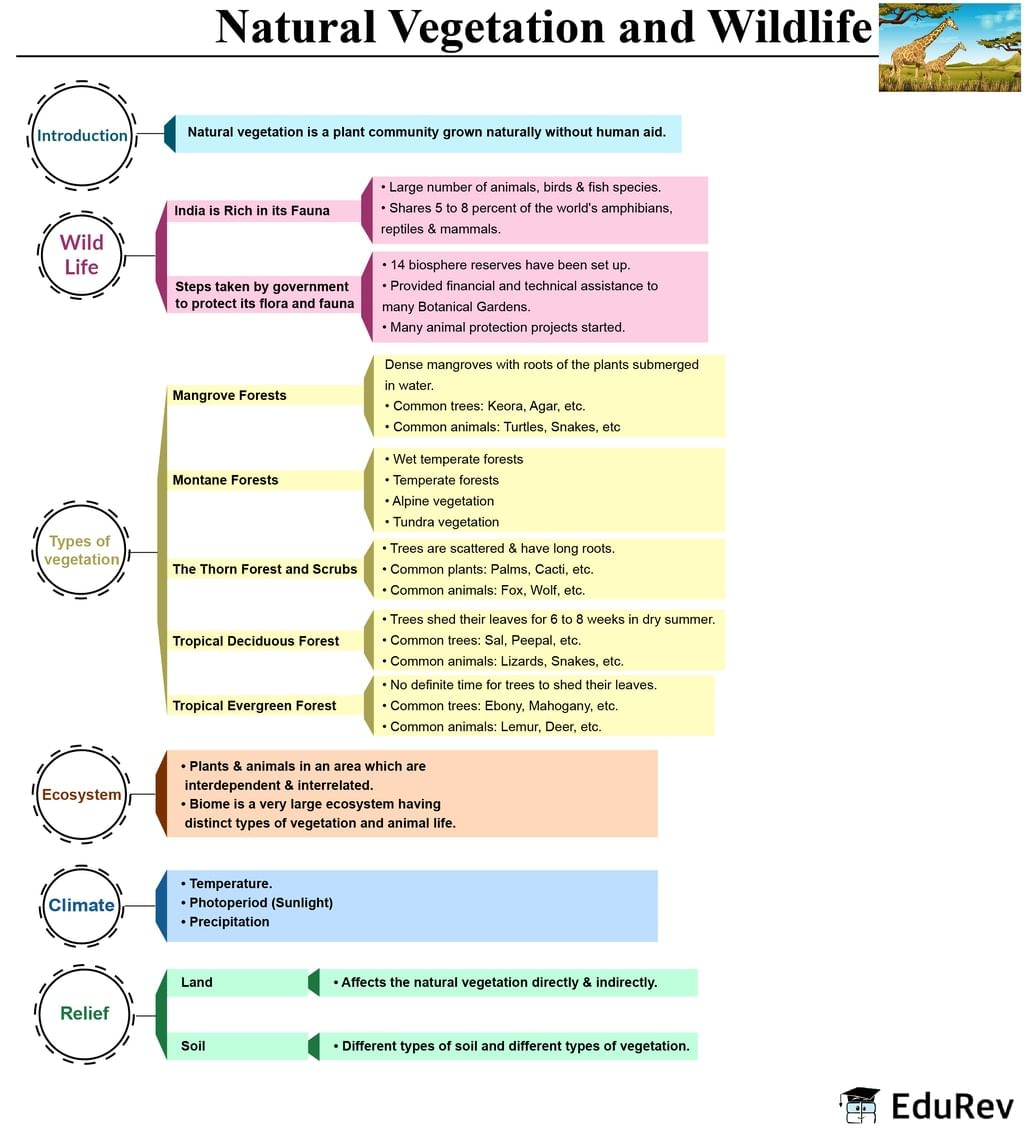
The document Mind Map: Natural vegetation and wildlife is a part of the UPSC Course Class 6 to 12 NCERT Mindmaps for UPSC Preparation.
All you need of UPSC at this link: UPSC
FAQs on Mind Map: Natural vegetation and wildlife
| 1. What are the different types of natural vegetation found across India and how do they differ? |  |
Ans. Natural vegetation types in India include tropical rainforests, deciduous forests, grasslands, and deserts, each shaped by climate and rainfall patterns. Tropical forests thrive in high-rainfall areas like the Western Ghats, while deciduous forests dominate monsoon regions and shed leaves seasonally. Grasslands and scrublands occur in semi-arid zones, whereas desert vegetation adapts to extreme aridity. Understanding these vegetation zones helps explain regional biodiversity and wildlife distribution across different ecosystems.
| 2. How does climate affect natural vegetation and wildlife distribution in different regions? | |
Ans. Climate-including temperature, rainfall, and seasons-directly determines which plants and animals survive in specific regions. High rainfall supports dense forests with diverse species, while low rainfall produces sparse vegetation and drought-resistant wildlife. Monsoon patterns influence deciduous forest leaf-shedding cycles, and altitude changes create distinct vegetation belts. Refer to mind maps and flashcards to visualise how climatic factors create unique habitats and support region-specific fauna adapted to local conditions.
| 3. What is the relationship between soil type and the kinds of plants that grow in an area? | |
Ans. Soil composition-including nutrients, pH, and water retention-determines which vegetation can establish and thrive. Fertile alluvial soils support dense agricultural and forest growth, while laterite soils in tropical regions produce specific tree species. Sandy soils in deserts sustain only hardy, drought-adapted plants with deep roots. Clay soils retain moisture, favouring wetland vegetation. Soil type essentially filters which natural flora survives, creating habitat boundaries for wildlife that depends on that vegetation.
| 4. Why do certain animals and birds only live in specific forest zones and not others? | |
Ans. Wildlife species are specially adapted to their habitat's vegetation, climate, and food sources-making them dependent on specific forest zones. Tropical rainforest animals like tigers and elephants require dense canopy cover and abundant prey, while grassland species like blackbucks need open spaces. Desert fauna such as camels possess heat-resistant traits unsuitable for forests. Each animal's diet, shelter needs, and physical adaptations tie it to particular vegetation types, creating distinct ecological communities across biomes.
| 5. How are endangered species in India connected to loss of natural vegetation and habitat destruction? | |
Ans. Endangered species decline when their natural vegetation habitats are cleared for agriculture, urbanisation, or logging. Tigers, rhinoceros, and Asian elephants lose forest cover essential for survival; migratory birds lose wetlands and grasslands. When native flora disappears, wildlife loses food, shelter, and breeding grounds simultaneously. Conservation efforts focus on protecting remaining natural vegetation zones-forests, grasslands, and wetlands-to ensure endangered fauna can recover. Habitat preservation directly determines species survival and biodiversity maintenance.
About this Document

4.97/5 Rating

Apr 22, 2026 Last updated
Document Description: Mind Map: Natural vegetation and wildlife for UPSC 2026 is part of Class 6 to 12 NCERT Mindmaps for UPSC Preparation preparation. The notes and questions for Mind Map: Natural vegetation and wildlife have been prepared according to the UPSC exam syllabus. Information about Mind Map: Natural vegetation and wildlife covers topics like and Mind Map: Natural vegetation and wildlife Example, for UPSC 2026 Exam. Find important definitions, questions, notes, meanings, examples, exercises and tests below for Mind Map: Natural vegetation and wildlife.
Introduction of Mind Map: Natural vegetation and wildlife in English is available as part of our Class 6 to 12 NCERT Mindmaps for UPSC Preparation for UPSC & Mind Map: Natural vegetation and wildlife in Hindi for Class 6 to 12 NCERT Mindmaps for UPSC Preparation course. Download more important topics related with notes, lectures and mock test series for UPSC Exam by signing up for free. UPSC: Mind Map: Natural vegetation and wildlife
Description
Mind Map: Natural vegetation & wildlife of Class 6 to 12 NCERT Mindmaps provides you one-page visual summary of the chapter covering all the important topics. Download the PDF from EduRev.
Information about Mind Map: Natural vegetation and wildlife
In this doc you can find the meaning of Mind Map: Natural vegetation and wildlife defined & explained in the simplest way possible. Besides explaining types of Mind Map: Natural vegetation and wildlife theory, EduRev gives you an ample number of questions to practice Mind Map: Natural vegetation and wildlife tests, examples and also practice UPSC tests



Related Searches
Exam, Previous Year Questions with Solutions, study material, Summary, Mind Map: Natural vegetation and wildlife, Mind Map: Natural vegetation and wildlife, mock tests for examination, MCQs, Extra Questions, Important questions, Viva Questions, past year papers, Objective type Questions, video lectures, Mind Map: Natural vegetation and wildlife, ppt, practice quizzes, Semester Notes, Free, shortcuts and tricks, pdf , Sample Paper;