CBSE Class 3 > Class 3 Notes > Social Science > Chapter Notes: Our Ancestors
Chapter Notes: Our Ancestors


Long ago, the life of man started. His life was very different and difficult from ours. He went through many stages to evolve into the humans of today. It took man a long time to grow up. This evolution covers roughly 3 million years.
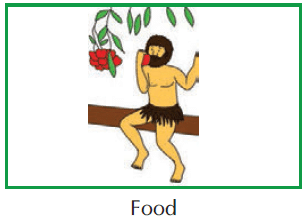
FOOD
Early Man lived in forests and caves. He ate raw fruits, roots, soft stems and the flesh of wild animals. At that time, he did not know how to cook food. He used to eat whatever was available in the jungle. He had to move from one place to another in search of food.
TOOLS
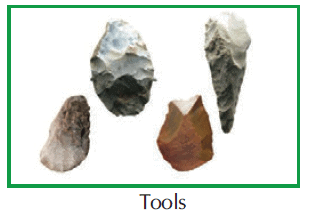
Early Man felt the need for some tools to kill wild animals and to dig out plants. He used simple stones with sharp edges to hunt animals. Later, he started shaping them to suit his purpose. The first weapon he made was a club. Then, he made sharper weapons which were shaped like hammers, choppers and axe heads. Later, he realised that if he tied a stone to a long piece of wood, he could throw it at an animal. This helped him to hunt animals without going near them.
DISCOVERY OF FIRE
Early humans led a very hard life. They had to suffer extreme cold weather. They had to live in darkness and were afraid of the wild animals.
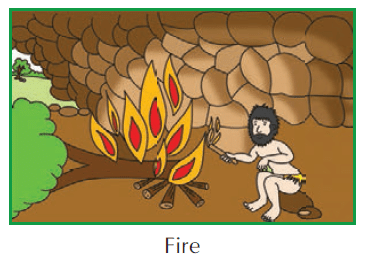
Over time, man learnt to make fire by rubbing stones. He used fire to cook food, to keep himself warm and to keep wild animals away. With the ever increasing development and sharpness of the human mind, he was able to develop and invent many more things to make his life comfortable.
INVENTION OF THE WHEEL
The Early Man had to carry heavy loads of wood and animals that he hunted back to his cave. He, then, cooked food with the help of fire. One day, accidently, a log of wood rolled down the mountain. Then, the early man observed how easier it was for heavy things to roll down from the mountains. He also observed that it was much easier to roll things over rounded objects, such as logs of wood rather than pulling them.

Later, man discovered that logs could be cut into circular discs. Changes were made to these discs which led to the invention of the present day wheel. Now, man could carry heavy loads easily from one place to another with the help of the wheel. The invention of the wheel led to many more inventions. Starting from a hand-cart, the present day man has developed the aeroplane with wheels.
KEYWORDS
- Evolution: the change in the biological characteristics over generations.
- Dig out: remove or harvest.
- Invent: to create anew.
SUMMARY
- The Early Man lived and moved in forests for food.
- The Early Man ate roots, fruits and the flesh of animals.
- Gradually, he learnt to use stones for digging and hunting.
- The Early Man learnt the use of fire and wheel.
- The invention of the wheel was a great step towards the progress in transportation.
The document Chapter Notes: Our Ancestors is a part of the Class 3 Course Social Science for Class 3.
All you need of Class 3 at this link: Class 3
FAQs on Chapter Notes: Our Ancestors
| 1. Who were our ancestors and how did they live differently from us? |  |
Ans. Ancestors were people who lived long ago and formed the foundation of human society. They hunted animals, gathered wild plants for food, and lived in caves or simple shelters. Unlike today, they had no technology, electricity, or modern comforts-they survived by making tools from stone and bone, and gradually learned farming, which changed how humans settled in communities.
| 2. What is the difference between Stone Age, Bronze Age, and Iron Age ancestors? | |
Ans. The Stone Age ancestors used tools made from stone for hunting and gathering. Bronze Age people discovered how to mix metals and create stronger tools and weapons. Iron Age ancestors learned to work with iron, producing even more durable implements for farming and warfare. Each period marked significant progress in human civilization and technology development throughout history.
| 3. How did our ancestors discover fire and why was it so important? | |
Ans. Ancestors discovered fire accidentally through natural sources like lightning or volcanic activity, then learned to create and control it. Fire was crucial because it allowed them to cook food for better nutrition, stay warm in cold climates, protect themselves from wild animals, and gather together as communities. This discovery transformed human survival and social bonding significantly.
| 4. What tools did ancient ancestors make and how did they use them? | |
Ans. Early ancestors crafted stone tools by chipping rocks into sharp edges for hunting and cutting meat. They made bone tools for fishing and scraping hides. Later, they developed pottery for storing food and water. These handmade tools show how ancestors adapted to their environment and solved daily survival challenges through innovation and practical problem-solving techniques.
| 5. How did ancestors transition from hunting to farming and settle in villages? | |
Ans. Ancestors gradually shifted from nomadic hunting to agriculture by observing plant growth and learning to cultivate crops like wheat and rice. This Neolithic Revolution allowed them to settle permanently in one location, build permanent homes, and form organized villages. Farming surplus food enabled population growth, social hierarchy development, and the foundation of civilizations across human history.
About this Document

4.60/5 Rating

Apr 18, 2026 Last updated
Related Exams
Document Description: Chapter Notes: Our Ancestors for Class 3 2026 is part of Social Science for Class 3 preparation. The notes and questions for Chapter Notes: Our Ancestors have been prepared according to the Class 3 exam syllabus. Information about Chapter Notes: Our Ancestors covers topics like and Chapter Notes: Our Ancestors Example, for Class 3 2026 Exam. Find important definitions, questions, notes, meanings, examples, exercises and tests below for Chapter Notes: Our Ancestors.
Introduction of Chapter Notes: Our Ancestors in English is available as part of our Social Science for Class 3 for Class 3 & Chapter Notes: Our Ancestors in Hindi for Social Science for Class 3 course. Download more important topics related with notes, lectures and mock test series for Class 3 Exam by signing up for free. Class 3: Chapter Notes: Our Ancestors
Description
Chapter Notes: Our Ancestors of SST with clear explanations of key concepts & important topics of the chapter, to help you underst& lessons better & revise quickly, & crack the Class 3 exam.
Information about Chapter Notes: Our Ancestors
In this doc you can find the meaning of Chapter Notes: Our Ancestors defined & explained in the simplest way possible. Besides explaining types of Chapter Notes: Our Ancestors theory, EduRev gives you an ample number of questions to practice Chapter Notes: Our Ancestors tests, examples and also practice Class 3 tests



Related Searches
Sample Paper, Summary, Extra Questions, past year papers, Chapter Notes: Our Ancestors, Objective type Questions, Semester Notes, Chapter Notes: Our Ancestors, pdf , shortcuts and tricks, Previous Year Questions with Solutions, Exam, practice quizzes, MCQs, Important questions, Chapter Notes: Our Ancestors, video lectures, Free, study material, mock tests for examination, Viva Questions, ppt;